Karen Whitmore stepped closer and looked Nia Carter up and down.
“You don’t live here,” she said. “Stop pretending.”
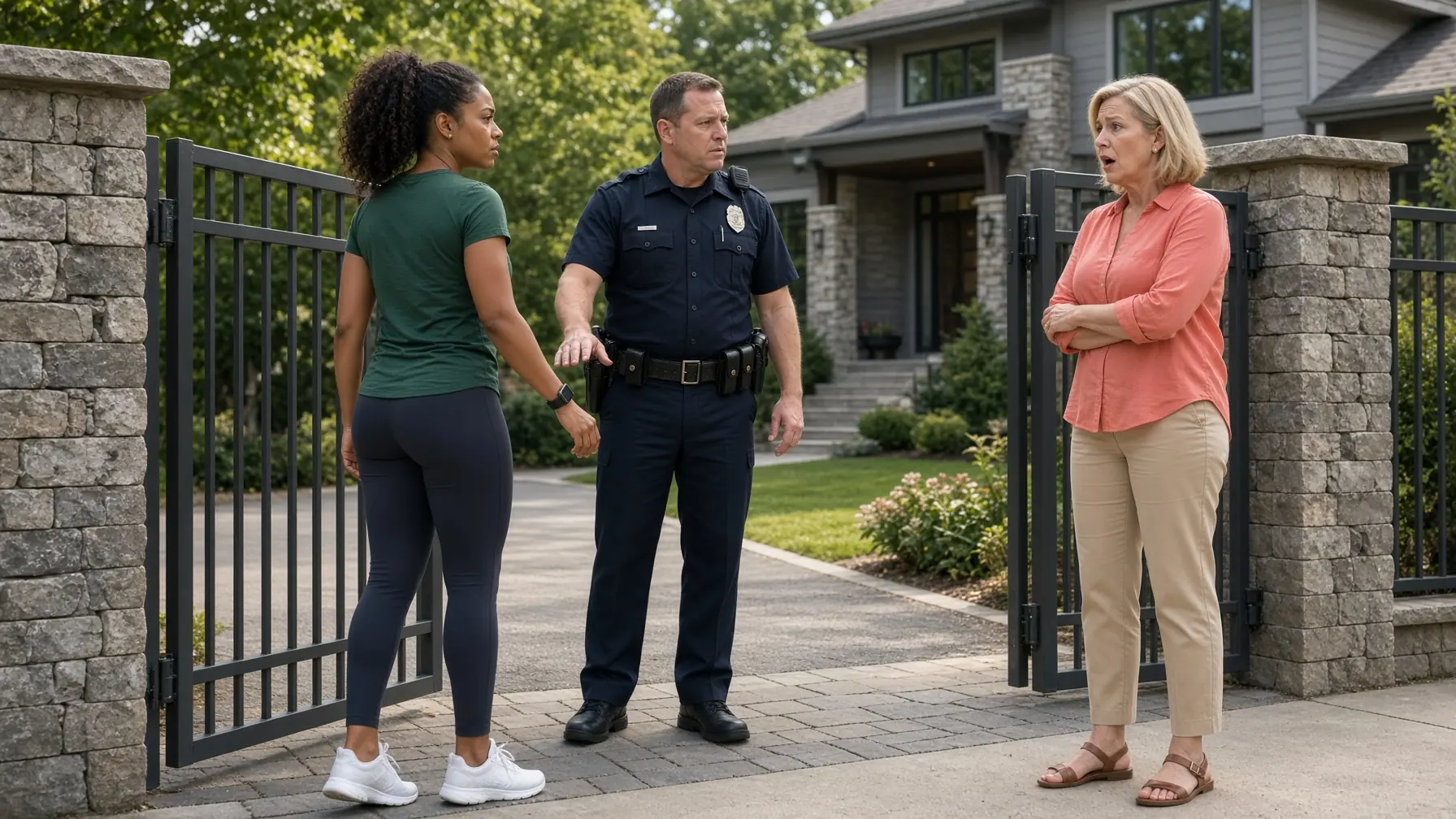
Behind Karen, the closed steel gate stood between two stone pillars. Beyond it lay the driveway, the front garden, and the house Nia had left less than an hour earlier.
A police officer moved into her path.
Nia looked from his navy uniform to Karen’s satisfied expression. Sweat was cooling beneath the collar of her forest-green athletic shirt, and the muscles in her legs still held the pleasant fatigue of a finished run.
She had expected water, a shower, and something to eat.
Instead, she was standing on a public sidewalk while two strangers discussed whether she belonged at her own address.
The gate was close enough to touch.
Neither of them intended to let her reach it.
Seven weeks earlier, Nia had stood on the inside of that same gate with a moving box balanced against one hip and laughed because she could not find the kitchen.
Not because the house was too large.
Because every room contained something that belonged somewhere else.
A lamp waited beside the refrigerator. Books covered half the dining table. The box marked KITCHEN held towels, a screwdriver, and a pair of shoes she had been searching for since morning.
Her mother stood in the hallway holding two mugs.
“Where do these go?”
Nia looked at the box in her arms.
“At this point, wherever you can find room.”
Her mother smiled.
“That’s how people lose mugs.”
“I’ve already lost the entire coffee supply.”
“Then the mugs aren’t your biggest problem.”
They found the kitchen together, set the mugs beside the sink, and made room on the counter. For the first time all day, Nia stopped moving.
Through the rear window, she could see the garden.
Through the front rooms, she could see the driveway leading toward the gate.
The house was still unfamiliar in ways that pleased her.
A door opened farther than she expected. Afternoon light reached a wall that had looked plain during the first viewing. The floors made different sounds beneath her shoes depending on where she stepped.
She had thought carefully before choosing it.
She had inspected what needed inspecting, asked questions, reread papers, and spent more nights than she liked admitting awake beneath the weight of a decision that would affect years of her life.
Nobody had handed her certainty.
She had made the decision with enough information to accept the uncertainty that remained.
Now the boxes were inside.
The keys were hers.
The gate closed behind the driveway without anyone else deciding when she could enter.
That last part had felt more important than she expected.
At twenty-nine, Nia had lived in places where privacy was a negotiation with noise, shared entrances, neighbors’ schedules, and the unreliable habits of locks that everyone assumed someone else would report.
She had learned to carry groceries while holding a door open with one foot. She had learned which stair creaked and which package delivery instructions were usually ignored.
None of those places had been shameful.
They had been homes.
But this house offered something she had wanted for a long time: room to settle without constantly working around somebody else’s access.
Her mother watched her looking through the window.
“You’re quiet.”
“I’m trying to believe it’s actually happened.”
“It has.”
“I know that.”
Her mother set a hand against the counter.
“Knowing takes a little while to catch up sometimes.”
Nia nodded.
Outside, a vehicle passed beyond the stone pillars.
She could see only the upper part through the gate.
The separation felt peaceful.
She did not yet know how differently the same barrier could feel when someone kept her on the wrong side of it.
The first week was consumed by practical things.
She found the towels.
Found the coffee.
Discovered that one of the labels on the moving boxes was accurate and began treating it as a personal achievement.
She adjusted shelves, made a list of minor repairs, and learned how the house held the afternoon heat.
The gate required attention too.
She wanted to understand its ordinary operation before relying on it as part of her routine. She checked the controls, made certain the access system worked as expected, and tested the connection available through her smartwatch.
It was useful for running.
She did not want to carry a collection of keys every time she went out.
The first time she returned from a short loop and opened the gate from her wrist, she smiled at the convenience of it.
Nothing about the action seemed worth remembering.
A tap.
The latch.
The opening.
A small problem removed from an ordinary day.
She went inside and put the kettle on.
Over the following weeks, the house became less of an acquisition and more of a place where things happened without ceremony.
A plant found its position by a window.
A chair moved twice before she decided where she liked it.