Marcus Bennett had spent the morning making certain there would be enough food.
That was the part of the afternoon he had worried about.
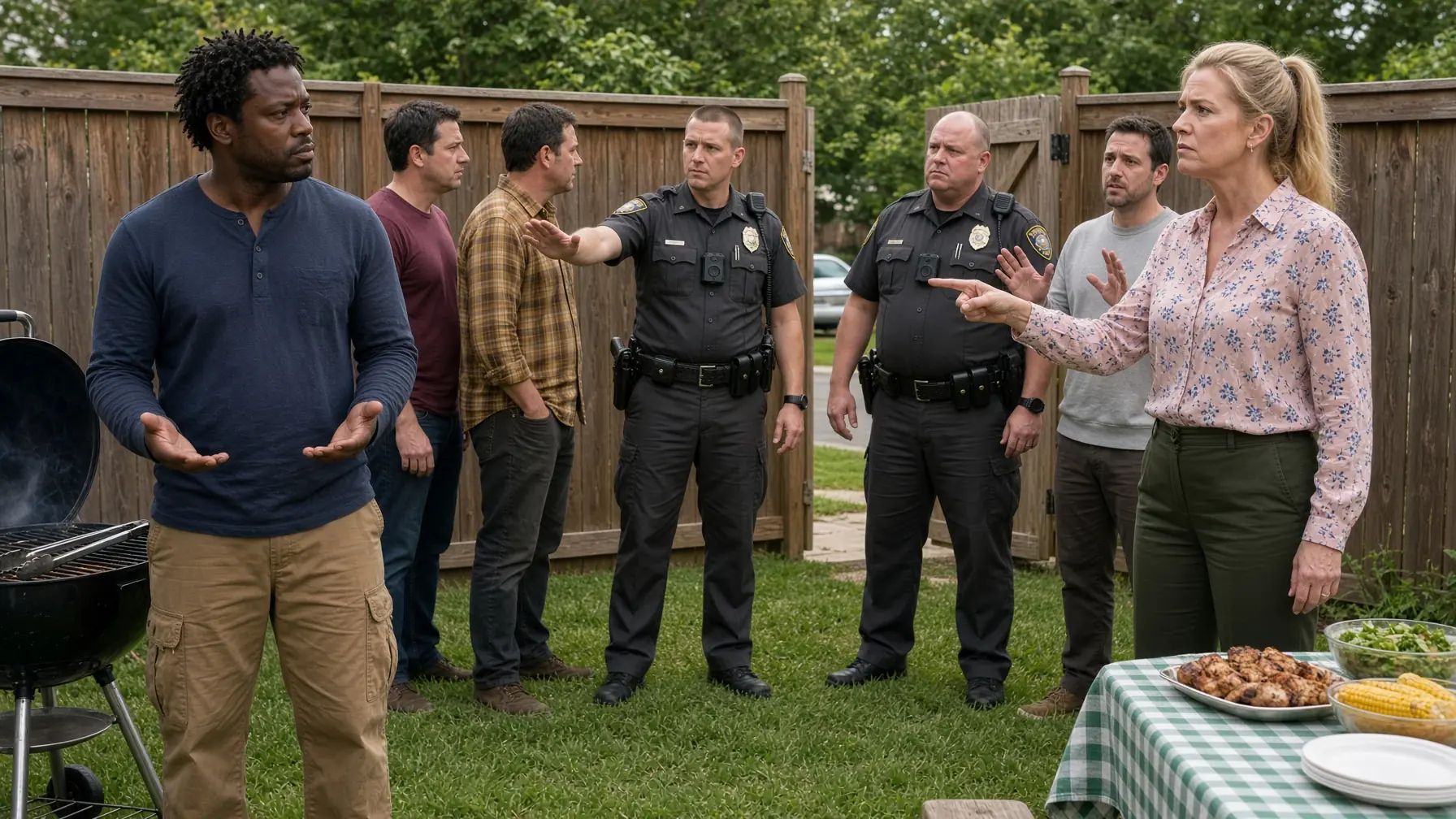
Whether the grill would heat evenly. Whether the table needed to be moved farther into the shade. Whether three men who always insisted they were not particularly hungry would leave him with anything to put away afterward.
He had not worried about where to stand if an officer put a hand across his chest.
He had not imagined watching his friends pushed against his fence.
The backyard was supposed to be the easiest part of his new home.
Inside, there were still things he had not settled. A box that belonged upstairs remained downstairs. One room held furniture arranged according to where it had been easiest to set down rather than where he wanted it to stay.
Outside, the arrangement was simpler.
Green lawn.
Wooden fence.
Leafy trees.
A grill with enough space around it to work comfortably.
He could understand a backyard in an afternoon.
The rest of the house would take longer.
Marcus was around forty, lean, with short twists and a clean-shaven face. He wore a faded navy henley, tan cargo trousers, and gray sneakers that had acquired a thin line of grass along the soles.
He had gone out early to move the picnic table.
Then moved it back.
The first position looked better from the porch.
The second kept people from sitting directly in the sun while they ate.
Comfort won.
He wiped the tabletop, carried out what could wait outside, and went back for the things that could not.
There was pleasure in the repetition.
Another trip.
Another small part of the gathering becoming ready.
He liked preparing a place for people he did not have to impress.
That was what the three men coming over offered him.
Their company did not require him to become a more polished version of himself. They knew the way he became distracted while cooking, knew he would claim something needed another minute when everybody could already smell that it was ready.
They would tease him.
He would tell them to carry something if they had enough energy to comment.
The exchange was familiar enough to feel like rest.
He wanted that in the new house.
A memory that belonged to him rather than to the work of moving.
By afternoon, the yard looked ready.
Food covered much of the picnic table. There were containers waiting to be opened, plates stacked where people could reach them, and drinks set apart from anything likely to be knocked over.
Marcus stood beside the grill and checked what needed turning.
Beyond the fence, the neighborhood carried on with its own day.
A car passed.
Somebody closed a garage.
Leaves moved overhead.
He was learning those sounds.
Every home had a background rhythm. The noises that initially made a person look up eventually became ordinary enough to disappear.
He had begun recognizing which vehicles belonged nearby and which gate made a particular sound when somebody shut it.
He had not yet become accustomed to Karen Whitmore.
Her appearances still made him stop what he was doing.
At first, he had assumed that would pass.
A new neighbor attracted attention. People asked questions, offered advice, and found reasons to mention things they thought mattered.
Marcus could manage that.
He did not expect to arrive in an established neighborhood and become invisible.