On a cold Tuesday morning in March 2009, Lana Dickstra stood behind a small rental house outside Shelbyville, Tennessee, and watched a forklift lower an entire pallet of cedar pieces she had never ordered through any normal lumber supplier.
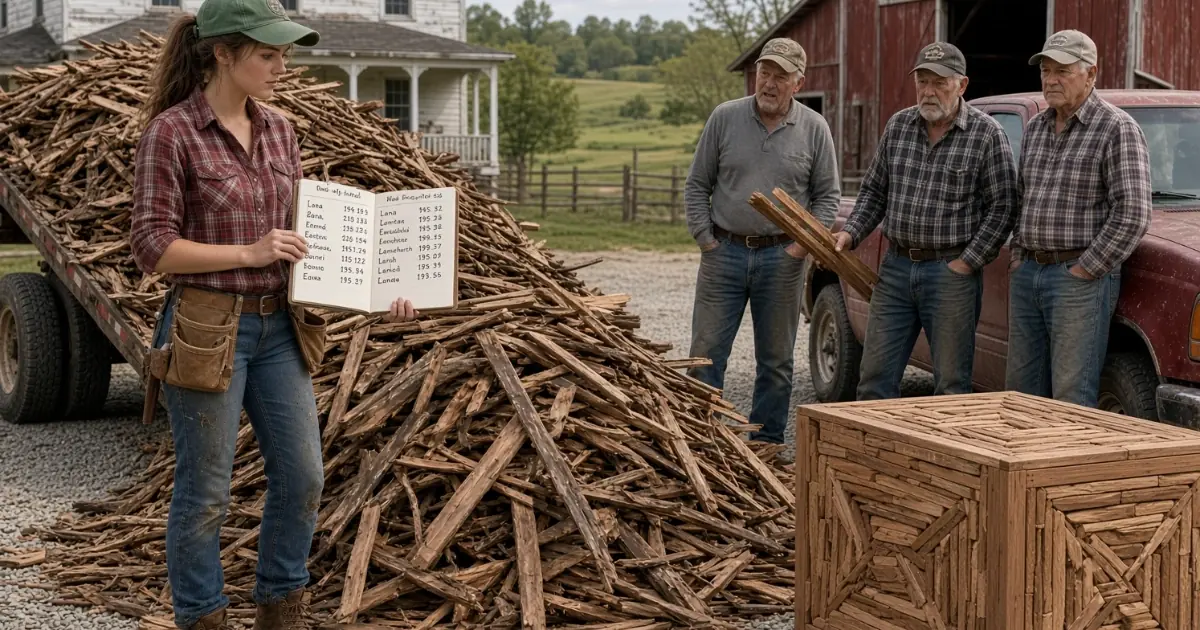
The wood looked terrible.
Some slats were too narrow.
Others too short.
Many were split along one edge or cut into dimensions no furniture maker would want.
A few twisted slightly.
Almost none would have survived a retail lumber inspection.
The forklift driver climbed down, walked toward Lana with a clipboard, and held out a pen.
“Where do you want to sign?”
Lana looked at the pallet.
Then at him.
Then back toward the house she was renting.
Behind one window sat a folding table covered in sketches.
Inside the garage were two used saws, an old router and a collection of hand tools bought secondhand from estate sales and classifieds.
In her checking account:
Forty dollars.
The forklift driver shifted impatiently.
“You taking it or not?”
Lana signed.
The driver climbed back into the forklift.
Minutes later, the truck disappeared down the road.
Lana remained standing beside the cedar.
The cool air around her smelled sharp and resinous.
Eastern red cedar.
The scent reminded her of old closets.
Grandmother chests.
Winter coats stored through summer.
And for reasons nobody else around her understood yet, Lana believed that smell might be worth more than the material itself.
She was twenty-two years old.
She had no employees.
No warehouse.
No serious equipment.
No investors.
No manufacturing experience.
No proof that customers would buy the thing she had imagined beyond one Craigslist advertisement for a closet organizer that had attracted eleven inquiries in four days.
But Lana had already learned one important lesson.
Sometimes the difference between waste and raw material depended entirely on who was looking at it.
Shelbyville sat in Middle Tennessee horse country, far enough from Nashville that factories and small manufacturers still shaped the rhythm of daily life.
People knew contractors by name.
Builders drank coffee with suppliers.
Machine shops passed work between one another.
Old industrial businesses survived by doing things too specialized or inconvenient for larger companies.
One of those businesses was Musgrave Pencil Company.
For generations, its plant had processed cedar into pencil components.
Pencils required precision.
Wood had to meet dimensions.
Grain mattered.
Quality mattered.
At industrial scale, that created scrap.
Pieces too short.
Too narrow.
Split.
Irregular.
Material that had already consumed labor, drying time and transportation but no longer fit the factory’s main product.
Some became chips.
Some were burned.
Some hauled away.
Some simply accumulated until somebody paid to make the problem disappear.
Lana looked at the same material and saw a contradiction.
People were paying thousands of dollars to renovate closets.
At the same time, a pencil mill only a few miles away was paying to remove cedar historically associated with premium storage.
Why could those two problems not solve one another?
The question had been following her for months.
Lana had not grown up around manufacturing.
Her father, Garrett Dickstra, had once farmed hundreds of acres in Iowa.
Then a serious back injury changed everything.
The family sold.
Moved to Tennessee.
Garrett never fully recovered from losing the farm.
He became cautious afterward.
Methodical.
Suspicious of debt.
He disliked business plans containing words like:
Probably.
Maybe.
Hopefully.
If everything goes right.
Garrett preferred machinery already paid for.
Cash reserves.
Clear numbers.
Worst-case scenarios.
He believed enthusiasm was useful only after arithmetic survived it.
Lana inherited his stubbornness.
She did not inherit his comfort with familiar boundaries.
She completed a community-college program in interior design.
One class changed her more than the others.
Materials.
Professor Wanda Okafor taught it.
Dr. Okafor had a habit of taking something ordinary—a chair leg, floorboard, countertop—and forcing students to understand the system behind it.
Where did it come from?
Why that material?
What did it replace?
What waste did its production create?
What assumptions made one material valuable and another worthless?
For a research assignment, Lana chose eastern red cedar.
Ten pages required.
She wrote thirty-one.
Cedar chests.
Closet lining.
Wardrobes.
Traditional textile storage.
Aromatic compounds.
Historical reputation for discouraging clothes moths.
But one thing interested her more than history.
Closets had changed.
Traditional cedar chests were disappearing.
Modern closets used painted drywall.
Particleboard.
Wire shelving.
Melamine.
Modular organizers.
They organized clothing efficiently.
But they removed the cedar environment people had once deliberately built around fabrics.
Meanwhile the Musgrave plant discarded cedar.
Lana wrote one question in the margin of her paper.