The first truck arrived before sunrise.
Abigail Turner heard it long before she saw the headlights coming down County Road 16.
She stood beside the open equipment shed with a mug of coffee in one hand and watched the old white dump truck crawl toward her property through the gray Kansas morning.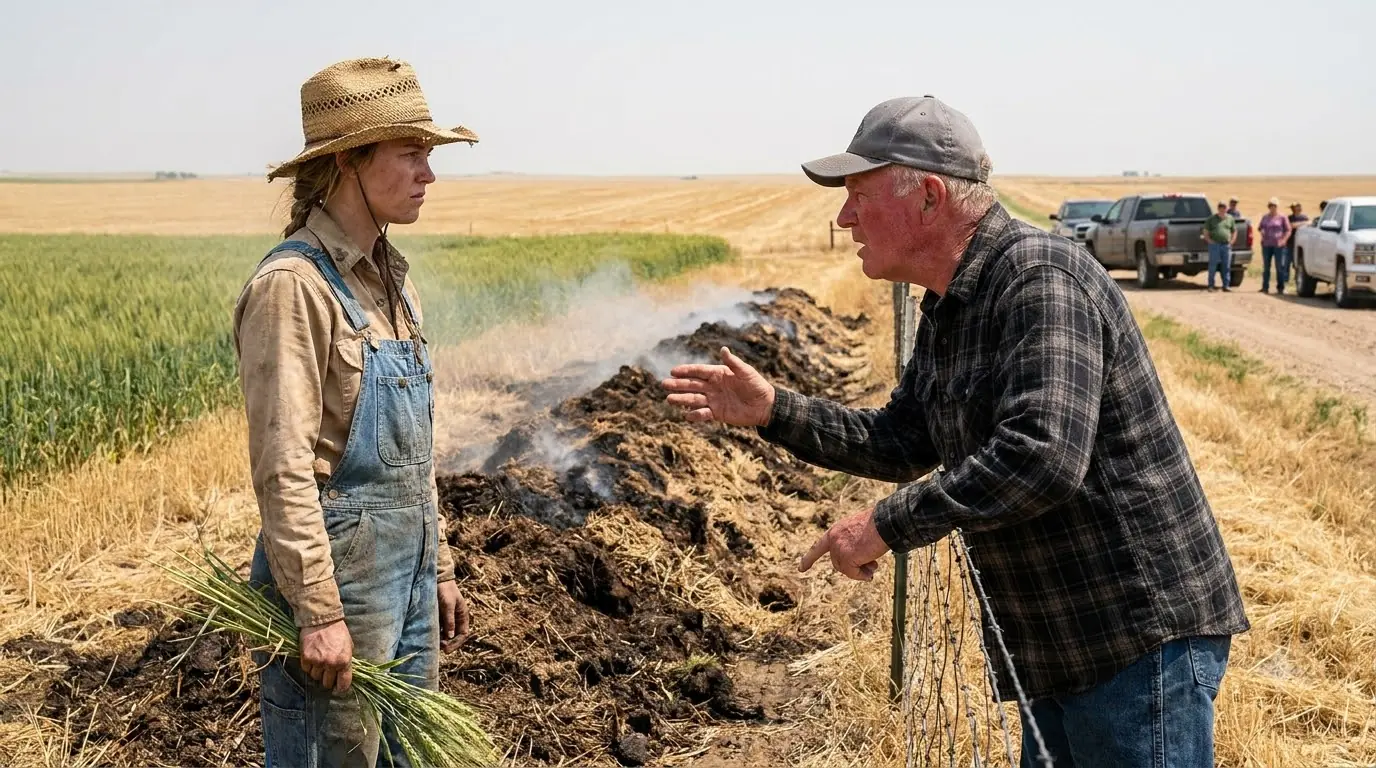
Its suspension groaned beneath the weight of wet leaves, shredded branches, spoiled hay, and dark composted manure.
The driver leaned out the window.
“You Turner?”
Abigail lifted one hand.
“That’s me.”
The truck rolled past the barn and stopped beside the north field.
Abigail pointed toward a strip of bare ground running nearly four hundred yards along the wheat.
“Right there. Start at the fence and work south.”
The driver stared.
“All of it?”
“All of it.”
He looked at the load behind him.
Then at Abigail.
“You sure?”
She smiled faintly.
“Very.”
The hydraulic bed rose.
A heavy mass of wet organic material slid onto the ground with a deep, sloppy crash.
Steam lifted into the cold air.
The smell followed.
Leaves.
Earth.
Manure.
Fermentation.
Something sweet from rotting apples mixed with something sharp from damp straw.
The driver wrinkled his nose.
“Your neighbors are going to love you.”
Abigail took another sip of coffee.
“They already don’t.”
By eight o’clock, three more trucks had arrived.
By noon, the dark mound stretched almost two hundred feet.
By sunset, everyone in Dry Creek County seemed to know about it.
The first person to come looking was Harold Griggs.
His red Ford pickup appeared at the edge of Abigail’s property shortly after four.
Harold was sixty-seven years old and had farmed the land immediately east of Turner Farm since before Abigail was born.
He wore the same faded gray cap almost every day, along with dark plaid shirts, worn jeans, and heavy leather boots polished by decades of dust.
He parked without asking.
Got out.
Walked toward the mound.
Stopped twenty feet away.
Then stared.
Abigail was spreading shredded straw across the top using the bucket of an old tractor.
Harold lifted both hands.
“What in God’s name are you doing?”
Abigail shut down the engine.
The field went quiet.
She climbed down.
“Afternoon, Harold.”
He pointed at the pile.
“What is that?”
“Organic material.”
“That’s garbage.”
“Some of it.”
His face tightened.
“You brought garbage onto farmland.”
Abigail brushed straw from her sleeve.
“I brought carbon, nitrogen, cellulose, food waste, wood fiber, manure, and moisture.”
Harold stared.
“Garbage.”
Abigail nodded.
“If that makes you feel better.”
“It doesn’t.”
He walked closer.
The mound was nearly five feet high in places.
Steam rose from several sections where decomposition had already begun.
Harold poked at it with his boot.
“What’s in here?”
“Leaves from the city.”
“Why?”
“Because they were free.”
“Branches?”
“Shredded.”
“Old vegetables?”
“From two grocery distributors.”
“Manure?”
“Three cattle operations.”
Harold stepped backward.
“You’ve lost your mind.”
Abigail smiled.
“That’s what Dad used to say whenever I changed something.”
“Your father would never have allowed this.”
That took the smile away.
Abigail looked across the field.
Her father, Thomas Turner, had died nineteen months earlier after a sudden heart attack.
He had been fifty-nine.
Strong enough to repair a grain auger by himself.
Stubborn enough to work through pneumonia.
Gone before Abigail could make the three-hour drive home from Wichita.
The farm passed to her.
So did the debt.
Two hundred and forty-seven thousand dollars spread across equipment notes, operating loans, and a mortgage her father had refinanced after two bad seasons.
Everyone assumed Abigail would sell.
She had been living in Wichita and working as a soil technician for an agricultural testing company.
Harold even offered to buy eighty acres.
Abigail declined.
Then she moved home.
Most people thought grief had made the decision for her.
They were partly right.
What they did not understand was that Abigail had spent six years testing soils other farmers sent to laboratories because something was failing.
Compaction.
Low organic matter.
Poor water infiltration.
Salt buildup.
Biological collapse.
Every sample told a story.
And western Kansas was telling the same story louder every year.
Rain came less reliably.
When it did come, it arrived hard.
Water struck dry ground, ran across the surface, filled ditches, and disappeared.
Fields could receive two inches in one night and still be thirsty a week later.
Abigail had watched it happen on her father’s farm.
Thomas believed the answer was deeper tillage.
More fertilizer.
Better seed.
Larger pumps.
Abigail believed the problem was beneath all of it.
The soil had forgotten how to hold water.
Harold pointed again.
“You planning to plant through this?”
“No.”
“Then why put it there?”
“I’m building compost.”
“That isn’t compost.”
“It will be.”
“You need a pit.”
“No.”
“A licensed facility.”
“No.”
“A permit.”
“For manure piles under agricultural use, not in this configuration.”
Harold narrowed his eyes.
“You checked.”
“Of course.”
He hated that answer.
“You’re going to stink up the whole road.”
“Maybe for a few days.”
“Flies.”
“I’m covering nitrogen layers.”
“Rats.”
“Not if the pile heats properly.”
“Disease.”
Abigail crossed her arms.
“Harold, you came here to ask what I’m doing or tell me what you’ve already decided?”
He stared.
“I came because this affects everyone.”
“How?”
“Property values.”
Abigail laughed.
“Property values?”
“Yes.”
“You own six hundred acres and can’t see my pile from your house.”
“People drive this road.”
“They’ll survive.”
Harold’s face reddened.
“This county is built on farming standards.”
“So is mine.”
“This is not farming.”
Abigail looked at steaming mound.
“We’ll see.”
That phrase became Harold’s least favorite sentence.
Within three days, photographs appeared online.
Someone posted:
TURNER FARM BECOMES COUNTY LANDFILL?
Another:
WHAT IS SHE THINKING?
A local Facebook group filled with comments.
Most were jokes.
Some were concern.
A few defended her.
Dennis Vaughn, who ran the feed store, wrote:
Pretty sure Abby knows more about soil than half of us combined.
Harold replied:
SOIL PEOPLE DON’T RUN FARMS. FARMERS DO.
Abigail saw it.
Did not respond.
The second week brought more trucks.
Wood chips from a tree service.
Coffee grounds from two cafés in Hays.
Spoiled alfalfa.
Pumpkin waste from a grocery warehouse.
Corn stalk residue.
Horse bedding.
Cattle manure.
Nothing hazardous.
Nothing synthetic.
Nothing Abby could not document.
She weighed every load.
Recorded source.
Estimated carbon-to-nitrogen balance.
Measured internal temperature twice daily.
Moisture.
pH.
Pile height.
The work was deliberate.
To everyone else, it looked insane.
Harold started calling it Garbage Mountain.
The name spread.
At first Abigail hated it.
Then she wrote GARBAGE MOUNTAIN - DO NOT CLIMB on a plywood sign and planted it beside the pile.
Her younger brother Luke saw it and laughed until he nearly dropped a wrench.
“You leaned into it.”
“Why not?”
“You hate Harold.”
“I don’t hate Harold.”
“You definitely hate Harold.”
“I hate repetition.”
“Same thing around here.”
Luke Turner was thirty-two and lived in Denver, where he worked as an electrician.
He came home twice a month to help.
Unlike Abigail, Luke had never wanted farm.
But he loved the place.
He loved barn.
The cottonwood trees.
The old windmill.
His father’s battered tool cabinet.
He just did not want bank deciding whether he could keep any of it.
Luke looked at mound.
“Seriously, Abby.”
“What?”
“How much did all this cost?”
“Trucking?”
“Yes.”
“About eleven thousand so far.”
Luke whistled.
“That’s not nothing.”
“No.”
“And you’re planning more.”
“Yes.”
“How much?”
“Another twenty loads.”
He stared.
“Why?”
Abigail picked up handful of wheat-field soil.
Dry.
Pale brown.
It broke apart in dusty crumbs.
“Our organic matter averaged 1.1 percent.”
Luke waited.
Abigail continued.
“Dad’s records from 1998 show 2.4.”
“That sounds bad.”
“It is.”
“How bad?”
“Every one-percent increase in soil organic matter can increase water-holding capacity significantly depending on soil type.”
Luke looked toward pile.
“So you’re trying to make dirt into sponge.”
Abigail smiled.
“Basically.”
“Why not just say that?”
“Because scientists need longer sentences.”
He laughed.
“What happens if this doesn’t work?”
Abigail looked at field.
The smile faded.
“Then we probably lose farm.”
Luke stopped laughing.
“How close?”
“Closer than I told you.”
He stared at her.
“How close?”
Abigail sighed.
“If wheat fails this year and next, I can’t service operating note without selling acreage.”