Patricia Davenport lied seventeen minutes after the police arrived.
Until that moment, Byron Fletcher had been willing to treat the afternoon as another ugly inconvenience.
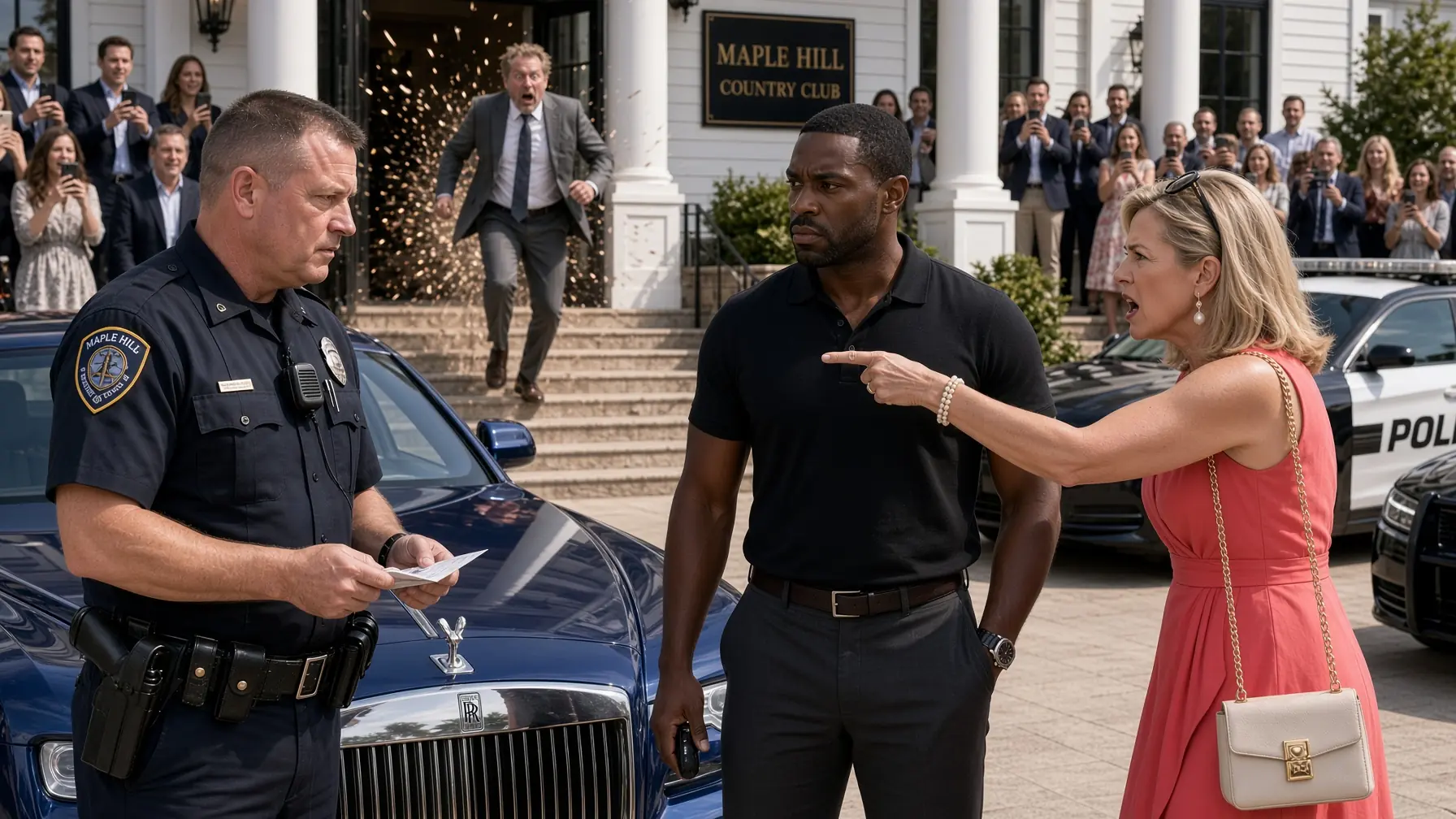
Humiliating.
Infuriating.
But survivable.
Then Patricia stepped down from the country-club terrace, placed one manicured hand against her chest, and said:
“Officer, when I confronted him, he threatened me.”
For the first time all afternoon, something changed in Byron’s eyes.
Officer Denise Caldwell noticed.
So did Russell, the Black valet standing twenty feet away with both hands clenched around the edge of his podium.
Officer Greg Nolan did not.
He was already reaching for his radio.
“Threatened you how?”
Patricia hesitated for half a second.
Not because she was frightened.
Because she was writing the next part in real time.
“He said I would regret calling the police.”
Byron looked at her.
“I never said that.”
Patricia immediately raised her voice.
“There! That tone.”
Byron almost laughed.
Not because anything was funny.
Because he had spoken five words.
Caldwell turned toward Patricia.
“Ma’am, did he threaten physical harm?”
Patricia blinked.
“I felt threatened.”
“That isn't what I asked.”
Nolan glanced toward Caldwell.
“Denise.”
She ignored him.
“Did Mr. Fletcher say he would hurt you?”
Patricia’s eyes moved toward the terrace.
Dozens of club members were watching.
Phones raised.
Friends beside her.
A reputation to protect.
“No…”
Then quickly:
“But the implication was obvious.”
Byron said nothing.
Caldwell made a note.
Nolan returned his attention to Byron.
“Open the vehicle.”
“No.”
Nolan’s jaw tightened.
“You understand refusing is making this take longer.”
Byron looked at him.
“My license matches the registration.”
“Yes.”
“My photograph matches my license.”
“Yes.”
“The VIN visible through the windshield matches the registration you checked.”
Nolan hesitated.
“Yes.”
“The club manager confirmed I’m a member.”
Todd Hargrave, standing near the entrance, looked like he wanted the ground to open beneath him.
Byron continued.
“What evidence do you have that the car is stolen?”
Nolan looked toward Patricia.
That answered the question.
Byron nodded.
“Exactly.”
Patricia folded her arms.
“You’re very practiced at this.”
Byron turned toward her.
“At proving I own my own property?”
She scoffed.
“People don't behave like this unless they have something to hide.”
Russell closed his eyes.
He had heard versions of that sentence his entire life.
So had Byron.
Then Nolan spoke into his radio.
“Requesting K9 assistance.”
Caldwell looked at him.
“For what?”
“Possible stolen vehicle.”
“The ownership has been verified.”
“Possible contraband.”
Byron’s expression changed again.
“What contraband?”
Nolan ignored him.
Caldwell lowered her voice.
“Greg, slow down.”
He looked at her.
“You want to run this scene?”
“No.”
“Then let me do my job.”
Caldwell stared at him for a moment.
Then stepped back.
But she did not stop watching.
Neither did Byron.
Because the afternoon was no longer only about Patricia Davenport.
It was becoming something larger.
And Byron had learned long ago that when powerful people began making bad decisions, the smartest thing he could do was let them document themselves.
His name was Byron Fletcher.
Forty-two years old.
Founder and chief executive of Titan Crest Holdings.
He had started the firm seventeen years earlier with two employees, one borrowed conference room, and a credit line his bank tried to cancel twice.
Now Titan Crest managed or controlled stakes in fourteen companies across logistics, hospitality, manufacturing, commercial real estate, and software infrastructure.
Business magazines occasionally called Byron a billionaire.
He hated the label.
Not because it was inaccurate.
Because it reduced twenty years of work to one number.
His mother, Lorraine Fletcher, would have hated it too.
Lorraine had taught English at a public high school on Chicago’s South Side for thirty-one years.
She woke at 4:45 every morning.
Caught two buses.
Carried her lunch in the same brown insulated bag until the zipper finally broke.
Byron grew up watching her make impossible budgets work.
She had one phrase for almost everything.
Stay low. Build high.
After she died, Byron found those words written on an old yellow sticky note inside one of her cookbooks.
He kept it on his refrigerator.
The Rolls-Royce Spectre came years later.
Midnight blue.
Quiet enough that the first time Byron drove it, he laughed.
He bought it six months after Lorraine’s death.
Not because he wanted people staring.
Because he remembered being twelve years old and seeing a Rolls-Royce outside the Palmer House.