Marcus Reed had owned his house for nine days when the HOA president called the police on him and three invited guests. She claimed an elderly resident might be in danger, even though Marcus had already told her whose backyard she was standing outside. When the officers refused to remove the men, she threatened a fine and demanded a meeting where her version would become the official record. Marcus began asking for the document behind that version, and each answer made the meeting more important.
The chicken needed another few minutes when the side gate began rattling.
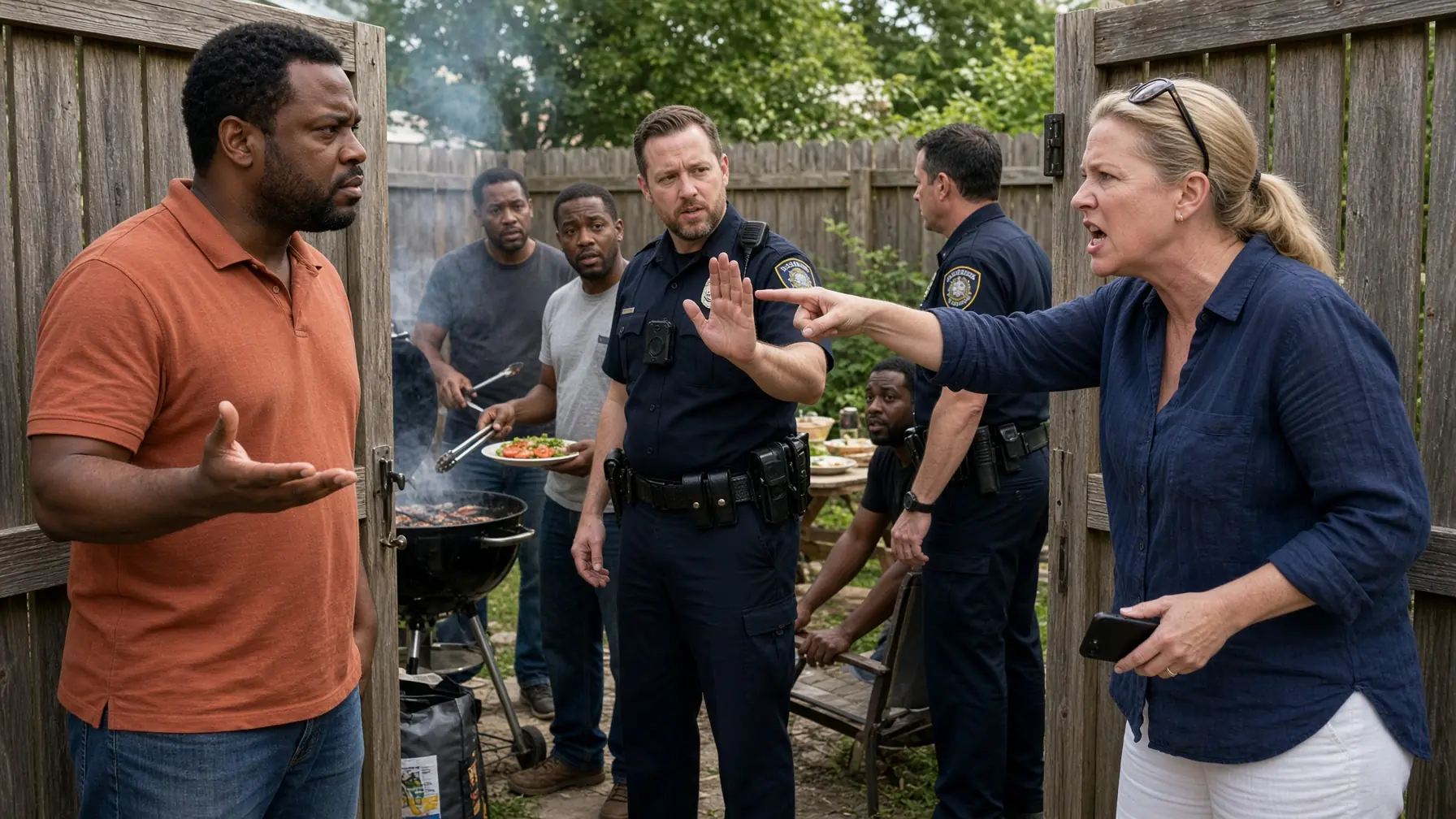
Marcus looked up with the tongs still in his hand. Beyond the fence, Karen Whitmore stood on the narrow access path, pulling at a latch he had locked that morning.
She had a phone pressed to her ear.
For a moment, he assumed she wanted to speak to him and had not noticed the bell near the front door. He set the tongs beside the grill and moved a few steps closer.
“Can I help you?”
Karen pulled at the latch again.
“Yes,” she said into the phone. “I’m at the property now.”
Her navy linen blouse and white trousers looked carefully chosen for an ordinary Saturday. Her ash-blonde hair was drawn into a tight ponytail, and square sunglasses concealed enough of her expression that Marcus could not tell whether she was ignoring him or expecting him to remain quiet.
Behind him, Andre stopped opening a bag of charcoal.
They did not need more charcoal, but his younger brother had been determined to find something useful to do after the last box was carried inside. Calvin was slicing tomatoes at the folding table, while Ben studied a patio chair that did not look quite right.
All three turned toward the gate.
“It’s locked,” Karen said. “They’ve locked themselves in.”
Marcus stopped several feet inside the fence.
“It’s my backyard.”
She turned slightly away from him.
“There are four of them. I can’t tell what they’re doing.”
Calvin looked at the knife and tomatoes in front of him, then carefully put the knife down. Ben glanced from the instruction sheet to the smoking grill.
Marcus felt the afternoon change.
“What are you talking about?”
Karen stepped farther along the path.
“The owner is an elderly woman. I’m concerned about her safety.”
He stared at her.
Then he understood.
“She doesn’t live here anymore. I bought the house.”
Karen looked directly at him.
There was time to correct what she had said. Time to explain that the new owner was present and the gathering was a lunch.
Instead, she looked away again.
“One of them is approaching me.”
Marcus had already stopped.
Andre put the charcoal down.
“Marcus.”
His brother said the name quietly, but Marcus heard the warning inside it. He lowered his hands and remained where he was.
“I’m not approaching you.”
Karen stepped backward anyway.
“Yes. Please send someone.”
She ended the call.
The grill crackled behind Marcus. Somewhere beyond the houses, a lawn mower continued moving across a yard.
“Did you call the police?”
Karen folded her arms.
“If you had answered the neighborhood’s concerns appropriately, this wouldn’t be necessary.”
“What concerns?”
“Who are they?”
“My guests.”
“That isn’t an answer.”
“It’s the answer you need.”
Her mouth tightened.
Ben laid the screwdriver on the table. Calvin turned off the small burner beneath the beans, and Andre looked toward the back door.
Marcus knew what his brother was thinking.
Lily was inside.
His seven-year-old daughter had spent the morning decorating paper cups for the meal. She had written DADDY on his and UNCLE ANDRE on another, then made Calvin’s blue because he said it was his favorite color.
He did not want her opening the door now.
Karen looked between the fence boards.
“You can’t hold an unauthorized gathering here.”
“Four people eating lunch?”
“This community has standards.”
“I’ve read them.”
The answer annoyed her.
Marcus had noticed that during their first conversation. She liked explaining expectations; she liked being asked where those expectations were written considerably less.
“I’m responsible for this neighborhood.”
“You’re not responsible for my lunch.”
Andre made a small sound that was almost a laugh.
Karen turned toward him.
“You think this is funny?”
“No. I think you should leave.”
She pointed.
“That’s the hostility I’m talking about.”
Andre pressed his lips together.
Marcus felt anger rising and kept his voice level. He and his brother knew how quickly a disagreement could become an account of their behavior instead of the conduct that started it.
Nobody wanted to practice that restraint in his new backyard.
“You’re outside my fence,” Marcus said. “Nobody threatened you. Please leave.”
“I’ll wait for the officers.”
She walked toward the street before he could answer.
For several seconds, Marcus stayed by the gate. The food still smelled good, which now seemed absurd.
He had spent two days planning this meal.
Half the house remained in boxes. The mortgage payment frightened him, and the chairs had arrived with instructions too small to read easily.
But the house was his.
He wanted one afternoon in which that fact felt like an achievement rather than a new responsibility. Now three men stood behind him waiting to discover whether lunch required explaining themselves to police.