The moment Adrian Carter signed the voluntary resignation letter, Vanessa Brooks smiled and turned to the entire floor, announcing she was throwing a party that night to celebrate finally clearing the last obstacle standing between her and the director's chair.
Applause and laughter filled the office while Adrian carried his box to the elevator without a word.
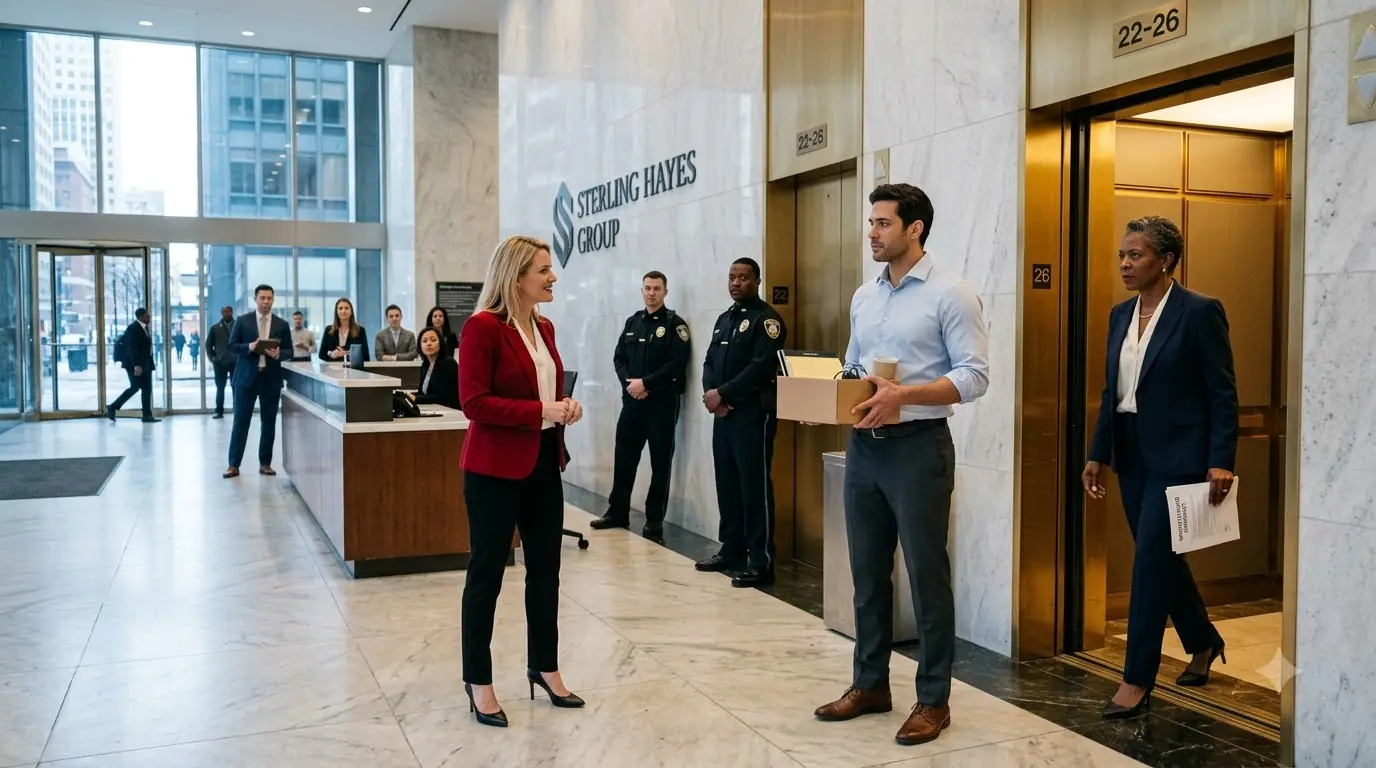
Minutes later the elevator opened again. Evelyn Harper, the company chairwoman, walked out pale, a document still gripped in one hand.
She scanned the room once and her voice cut through the laughter. "Where is he?"
Three hours before that elevator opened, the ninth floor of Sterling Hayes Group looked like any other Tuesday morning. Phones rang, printers hummed, and the corner conference room stood empty with its blinds half-drawn.
Adrian Carter's desk sat at the far end of the row by the window, the only workstation on the floor without a single photograph, plaque, or novelty mug on it. Just a monitor, a keyboard, and three legal pads stacked square at the corner.
People walked past it every day for four years and never once looked twice. He had come to the firm as a senior specialist in strategic accounts and stayed one, which was the first thing anyone found strange about him.
Twice the company had opened a management track and twice Adrian had let the deadline pass without submitting his name. Human Resources assumed he lacked ambition.
The truth was simpler, and nobody had ever bothered to ask. Management meant travel, and travel was the one thing his life at home could not absorb.
He ran a household alone, and the arithmetic of his week was fixed in a way other people's were not. So he took the work nobody else wanted and did it from a desk.
That work happened to be the hardest work in the building. When a distribution account in Cleveland went silent for five weeks, Adrian rebuilt the relationship over eleven phone calls and a rewritten payment schedule.
When the compliance filing for the Western region came back rejected forty hours before the deadline, he found the error at two in the morning and had a corrected package couriered by seven. The floor knew these things happened.
The floor did not particularly connect them to him because Adrian never stood up afterward and said so. Gregory Doyle, who sat two rows over and had joined the firm eight months after Adrian, once described him to a group at lunch as "the guy who fixes stuff."
It was not meant cruelly. It was meant as a description of furniture.
That was the shape Adrian's reputation had taken over four years, and he had done nothing at all to change it, which the office read as agreement. Vanessa Brooks read it differently.
She had run the strategic accounts department for two and a half years, and she had a habit of pulling the client correspondence logs on Friday afternoons the way other people read stock tickers. She wore her ambition the way she wore her jackets, tailored and impossible to miss.
The director of the commercial division was retiring in the fall. She had already met with two board members informally, already had her presentation deck at eleven slides, and already knew exactly what was standing in front of it.
It was not a competitor. Adrian had never once applied for anything.
It was worse than that. It was the correspondence log itself.
Every quarter when Vanessa pulled the department's records to build her performance summary, the same name appeared underneath the biggest wins. Not in the headlines, not in the presentations she delivered upstairs, but in the substrate.
The Cleveland recovery. The compliance fix.
The renegotiated terms in Phoenix.
If anyone on the executive floor ever opened the raw files instead of reading her summary, they would find a department whose results ran through one desk by the window, and they would find that the woman claiming to lead it had spent two and a half years describing his work as departmental performance. She had told herself for a long time that this was normal.
Managers presented team results. That was the job.
But somewhere in the last year, the story had gotten harder to hold because the results were not distributed across a team. They were concentrated, and the concentration was becoming visible to anyone who looked.
Then came Nolan Whitfield Industries. It had started small, and it had started with Adrian, which Vanessa knew because she had approved the initial travel expense herself and thought nothing of it at the time.
A cold introduction at a trade conference in March, a follow-up call, then another. Marshall Reed, who handled North American partnerships for Whitfield, was known across the industry as impossible to move, a man who had walked away from three suppliers in two years over what he called handshake problems.
He did not respond to pitches. He responded, apparently, to a man who answered his emails at strange hours and never once oversold anything.
By July, the conversation had become a negotiation. By September, it was an agreement on the table worth $12 million over three years, the largest single contract in the company's history.
Vanessa had done what she had always done. She had built the summary.
She had presented the progress upstairs in the monthly review. She had used the word "we" so many times it stopped meaning anything, and nobody upstairs had ever asked to see the thread of correspondence underneath it, because why would they?
What she told herself was that the deal was essentially finished. The terms were settled.
The relationship was built.
Whatever remained was paperwork. And paperwork did not require the man by the window.
It required a director's signature, and in six weeks there would be a new director. Everything after that would belong to whoever was holding the pen.
There was one thing she had not read. Marshall Reed had insisted on a personnel continuity clause in the final annex drafted in the last round of revisions negotiated directly between him and Adrian across four separate calls.
Vanessa had received the annex as an attachment on a Thursday and had not opened it. It ran to forty pages of appendices, and she had a board dinner that night.
She filed it. She had every intention of reading it later.
On the night of October 14, Adrian sat at his kitchen table with a laptop and a mug of coffee gone cold because Whitfield's executive committee sat in a time zone eleven hours ahead. The final language on liability transfer had to be settled before their board convened.
The call started at half past ten at night. It was still going at four in the morning.
Marshall Reed was on the line for all of it, and twice he apologized for the hour. Adrian told him not to.
They worked through the indemnity schedule clause by clause. At one point Reed pushed back hard on a limitation that Sterling Hayes's legal team had inserted, and Adrian did something a salesman would not do.
He agreed with him. He said the clause protected Sterling and not the partnership, and he proposed alternative language that gave Whitfield more room.
There was a long quiet on the other end before Reed spoke again. He said that in nineteen years he had never had a supplier argue against his own legal department at four in the morning, and that this was the reason he was signing it all.
Adrian said something noncommittal and moved to the next item. He did not write the moment down.
It did not occur to him that it mattered. The call ended at ten minutes to five.