Maggie Turner found the motorcycle because she was angry.
That was how she remembered it years later. Not curious, not inspired, not guided by some mysterious instinct toward buried treasure. She was twenty-two years old, covered in dust, three months behind on the scrapyard’s property tax, furious at a leaking roof, and trying to clear enough metal from the south corner of Turner Salvage to make room for a load of wrecked farm equipment arriving Monday morning.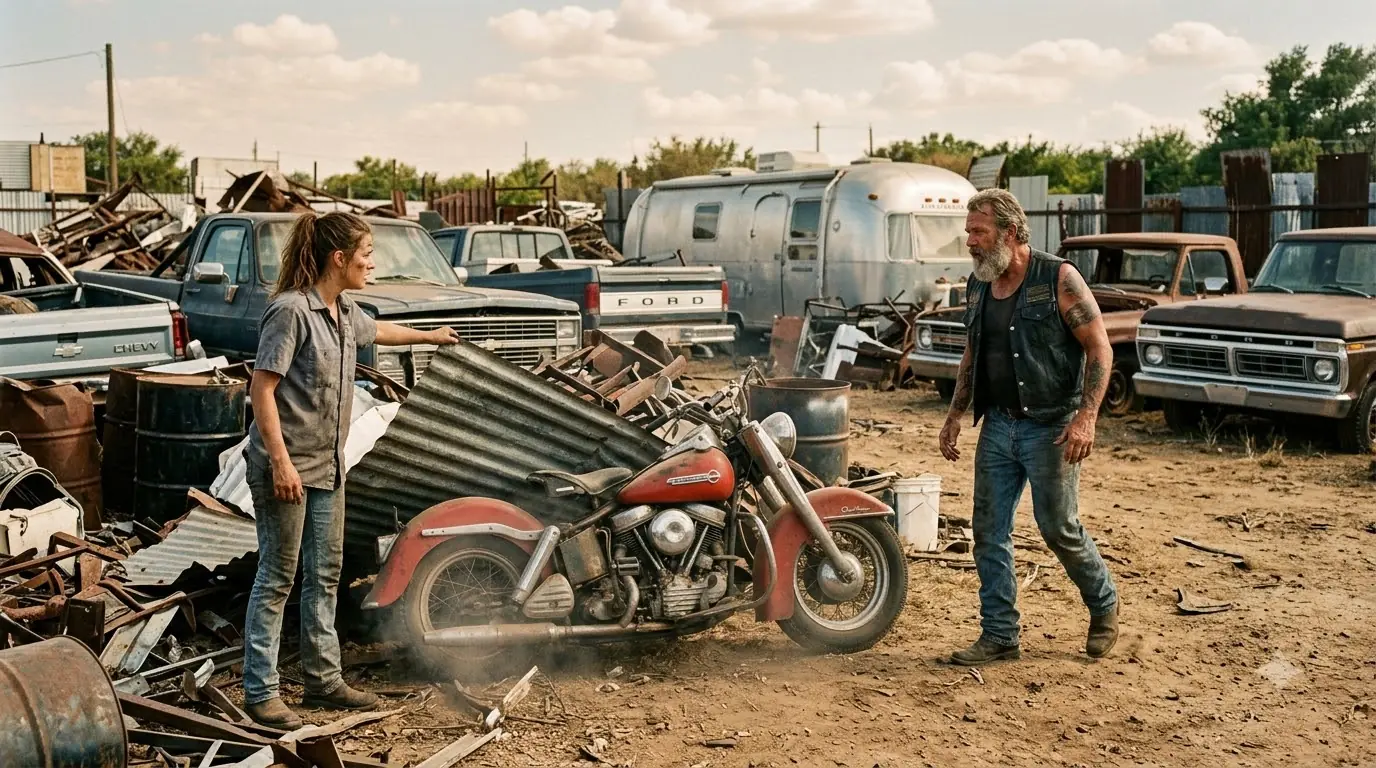
The corrugated sheet refused to move.
Maggie pulled once.
Nothing.
She wedged a steel bar underneath it and pushed until her shoulders burned. The sheet finally tore free with a shriek of rusted metal, sliding down the pile and nearly taking Maggie with it.
“Perfect,” she muttered.
Then she saw chrome.
Not much.
A curved piece reflecting the Oklahoma afternoon sun from beneath a nest of bent fencing, old exhaust pipes, and two crushed wheel rims.
Maggie stopped.
She dropped the steel bar.
Then crouched.
At first she thought it was part of an old bumper.
She pulled away a rusted pipe.
Chrome handlebar.
Maggie frowned.
She removed another piece.
Then another.
A motorcycle began appearing one fragment at a time.
Red fuel tank.
Black leather seat split down the middle.
Front fork buried under sheet metal.
Rear wheel trapped beneath an old truck axle.
Most of the chrome had dulled almost gray, and the exposed steel carried decades of corrosion, but the shape was unmistakable.
A Harley-Davidson.
Maggie stared.
She had grown up in Turner Salvage.
Her father had taught her the difference between a usable transmission and an eighty-pound paperweight before she learned long division. She could identify most American engines by sight, knew which tractor parts farmers would pay for and which would sit untouched for fifteen years, and had developed an almost unreasonable affection for anything mechanical that other people had already given up on.
But she had never seen this motorcycle.
That bothered her.
Her father, Daniel Turner, had known almost every object that entered the yard.
Even near the end, when cancer reduced him from a broad, loud man who could lift a transmission bell housing alone to someone who needed both hands to stand from the kitchen table, Daniel could still tell Maggie where a particular carburetor came from or which pile contained the rear axle from a 1968 Ford.
He had died eleven months earlier.
The scrapyard had become hers.
So had the debts.
Maggie looked at the motorcycle again.
“Where the hell did you come from?”
The Harley did not answer.
She spent the next hour uncovering it.
By sunset, Maggie had dragged away enough scrap to reveal most of the machine.
The tank was red beneath layers of grime.
Someone had hand-painted a thin black stripe along both sides decades earlier.
The speedometer glass was cracked.
The left mirror was gone.
One exhaust pipe had been crushed nearly flat.
There were scratches across the primary cover and deep dents along one side of the tank.
Maggie wiped dirt from the engine number.
Old.
Definitely old.
She reached for her phone and searched enough identifying details to narrow it down.
Late 1970s.
Possibly a 1978 Harley-Davidson FLH.
She stood back.
The motorcycle looked enormous compared with her.
Not because she was small. Maggie was five feet eight, lean and strong from years of lifting metal, running equipment, and refusing to admit when something was too heavy.
The Harley simply carried weight differently.
Like a machine built before manufacturers worried whether every customer could comfortably move it around a showroom.
Maggie rested one hand on the tank.
Dust came away beneath her fingers.
“Dead, huh?”
She tried the kick mechanism.
Locked.
Of course.
Then she noticed something.
The rear wheel was not buried naturally.
Neither was the motorcycle.
Someone had covered it deliberately.
Sheet metal first.
Then fencing.
Then heavier scrap around the edges.
It had been hidden.
Maggie looked toward the old office.
Her father had left behind thirty-seven years of terrible bookkeeping inside eight metal filing cabinets.
If the motorcycle came through Turner Salvage, there might be a record.
That evening she forgot dinner.
She opened files.
Receipts smelled like dust and machine oil.
Daniel’s handwriting grew worse depending on how busy the year had been.
Maggie found purchases for stripped cars, farm equipment, refrigeration units, a destroyed school bus, two dozen bicycles, and something described only as “assorted junk from Miller place.”
No Harley.
At midnight she found a thin ledger labeled UNCLAIMED / STORAGE.
Most entries involved vehicles people promised to retrieve and never did.
One line stopped her.
Red HD motorcycle — brought by Sheriff’s Office. June 1999. Hold. Do not process.
No owner name.
No model.
No VIN.
Maggie read it again.
Sheriff’s Office.
Hold.
Do not process.
She sat back.
Her father had never mentioned it.
That made the motorcycle considerably more interesting.
Maggie closed the ledger.
Then looked through the office window toward the dark scrapyard.
The Harley was invisible beneath the moonless sky.
She should have left it alone.
Instead she smiled.
That was the first mistake.
Or the first good decision.
Years later she never decided which.
The next morning Maggie brought the small loader to the pile.
She worked carefully.
No grabbing the Harley directly.
No chains across the frame.
She moved the surrounding junk first, piece by piece, until the motorcycle stood mostly free.
Then she built a wooden support underneath and used straps to lift just enough weight to pull the final axle from beneath the rear wheel.
By noon, the Harley stood upright for the first time in perhaps twenty-seven years.
Maggie stepped around it.
Someone had cared for it once.
She could tell.
Even beneath corrosion, there were signs.
Custom grips.
Hand-painted pinstriping.
An aftermarket seat with a small stitched emblem near the rear.
A silver coin fixed beneath the tank.
Maggie wiped it.
Saint Christopher medal.
She turned it over.
The back carried two engraved initials.
J.M.
Maggie stared.
Then she heard tires on gravel.
A pickup entered the yard.
Old Ford.
Faded blue.
A man stepped out.
Maggie knew him.
Harold Pierce, sixty-seven, retired mechanic, longtime customer, professional critic of everything younger people did differently from him.
He saw the motorcycle.
His eyes widened.
“Well, damn.”
Maggie smiled.
“You know it?”
“No.”
Harold walked closer.
“Thought there wasn’t anything under that pile but tetanus.”
Maggie looked at him.
“You knew the pile?”
“Everybody knew the pile.”
“Dad ever tell you what was underneath?”
“Nope.”
Harold crouched near the engine.
“What’re you gonna do?”
“See if it turns.”
He laughed.
“That motor?”
“Yes.”
“Maggie.”
“What?”
“That thing has been sitting longer than you’ve been alive.”
“So?”
“So the cylinders are probably rusted solid.”
“Probably.”
“Wiring’s ruined.”
“Probably.”
“Carburetor’s garbage.”
“Probably.”
“Then why?”
Maggie looked at the red tank.
“Because probably isn’t definitely.”
Harold smiled reluctantly.
“That your old man talking?”
“Unfortunately.”
Harold stood.
“Well, don’t try forcing anything.”
“I know.”
“I’m serious.”
“I know.”
“Pull the plugs first.”
“Harold.”
“What?”
“I know.”
He held up both hands.
“Fine.”
Then he walked away.
Five steps later he turned.
“You get that thing running, I’ll buy lunch.”
Maggie laughed.
“When?”
“The day hell freezes.”
“Deal.”
She did not try starting the motorcycle.
Not that day.
Not the next.
Maggie knew enough to understand that waking an old engine violently was the fastest way to finish killing it.
She removed the spark plugs.
Filled the cylinders with penetrating oil.
Waited.
Removed the tank.
Drained a substance that had once been gasoline and now smelled like industrial varnish.
The carburetor came apart on her workbench.
Inside was exactly what Harold predicted.
Corrosion.
Residue.
Blocked passages.
Maggie cleaned everything.
The fuel lines were useless.
Replaced.
Battery absent.
Wiring brittle.
She traced each circuit manually.
Some evenings she worked until midnight.
Other nights she became angry and ignored the bike completely.
The scrapyard still needed to survive.
Customers did not care about mysterious motorcycles.
Farmers needed used alternators.
A construction company bought twenty sections of steel pipe.
Maggie spent three days cutting a wrecked grain truck apart because the buyer wanted the rear differential.
Bills arrived.
Property tax notice.
Insurance.
Electricity.
Maggie nearly sold the Harley twice.
A collector from Tulsa offered fifteen hundred dollars after seeing photographs.
Maggie refused.
She told herself it was because she had not established ownership.
That was true.
It was not the whole truth.
The bike had become something personal.
Daniel had hidden it.
Or at least protected it.
Why?
Maggie searched more records.
Nothing.
Then she called the county sheriff’s office.
The receptionist transferred her three times.
Eventually an older records clerk answered.
Maggie explained.
“Motorcycle delivered to Turner Salvage in June of 1999.”
“Case number?”
“Don’t have one.”
“Owner?”
“Don’t know.”
“Then I can’t search much.”
Maggie sighed.
“Can you search impound records by destination?”
Pause.
“Maybe.”
Keyboard clicking.
“What date?”
“Ledger only says June.”
More clicking.
Then silence.
“Interesting.”
Maggie leaned closer to the phone.
“What?”
“There’s an old property entry.”
“For the motorcycle?”
“Possibly.”
“Owner?”
The clerk paused.
“John Mercer.”
Maggie wrote the name.
“Address?”
“I can’t give you protected information from the old record without formal request.”
“Why was it sent here?”
“Case marked closed.”
“What case?”
“No digital detail.”
“Can you tell me anything?”
Another pause.
“Vehicle recovered near Black Creek Road.”
Maggie knew the road.
Rural.
Twenty miles north.
“What happened to John Mercer?”
“I don’t know.”
“Was he arrested?”
“Doesn’t say.”
“Dead?”
“Doesn’t say.”
“Missing?”
The clerk became quiet.
Maggie noticed.
“Was he missing?”
“You’ll need to file a records request.”
That was answer enough.
The name stayed in Maggie’s mind.
John Mercer.
J.M.
Saint Christopher medal.
She searched newspapers.
Old archives were incomplete online.
The local library still kept microfilm.
Maggie spent Wednesday afternoon scrolling through June 1999.
Nothing first week.
Nothing second.
Then:
LOCAL MAN REPORTED MISSING AFTER MOTORCYCLE FOUND NEAR BLACK CREEK
Maggie stopped.
She enlarged the article.
John Mercer, 37, of Red Creek was reported missing Tuesday after his motorcycle was located abandoned near Black Creek Road. Authorities said there was no immediate evidence of foul play. Family members stated Mercer had planned a weekend ride but failed to return.
Photograph.
Black and white.
John Mercer stood beside the Harley.
Younger than Maggie expected.
Long dark hair.
Mustache.
Leather vest.
Smiling.
Maggie looked from the screen to the photocopy of the motorcycle she had brought with her.
Same tank stripe.
Same seat.
Same Saint Christopher medal visible beneath the tank if she enlarged the newspaper photograph.
Her pulse quickened.
She searched the following week.
SEARCH CONTINUES FOR MISSING RIDER
Then another.
MERCER FAMILY OFFERS REWARD
Then silence.
July.
August.
Nothing.
October.
A small article.
SEARCH FOR MERCER SUSPENDED
No body.
No explanation.
Maggie sat motionless.
The Harley under her father’s scrap pile had belonged to a missing man.
She requested more archive material.
At closing time, librarian Beth Coleman approached.
“You finding what you need?”
“Maybe too much.”
Beth looked at the screen.
“John Mercer.”
“You remember?”
“No.”
“My mother did.”
Maggie turned.
Beth was around fifty.
“What did she say?”
“That his brother never accepted the sheriff’s theory.”
“What theory?”
“That John left voluntarily.”
Maggie frowned.
“Why abandon the motorcycle?”
“Exactly.”
“Brother still alive?”
Beth nodded.
“Think so.”
“Name?”
“Wade.”
Maggie wrote it.
Wade Mercer.
She did not contact him immediately.
The Harley came first.
Maybe that was cowardice.