She was a saloon girl.
He was the sheriff’s new right hand.
And on a Tuesday afternoon that looked like every other Tuesday afternoon, the doors of the Gilded Spur swung open, and their eyes met across the length of the bar.
Pearl Delaney looked away first.
She had not done that in six years.
Not from a man.
Not from a lawman.
Not from a gambler with a knife smile, not from a miner with too much whiskey in him, not from a cattle buyer who thought money made him charming, not from a preacher’s son who came into the saloon through the back door and left through shame.
Pearl had learned long ago that the first person to look away usually gave something up.
Ground.
Power.
Certainty.
A little piece of the room.
She had spent six years not giving up any of those things.
But that Tuesday afternoon, when the new deputy stood in the doorway with the road still on his coat and the sun at his back, his eyes moved across the long bar, past the men at the tables, past the piano, past the bottles, past the smoke.
Then they found hers.
And they stopped.
Pearl looked away first.
Her hand on the next bottle was not quite right.
She set it down cleanly, because she had trained herself too well to fumble where men could see it, and went on working as though nothing had happened.
Carl Decker was still beside her, talking in slow circles about his fence line and how the north stretch had been mismeasured by the previous owner, a complaint he had repeated for three straight weeks and would repeat for three more if no one stopped him.
Pearl smiled at the right moment.
The piano played its usual complaint.
Dust rested on the windows.
Whiskey shone amber in the bottles behind the bar.
The afternoon continued in the exact shape afternoons always took.
But Pearl’s hand had not gone unsteady in six years.
And she knew the difference between a thing that meant nothing and a thing that meant something.
She did not insult herself by pretending otherwise.
The town was called Mercy Ridge, which had always struck Pearl as one of the crueler jokes played by geography.
There was no ridge worth naming, only a long rise of hard ground north of town where wind gathered and came down sharp in winter.
And mercy was something people discussed most when deciding whether someone else deserved it.
Mercy Ridge sat between cattle trails, mining claims, freight roads, and rumors of better places farther west. It had a main street of hard-packed dirt, two churches, three saloons, one jail, a livery, a blacksmith, a general store, a milliner, a dry goods shop, and enough gossip to power a locomotive if gossip could be burned like coal.
The Gilded Spur stood at the west end of Main Street.
It was not the largest saloon in the county, but it was the one men remembered.
It had a wide front porch, green swinging doors, a long polished bar scarred by knives and elbows, a piano that had survived three owners and one fire, and a curtained back room nobody mentioned in front of decent women, though most decent women knew more than they said.
Pearl knew the saloon the way she knew her own breathing.
The scrape of a chair before a fight.
The hush that dropped over a table when a hand turned bad.
The kind of laugh a man gave when he had money.
The kind he gave when he was working hard to hide that he did not.
The way a room changed when someone dangerous stepped inside.
The way a man’s eyes moved before his hand went to his gun.
The difference between drunk anger, true cruelty, and ordinary foolishness.
Men, she had decided early, were simple math.
Not because men were simple in every way, but because desire, pride, fear, and hunger arranged themselves in patterns if a woman learned to watch.
Pearl had learned.
She had not been wrong about it in years.
She was twenty-six years old, though some days the mirror gave her thirty and some nights the lamplight gave her nineteen.
Her hair was dark auburn, not red exactly, but close enough that men called it red when they were trying to be poetic. She wore it pinned high during working hours, with a few loose pieces arranged to look accidental, though nothing about Pearl at the Gilded Spur was accidental.
Her eyes were brown.
Not soft brown.
Not sweet brown.
A dark, steady brown that made men think twice when they mistook her silence for invitation.
She had a narrow waist, a strong back, and hands that could pour whiskey, carry trays, count coins, slap away a grabbing hand, and braid her own hair in less than five minutes.
She had come to Mercy Ridge at twenty.
Not because she wanted saloon work.
Because wanting had become irrelevant.
Her father had died under a wagon wheel outside Abilene.
Her mother had lasted eight months after that, long enough to sell what little they had, cough through one winter, and leave Pearl with a locket, a trunk, and no one willing to take in a grown girl without asking for something in return.
Pearl tried sewing first.
Then kitchen work.
Then laundry.
Laundry paid badly and ruined the hands.
Kitchen work paid badly and ruined the back.
Sewing paid only when people had money to spend on what could be done badly at home.
The Gilded Spur paid cash.
That was the fact around which her life arranged itself.
Pearl learned quickly that survival had a cost, and that people who judged the cost usually had someone else paying theirs.
She became good at saloon work because being bad at it was dangerous.
She learned not to drink with customers.
Not really.
She learned to take a sip and leave most in the glass.
She learned to laugh just enough.
Never too much.
Too much laughter gave men courage.
Too little offended them.
She learned to stand where she could see the doors.
She learned which regulars were harmless until payday.
Which were worse after losing at cards.
Which women in town would not speak to her on the street but sent their husbands to her for information when money went missing.
She learned that shame could be assigned like debt, and once a town decided what a woman was, facts mattered less than usefulness.
Pearl was useful at the Gilded Spur.
Men talked around her.
They forgot her.
They remembered her only when they wanted something and forgot her when they said something they should not have said.
She became a keeper of discarded truths.
A land deal whispered over rye.
A bribe passed beneath a napkin.
A forged signature laughed about near the stove.
A false claim arranged behind a curtain.
A judge’s weakness.
A rancher’s debt.
A merchant’s fraud.
Pearl held it all inside, not from loyalty, but because a roof and wages depended on silence.
Silence kept her paid.
Silence kept her out of jail.
Silence kept her alive.
Then Nathan Wells walked through the doors on a Tuesday afternoon and looked at her as if silence had weight and he could see it.
She heard his name the way names always reached her.
Sideways.
Through other people.
Women at the dry goods counter dropping their voices to that particular register that meant the conversation had stopped being about errands.
Nathan Wells, the sheriff’s new deputy.
Sheriff’s new right hand.
From Texas, someone said.
No, Kansas, someone else insisted.
Had worn a badge before.
Had fought cattle thieves near the Cimarron.
Had shot a man in self-defense.
Had never shot anyone, depending on who told it.
Quiet.
Unmarried.
No known bad habits.
The kind of man who said please to old women and sir to men he did not like.
Two weeks in town, and the women were saying his name like something they wanted to hold carefully.
Pearl had smiled at that.
She thought she understood.
She thought the women liked him because he was new, handsome enough, and wore authority without swagger.
That was all likely true.
But when she saw him that Tuesday, she understood there was something else.
Nathan Wells had a stillness that did not feel empty.
Most quiet men in saloons were either plotting, afraid, drunk beyond speech, or waiting to prove they were dangerous.
Nathan was simply present.
He stood in the doorway with the road on him, dust on his boots, a dark hat in one hand, and the relaxed posture of a man who had nothing to prove because proving things had ceased to interest him.
He was tall, but not dramatically.
His hair was brown, cut short, and his face had the weathered fairness of someone who had spent more years under sun than under roofs. There was a faint scar near his left eyebrow, not ugly, just enough to interrupt perfection and make his face more real.
Pearl saw all this in the time it took for his eyes to find hers.
Then she looked away.
Carl Decker was still talking.
“So I told Mercer, I said, if that fence line runs east of the cottonwood, then half that pasture is mine by rights, and I don’t intend to let some paper-drawer in Helena tell me different.”
Pearl poured his whiskey.
“That so?”
“That is so.”
“You should speak to the surveyor.”
“Surveyors are half the trouble.”
“Then speak to the other half.”
Carl laughed because he thought she had made a joke for him.
Pearl smiled.
Nathan came to the bar with Sheriff Amos Rusk beside him.
Sheriff Rusk was a broad, gray-mustached man with tired eyes and a habit of chewing tobacco he pretended his wife did not know about. He had been sheriff for twelve years, which in Mercy Ridge meant he had survived stupidity, politics, weather, and men with grudges.
He greeted Pearl with a nod.
“Pearl.”
“Sheriff.”
“This is Nathan Wells. New deputy.”
“So I hear.”
Nathan’s eyes met hers again.
This time she did not look away immediately.
“Miss Delaney,” he said.
His voice was lower than she expected.
Not soft.
Not rough.
Plain.
He said her name as though it was simply her name, not a joke, not a claim, not an invitation.
Pearl set two glasses on the bar.
“Sheriff drinks coffee if he’s working.”
Nathan glanced at Rusk.
The sheriff sighed.
“She knows everything.”
“Not everything,” Pearl said.
“Enough.”
Pearl filled one cup with coffee and waited.
Nathan looked at the whiskey bottles, then at the coffee.
“Coffee,” he said.
Pearl’s eyebrow moved slightly.
“You sure?”
“Yes, ma’am.”
Ma’am.
Not sweetheart.
Not girl.
Not darling.
Not Pearl in that oily tone men used when they wanted to prove they knew her.
Ma’am.
It should not have mattered.
It did.
She poured coffee.
Nathan paid for both cups.
The sheriff objected.
Nathan ignored him.
Pearl watched the coin hit the bar.
Honest payment.
No flourish.
No expectation.
She set his change down.
He took it, nodded once, and walked with the sheriff to a table near the wall.
Carl Decker leaned closer.
“New deputy thinks he’s mighty proper.”
Pearl watched Nathan sit with his back to the wall and eyes on the room.
“No,” she said. “He thinks.”
Carl did not know what to do with that, so he drank.
For two weeks, Nathan came through the Gilded Spur only with Sheriff Rusk.
He drank coffee.
He did not linger at Pearl’s end of the bar.
He did not ask personal questions.
He did not pretend not to notice the room, but he also did not stare as if every man were a suspect and every woman a regret.
When men tried to draw him into talk, he answered enough and no more.
When saloon girls teased him, he tipped his hat and let the teasing pass without feeding it.
Pearl watched him because watching was what she did.
She saw that he placed himself where he could see exits.
She saw that he had patience with fools until foolishness threatened someone else.
She saw that he listened longer than most men.
She saw that he had no interest in being liked by men who respected only noise.
She also saw that he noticed her noticing.
He did not challenge it.
He did not smirk.
He simply allowed himself to be observed, which was a kind of confidence she rarely encountered.
Once, on a slow afternoon, he came in alone.
Pearl was wiping glasses behind the bar.
The piano player had gone to visit his sister and the saloon felt wrong without his uneven music.
Nathan removed his hat.
“Coffee?”
“Fresh enough,” Pearl said.
“Fresh enough means fresh or dangerous?”
“In this establishment, those are frequently the same.”
He almost smiled.
She poured him a cup.
He paid.
He drank standing at the bar.
A man at the faro table cursed loudly.
Pearl did not look over.
Nathan did.
“He always like that?” he asked.
“Only when losing.”
“He losing?”
“He’s breathing.”
This time the smile came fully, though briefly.
It changed his face.
Pearl looked away before he could see that she had noticed.
A week later, everything changed.
It was a Thursday morning when the law came through the doors.
Not one man this time.
The sheriff and four deputies moved with the quiet of men who had already settled the question of how the morning would go.
Nathan was among them.
He did not look at Pearl.
She understood immediately that this was the kindest thing he could have done.
The Gilded Spur was not yet busy.
Morning light cut through the dust on the windows. Two men sat at a table with cards they pretended were innocent. A traveling salesman slept with his head on his arms near the stove. The owner, Horace Vail, stood behind the bar counting coins with fingers that went still when he saw the badges.
Horace Vail was a thin man with pale eyes, a sharp nose, and the soft hands of someone who profited from other people’s dirt without doing much digging himself.
Pearl had worked for him six years.
She did not like him.
But liking had never been part of the arrangement.
Vail saw the sheriff and went the color of old ash.
“Morning, Sheriff,” he said.
Rusk stepped forward.
“Horace.”
“What brings you in so early?”
“You know.”
Pearl’s stomach tightened.
She knew too.
Whatever had been happening in the curtained room at the back, and she had known, she had known for two years, had kept it pressed flat inside her because her roof and wages depended on her not knowing, had finally run its course.
Not just cards.
Not just girls.
Not just whiskey sold after hours.
Documents.
Money.
Land claims.
Bribes.
Men went into that room with clean hands and came out owning things they had no right to own.
Pearl had carried glasses in there.
She had cleared ashtrays.
She had heard enough to know the back room was not merely immoral.
It was criminal.
Sheriff Rusk handed Vail a paper.
“Search order.”
Vail’s mouth opened.
No words came.
Nathan and another deputy moved toward the curtained room.
Pearl stepped aside.
Her heartbeat was steady, but her hands felt cold.
Nathan passed within three feet of her.
He still did not look at her.
She appreciated it more than she wanted to.
The curtain was pulled back.
Papers were found in a locked drawer beneath the false bottom of a liquor crate.
Ledgers.
Survey copies.
Cash.
Names.
The owner protested once, then stopped when Sheriff Rusk read a line from one of the documents aloud.
By eleven, Horace Vail was in handcuffs.
By noon, the Gilded Spur was shut.
The piano sat silent for the first time Pearl could remember.
Men gathered outside on the boardwalk pretending concern and smelling scandal.
The saloon girls stood in a line near the bar with their bags, faces guarded.
Some cried.
Some cursed.
Pearl did neither.
She went upstairs to the small room she had rented above the saloon for six years, packed her clothes into one carpetbag, wrapped her mother’s locket in a handkerchief, and came back down.
Nobody told her what came next.
Nobody had to.
She stepped outside onto the boardwalk with her bag at her feet.
The street went about its business around her.
A wagon passed.
Two men came out of the land office and went separate ways without looking at her.
A woman across the street pulled her child closer.
Pearl stood there and did the math.
The math was bad.
Six years at a saloon raided by the law.
Her name attached to it the way a brand attaches.
Not something a woman simply set down.
The boarding house on Elm had not let her finish her sentence.
Mrs. Kellerman opened the door, saw Pearl’s bag, and looked over Pearl’s shoulder to see if anyone was watching.
“I need a room,” Pearl said.
Mrs. Kellerman’s face had already answered.
“I’m sorry, Miss Delaney.”
“Are you?”
The woman’s lips tightened.
“This is a respectable house.”
Pearl looked at her.
She could have said many things.
She could have named the men from respectable houses who had sat with her at the Gilded Spur.
She could have repeated words spoken by husbands, brothers, fathers, and sons beneath the warm red glow of saloon lamps.
She could have torn holes in half the town’s respectability before supper.
Instead, she nodded once.
“Then I won’t trouble it.”
She walked away cleanly rather than stand there while the rest was said aloud.
She tried the hotel.
Full, they claimed.
It was not full.
She tried the widow Porter, who sometimes rented a back room to women passing through.
Widow Porter cried while saying no, which somehow made it worse.
By late afternoon, Pearl had stopped asking.
She returned to the boardwalk outside the closed Gilded Spur because it was the only place in town that had ever admitted what it was.
She stood there with her bag at her feet and watched the lamps come on one by one as evening lowered itself over Mercy Ridge.
She kept her chin level.
Her hands loose.
Her face calm.
She did not perform fear.
She did not perform shame.
She let the math be what it was.
The light was nearly gone when she heard boots on the boardwalk behind her.
There was something familiar in the unhurried step.
She turned.
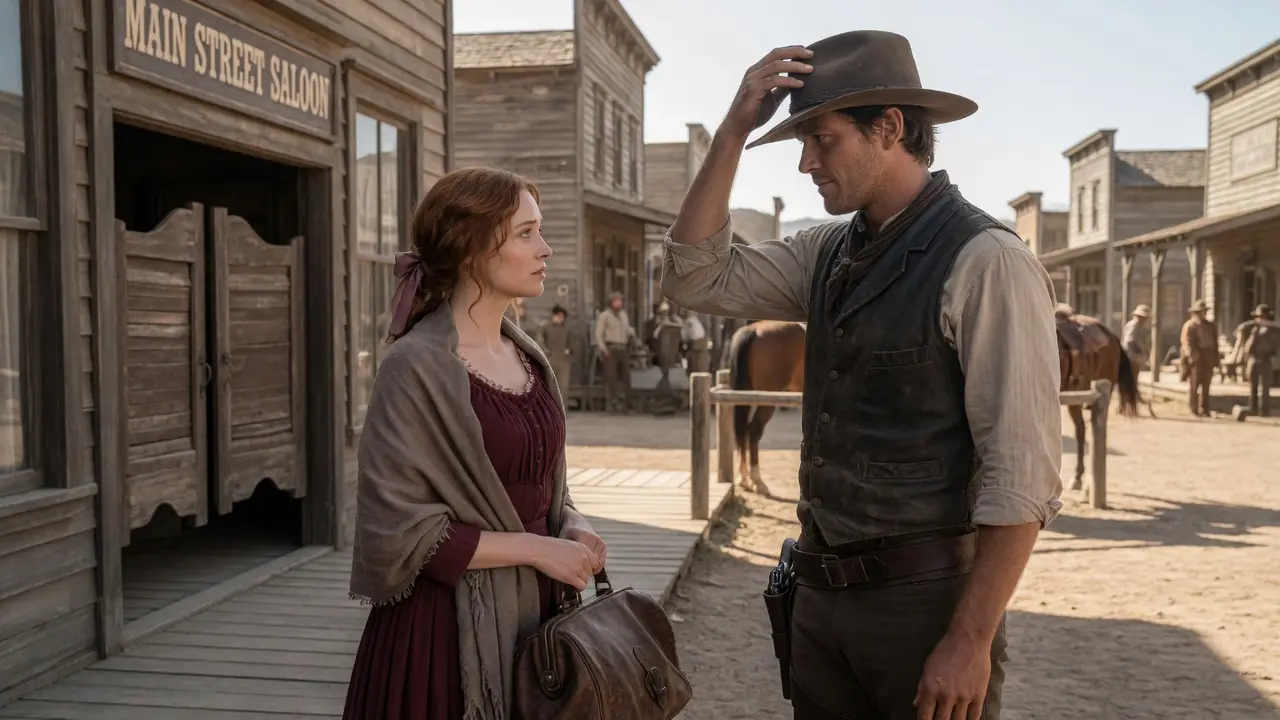
Nathan Wells stood a few feet away.
He looked at her bag on the ground, then at her face.
“I have a spare room,” he said.
Pearl did not answer.
“You can have it until you find something sorted.”
The words sat between them.
Not rushed.
Not ornamented.
Not wrapped in false charity.
Pearl looked down the street at the lamps burning amber in the early dark.
“The town will talk.”
Nathan’s expression said he had already accounted for it.
“I know it will.”
She looked at him.
She had expected him to say it did not matter, the way men said things like that before discovering it did.
He had not said that.
He had said he knew.
Which meant he had looked at the full cost of coming down here and come anyway.
“Why?” she asked.
“Because you need a room.”
“That is not an answer.”
“It is the truest one.”
Pearl studied him.
“Men usually have another answer.”
“I know.”
“And you?”
Nathan looked toward the closed saloon.
Then back at her.
“I saw a woman lose her work and roof in the same day because of crimes she did not commit.”
“I knew some of it.”
“Yes.”
His honesty struck her harder than a defense would have.
Nathan continued.
“And I think you knew there was no one safe to tell.”
Pearl looked away first again, and this time she hated it less.
He stepped closer and reached for her bag.
She held it.
“I can carry my own.”
“I know.”
He did not take it from her hand until she let him.
That mattered.
Finally, she released the handle.
Nathan took the bag.
They walked up the street in the early dark.
Pearl kept her eyes forward and did not look at the amber light in the windows of the houses they passed.
She felt eyes anyway.
Curtains shifting.
A pause in conversation on a porch.
A boy staring until his mother pulled him inside.
Nathan did not hurry.
He did not slow down.
He walked beside her like a man walking with someone whose place beside him required no explanation.
That made her throat feel tight, so she said nothing.
Nathan’s house stood at the edge of town, past the jail and beyond the blacksmith, where the road began to loosen into open land.
It was small.
One story.
Plain board walls.
A front porch with two chairs, one newer than the other.
A pen out back for his horse.
Smoke from the chimney.
The room he gave her faced the yard where his gray horse stood each evening.
There was a quilt on the bed, a basin on the stand, a hook on the back of the door, and a window that opened if lifted hard enough.
Pearl stood in the doorway.
“It locks,” Nathan said.
He pointed to the door latch.
“The inside bolt works. I checked it.”
She glanced at him.
He looked as if he understood why that mattered and did not require thanks for understanding.
“The kitchen is yours to use,” he continued. “I leave early. Come and go as you please. I can sleep in the front room if you’d rather have more distance.”
Pearl looked at the room.
The clean quilt.
The basin.
The working lock.
“I can pay when I find work.”
“I did not ask for rent.”
“I did not ask for charity.”
“No.”
He accepted that without offense.
“When you find work,” he said, “we can discuss terms.”
“We?”
“Terms usually take more than one person.”
She almost smiled.
Almost.
He set her bag inside the room and stepped back.
“Supper is beans and cornbread. I am not proud of either.”
“You cook?”
“Only under threat of starvation.”
“That bad?”
“Worse.”
Pearl looked at him, then down the hall toward the kitchen.
“I’ll see what can be salvaged.”
That was how she stayed the first night.
Not as a rescued woman.
Not as a kept woman.
Not as a scandal, though the town would call her one.
As a person who knew how to make supper because there was food and a stove, and because hands needed something to do when a life had been overturned.
She cooked because there was food and she knew what to do with it.
She ran his errands in the mornings because moving through town with a purpose was survivable in a way that moving through it without one was not.
She cleaned because the house needed it, and her hands needed work in the long hours between his leaving and his coming back.
At first, she told herself she was only occupying the days.
That was true.
It was not the whole truth.
Nathan’s house was not a place of many comforts, but it had a steadiness that worked on her slowly.
The boards creaked in predictable places.
The stove drew well if the damper was opened halfway.
The pump handle stuck at the top unless pulled sharply.
The gray horse, whose name was Mercy for reasons Nathan claimed were a joke, disliked carrots but liked apples.
There were two cups with chipped rims.
One lamp smoked.
The kitchen table had knife marks near one corner.
Pearl learned these things because she was there, and because knowing the shape of a place made it less likely to turn on you.
The town talked.
Of course it did.
Two women outside the milliner’s went quiet a half beat too late as she passed.
A man who had tipped his hat to her at the saloon for three years found something fascinating on the other side of the street.
Children stared until called away.
At the general store, Mr. Bellamy, the owner, spoke to her politely but avoided saying Nathan’s name.
Pearl kept her pace and her face level.
She had survived worse versions of this.
She believed that most days.
Some days, she did not.
In the evenings, Nathan came home, and she put supper on the table, and they talked.
Not about important things at first.
The horse.
The weather.
Whether the coffee at the jail was being brewed or punished.
A complaint about the feed merchant’s short measure made her raise an eyebrow because she had thought the same thing for two years and never said so.
Nathan caught the expression.
“You knew about that.”
Pearl refilled his coffee before she answered.
“Everyone knew. He’s been doing it since ’94.”
Nathan was quiet a moment, turning that over.
Then he looked up at her.
“What else does everyone know?”
She set the pot back on the stove.
“That depends on who you mean by everyone.”
He almost smiled.
She caught the edge of it before he looked down at his plate, and she went back to the stove and kept her hands busy, telling herself it was the heat from the fire she was feeling.
About ten days in, he mentioned a land dispute that had come across the sheriff’s desk.
Boundary claim.
Two competing surveys.
No clean answer.
He said it the way he said most things.
Not asking directly.
Just turning it over out loud.
Pearl stood by the stove, listening.
“Who signed the second survey?” she asked.
Nathan looked up.
“Caleb Wirth.”
Pearl wiped her hands on a towel and came to the table.
“Show me.”
Nathan pushed the rough map toward her.
She leaned over it, close enough that her hand was near his on the page.
Her finger touched the eastern line.
“Not Wirth’s work.”
Nathan’s eyes sharpened.
“You know survey work?”
“No. I know liars.”
She pointed to the line.
“Wirth signs what he is paid to sign when the price is right. But he doesn’t draw lines that clean. He drinks too much when he works. His lines stagger.”
Nathan looked at the map again.
Pearl tapped the eastern boundary.
“That was drawn by Edwin Cole from the land office. He did the clean copy.”
“How do you know?”
“Because Cole was in the back room of the Spur on February ninth, late. He sat with Martin Vail and two men from the alderman’s office. Money changed hands.”
Nathan did not interrupt.
Pearl continued.
“Forty dollars up front. Another sixty after the claim went through. They ordered rye first, then switched to coffee because Cole was shaking too badly and Vail told him to sober up before signing anything.”
She stopped.
The room was quiet.
The stove ticked.
Nathan was watching her, not the map.
That full, unhurried attention of his did not move when she caught it.
Pearl lost the next word entirely.
Found it.
Finished the sentence.
“There was a third man too. Luther Pike. He laughed when the money changed hands and said the widow wouldn’t know a boundary from a bedsheet.”
Nathan leaned back.
“And you heard all that clearing glasses?”
“I was three feet away for the better part of an hour. Nobody looked at me once.”
She straightened and returned to her side of the table.
“I have six years of that,” she said to the middle distance. “If it’s useful.”
Nathan was quiet.
“Why didn’t you take it to the sheriff yourself?”
She looked at him then.
“Would he have listened?”
Nathan thought about that honestly.
She appreciated that.
“Probably not,” he said finally.
Pearl picked up her coffee.
“There’s your answer.”
Three days later, Nathan brought the land office clerk to the kitchen table because the sheriff needed him certain.
Pearl knew the clerk.
He had been in the saloon four winters back, sitting quiet in the corner while two men worked out an arrangement involving a survey line and a number that was not the number on public record.
He had not participated.
He had not left either.
Nathan set a paper on the table and asked if she recognized the names on it.
Pearl looked once.
Then she told them the date, the amount, the drink ordered, and the name of the man who had laughed when the money changed hands.
She said it all to the clerk, not to Nathan, because the clerk was the one who needed to hear it plainly from someone who had been in the room.
The clerk stopped looking at Nathan.
He looked at Pearl instead.
Not the way men usually looked at her.
The way a man looks when he has just been forced to revise something he thought he understood.
By the following morning, the alderman’s back office that had stayed open for years was shut.
The man who had walked Main Street like he owned the boards beneath him started taking the alley home and did not stop.
Nathan said nothing about it at supper that evening.
He did not need to.
Pearl went on with the stove, the errands, and the evenings, and she did not look too closely at what the days had become.
But the town looked.
It saw what it wanted first.
The saloon girl in the deputy’s house.
Then it saw things it did not know how to explain.
Men arrested because of things Pearl remembered.
A widow’s land restored because Pearl knew who had paid for the false line.
A clerk shamed into honesty because Pearl could name the drink in his hand four years ago.
The sheriff stopping at Nathan’s house in the morning and leaving with notes.
Nathan walking beside Pearl into the general store as if she belonged in daylight.
People did not change their minds all at once.
Most resisted.
A woman with a bad reputation becoming useful to the law was inconvenient.
It made categories less comfortable.
And respectable people relied heavily on categories.
It was a Friday morning when the women came to it directly.
Pearl was at the general store.
Flour.
Coffee.
Lamp oil.
A spool of thread.
Three women stood near the counter when she entered.
Mrs. Latham, whose husband drank at the Gilded Spur twice a week and lied poorly about it.
Mrs. Crane, who led church sewing circles and collected secrets with more zeal than she collected scraps.
And Abigail Mercer, unmarried, sharp-faced, and convinced that morality was best applied outward.
Pearl knew all of them.
She had served two of their husbands at the saloon and kept private what she had seen of those men, which was considerably more than either husband had earned from her.
The women let Pearl reach the counter before Mrs. Crane spoke.
“Miss Delaney.”
Pearl placed her list flat on the counter.
“Mrs. Crane.”
The voice that answered carried the particular warmth of organized concern.
“A man in Deputy Wells’s position has a certain kind of future ahead of him in this county.”
Pearl said nothing.
“The right foundation matters for a man still establishing himself.”
Pearl let that breathe.
Then Mrs. Latham added, “Some arrangements, however charitable in spirit, have a way of following a man whether he intends it or not.”
Abigail Mercer’s face held sympathy so polished it gleamed.
“Surely a woman of your background understands what we mean without it needing to be laid out any further.”
Mr. Bellamy behind the counter found the flour barrel intensely interesting.
Pearl placed both hands on the wood.
She looked at Abigail Mercer and held it.
Not with heat.
Not with anything that could be picked up and used against her.
Just the steady patience of someone who had been talked around for six years and had not yet found a reason to look away.
The warmth in Abigail’s face began to cost her something to maintain.
Pearl said, “Half the town’s men have spent six years talking in front of me because they mistook my silence for emptiness.”
Mrs. Crane stiffened.
Pearl continued, her voice level.
“I know which husbands drink. Which gamble. Which lie about it badly. Which debts are hidden from wives. Which church donations came from poker winnings. Which respectable men prefer the back door.”
The store went so quiet that the scrape of Bellamy’s pencil sounded loud.
Pearl looked at each woman in turn.
“I have never carried those things into daylight because I know what it is to live at the mercy of other people’s mouths.”
Mrs. Latham had gone pale.
Pearl picked up her list.
“So if you mean to warn me about reputation, don’t. I know more about its cost than anyone in this room.”
She bought her flour, coffee, lamp oil, and thread.
She walked out.
Only when she turned the corner and stood alone in the cold air did she let her breath shake.
Just a moment.
Then she went home, put the groceries away, started supper, and kept her hands moving until they felt like her own again.
She had not planned to say anything about it.
But Nathan came home that evening, hung his hat, washed at the basin, sat at the table, and looked at her once across the kitchen.
Not long.
Just enough.
“What happened?”
Pearl stirred the pot.
“Nothing worth troubling over.”
He waited.
That was his most maddening habit.
Waiting made her more honest than questions did.
She told him flat, no weight on it, just the shape of the thing in plain words.
The women.
Their concern.
Their warning.
Her answer.
Nathan listened all the way to the end without interrupting.
Then he pushed back from the table and stood.
“I’ll be back before supper.”
“Nathan.”
He looked at her.
“This does not require a gun.”
“I know.”
“Or a badge used foolishly.”
“I know.”
“Then where are you going?”
“To speak plainly.”
He was back in forty minutes.
He sat down.
Pearl put his plate in front of him.
When she set it down, his hand came over hers on the table.
Just for a moment.
Warm.
Certain.
Then gone.
“I spoke to Mrs. Crane,” he said.
Pearl stood very still.
“And Mrs. Latham. And Miss Mercer.”
“What did you say?”
“That my house is my house. My judgment is my judgment. And anyone concerned for my future may begin by respecting the woman who helped the sheriff uncover more corruption in three weeks than half the town has had courage to name in three years.”
Pearl looked at him.
Her throat tightened unexpectedly.
“You should not have done that.”
“I know what I did.”
“They will talk worse.”
“Maybe.”
“That could cost you.”
“I know.”
There it was again.
Not it does not matter.
Not empty assurance.
I know.
Pearl turned back to the stove before her face could betray too much.
Neither of them said another word about it.
She did not sleep well that night.
She did not examine why.
The next morning, she passed all three women outside the church.
Not one spoke.
Not one found her eyes.
Pearl walked on and let it be what it was.
A week after that, she fell asleep in the chair by the hearth.
She had not meant to.
It had been a long day.
The fire was warm.
After supper, Nathan sat at the table with paperwork, and Pearl sat near the hearth intending only to rest her feet for a moment.
When she opened her eyes, the room was quieter.
The fire had settled low.
There was a blanket over her that had not been there before.
Nathan was still at the table, reading something by the lamp, his face tilted toward the page.
Pearl watched him in the low light without meaning to.
The set of his shoulders.
The way he turned the page carefully, unhurried, the same way he did everything.
The fire threw light across the side of his face.
The room was very still.
She was warm in a way that had nothing to do with the blanket.
And she knew it.
Nathan looked up.
Pearl looked at the fire.
Her face was already warm, and the fire was not entirely responsible.
There was nothing she could do about that except let it pass.
He closed the papers.
“You should get proper sleep.”
“I was sleeping.”
“In a chair.”
He said it without judgment, just as a plain fact about chairs.
She kept her eyes on the fire.
“I’ve slept in worse.”
He was quiet for a moment.
When he spoke again, his voice was lower, careful not to break the room.
“I know you have.”
There was something in it.
Not pity.
Nothing like that.
Just the simple acknowledgment of a man who understood what her life had cost and did not flinch from it.
Pearl pulled the blanket further around her shoulders.
After a while, Nathan stood, banked the stove, and crossed the room.
His hand rested briefly on her shoulder as he passed.
Just a moment.
Warm through the blanket.
Then he was gone.
Pearl sat in the quiet room for a long time before she followed.
November came in cold and stayed that way.
Pearl had stopped looking for another situation without marking the exact moment it happened.
The mornings had taken on a shape no longer temporary.
The kitchen smelled the way a kitchen smells when it has been used the same way long enough to hold it in the walls.
She knew which board on the back step creaked and which window latch needed lifting before it would turn.
She knew Mercy’s sound in the yard before she heard Nathan’s boots on the path.
She knew that Nathan took coffee black unless the day had been especially bad, then he used sugar and pretended not to notice.
She knew he cleaned his gun every Sunday evening, not with pride, but with solemn dislike for anything that could fail when needed.
She knew he kept three letters in a tin box and never opened them when anyone was near.
She knew he preferred cornbread with edges.
She knew his quiets.
There were several kinds.
The ordinary quiet of a man at rest.
The thinking quiet.
The tired quiet.
The dangerous quiet.
And, increasingly, the quiet that came when he looked at her and chose not to say what both of them could feel growing in the room.
Pearl had also learned without meaning to exactly how long she could hold his gaze across the supper table before her breath did something she had not given it permission to do.
The answer was not very long.
She was twenty-six years old and had spent six of those years learning to keep herself steady around men who did not deserve the effort.
She had not accounted for one who did.
The first snow came on a Monday.
Not much.
Just a thin white dusting on the fence rails and porch boards.
Pearl stepped outside before sunrise and found Nathan splitting wood near the shed.
His sleeves were rolled despite the cold.
His breath showed white.
The axe fell cleanly.
She stood in the doorway watching for perhaps too long.
He looked up.
“You’ll freeze.”
“So will you.”
“I’m working.”
“I’m supervising.”
His mouth curved slightly.
“Am I doing it wrong?”
“Not yet.”
He split another log.
Pearl wrapped her shawl tighter and stepped onto the porch.
“I found the letters,” she said.
Nathan’s axe paused.
“In the tin box.”
“I wasn’t prying.”
“I didn’t think you were.”
“The latch on the shelf was stuck. The tin fell.”
He set the axe down.
Pearl watched him carefully.
“You don’t have to tell me.”
Nathan leaned one hand against the chopping block.
“My brother writes.”
“You have a brother?”
“Had. Have. Depends on the day.”
Pearl said nothing.
“He rode with bad men for a while. Not because he was hungry. Because he liked feeling feared.”
Nathan picked up a split log and tossed it onto the pile.
“I wore a badge in Kansas. One night, my brother came through with two others. They robbed a freight office. A clerk died.”
Pearl’s chest tightened.
“I tracked them.”
“Your own brother?”
“Yes.”
“What happened?”
Nathan looked toward the pale morning.
“He drew first. I shot him. He lived. Went to prison. Writes twice a year to tell me I was right and he hates me for it.”
Pearl absorbed that.
The pain of it sat in his voice, not asking to be comforted, simply present.
“That why you left Kansas?”
“Partly.”
“What was the other part?”
“I got tired of people asking which brother I was.”
Pearl stepped down from the porch and came closer.
“I know something about being mistaken for someone else’s sin.”
Nathan looked at her.
Their eyes held.
This time she did not look away.
The cold moved around them.
For once, neither had to explain.
A few days later, Sheriff Rusk came to the house with his hat in his hands and a difficult expression on his face.
Pearl was making coffee.
Nathan looked up from the table.
“Sheriff?”
Rusk removed his coat.
“Need to speak with Pearl.”
Pearl turned.
“Then speak.”
Rusk looked uncomfortable.
“There’s a hearing next week. County judge coming in. Vail’s lawyer is claiming the ledgers were planted.”
Pearl laughed once.
The sound had no amusement in it.
“Of course he is.”
“They’re saying the saloon girls had reason to lie. That you were angry at Vail over wages. That Nathan took you in to keep your testimony convenient.”
Nathan stood.
Rusk lifted a hand.
“I’m telling you because it will be ugly. If you testify, they’ll put your life on display and call it evidence.”
Pearl set the coffee pot down.
“And if I don’t?”
“Vail could walk. Maybe not free, but lighter than he ought.”
Nathan’s face was controlled, but Pearl saw the anger beneath it.
Rusk continued.
“I won’t ask it of you. I came to give you the choice.”
Choice.
That word was rare enough to taste strange.
Pearl looked at the stove.
The kitchen.
The table.
The room that had slowly become a place where her hands did not shake.
Then she looked at Nathan.
He did not nod.
He did not urge.
He did not rescue her from deciding.
That mattered too.
Pearl said, “I’ll testify.”
Nathan’s jaw tightened.
“Pearl.”
“If I stay silent now, then six years of keeping my eyes open was for nothing.”
Rusk nodded slowly.
“The hearing is Friday.”
Pearl picked up the coffee again.
“Then you’ll both need breakfast before it.”
The hearing filled the courthouse.
Men who had spent years pretending not to know anything about Horace Vail came early to hear what Pearl Delaney would say under oath.
Women came too, some out of concern, some curiosity, some judgment, though judgment and curiosity often wore the same bonnet.
Pearl wore a plain dark dress Nathan had paid for only after she insisted on recording it as a debt in the kitchen ledger.
Her hair was pinned simply.
No saloon ribbons.
No paint.
No attempt to appear innocent by looking small.
Nathan walked beside her to the courthouse and stopped at the door.
“I can sit where you can see me,” he said.
“I know where you’ll be.”
He nodded.
“You owe them nothing beyond the truth.”
Pearl looked at the courthouse doors.
“I know.”
She did.
That was new.
The lawyer tried exactly what Rusk said he would try.
He asked about her work.
Her employer.
Her wages.
Her room above the saloon.
The men she had served.
Whether she had entertained customers.
Whether she disliked Horace Vail.
Whether Deputy Wells had promised her anything.
A murmur moved through the room.
Pearl sat with her hands folded and answered without flinching.
“I worked at the Gilded Spur six years.”
“Yes, I served drinks.”
“Yes, I heard conversations.”
“No, I was not paid to lie.”
“No, Deputy Wells promised me nothing in exchange for testimony.”
“Yes, I disliked Horace Vail.”
The lawyer seized on that.
“So you admit bias?”
Pearl looked at him.
“I disliked him because I watched him cheat, threaten, bribe, and profit from desperate men. If truth sounds biased against him, that is not my doing.”
The room shifted.
The judge hid something that might have been a smile.
The lawyer’s face reddened.
He tried again.
“Miss Delaney, are we to believe that men openly discussed illegal dealings in front of you?”
Pearl leaned slightly forward.
“No.”
The lawyer smiled.
“No?”
“They discussed them around me. That was their mistake.”
A ripple moved through the room.
The lawyer pressed his lips tight.
Pearl then gave dates.
Names.
Amounts.
Descriptions of documents.
Who sat where.
What they drank.
Which man had ink on his thumb.
Which one used his left hand to pass money under the table.
Which clerk had said, “The widow won’t fight it if the papers look official.”
By the time she finished, the courtroom had changed.
She felt it.
People were no longer looking at her like a saloon girl being examined.
They were looking at a witness.
A dangerous one.
A woman who had been underestimated so completely that men had confessed crimes in front of her without realizing they had done it.
Horace Vail stopped looking smug.
The judge ordered him held for trial.
Several others were named for further inquiry.
When Pearl stepped down, the room was silent.
Nathan stood near the back wall.
Their eyes met.
He did not smile.
He did something better.
He looked proud.
Pearl walked out of the courthouse without lowering her eyes.
The town did not transform overnight.
People rarely do.
But after the hearing, something shifted.
Small things first.
Mr. Bellamy at the general store began saying, “Good morning, Miss Delaney,” in a voice meant for others to hear.
Widow Porter sent over a jar of preserves with no note.
Mrs. Latham crossed the street one afternoon, stopped in front of Pearl, and said, stiffly, “My husband drank more than was good for him at that saloon.”
Pearl waited.
Mrs. Latham’s eyes watered with frustration, pride, and something like shame.
“I expect you could have made that known.”
“Yes.”
“You didn’t.”
“No.”
Mrs. Latham nodded once.
“Thank you.”
It was not an apology exactly.
But it was something.
Pearl accepted it.
The sheriff began asking for her input openly.
Not in front of everyone at first.
Then in front of Nathan.
Then in front of the clerk.
Then, one morning, in the jail office with two ranchers present, he said, “Pearl, you ever hear of a man named Silas Broom?”
The ranchers looked startled.
Pearl answered.
By December, no one sensible dismissed what she knew.
Still, there remained the question of Nathan’s house.
Of Pearl’s place in it.
Of the space between them that had grown so quietly and surely that it had become impossible to pretend it was only kindness.
One evening, Nathan came home later than usual.
Pearl put the coffee on without thinking about it.
She heard Mercy in the yard, then Nathan’s boots on the step, then the door.
She had the cup waiting when he entered.
He removed his hat and stood for a moment in the kitchen, looking tired in a way that went deeper than work.
“What happened?” she asked.
“Letter from Kansas.”
Pearl set the cup on the table.
“Your brother?”
Nathan nodded.
“He died.”
The room went still.
“In prison?” she asked.
“Yes.”
Pearl did not say she was sorry immediately.
She knew grief was complicated when love and hurt wore the same face.
Nathan sat down.
“He wrote before. The letter came with the notice. Said he hated me less than he used to.”
“That is something.”
“Yes.”
He looked at the cup.
“I don’t know what I feel.”
Pearl sat across from him.
“Then don’t decide tonight.”
He looked up.
That struck him.
She knew because the words had struck her when he once gave them back in a different shape.
He covered his face with one hand for a moment.
Pearl reached across the table.
Slowly.
Deliberately.
She put her hand over his wrist.
He went very still.
She did not pull away.
“Nathan,” she said softly.
He lowered his hand.
Their eyes met across the lamp.
For months, he had been careful.
Careful of her history.
Careful of the town.
Careful of the imbalance created by the fact that he had a house and she had needed one.
Careful not to turn shelter into obligation.
She knew that care for what it was.
Respect.
But care had become its own kind of waiting.
And Pearl had spent enough of her life waiting for men to decide what she was allowed to want.
She held his gaze.
“Do you want me here?”
His expression changed.
“Yes.”
The word came immediately.
Too immediate to be anything but true.
“Not because I cook.”
“Yes.”
“Not because you feel responsible.”
“No.”
“Not because the town has already decided the worst and marrying me would make it tidier.”
“No.”
Pearl’s breath shook once.
“Then how?”
Nathan turned his hand under hers.
Held on.
“I want you here because the house feels empty before you wake and wrong when you leave. Because you see more than anyone I know and you make me think harder than I want to. Because you have been treated like a thing men could define, and you are the most fully yourself person I have ever met.”
Pearl’s eyes burned.
Nathan continued, voice low.
“Because I love you, Pearl Delaney. And I have been trying not to say it until I could be sure saying it would not feel like another claim placed on you.”
The stove ticked.
Outside, the wind moved across the flat land.
Pearl looked at this man who had come for her in the dark and taken her bag only when she let him.
Who had listened to six years of carefully kept information and treated every word as worth something.
Who had placed a blanket over her while she slept and asked nothing back.
Who had covered her hand with his for one moment after the worst afternoon she’d had in months and then let go.
Who had let her choose.
Again and again.
She had spent six years learning to want very little.
She had gotten so practiced at not wanting that she had stopped noticing what it cost.
Now wanting rose in her like warmth after a long winter.
“I was wondering,” she said, “when you were going to get around to that.”
Something moved through his face.
Not quite a smile.
Close enough.
“I didn’t want to rush you.”
“You did not.”
“I did not want you to feel obligated.”
“I don’t.”
“I did not want the town’s talk to push you into something.”
“Nathan.”
He stopped.
Pearl leaned closer.
“Yes,” she said. “Obviously, yes.”
His hand tightened around hers.
“Is that yes to loving me back, or yes to staying, or yes to marrying me?”
Pearl smiled.
The smile felt strange on her face because it was not a saloon smile, not a practiced smile, not armor.
It was simply hers.
“Yes.”
Nathan stared at her for a second.
Then he laughed softly.
Pearl had not heard him laugh like that before.
It undid her a little.
He stood and came around the table.
Slowly enough that she could have stopped him.
She did not.
He knelt beside her chair and took both her hands.
“Pearl Delaney,” he said, “will you marry me?”
She looked down at him.
“Was that so difficult?”
“Yes.”
“Good.”
“Good?”
“You’ll remember it.”
He smiled.
“Will you?”
“Yes,” she said again. “I will.”
They married on a Saturday in December.
The church was cold enough that the minister’s breath showed between the words.
The town came, most of it.
Some came out of warmth.
Some came because they liked Nathan.
Some came because Pearl’s testimony had saved land, exposed thieves, and humbled men who had been overdue for it.
Some came because they wanted to see it with their own eyes.
The sheriff sat near the front.
Three women from the general store sat toward the back.
That they came at all said something.
Pearl received it without examining too hard.
She wore a dark blue dress made by Widow Porter, who delivered it with the stiff declaration that she had “extra cloth needing use,” though the seams were too careful for anything casual.
Nathan wore a black suit borrowed from the sheriff and altered badly by himself until Pearl fixed the cuffs the night before the wedding.
“You cannot go to church looking like you wrestled your sleeves,” she told him.
“I thought they were fine.”
“That is because your standards were raised in a barn.”
“Stable.”
“Worse.”
He stood obediently while she pinned the cuffs.
At one point, his eyes lowered to her face.
She glanced up.
“What?”
“Nothing.”
“You’re staring.”
“I know.”
She felt warmth rise in her cheeks and scolded herself for it.
“You may stare tomorrow.”
“I intend to.”
“Nathan.”
“Yes, ma’am.”
She jabbed him lightly with a pin.
He deserved it.
On the wedding day, Pearl stood at the church door and looked down the aisle.
For one moment, old instincts rose.
The room was full of eyes.
Eyes had not always been kind.
Eyes had judged, priced, wanted, dismissed, accused.
But then she saw Nathan at the front.
Still.
Steady.
Looking at her not as though the town had brought her to him, but as though she had come by her own will and he was honored by it.
Pearl lifted her chin and walked.
The minister spoke.
Nathan’s voice was clear when he made his vows.
Pearl’s voice did not shake.
When the minister pronounced them husband and wife, the church was quiet for one breath.
Then Sheriff Rusk clapped once, hard.
Others joined.
By the time Nathan kissed her, the whole room had decided applause was acceptable.
Outside after, the cold came off the flat land in a steady push.
Someone’s dog crossed the street at a trot, occupied with its own business.
Two boys ran past arguing about something that would be resolved or forgotten before dark.
The town went on around them the way towns go on.
Indifferent.
Familiar.
Entirely changed and not changed at all.
Nathan put his hand at her back, and they walked to the wagon.
Not possessive.
Not guiding as if she could not walk.
Just there.
The road home ran straight through flat country, frost at the field edges, the sky going pale in the late afternoon.
Pearl could see the house from a long way off.
Low and solid against the open land.
Smoke from the chimney rising straight in the still air.
Mercy lifted his head in the pen when they turned in at the gate.
Pearl had come to that house with a bag, one offer, and nowhere else to go.
She climbed down from the wagon and stood a moment in the cold, looking at it.
The stove would need building up.
There was supper to start.
The lamp oil was low, and she had forgotten to put it on the list.
Nathan came to stand beside her.
He looked at the house the same way she did.
Not performing anything.
Just looking the way a man looks at something he intends to take good care of for a long time.
Pearl had been managing her breathing around this man for months.
She did not bother managing it now.
She went inside.
He followed.
The door closed behind them both, and the smoke from the chimney went on rising straight and steady into the cold December sky.
Marriage did not make the town forget.
That was not how towns worked.
But it changed the questions people dared ask.
Pearl did not become respectable overnight, mostly because respectability had never been her highest ambition.
She became something harder to dismiss.
Nathan’s wife.
The sheriff’s trusted source.
A woman whose memory could ruin a liar.
A woman who knew the weight of silence and the cost of speech.
She learned the rhythms of Nathan’s work from the other side of marriage.
Bad nights when he returned quiet and washed too long at the basin.
Good mornings when he hummed without realizing it.
Days when the sheriff came to the house and spread papers across the kitchen table.
Pearl still helped when she could.
Not as a saloon girl overhearing men in corners, but as someone who understood how Mercy Ridge hid its crimes in plain speech.
She did not attend every inquiry.
She did not want to become a public spectacle.
But when Nathan asked, “Do you know this name?” she answered.
When the sheriff said, “This story has a gap,” Pearl often knew where to look.
In spring, the county established a proper evidence room.
Rusk joked it was Pearl’s fault.
Pearl said if men had kept better records and fewer secrets, she would not have needed to remember so much.
The sheriff laughed.
Nathan looked proud again.
Pearl liked that look more than she admitted.
One afternoon in May, Mrs. Crane came to the house.
Pearl saw her through the window and considered pretending not to be home.
Then she opened the door because she was tired of hiding from women with casseroles and opinions.
Mrs. Crane held a basket.
“I brought bread.”
Pearl looked at it.
“I have bread.”
“This has raisins.”
“A powerful argument.”
Mrs. Crane looked down.
“I owe you an apology.”
Pearl waited.
“I spoke cruelly.”
“Yes.”
Mrs. Crane flinched.
Pearl did not soften it.
The woman swallowed.
“I thought I was defending decency.”
Pearl leaned against the doorframe.
“Were you?”
“No.”
That answer surprised her.
Mrs. Crane looked up.
“I was defending the shape of things because it was easier than admitting the shape was wrong.”
Pearl said nothing.
“My husband was named in Vail’s records.”
Pearl had known.
“He swore he only sat in. That he never took money.”
Pearl still said nothing.
Mrs. Crane’s eyes filled.
“You could have named him in court.”
“I named what I knew. Not what I suspected.”
“Why?”
“Because truth is not a broom. You do not swing it wildly because the room is dirty.”
Mrs. Crane stared at her.
Then she laughed once through tears.
“I suppose I deserved that.”
“No. You needed it.”
The apology did not make them friends.
Not then.
But Mrs. Crane left the raisin bread, and Pearl ate some with coffee that afternoon, and both things mattered in a small way.
Months turned.
The Gilded Spur remained closed for half a year.
Eventually, the building was sold to a man from Cheyenne who opened a furniture store and painted over the sign.
For weeks, Pearl could not pass it without feeling something sharp under her ribs.
Not nostalgia.
Not exactly.
That place had sheltered her and used her.
Paid her and branded her.
Taught her to survive and charged her heavily for the lesson.
One evening, Nathan found her standing across the street from it.
The new sign read Whitcomb Furniture and Repair.
Fresh paint.
Clean windows.
No piano.
“Do you miss it?” he asked.
Pearl took her time answering.
“I miss being certain.”
“Certain of what?”
“What men wanted. What rooms meant. Where danger sat.”
Nathan stood beside her.
“And now?”
“Now I have to learn different things.”
“Like what?”
She looked toward the house at the edge of town, though they were too far to see it.
“How to trust a quiet room.”
Nathan’s hand brushed hers.
Not grabbing.
Offering.
Pearl took it.
They stood there while wagons passed and no one dared comment.
Years later, people would tell the story differently.
They would say Nathan Wells saved Pearl Delaney after the saloon closed.
Pearl hated that version.
Nathan did not like it either.
When someone tried saying it once at a town supper, Nathan set down his fork.
“I offered her a room,” he said. “She saved herself. Then she helped save half this town from men who thought she wasn’t listening.”
The table went quiet.
Pearl continued eating, but beneath the table, she touched her foot lightly to his boot.
Thank you.
He did not look at her.
His foot remained there, steady against hers.
That was the truer story.
A woman everyone thought they understood had been watching all along.
A man with a badge had the sense to listen.
A room offered in a hard hour became a table, then trust, then a life.
Love did not come to them dressed in poetry.
It came as a spare room.
A working lock.
Coffee after dark.
A blanket placed over sleeping shoulders.
A hand over hers for one warm second.
A man saying, “I know it will,” when warned that the town would talk.
A woman deciding, at last, that wanting more did not make her foolish.
That was how Pearl Delaney, saloon girl of the Gilded Spur, became Pearl Wells.
Not remade.
Not redeemed by a man.
Not washed clean of her past as though survival had stained her.
She carried everything with her.
The saloon.
The whispers.
The six years of watching.
The names.
The shame people tried to hand her.
The strength it took not to accept it.
Nathan loved all of her because all of her had walked through his door.
And Pearl loved him because he never asked her to leave any part of herself outside.
In Mercy Ridge, where mercy had once been more name than practice, that was no small thing.
It was a beginning.
And sometimes, in a hard country, a beginning is worth more than all the clean endings in the world.