She had no idea the trembling woman she pulled from the blizzard would reveal a secret that had been protecting her family for twenty years.
Kesha Williams gripped the steering wheel as her old Honda fought through the worst snowstorm Chicago had seen in decades.
She was already running late for her evening cleaning shift, the one that paid eighteen dollars an hour instead of her usual twelve.
Tonight’s overtime meant the difference between buying her daughter’s fever medicine and keeping the lights on.
Through the chaos, a figure caught her eye.
An elderly white woman with a white cane had collapsed against a bus stop, clutching wilted flowers to her chest. Her expensive coat was soaked through, offering no protection against the brutal cold.
Kesha’s heart sank.
Stop to help, and she would lose the $144 her family desperately needed.
Drive past, and this woman might not survive the night.
What Kesha did not know was that this five-minute decision would unlock the mystery of every lucky break her family had ever received and reveal the connection that would change everything.
Kesha’s alarm screamed at 5:30 a.m. in her cramped South Side apartment. Maya, her eight-year-old daughter, was curled on the pullout couch, fever-flushed and restless. The radiator clanked ominously, giving heat only when it felt like it.
“Mama, my head hurts,” Maya whispered.
Kesha pressed her palm to Maya’s forehead. Still burning hot.
The children’s Tylenol bottle sat empty on the kitchen counter. She had used the last dose yesterday.
Three jobs. That was what it took to barely survive in Chicago.
Days at Mercy General as a nurse’s aide for fourteen dollars an hour. Evenings cleaning downtown office buildings for twelve. Weekends at the diner when they would take her.
Her hands were cracked from constant sanitizing. Her feet were swollen from ten-hour shifts. The bills stacked on her kitchen table told the story: three months behind on rent, an electricity notice threatening disconnection tomorrow, and Maya’s prescription copy she could not afford.
But here was what Kesha never understood.
Why did good things sometimes just happen to them?
Two years ago, an anonymous scholarship appeared out of nowhere, covering her nurse’s aide certification. The letter said she had been randomly selected.
Maya somehow got into Lincoln Elementary with a seventy-percent tuition reduction because of a “computer error” no one ever corrected.
Medical bills occasionally disappeared with notes about new hospital policies.
Kesha kept these mysteries to herself.
Growing up, her mother, Joyce, had taught her not to question blessings.
“Baby girl,” Joyce used to say, adjusting her nurse’s uniform before night shifts, “someone’s watching over our family. I can feel it. When that help comes, you just say thank you and pass it forward.”
Joyce Williams had been everything to Kesha.
Single mother. Nurse. The kindest person Kesha had ever known.
Cancer took her six years ago, but her words lived on in Kesha’s heart.
“Help people when they need it,” Kesha now taught Maya, using the exact phrase Joyce had drilled into her. “That’s just what you do.”
Even when helping hurt.
Even when they had nothing to spare.
Last month, Kesha gave her lunch money to the homeless veteran outside the hospital. She ate crackers from the break room instead.
Maya never knew.
Tonight was supposed to be different.
The cleaning supervisor had called with overtime. Eighteen dollars an hour for four hours would mean $144. Enough for Maya’s medicine. Enough to keep the lights on.
Maya’s fever spiked again. She needed medicine tonight, not tomorrow.
Kesha checked her wallet.
Thirty-seven dollars.
Not enough for the antibiotics Dr. Martinez had prescribed.
The irony was not lost on her. She spent her days caring for other people’s families at the hospital, but could not afford to properly care for her own daughter.
Her phone buzzed.
Mrs. Rodriguez from upstairs.
Maya can stay with me tonight if you need to work.
Kesha glanced at her daughter, then at the overdue electricity notice.
Maya needed her here, but they also needed that overtime money.
That was the blessing and curse of being a single mother. Every choice carried impossible weight.
She gathered the generic fever medicine that barely touched Maya’s temperature and kissed her daughter’s burning forehead.
“Mama has to work tonight, baby. Mrs. Rodriguez will check on you.”
Maya nodded weakly.
At eight years old, she already understood sacrifice.
The drive to work was treacherous. Her 2008 Honda, with 180,000 miles on it, struggled through the mounting snow. The gas gauge hovered near empty. She had put in ten dollars that morning, hoping it would last the week.
As she turned onto Michigan Avenue, Kesha felt her mother’s presence.
Joyce had worked through storms like this. She had chosen helping others over personal comfort every single day.
The hospital where Joyce spent her final years still had her photo in the staff memorial hallway.
Joyce Williams, RN.
She made everyone feel loved.
Kesha walked past that photo every day, drawing strength from her mother’s example.
What Kesha did not know was that her mother’s kindness had already changed her life in ways she could not imagine.
Twenty years ago, Joyce Williams had saved someone’s life during a winter storm.
Someone who never forgot.
Someone who had been quietly watching over Joyce’s daughter ever since.
The anonymous scholarship that put Kesha through school was not random.
Maya’s miraculous tuition reduction was not a computer error.
Those medical bills that mysteriously vanished were not hospital policy.
Someone had been protecting the Williams family from the shadows, waiting for the right moment to reveal themselves.
Tonight, in the worst blizzard in decades, that moment was about to arrive.
Kesha drove through the storm, unaware that she was heading toward a collision with destiny. In her pocket, she carried thirty-seven dollars and her mother’s wisdom.
In her heart, she carried the unshakable belief that helping others was always the right choice, no matter the cost.
That same evening, while Kesha struggled with impossible choices, Eleanor Harrison was completing her most sacred annual ritual, one that would soon collide with fate.
Every February 15th, for twenty years, Eleanor made the same journey.
From her Gold Coast mansion to Graceland Cemetery on the South Side, carrying white roses and a letter written in Braille.
Today’s letter, like all the others, began the same way.
Dear Joyce,
Thank you for saving my life.
Eleanor Harrison was seventy-three years old and completely blind. She navigated the world through sound, touch, and an unshakable faith in human kindness.
A faith that Joyce Williams had restored twenty years ago during the worst night of Eleanor’s life.
Before the accident, Eleanor had been building Harrison Enterprises into Chicago’s premier medical technology company. She was driving home late from a board meeting when an eighteen-wheeler ran a red light.
The crash left her fighting for her life and took her eyesight forever.
Joyce Williams, an ER nurse finishing her shift, was first on the scene.
While paramedics worked to free Eleanor from the wreckage, Joyce held her hand and whispered, “You’re going to be okay. I’m staying right here with you.”
Joyce stayed through the surgery, through the first terrifying night of blindness, through Eleanor’s darkest hours.
When Eleanor’s family was unreachable, Joyce missed her own shift to sit beside a stranger’s bed.
“Why?” Eleanor had asked weakly. “You don’t even know me.”
Joyce’s answer changed everything.
“My mama taught me to help people when they need it. That’s just what you do.”
Those words became Eleanor’s guiding principle.
After recovering, she transformed Harrison Enterprises into a foundation, dedicating her fortune to helping others. Every dollar donated, every life changed, stemmed from Joyce Williams’s kindness that terrible night.
Now, Eleanor made this pilgrimage annually.
James, her driver of fifteen years, understood the ritual. Drive to the cemetery, wait while Eleanor spent an hour at Joyce’s grave, then return home.
But tonight, Chicago was under siege.
The National Weather Service had issued a blizzard warning. Winds at forty-five miles per hour. Visibility near zero.
James hesitated outside Eleanor’s mansion.
“Mrs. Harrison, perhaps we should wait until tomorrow.”
“No.” Eleanor’s voice was firm. “Twenty years, James. I’ve never missed a year.”
The drive took twice as long as usual.
James navigated carefully through streets already clogged with abandoned cars. At the cemetery, Eleanor insisted on walking to Joyce’s grave alone, guided by her white cane and twenty years of practice.
She knelt in the snow, placed the roses against Joyce’s headstone, and read her letter aloud in the howling wind.
“Joyce, your daughter Kesha is beautiful and kind, just like you. She’s struggling, but she doesn’t know I’m watching over her. She works three jobs just like you did. She puts others first, just like you taught her. I see you in everything she does.”
Eleanor had been following Kesha’s life from a distance.
The anonymous scholarships.
The tuition assistance.
The medical bills quietly paid.
All of it was Eleanor’s way of honoring Joyce’s memory.
“I wish I could tell Kesha about us,” Eleanor whispered to the stone. “But how do you explain to someone that their mother’s kindness saved a stranger who became their guardian angel?”
The wind picked up, cutting through Eleanor’s expensive coat. She should have listened to James about the weather.
Standing to leave, Eleanor heard James calling from the car, but the wind scattered his words.
She followed the sound, but got turned around in the whipping snow.
Her cane tapped frantically, searching for the familiar path.
Twenty minutes passed.
Then thirty.
Eleanor’s hands were numb, her coat soaked through. She had somehow wandered beyond the cemetery gates.
But which direction was home?
Her phone was dead. She had forgotten to charge it.
The cold seeped into her bones, making her confused and disoriented.
She stumbled forward, hoping to find shelter.
A bus stop.
Eleanor collapsed against it, clutching Joyce’s roses to her chest.
The irony was not lost on her.
She might die in a storm, just like the night Joyce had saved her.
“Joyce,” she whispered into the wind, “if you can hear me, please send someone. Anyone.”
The cold was winning.
Eleanor felt herself fading, just like twenty years ago.
But this time, there was no Joyce Williams to save her.
Or was there?
Through the storm, headlights cut through the darkness.
A car was approaching, moving slowly through the treacherous conditions.
Eleanor tried to call out, but her voice was lost in the wind.
She could only hope the driver would see her.
Inside that car, Kesha Williams was making the same kind of drive her mother had made thousands of times, rushing to help others, putting service before self, carrying forward a legacy she did not even know existed.
Kesha’s headlights swept across the bus stop.
Something moved in the shadows.
She slowed down.
Through the windshield, she saw an elderly woman collapsed against the shelter, a white cane fallen beside her.
Flowers scattered in the snow.
Maya’s fever.
The overtime money.
The electricity bill.
None of it mattered.
Kesha pulled over, hazard lights flashing.
“Ma’am?”
She rushed through the knee-deep snow.
“Can you hear me?”
The woman was conscious, but shivering violently. Her lips were blue, her skin pale as the snow around her.
Hypothermia.
Kesha recognized the signs from her hospital training.
“I’m lost,” the woman whispered. Her eyes were clouded white, completely blind. “I was visiting someone at the cemetery. My driver… I can’t find him.”
“Don’t worry. I’m a nurse’s aide. I’m going to help you.”
Without hesitation, Kesha slipped her arms under the woman’s shoulders. The stranger was lighter than expected, fragile like a bird. Her expensive coat was designer quality, but useless against Chicago’s fury.
“What’s your name?” Kesha asked, helping her toward the car.
“Eleanor. Eleanor Harrison.”
The name meant nothing to Kesha.
She focused on getting Eleanor warm, cranking the heater to maximum and wrapping her own jacket around the shivering woman.
“Eleanor, I need you to stay awake. Okay? Talk to me.”
As they drove toward Mercy General, Eleanor studied Kesha’s voice.
Something familiar stirred in her memory.
Something she had carried for twenty years.
“You said you’re a nurse?”
“Nurse’s aide. I work at the hospital.”
“We’re going to Mercy General?”
Eleanor’s heart quickened.
“What’s your name?”
“Kesha Williams.”
Williams.
Eleanor gripped the door handle.
“Your mother,” Eleanor whispered. “Was she a nurse?”
“Yes.” Kesha’s voice softened with grief. “She died six years ago. Cancer.”
Eleanor felt the world tilt.
Joyce Williams’s daughter.
After all these years of watching from afar, here was Kesha, saving her life just as Joyce had done.
“I’m sorry for your loss,” Eleanor managed, her voice thick with emotion Kesha could not understand.
At the hospital, Kesha did not just drop Eleanor off.
She stayed through triage, translated medical terms, and held Eleanor’s hand during the examination.
“Mild hypothermia,” Dr. Carter confirmed. “Thirty more minutes in that storm could have been fatal. Good thing you found her when you did.”
Eleanor squeezed Kesha’s hand.
“Thank you. You saved my life.”
“Anyone would have done the same.”
Those words.
Eleanor’s breath caught.
Exactly what Joyce had said twenty years ago in this same hospital when Eleanor had thanked her for staying through the night.
The same phrase.
The same selfless spirit.
Mother and daughter, separated by decades, but united in kindness.
“No,” Eleanor said softly. “Not everyone would have stopped. Not in weather like this. Not when you clearly had somewhere important to be.”
Kesha’s phone buzzed.
A text from her supervisor.
Where are you? We started the overtime shift without you.
Her heart sank.
The $144.
Maya’s medicine.
The electricity bill.
All of it slipped away.
Eleanor noticed Kesha’s expression.
“That was important, wasn’t it? Where were you going?”
“It doesn’t matter. You needed help.”
“It does matter. Please let me—”
“No money, really.” Kesha’s voice was firm but kind. “My mother taught me to help people when they need it. That’s just what you do.”
Eleanor’s world stopped.
Word for word.
The exact phrase Joyce had spoken twenty years ago.
A sedan pulled up outside.
James, Eleanor’s driver, had finally tracked them down through the hospital.
“Mrs. Harrison.” James rushed in, snow-covered and apologetic. “I’m so sorry. The car got stuck and I lost signal on your phone.”
Mrs. Harrison.
Kesha noticed James’s formal deference, but thought nothing of it.
Rich people often had drivers.
“It’s okay, James,” Eleanor said. “This angel found me.”
Eleanor turned to Kesha.
“I don’t know how to thank you properly.”
“You don’t need to. I’m just glad you’re safe.”
Eleanor studied Kesha’s face.
The same kind eyes as Joyce.
The same gentle manner.
She wanted to reveal everything right then, but this was not the place. This moment was too precious, too sacred to rush.
“Could I have your number?” Eleanor asked. “I’d like to send flowers or make a donation to the hospital in your name.”
Kesha hesitated.
“That’s really not necessary.”
“Please. It would mean everything to me.”
Something in Eleanor’s voice made Kesha relent.
She wrote her number on a hospital slip.
As James helped Eleanor toward the exit, Eleanor turned back.
“Kesha?”
“Yes?”
“Your mother raised an extraordinary daughter. I hope you know that.”
Before Kesha could ask how Eleanor knew anything about Joyce, they were gone into the storm.
Driving home through the empty streets, Kesha’s phone showed three missed calls from her supervisor.
The overtime shift was over.
The money was gone.
But Maya’s fever had broken when Kesha walked through the door.
“Mama.” Maya sat up on the couch, eyes clearer than they had been in days. “I feel better.”
Mrs. Rodriguez smiled from the kitchen.
“She turned around about an hour ago. Fever just disappeared like magic.”
Kesha hugged her daughter, breathing in the scent of her hair.
Maybe losing the overtime money did not matter.
Maya was okay.
That was enough.
She tucked Maya into bed and noticed Joyce’s photo on the nightstand. The same kind eyes Eleanor had commented on.
“What would you think about tonight, Mama?” Kesha whispered to the picture. “Was I right to stop?”
In the quiet apartment, she could almost hear Joyce’s voice.
Baby girl, kindness is never wrong. You’ll see.
Twenty miles away, in her Gold Coast mansion, Eleanor could not sleep.
She held the hospital slip with Kesha’s number, tears streaming down her cheeks.
Tomorrow she would call her son Michael in New York.
Tomorrow she would set in motion the plan she had been preparing for twenty years.
Tomorrow she would finally repay the debt that had shaped her entire life.
But tonight, she simply marveled at the miracle of it all.
Joyce Williams had raised her daughter exactly right.
And now Eleanor finally had the chance to honor that legacy properly.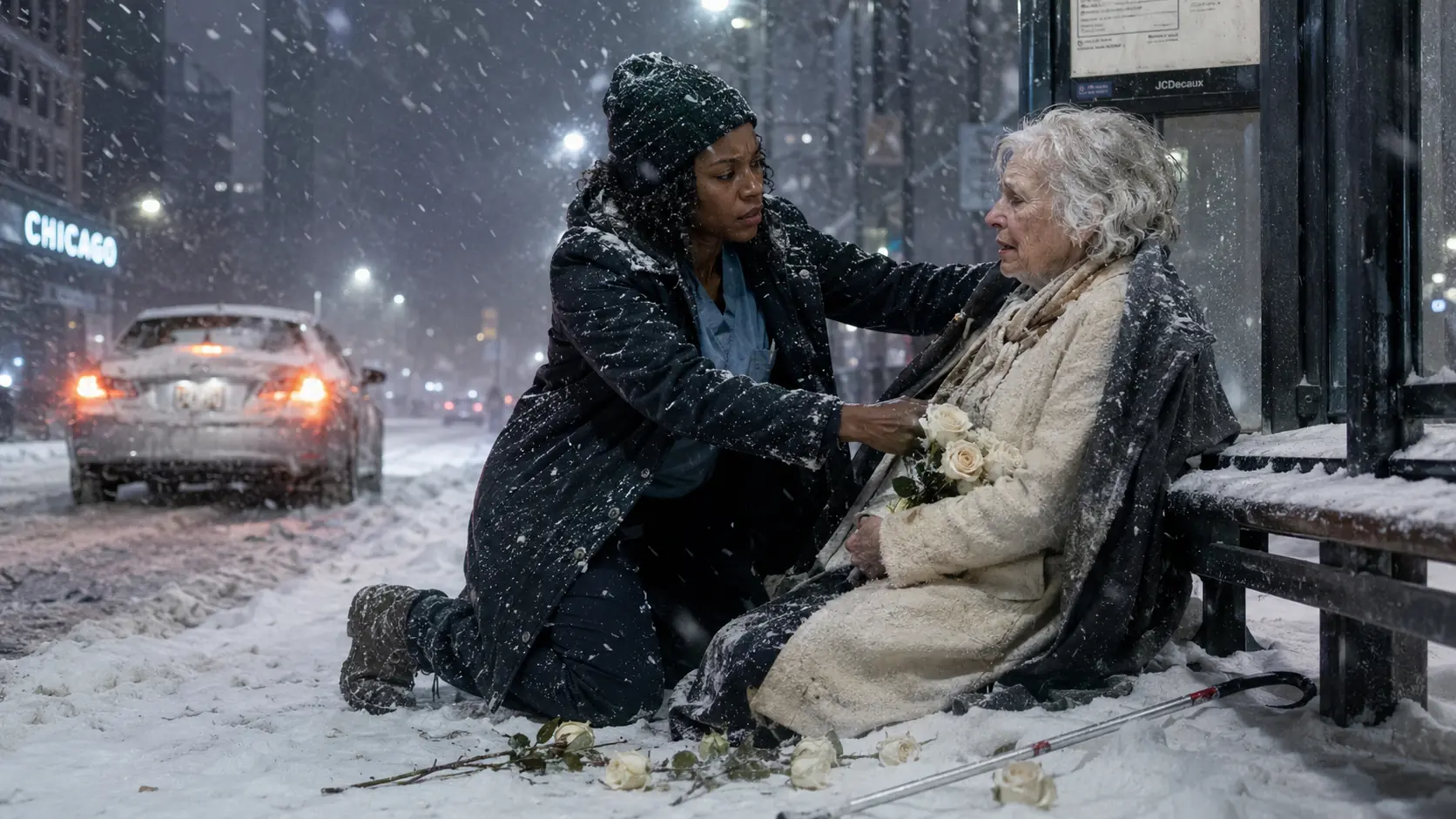
The storm was ending.
And for the Williams family, everything was about to change.
The flowers arrived first.
Two dozen white roses with a card written in Braille and English.
Thank you for being the light in the storm.
Maya pressed her nose to the petals.
“Mama, these are the fancy kind from the rich flower shop downtown. Mrs. Rodriguez showed me when we walked by.”
Kesha studied the elegant arrangement. She had never received flowers this expensive. The delivery man had treated them like they were made of gold.
That evening, the local news ran a brief segment that caught Kesha’s attention.
Prominent Chicago philanthropist Eleanor Harrison was rescued from last night’s blizzard by a good Samaritan. Harrison, who heads the city’s largest private foundation, was reportedly visiting a grave when the storm struck.
Kesha nearly dropped her coffee mug.
Eleanor Harrison.
The same woman she had helped.
She pulled out the business card Eleanor had given her.
Harrison Foundation.
Her fingers traced the elegant lettering.
What kind of foundation?
A quick search made her head spin.
The Harrison Foundation had donated over $500 million to Chicago-area causes: medical research, education programs, emergency assistance for families in crisis.
The woman Kesha had pulled from a bus stop was worth more than she could even process.
Her phone rang.
Unknown number.
“Miss Williams, this is Margaret from Eleanor Harrison’s office.”
Kesha’s heart pounded.
“Is she okay?”
“Oh, yes. She’s wonderful, thanks to you. Mrs. Harrison would like to invite you to lunch tomorrow. She has something she’d like to discuss with you.”
“What kind of something?”
“She’ll explain everything when you meet. Would Saturday at noon work? The Peninsula Hotel downtown.”
Kesha looked around her cramped apartment.
The Peninsula Hotel was where celebrities stayed, where business deals worth millions were made.
“I don’t think I belong there.”
“Mrs. Harrison specifically requested you, Miss Williams. She said it was very important.”
After hanging up, Kesha stared at Eleanor’s business card.
Why would a billionaire philanthropist want to have lunch with a nurse’s aide?
What could they possibly have to discuss?
That night, she dreamed of her mother.
Joyce was standing in a hospital hallway, smiling that knowing smile she used to get when she had a surprise.
“Baby girl,” dream-Joyce said, “sometimes the people we help are more important than we know. Sometimes kindness travels in circles we can’t see.”
Kesha woke up with those words echoing in her mind.
Across town, Eleanor sat in her study, speaking quietly into a Braille recorder.
“Day two, post contact. Kesha is everything Joyce was and more. Tomorrow I tell her the truth. Tomorrow I finally repay the debt that has defined my life.”
She paused, touching a framed photo she could not see, but had memorized through her fingertips.
Joyce Williams in her hospital scrubs, smiling.
“Tomorrow, Joyce, your daughter learns she was never alone.”
But the lunch never happened.
Saturday morning, as Kesha stood in front of her closet trying to find something appropriate for the Peninsula Hotel, Maya called from the kitchen.
“Mama, there are fancy cars outside.”
Kesha looked out the window and froze.
Three Mercedes sedans were parked in front of her building. Men in dark suits stood beside them, and Eleanor Harrison was being helped from the middle car.
But Eleanor was not alone.
A tall man in an expensive navy coat emerged from the lead vehicle. Mid-forties, confident stride, the kind of presence that commanded attention.
Even from three floors up, Kesha could tell he was someone important.
Her doorbell rang.
Heart pounding, Kesha buzzed them up.
She could hear Mrs. Rodriguez opening her door down the hall, probably wondering what kind of movie was being filmed in their building.
The knock came softly, respectfully.
Kesha opened the door to find Eleanor standing beside the most well-dressed man she had ever seen in person. His smile was warm, but his eyes were intense, studying her face like he was solving a puzzle.
“Kesha,” Eleanor said, her voice thick with emotion. “I hope you don’t mind us coming here. There’s something I need to tell you. Something I should have told you forty-eight hours ago. This is my son, Michael Harrison.”
Michael stepped forward, extending his hand.
“Miss Williams, my mother has told me everything about the other night. I wanted to thank you personally.”
His handshake was firm, genuine, but there was something else in his expression.
Recognition.
Sadness.
“Please,” Kesha managed. “Come in.”
As they settled in her small living room, Maya peeked around the corner, eyes wide at their elegant visitors.
“Maya, baby, say hello to Mrs. Harrison and Mr. Harrison.”
Maya approached shyly.
Eleanor’s face lit up as she heard the little girl’s footsteps.
“Hello, Maya. Your mama saved my life. Did you know that?”
Maya nodded solemnly.
“Mama says helping people is just what you do.”
Eleanor’s breath caught.
“Yes,” she whispered. “That’s exactly right.”
Michael leaned forward, his voice gentle.
“Maya, did your grandmother ever tell your mom stories about her work at the hospital?”
Kesha frowned.
How did this stranger know about her mother?
“Mr. Harrison, I’m not sure what—”
“Please,” Eleanor interrupted, reaching for Kesha’s hand. “Let me tell you a story.”
Twenty years ago, Eleanor explained, she had been driving home from a board meeting. It was February 15th, 1994. A truck ran a red light and nearly ended her life.
Kesha listened, confused about why Eleanor was sharing this.
“I was trapped in my car,” Eleanor said, “bleeding, terrified. The first person to reach me was a nurse finishing her shift at Mercy General. She held my hand, stayed with me through surgery, and sat by my bed all night when my family couldn’t be reached.”
Eleanor’s voice broke.
“That nurse saved my life. And when I tried to thank her, tried to give her money, she said the same thing Maya just said. The same thing you said two nights ago.”
Kesha’s world began to tilt.
“Her name was Joyce Williams.”
The words hit Kesha like a physical blow.
“That was… my mother?”
“Yes,” Eleanor whispered. “Your mother saved me. Twenty years ago, your mother changed my life forever. She taught me that kindness is the only thing that matters. Everything I’ve done since then, every dollar donated, every life changed, it all started with Joyce Williams holding my hand in the dark.”
Kesha could barely breathe.
“You knew my mother?”
Michael spoke quietly.
“Miss Williams, my mother has been looking for Joyce’s family ever since that night. She wanted to thank her properly, to honor what she had done.”
“But I found out too late,” Eleanor continued, tears streaming. “Joyce died before I could tell her how much she meant to me. Before I could tell her that her kindness created a foundation that has helped thousands of people.”
The room went silent except for Maya’s quiet breathing.
“But I could still watch over her daughter.”
Kesha stared at her.
“Every scholarship you received,” Eleanor said softly. “Every time Maya’s school fees were mysteriously reduced. Every medical bill that disappeared. That wasn’t luck, Kesha. That was me trying to take care of Joyce Williams’s daughter the way she took care of me.”
The impossible truth crashed over Kesha in waves.
“You’ve been helping us all these years?”
“For twenty years, I’ve been your guardian angel from a distance,” Eleanor said, “just like your mother was mine.”
Michael pulled out a folder.
“We have photos, Kesha. Pictures of you graduating, Maya’s first day of school, your mother’s memorial service. My mother has been watching your family with love and pride for two decades.”
“Why didn’t you tell me sooner?” Kesha asked, tears filling her eyes.
Eleanor’s smile was sad and beautiful.
“How do you walk up to someone and say, ‘Your mother saved my life, so I’ve been secretly supporting your family’? I was waiting for the right moment. For a sign.”
“And then Tuesday night happened,” Michael added. “You saved her life just like your mother did. Same storm, same kindness, same beautiful heart. It was like Joyce was speaking through you.”
Kesha looked at Maya, who was listening with wide eyes, then back at Eleanor and Michael.
“My mother… she really changed your life that much?”
“She changed everything,” Eleanor whispered. “And now, if you’ll let me, I want to change yours.”
Michael opened a leather portfolio and spread documents across Kesha’s coffee table.
“Kesha, we want to establish the Joyce Williams Memorial Foundation, a program specifically designed to train nurses from underserved communities.”
Eleanor leaned forward, her voice strong with purpose.
“Your mother believed healthcare should be accessible to everyone. She worked in communities where people couldn’t afford proper medical care. This foundation will train hundreds of nurses to serve those same communities.”
Kesha stared at the papers, not fully understanding.
“That’s beautiful. But why are you telling me?”
“Because,” Michael said with a smile, “we want you to run it.”
The words hung in the air like something from a dream.
“We’re offering you the position of executive director,” Eleanor continued. “One hundred fifty thousand dollars a year to start. Full benefits. Your own office staff.”
Kesha’s head spun.
“I’m not qualified for that. I’m just a nurse’s aide.”
“You’re Joyce Williams’s daughter,” Eleanor said firmly. “You understand the communities we want to serve because you live in them. You know the struggles these families face because you face them yourself.”
Michael pulled out another set of documents.
“But first, we want to send you back to school. Full scholarship to Northwestern’s nursing program. We’ll cover tuition, books, living expenses, everything.”
“And childcare,” Eleanor added quickly. “Maya will have the best care while you’re in classes.”
Kesha looked at Maya, who was trying to process what the fancy adults were saying.
“I can’t accept this. It’s too much.”
“Kesha.” Eleanor’s voice grew gentle but insistent. “Your mother died thinking she hadn’t done enough for your future. She worried constantly about how you and Maya would survive without her. Don’t you think she deserves to know that her daughter not only survived, but thrived?”
“But I barely know you.”
“You know everything you need to know about me,” Eleanor said. “Your mother taught me the most important lesson of my life. She showed me that one person’s kindness can change the world. Now I want to help you change the world the same way.”
The foundation would start with fifty million dollars.
It would partner with hospitals across the Midwest.
In five years, it could graduate five hundred new nurses.
In ten years, a thousand.
“But it needs the right person to lead it,” Eleanor said. “Someone who understands what Joyce understood. Healing isn’t just about medical training. It’s about caring for people’s hearts.”
Maya tugged on Kesha’s sleeve.
“Mama, does this mean we can help other people like Grandma Joyce did?”
Eleanor’s face lit up at Maya’s voice.
“Yes, sweetheart. Your mama would be helping lots of families have better lives.”
Kesha felt tears building.
“What if I fail? What if I’m not smart enough?”
“Your mother wasn’t born knowing how to save lives,” Eleanor said softly. “She learned. She grew. She became extraordinary because she cared deeply and never stopped trying to help people.”
Michael pulled out a photograph.
“This is from the hospital where you work. It’s your employee evaluation from last year.”
Kesha recognized her supervisor’s handwriting.
Kesha Williams is beloved by patients and staff alike. Her compassion and dedication are remarkable. She has natural leadership qualities and would excel in any healthcare role.
“You’re already leading, Kesha,” Michael said. “You just don’t realize it.”
Kesha looked around her small apartment.
At the stack of bills on the kitchen counter.
At Maya’s outgrown clothes.
At the photo of Joyce watching over them every day.
She thought about her mother working double shifts, coming home exhausted, but always finding energy to read bedtime stories.
Joyce had sacrificed everything so Kesha could have chances she had never had.
“What would I actually do day to day?” Kesha asked slowly.
Eleanor returned to her seat, excitement building in her voice.
“Design curriculum with medical schools. Interview scholarship candidates. Visit the hospitals where our graduates work. Travel to communities that need healthcare services.”
“You’d be changing lives,” Michael said simply. “Just like your mother did.”
Kesha closed her eyes, and for a moment, she could hear Joyce’s voice.
Baby girl, when God opens a door, you walk through it. Don’t let fear keep you from your purpose.
“If I say yes,” Kesha said slowly, “I have one condition.”
Eleanor nodded.
“Anything.”
“We don’t just train nurses. We also provide healthcare services directly to communities that can’t afford them. Mobile clinics, free screenings, medication assistance, everything my mother believed in.”
Michael grinned.
“Deal.”
“And Maya comes first. Always. If she needs me, work stops.”
“Of course,” Eleanor said. “Family is everything.”
Kesha looked at Maya, then at the photo of Joyce, then at the two people who were offering to change their lives forever.
“Okay,” she whispered. “Yes.”
Eleanor’s face crumpled with joy.
“Joyce would be so proud.”
As Maya hugged her tight, Kesha realized that her mother’s kindness had just come full circle in the most beautiful way possible.
Eighteen months later, the ripples from one snowy night had become waves of change that transformed countless lives across Chicago and beyond.
The Joyce Williams Memorial Foundation occupied an entire floor of a gleaming medical building downtown. Through the floor-to-ceiling windows, Kesha Williams, now executive director, could see Lake Michigan stretching toward the horizon.
She still could not believe this was her office.
“Miss Williams.”
Her assistant Margaret knocked on the door.
“The Channel 7 news crew is here for your interview.”
Kesha smoothed her navy blazer, professional attire Maya had helped pick out.
“Send them in.”
The transformation had been extraordinary.
In eighteen months, the foundation had graduated 127 new nurses from underserved communities, opened mobile health clinics in twelve neighborhoods, provided over two million dollars in direct medical assistance, and partnered with fifteen hospitals across Illinois.
But the numbers only told part of the story.
“Tell us about Maria Santos,” the reporter said, cameras rolling. “She’s one of your first graduates.”
Kesha smiled.
“Maria was a single mother working three jobs, just like I was. She dreamed of nursing school but never thought she could afford it. Now she’s head of pediatric care at Community General.”
Maria had sent Kesha a photo last week: herself in scrubs, surrounded by the children she cared for, beaming with pride.
“And David Carter,” Kesha continued. “Former security guard, now working in our trauma unit. He tells me every day that this program saved his family’s future.”
The foundation’s success attracted national attention.
Speaking requests poured in from across the country.
But the moment that mattered most came every evening when Kesha picked up Maya from Eleanor’s mansion.
Maya, now ten, spent her after-school hours with Eleanor, learning Braille, practicing piano, and hearing endless stories about her grandmother Joyce.
The two had formed an unbreakable bond.
“Mama!” Maya ran to the car, backpack bouncing. “Miss Eleanor taught me how to make her famous chocolate chip cookies, and she told me more stories about Grandma Joyce.”
Eleanor appeared in the doorway, guided by her cane, but moving with confidence and joy.
Since Kesha had entered her life, Eleanor seemed ten years younger.
“How was your day, dear?” Eleanor asked as Kesha hugged her goodbye.
“We just got approval for the Milwaukee expansion. Fifty more students starting this fall.”
“Joyce would be dancing,” Eleanor said, tears in her eyes. “Her daughter is changing the world.”
The foundation’s impact went beyond individual success stories.
Entire communities were being transformed.
Neighborhoods that had struggled with limited healthcare access now had clinics staffed by Joyce Williams Foundation graduates.
The model was being replicated across the Midwest.
Detroit wanted to start a Joyce Williams program.
Cleveland had already committed funding.
Milwaukee’s launch was only the beginning.
Michael Harrison expanded the foundation’s technology infrastructure, creating an app that connected patients with affordable care options. He visited Chicago monthly, proud of what his mother and Kesha had built together.
“You know what’s remarkable?” he told Kesha during a board meeting. “My mother spent forty years building Harrison Enterprises, but this foundation, your mother’s foundation, has given her more joy than all her business success combined.”
The foundation’s annual gala became Chicago’s premier healthcare fundraising event.
Last year, they raised twelve million dollars in a single evening.
Maya presented the keynote speech, talking about her grandmother’s legacy.
“Grandma Joyce believed that helping people was just what you do,” ten-year-old Maya told the ballroom full of Chicago’s elite. “She taught my mama, and my mama is teaching lots of other people. That’s how love keeps growing.”
There was not a dry eye in the room.
But perhaps the most meaningful moment came on a quiet Tuesday morning when Kesha received a handwritten letter.
Miss Williams,
My name is Jennifer Rodriguez. I’m a nurse practitioner now because of your foundation.
Yesterday, I delivered a baby in our mobile clinic, a healthy little girl. The mother couldn’t afford hospital care, but she got everything she needed from us.
I thought you should know that baby’s middle name is Joyce.
Thank you for making sure your mother’s kindness lives on.
Jennifer.
Kesha kept that letter framed on her desk beside the photo of her mother.
The circle of kindness was growing larger every day.
Three years after that life-changing blizzard, destiny arranged one final moment that proved Joyce Williams’s legacy was truly eternal.
February 15th brought another fierce winter storm to Chicago.
It was the anniversary of Joyce saving Eleanor.
The anniversary of Eleanor saving Kesha’s future.
Kesha was driving home from the foundation’s newest clinic opening when she spotted a familiar scene.
A young Latina woman stranded beside her broken-down car, a toddler crying in the back seat, snow swirling around them in the growing darkness.
Without hesitation, Kesha pulled over.
“Ma’am, are you okay?”
The woman looked up, tears freezing on her cheeks.
“My car died. My baby’s sick, and I was trying to get to the emergency room.”
Kesha’s nurse training kicked in immediately.
The toddler had a high fever, but was alert and responsive. Not critical, but definitely needing medical attention.
“I’m Kesha Williams from the Joyce Williams Foundation. Let me get you both somewhere warm.”
As they drove to the nearest clinic, one staffed by foundation graduates, the young mother shared her story.
Isabella Morales, twenty-four, working two jobs to support her son Diego.
No health insurance.
Scared and overwhelmed.
“I don’t know how I’ll pay for the doctor,” Isabella whispered.
“Don’t worry about that,” Kesha said gently. “Our clinic provides care regardless of ability to pay.”
At the clinic, Dr. Sarah Carter, one of the foundation’s first graduates, examined Diego with the same compassion Kesha had seen in her mother years ago.
“Just a viral infection,” Dr. Carter assured Isabella. “He’ll be fine with rest and fluids.”
As they prepared to leave, Kesha handed Isabella a foundation brochure.
“If you’re ever interested in healthcare training, call this number. We have programs for working mothers.”
Isabella’s eyes widened.
“You mean I could become a nurse?”
“You’re dedicated to your family, and you care about helping people. Those are exactly the qualities we look for.”
“But I never finished high school.”
“Neither did my mother when she started,” Kesha said. “We’ll help you with that, too.”
Driving Isabella and Diego home, Kesha felt her mother’s presence stronger than ever.
This was exactly what Joyce would have done.
Not just solve the immediate problem, but open doors to a better future.
“Why are you helping me?” Isabella asked. “You don’t even know me.”
Kesha smiled, hearing her mother’s words flow through her.
“My mother taught me to help people when they need it. That’s just what you do.”
Six months later, Isabella enrolled in the foundation’s high school completion program.
A year after that, she started nursing school.
At home that night, Kesha stood before her mother’s photo.
Maya, now thirteen and already volunteering at the foundation, joined her.
“Mama, do you think Grandma Joyce knows about all the people we’re helping?”
Kesha touched the glass frame gently.
“I think she’s been watching over every single one of us, baby girl. Her kindness just keeps growing and growing.”
Outside, snow fell softly on Chicago, covering the city in peaceful white.
Just like the night that started it all.
In a world that often feels cold and disconnected, Kesha and Eleanor’s story proved something beautiful.
Kindness never dies.
It multiplies across generations.
Joyce Williams saved a stranger twenty years ago.
That single act created a foundation that trained nurses, opened clinics, and gave countless families a chance at a healthier life.
But Joyce never knew the full magnitude of what her kindness would create.
She only knew what she had always believed.
When someone needs help, you stop.
You reach out.
You stay.
Because sometimes, the smallest act of compassion becomes a shelter in someone else’s storm.
And sometimes, long after you are gone, that kindness finds its way back to the people you love most.