The first thing Nora Ashworth found was not the crates. It was a patch of floor that refused to sound like the rest of the building.
She stood alone in the old milk room at Lowgarth Farm, with her boots planted on stone dust and the stale remains of seventy years of hay piled against the wall behind her. A rain shower was moving across the ridge above the valley, though sunlight still lay in strips through the narrow slits of the barn. Her right hand held a small wooden mallet. Her left held a pencil with a broken eraser. She struck one board, then the next, listening as each gave back the flat, cramped knock of timber resting close above stone.
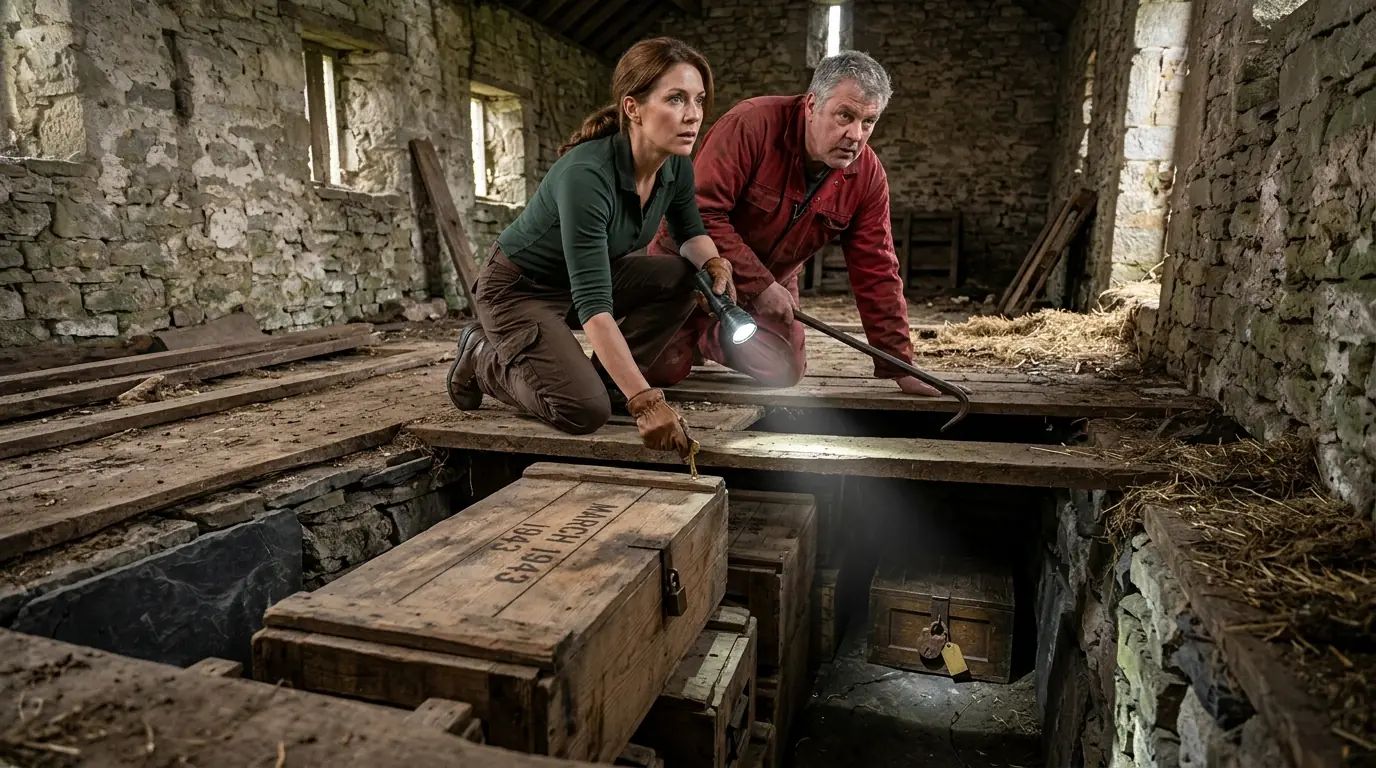
The fifth board answered with a hollow note that seemed to fall away beneath her feet.
Nora struck it again.
Something was wrong with the floor. She knew enough about old buildings to say that with confidence, but she did not yet know whether wrong meant decay, careless repair, or a cavity someone had deliberately made. Her professional habit was to decide what the evidence showed before deciding what she wanted it to mean.
She measured the patch. Twelve feet by eight, approximately. The rectangular section was held down with round wire nails that differed from the square hand-forged nails elsewhere. Dust had settled in the seams so thoroughly that the alteration was nearly invisible unless a person knew what to look for. Someone had lifted this portion long after the milk room itself was built and nailed it back in place.
Nora wrote the measurements into her notebook. Then she sat on an overturned bucket, looked toward the dark space under the boards, and thought about the man who had owned this place before her.
Great-uncle Alan had never talked about a hidden compartment. He had hardly talked about the barn at all. As a child she remembered it as a locked door with a rusty chain, a smell of old grass escaping through the cracks, and the same warning every summer when she wandered too close: mind your feet, Nora, and leave that old place alone.
Her uncle had not been a dramatic man. He raised beef cattle, repaired what mattered, and let everything else grow older on its own. The farm had been in the Ashworth family for decades, and she had inherited it after Alan died without children, leaving her a farmhouse with a leaking porch, sixty-two acres of grass and rough pasture, and this long stone building from the 1790s that had outlasted the work it was built to do.
At forty-one Nora lived in Leeds and worked as a building surveyor. She inspected ancient roofs for insurers, measured cracked walls, climbed into lofts, and told property owners unromantic truths about rotten beams. Few people would have called that a route into dairying. But old farm buildings had always interested her because they contained evidence of what people needed before modern machinery made the logic of their lives less visible. A low window was there because light mattered at a particular bench. A channel in the stone was there because water and waste had to go somewhere. Ventilation slots, pitching holes, door widths, and floor gradients were not decoration. They were decisions preserved in masonry.