Karen Whitmore believed a locked door would make the Carter children obey her. She pushed them into the garden shed, snapped a padlock through the latch, and stood outside while they called for their father. When Marcus Carter came through the side gate, she still expected to control the conversation—but then she followed his glance toward the house.
The brass padlock clicked shut while Maya was still reaching for her brother.
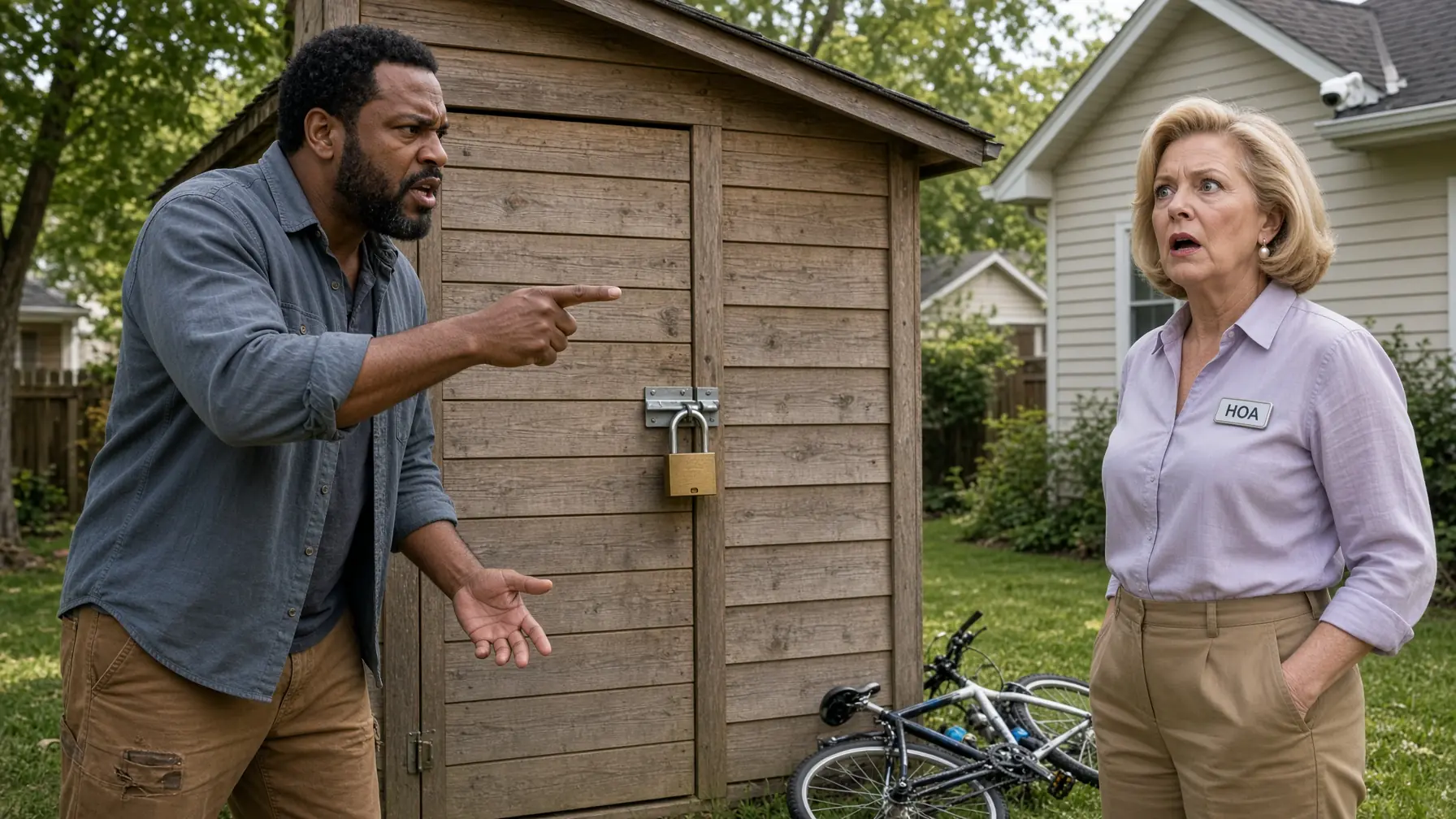
Ethan turned in time to see the last narrow strip of daylight disappear. The wooden door struck the frame, making a rake tremble against the wall, and his sister caught the back of his green T-shirt with both hands.
For a second, neither child spoke.
They could hear Karen outside.
A scrape of shoes.
The small metallic sound of the key being pulled free.
Then silence.
Ethan lunged toward the door.
“Open it!”
The wood moved against the latch but did not open.
Maya pressed against his shoulder, breathing too quickly. She was nine, small enough that the shelves seemed taller inside the shed than they had from the doorway, and the narrow window above them offered light without showing much of the outside world.
“We want our dad!”
Ethan struck the door with the heel of his hand.
Karen stepped back on the grass.
At fifty-five, she had learned to make stillness look official. Her pale lavender blouse was neat, the cuffs folded evenly, and the small HOA badge rested high enough on her chest that people usually saw it before they looked at her face.
“Then learn to follow the rules.”
Inside, Ethan stared at the door.
He was eleven.
He knew there were adults who could tell him not to ride too fast, not to leave his bicycle across a path, and not to throw a ball near someone’s window.
He did not understand how any of those things had become this.
Maya pulled harder on his shirt.
“Ethan.”
He turned.
Her braids had slipped forward over her shoulders, and one white sneaker was planted awkwardly against a bag near the wall. She had stumbled when Karen pushed her through the doorway, catching herself only because Ethan reached back.
He took her hand.
“Dad’s coming.”
He wanted the words to be true.
He did not know whether their father had heard them.
Outside, their bicycles lay on the grass.
The afternoon remained clear. Birds moved along the roofs, a sprinkler ticked in another yard, and somewhere nearby someone was laughing over lunch.
The ordinary sounds made the locked door harder to understand.
Karen folded her arms.
She expected crying.
She expected promises.
She expected two frightened children to come out quieter than they had gone in.
She did not expect the side gate to open.
That morning, Marcus Carter had repaired Maya’s bicycle chain before breakfast.
She stood beside him in the driveway, wearing the yellow T-shirt she had chosen the night before, while Ethan watched from the steps and offered instructions nobody had requested.
“Turn it the other way,” Ethan said.
Marcus looked up.
“You want the tools?”
Ethan grinned.
“No.”
“Then let the man with the tools finish.”
Maya leaned closer.
“Is it broken?”
“No. It slipped.”
“Will it slip again?”
“Maybe someday. Not because you did anything wrong.”
She nodded seriously.
That distinction mattered to Maya.
She had begun asking whether small mistakes were her fault even when nobody had said they were. Marcus noticed it most when something spilled, a zipper caught, or one of her school papers came home folded instead of flat.
He did not know exactly when the habit began.
He knew he wanted to stop it growing.
At around forty, Marcus had broad shoulders, short curls, and a trimmed beard that was beginning to show a few pale hairs near his chin. He worked with his hands often enough that the children associated his muted blue work shirts with things being repaired.
A drawer.
A gate.
A bicycle.
If Dad put on the blue shirt, something probably needed fixing.
That Saturday, he had several jobs planned around the house.
Nothing urgent.
Nothing he wanted the children to spend the whole afternoon waiting through.
He checked the chain, wiped his fingers, and gave the pedal a turn.
“There.”
Maya climbed onto the bicycle.
Ethan moved beside her.
“Race you to the corner.”
Marcus lifted a hand.
“Not yet.”
Both children stopped.
He pointed toward the path leading around the houses.
“Where are you going?”
“The green,” Ethan said.
“What time do you come back?”
“Before lunch.”
“And the bikes?”
Maya answered quickly.
“Off the walking path.”
Marcus nodded.
“Good.”
Ethan rolled his eyes slightly.
His father noticed.
“You can remember a rule without liking being reminded.”
“I know.”
“Then prove it.”
Ethan smiled.
They rode away together, Maya following her brother at a distance that let her watch his turns without trying to match every one.
Marcus stayed near the driveway until both were safely on the shared path.
Then he went inside.
He had no reason to think an ordinary morning could become a question of whether someone else considered his children safe to touch.
Willow Creek had looked different to the Carters when they first moved in.
The houses surrounded a shared green space, with walking paths, flower beds, a few benches, and the small wooden shed used to store garden equipment. From the kitchen window, Marcus could see enough of the grass to know when the children were playing nearby.
That had been part of the appeal.
They had lived somewhere before where every bicycle ride required a parent beside them and every patch of grass belonged to somebody who did not want it used.
Willow Creek seemed to offer room.
Not endless room.
Enough.
On the first evening, Maya stood by the back window and asked whether the grass belonged to them.
“Some of it,” Marcus said.
“How much?”
“It’s shared.”
“With who?”
“The neighbors.”
She considered that.
“Then they can play too?”