Megan Morrison stood at the empty bus stop on Willow Street at 11:47 on New Year’s Eve, watching the taillights of the last bus disappear around the corner three blocks away.
For several seconds, she did not move.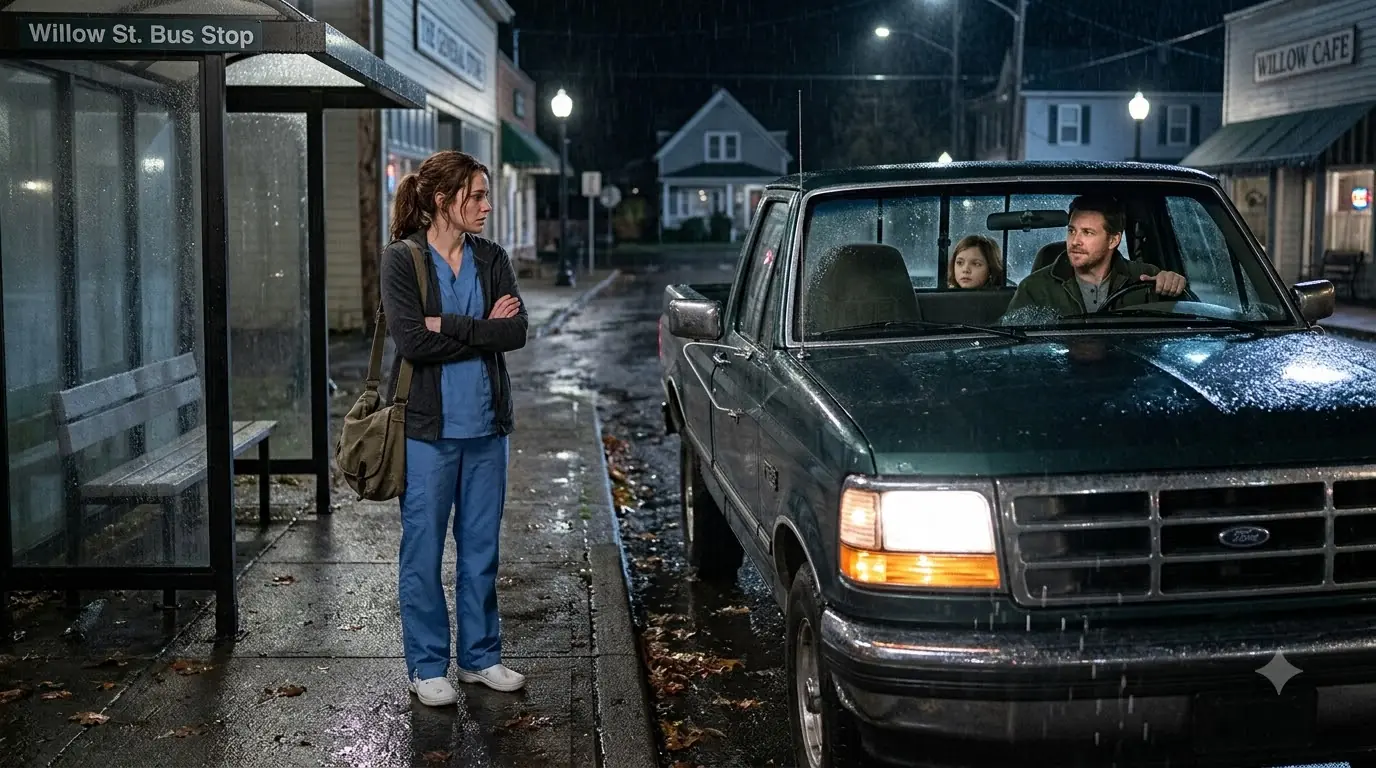
She simply stood there in the freezing Oregon rain with her hospital bag sliding off one shoulder, her wet scrubs clinging to her legs, and her breath coming out in small white clouds. The bus was gone. The red lights blurred through the downpour and then vanished behind a row of dark storefronts already closed for the holiday.
Megan wanted to scream.
She had missed it by maybe ten minutes.
Ten minutes should not have been enough to ruin a person’s night. Ten minutes should not have been enough to leave a woman stranded in twenty-eight-degree weather, wearing only thin navy scrubs, cheap sneakers, and a jacket that did absolutely nothing against the wind.
But sometimes ten minutes was all life needed.
She had just finished a brutal sixteen-hour shift at Will Valley Hospital. A coworker had called in sick that morning, and the oncology floor was already short-staffed because half the town seemed to have plans for New Year’s Eve. Megan had stayed because patients did not stop needing care just because the calendar changed.
By ten that night, her feet felt like they had been filled with broken glass. Her lower back burned every time she bent down. Her shoulders ached from helping move patients, adjusting beds, carrying supplies, and standing beside families who needed answers no nurse could honestly give them.
Then Mr. Chen had started fading.
He was eighty-one years old, quiet, thin, and polite in the way some elderly people remained polite even while dying. He had no wife, no children, no siblings who could be located, and no friends who answered the phone numbers listed in his chart. For three days, he had asked whether someone might come.
No one did.
At 10:30, Megan’s replacement told her she could go.
Megan looked toward Mr. Chen’s room.
He was breathing shallowly by then, his eyes half-open, his hand resting on top of the blanket as if waiting for someone to hold it.
“I’ll stay a little longer,” she said.
The other nurse did not argue. She only nodded with the weary understanding of someone who knew exactly why Megan could not walk away.
Because nobody should have to die alone.
Especially not on New Year’s Eve, when the rest of the world was putting on glitter, counting down seconds, pouring champagne, and pretending the year ahead would be kinder than the one behind it.
Mr. Chen passed away at 11:15.
Megan was sitting beside him when it happened. She held his hand while fireworks from early celebrations echoed somewhere beyond the hospital windows. His fingers tightened once around hers, not strongly, but enough for her to feel that he knew someone was there.
“You’re not alone,” she whispered.
His breathing stopped a few minutes later.
Megan stayed until the funeral home came. She signed what needed signing, spoke quietly with the night supervisor, washed her hands twice, gathered her bag, and ran for the bus.
She ran through cold rain, across the hospital parking lot, down two blocks, past a dark coffee shop with paper snowflakes taped to the glass. Her lungs burned. Her shoes splashed through puddles. Her phone buzzed in her pocket with a low-battery warning.
When she reached Willow Street, the bus was already leaving.
Now she stood beneath the small shelter with water dripping from the metal roof, trying not to fall apart.
Her phone was at three percent battery because she had forgotten to charge it during her double shift. She opened the Uber app with trembling fingers, praying for a miracle.
The ride estimate appeared.
Eighty-seven dollars.
Megan stared at the number.
It might as well have been a million.
She had exactly thirty-two dollars in her checking account until payday on Friday. Thirty-two dollars needed to cover groceries, laundry, and whatever emergency decided to arrive before then. There was no cushion. There was never a cushion.
She closed the app.
Her phone dropped to two percent.
Here was the thing about moving to a small town six months earlier to escape a bad breakup and start over completely alone. People romanticized it. They talked about fresh starts like they were clean white pages, like a person could simply pack a few boxes, move somewhere quieter, and become new.
They did not talk about what happened when the fresh start stayed empty.
They did not talk about eating dinner alone every night at a small table near a window overlooking a parking lot. They did not talk about coworkers who were friendly at work but already had families, partners, church groups, old friends, and full lives. They did not talk about how humiliating it felt to realize that after six months in a new town, there was not a single person you could call at midnight and say, “Please come get me. I am scared.”
No friends.
No family within five hundred miles.
No boyfriend anymore.
No one who would wonder why she had not made it home.
Megan sat down on the frozen bench.
The cold immediately soaked through her scrubs.
She lowered her face into her hands.
And finally, because there was no one there to see her, she cried.
She cried from exhaustion.
From cold.
From missing the bus.
From Mr. Chen’s hand going still inside hers.
From the crushing loneliness of realizing she could comfort a dying stranger but had no one to call when she was the one stranded in the rain.
Five miles away, Nathan Sullivan was driving home from his sister Jess’s New Year’s Eve party with his seven-year-old daughter, Ellie, half asleep in the back seat.
He had been relieved to leave.
That was not fair to Jess, who had tried so hard. She had decorated the house with silver streamers, made too much food, invited families with kids so Ellie would have someone to play with, and kept checking Nathan’s face all night with the worried softness of an older sister who loved him enough to annoy him.
But Nathan hated New Year’s Eve.
He hated the countdowns.
The noise.
The bright declarations that everything would be different after midnight, as if a calendar had ever possessed the power to heal anything important.
His wife, Clare, had died on January 2nd three years earlier after an eight-month battle with ovarian cancer. Every New Year’s Eve since then felt less like celebration and more like standing at the edge of a cliff he had already fallen from once. It was the last holiday they had shared before everything ended. The last time Clare had laughed at midnight. The last time Ellie had sat on her mother’s lap wearing sparkly pajamas, clapping at fireworks through the living room window.
After that, came the tests.
The appointments.
The language doctors used when hope began shrinking.
By spring, Clare could not walk far without help. By summer, her hair was gone. By fall, Nathan had learned to sleep sitting upright in hospital chairs. By winter, he had learned that love could be enormous and still powerless.
Since then, New Year’s Eve had felt like an insult.
He had gone to Jess’s party only because Ellie needed it. She needed to be around cousins, games, noise, and other children who did not understand grief well enough to step carefully around it. She needed to see her father pretend, at least for a few hours, that he knew how to live.
But when the clock hit 11:30, Nathan had kissed Jess on the cheek, thanked her, gathered Ellie’s coat and shoes, and made his excuses.
“Leaving before midnight?” Jess asked quietly near the front door.
“Ellie’s tired.”
Jess looked past him.
Ellie was very much not tired. She was sitting on the stairs with her cousin, arguing about who had won Uno.
Jess folded her arms.
“Nathan.”
He sighed.
“I can’t do midnight here.”
His sister’s expression softened.
“I know.”
That was worse than if she had argued.
Now Ellie was bundled in the back seat under a fuzzy purple blanket, her hair messy from party games, her face turned toward the window. She was trying to stay awake and failing.
Nathan drove through the rain with both hands on the wheel.
The town looked emptied out by weather and holiday. Storefronts were dark. Puddles reflected traffic lights. Somewhere far off, early fireworks flashed behind clouds, muted by rain.
As he turned onto Willow Street, his headlights swept across the bus stop.
A woman sat on the bench in scrubs with her face in her hands.
Clearly crying.
Nathan’s foot eased slightly off the gas.
Then pressed down again.
His first instinct was to keep driving.
It was not his problem.
He had a child in the back seat. He had learned long ago that danger did not announce itself honestly. Stopping for strangers in the middle of a freezing night was not responsible. He could not afford to make a mistake with Ellie in the car.
He drove past.
Two blocks later, Ellie’s sleepy voice came from the back seat.
“Daddy?”
“Yeah, bug?”
“Why didn’t we help that sad lady?”
Nathan tightened his grip on the wheel.
“She’s probably waiting for someone, honey. I’m sure she’s fine.”
Even as he said it, he knew it was a lie.
Nobody was fine sitting alone at a bus stop crying on New Year’s Eve in freezing rain.
Ellie sat up straighter.
“But she was really crying. Like a lot.”
Nathan looked at her in the rearview mirror.
“She might not want help from strangers.”
“But Mommy always said we should help people who are sad, especially if they’re alone. Remember Mommy said that?”
The words hit him like a physical blow.
Because yes.
Clare had said that.
Clare had been the kind of woman who stopped. For lost dogs. For elderly neighbors with groceries. For cashiers being yelled at by impatient customers. For people crying in parking lots. She had believed sadness was a signal flare and that decent people did not ignore flares just because they were inconvenient.
Nathan had spent three years trying to live up to her memory.
And here he was, driving away.
He exhaled sharply, checked the empty road, and made a U-turn.
Ellie leaned forward with sudden alertness.
“We’re going back?”
“We’re going back.”
“Mommy would be happy.”
Nathan did not answer.
His throat had tightened too much.
When he pulled up beside the bus stop, the woman immediately lifted her head. Her face changed from grief to fear so quickly that Nathan’s heart twisted. She stood and took a step back from the curb, one hand gripping the strap of her hospital bag.
Nathan put the truck in park and rolled down his window.
He kept both hands visible on the steering wheel.
“Hey,” he said, speaking gently. “I know this is really weird, and you have zero reason to trust me, but my daughter saw you. We were wondering if you need a ride somewhere. It’s freezing out here, and it’s New Year’s Eve.”
The woman stared at him.
She was younger than he had first thought, maybe early thirties, though exhaustion made her look older around the eyes. Her brown hair was tied back in a messy bun, and rain had flattened loose strands against her cheeks. Her lips were pale from cold.
“I’m okay,” she said automatically.
Nathan almost smiled.
She was very obviously not okay.
“I’m Nathan Sullivan,” he said. “I own Sullivan Construction here in town. You can Google me if your phone works. I have my seven-year-old daughter in the back seat. I promise I’m not a creep. I’m just a dad who got guilted into stopping.”
Ellie popped up behind him and waved through the window.
“Hi. I’m Ellie. You look really cold. We have heat in our car.”
Despite everything, the woman gave a small, surprised laugh. It was barely a sound, but it softened her face.
“I’m Megan,” she said. “Megan Morrison. I’m a nurse at the hospital.”
Nathan nodded toward her scrubs.
“I figured hospital or very committed pajamas.”
Her laugh became real for half a second.
Then it faded.
“I just got off a double shift. I missed the last bus. My phone’s almost dead, and I can’t afford an Uber.”
She looked embarrassed saying the last part.
Nathan hated that.
“Where do you need to go?”
“Riverside Apartments on Fourth Street. If that’s not too far out of your way.”
“It’s not.”
“It probably is.”
“It’s New Year’s Eve,” he said. “Everything’s out of the way tonight. Come on.”
Megan hesitated, doing the calculation he knew she had every right to do.
Good Samaritan or threat.
Safe car or mistake.
Help or danger.
Nathan unlocked the doors but did not get out.
“You can sit in the back with Ellie,” he said. “Whatever makes you feel safer.”
Megan looked at him for a long moment.
Then she opened the back door and climbed in beside Ellie.
The warmth hit her so quickly she almost cried again.
Ellie immediately scooted over.
“You can use some of my blanket.”
“Oh, honey, I don’t want to take your blanket.”
“I’m already warm,” Ellie said. “You’re shaking.”
Megan accepted the edge of the blanket.
“Thank you.”
Nathan pulled away from the curb slowly.
For a moment, the truck was quiet except for the heater and the rain against the windshield.
Then Ellie said, “Were you crying because someone died? You’re wearing hospital clothes, so maybe someone died, and that’s really sad.”
“Ellie,” Nathan said quickly. “Sweetheart, we don’t ask people things like that.”
“It’s okay,” Megan said.
She looked out the window for a moment.
“Actually, yes. A patient passed away tonight. He didn’t have any family, so I stayed with him so he wouldn’t be alone.”
Ellie’s face became very serious.
“My mom died three years ago. It’s really sad when people die.”
Nathan’s jaw tightened, not from anger, but from the familiar ache of hearing Ellie state the truth with a child’s plainness.
“I’m sorry your patient died,” Ellie continued. “You’re really nice for staying with him.”
Megan’s eyes filled again.
“Thank you, Ellie.”
The road ahead shone black beneath the headlights.
Nathan drove carefully, listening as Megan and Ellie spoke in soft fragments. Ellie told Megan she had been at her Aunt Jess’s party, that she hated party hats because the elastic hurt her chin, and that her dad made pancakes shaped like circles because he was “not artistically talented.”
Megan smiled in the dark.
“That sounds like a serious limitation.”
“It is,” Ellie said. “Mommy used to make bunny pancakes.”
Nathan looked straight ahead.
Megan caught the change in his face in the rearview mirror.
Gently, she asked, “Was your wife’s name Clare?”
Nathan’s hands shifted on the wheel.
“Yeah.”
“You don’t have to talk about it.”
“No. It’s okay.”
He gave the short version.
Married young.
Ellie born two years later.
Ovarian cancer.
Eight months from diagnosis to goodbye.
Just him and Ellie now, trying to figure out what life was supposed to look like after the person who had held it together was gone.
Megan listened without filling the silence with empty comfort.
Nathan noticed that.
People often rushed to say things when he mentioned Clare. They said she was in a better place, or everything happened for a reason, or at least he had Ellie. They meant well. He knew they meant well. But grief did not become lighter just because someone handed it a cliché.
Megan only said, “I’m sorry she had to go through that.”
That was different.
She was sorry for Clare, not just for Nathan.
He appreciated it more than he could say.
They reached Riverside Apartments at 12:03.
The new year had begun three minutes earlier.
Fireworks cracked somewhere in the distance, muffled by rain.
Megan leaned forward.
“Thank you so much. I really don’t know what I would have done if—”
She stopped.
The apartment building was surrounded by fire trucks, emergency vehicles, and yellow caution tape. Red lights flashed across the wet pavement. Water poured from second-floor windows in steady streams, spilling over the siding and splashing onto the frozen ground below.
Megan’s face went completely white.
“No,” she whispered.
She was out of the truck before Nathan could stop her.
He followed, with Ellie close behind holding her blanket around her shoulders.
A miserable-looking building manager stood near the front walkway with a clipboard protected under his jacket.
Megan ran toward him.
“I live here. Apartment 2B. What happened?”
The manager looked at her with exhausted sympathy.
“A pipe burst around eight o’clock. Flooded multiple units. Second floor got hit worst.”
“I was at work. My phone died. I didn’t know.”
“We tried calling everyone. Posted notices too. I’m sorry.”
Megan stared at the water pouring from the windows.
“Can I get my things?”
“Not tonight. Fire department won’t let anyone back in until the inspection. Building’s condemned until repairs are done.”
“Condemned?”
“Temporarily,” he said quickly. “But repairs could take two to four weeks minimum.”
Megan looked at him as if the words were arriving from very far away.
“What am I supposed to do tonight?”
The manager shifted.
“Hotel maybe? Family?”
Like those were simple answers.
Like everyone had a hotel fund and a mother waiting with clean sheets.
Megan gave a small laugh that sounded nothing like humor.
“Right.”
She walked away from him, crossed the wet sidewalk, and sat down on the curb.
Rain collected in her hair.
Fireworks exploded somewhere behind the clouds.