Crystal Vaughn snatched the brochure right out of Gloria Washington's hands. Not asked for it, not requested it.
Snatched it the way you take something from a child who wandered into the wrong room. She held it against her chest, looked down at the elderly woman standing in front of her, and smiled the kind of smile that wasn't a smile at all.
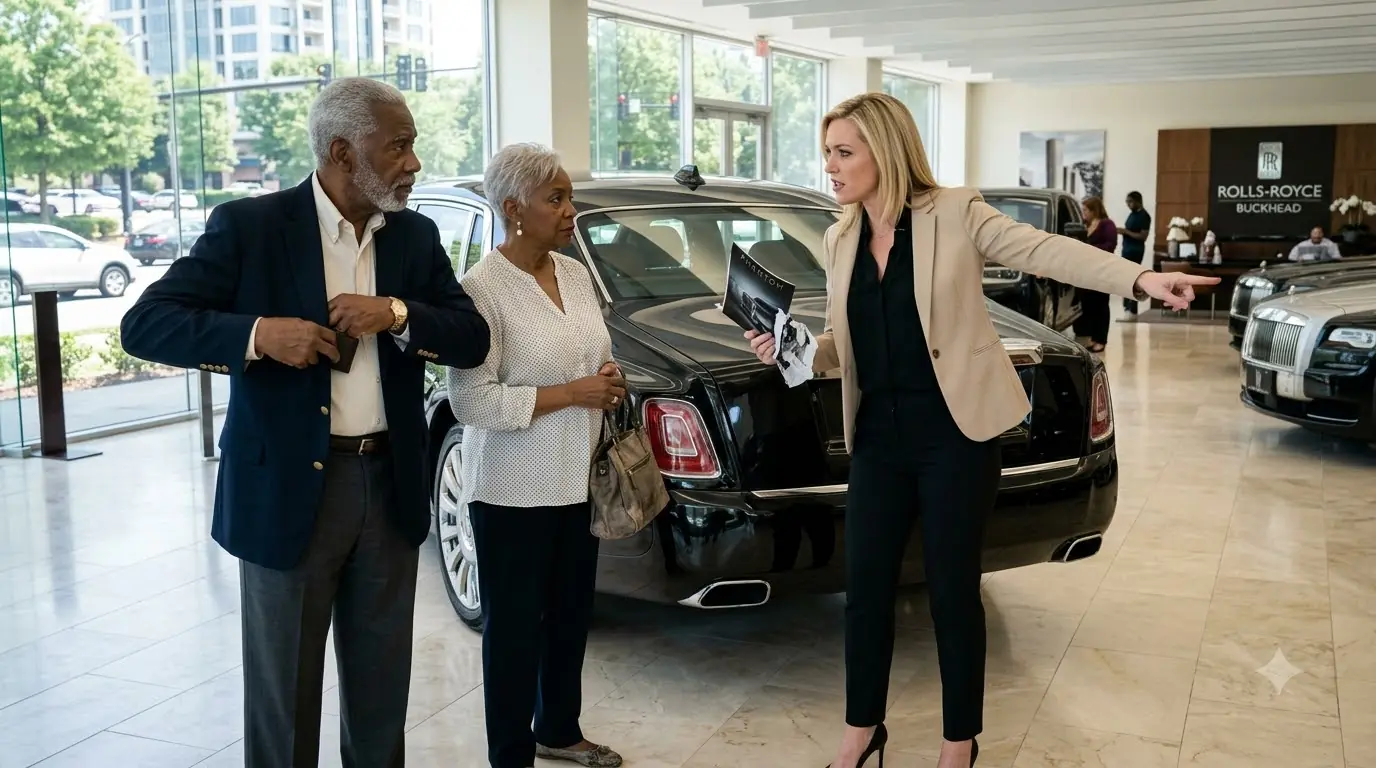
"Honey, let me save you and your husband some embarrassment. People like you don't belong in a Rolls-Royce."
Gloria said nothing. Crystal turned to Edward, looked him up and down once slowly from the old watch to the simple jacket, and tilted her head.
"Sir, I don't know who told you this was a good idea, but a man walking in here in thrift-store clothes asking about a Phantom is not something I have time for today." Still, Edward said nothing.
Crystal laughed a short sharp sound, more dismissal than amusement, and turned to the colleague behind her.
"Can you believe this? They probably thought this was a Kia dealership."
The showroom went quiet. Every customer within earshot stopped moving, and Edward Washington reached slowly into the inside pocket of his jacket.
What he placed on the hood of that $547,000 Phantom didn't just silence Crystal Vaughn. It ended her.
Edward Augustus Washington woke up every morning at 5:30. No alarm, never needed one.
52 years of discipline had rewired his body into something that didn't require reminders. His eyes opened in the dark, and he lay still for exactly 3 minutes, not because a doctor told him to, not because of some wellness routine he'd read about in a magazine.
He did it because his father had done it.
Because Elijah Washington, Pullman Porter for 31 years, had told his son once, "Before the world gets to you, you get to yourself first."
Edward had never forgotten that. The house in Cascade Heights sat quiet at that hour.
A five-bedroom colonial on a wide treeline street in one of Atlanta's oldest middle-class neighborhoods. Edward had bought it in 1989 for $187,000 when the area was still considered a reach for a man his age.
Now the same street held the homes of doctors, federal judges, a retired NFL quarterback. The neighborhood had grown into its own dignity slowly without asking anyone's permission.
He made his coffee the same way every morning. Drip pot, medium roast, two sugars, a splash of cream.
Gloria always teased him about the sugar. "A man worth that much and you still drink gas-station coffee."
He always smiled at that. The truth was he'd been making it the same way since 1974 when he was a 24-year-old man with $12,000 in a checking account, a secondhand desk, and an idea that most people told him was too ambitious for someone like him.
Washington Capital Group had started in a two-room office on Auburn Avenue, three blocks from the birthplace of Martin Luther King Jr. Edward chose that address deliberately.
There was something right about building something real within walking distance of where a man had once told the world that dignity was not negotiable.
30 years later, Washington Capital Group managed a portfolio worth north of $2.1 billion: private equity, commercial real estate, logistics, infrastructure, hospitality, quiet investments in companies most people had never heard of. Edward didn't seek visibility.
He sought leverage, the kind that compounded quietly, the kind that didn't need a press release to be real.
18 months ago, Washington Capital Group had acquired a 58% controlling stake in Prestige Automotive Holdings, a Southeast regional conglomerate, operating six luxury dealership franchises across Atlanta, Charlotte, and Nashville. The flagship location sat on Peachtree Road in Buckhead.
Rolls-Royce, Bentley, Aston Martin. Marble floors, 22-foot ceilings, the kind of place that offered you sparkling water before they showed you a car.
Edward had never visited after the acquisition. His team handled operations.
He reviewed quarterly reports. He trusted his people.
But today was different. Today had nothing to do with business.
Gloria Diane Washington, née Patterson, born in Decatur, Georgia, in 1953, had been Edward's wife for exactly 50 years as of this morning.
They had married on a Saturday in June 1974 in a small Baptist church that no longer existed in front of 47 people, most of whom were also no longer alive. Gloria wore a dress her mother sewed by hand.
Edward wore a borrowed suit slightly too short in the sleeves. The photograph from that day sat on Edward's desk at Washington Capital Group headquarters, framed in simple wood, the first thing he saw every morning.
Gloria had spent 31 years as an educator, classroom teacher first, then assistant principal, then principal of Frederick Douglass High School in Southwest Atlanta for 14 years.
She retired in 2018 to a standing ovation from 600 students in a gymnasium that smelled like floor wax and old wood. She cried exactly once when the students in the front row held up a banner they had made by hand.
Not at the speeches, not at the plaque, at the banner because she understood the value of things made by hand. She was 71 years old and she carried herself like someone who had spent a lifetime teaching other people what backbone looked like.
Edward had made her a promise in 1974. Standing outside that church in the borrowed suit, watching her laugh at something her cousin said, he leaned close and whispered it like a secret.
"One day I'm going to put you in the finest car ever made." Gloria laughed.
She always laughed first. "Boy, we don't even have a car."
He smiled. "Not yet."
50 years. He had kept every other promise first.
The house, the education for their two sons, the vacations always taken late after the work was done never before. The big promises first, and this one, the small extravagant one, the one that was really just about joy, had waited until it could be done right.
This morning, Edward placed a single envelope on Gloria's breakfast plate. Inside, a card in his handwriting.
Four words: Today, whatever you want.
Gloria read it twice, looked up at him across the table, did not cry, simply nodded once the way she nodded when something was exactly right, and said, "Give me 20 minutes."
They left the house at 10:40 a.m. Edward in a dark navy jacket, simple slacks, his father's watch on his wrist, a Bulova from 1962, gold-toned, scratched on the back from decades of wear.
Gloria in a cream blouse and charcoal trousers, small pearl earrings, a handbag she'd owned for 12 years. They looked like what they were, two people who had built something real and had nothing left to prove.
They pulled into Prestige Motor Group Buckhead at 11:04 a.m. The showroom doors opened automatically. Cool air, the faint smell of leather and fresh flowers.
Seven Rolls-Royce models positioned under gallery lighting like sculptures in a museum. And across the marble floor, a woman named Crystal Vaughn looked up from her desk, scanned them in 3 seconds, and made a decision she would spend the rest of her life trying to undo.
Prestige Motor Group Buckhead was not a car dealership in the ordinary sense of the word. It was a statement.
The building alone had cost $40 million to construct a modernist glass and steel structure set back from Peachtree Road behind a curved limestone driveway lined with Italian boxwood hedges trimmed to geometric precision.
The facade was floor-to-ceiling glass so that passersby could see the cars from the street, not as an invitation, as a reminder of the distance between what most people could look at and what a very few could touch.
Inside the showroom floor was Calacatta marble imported from a quarry outside Bologna. The ceiling rose 22 feet, hung with custom pendant lighting that cast each vehicle in its own warm pool of gold.
Seven Rolls-Royce models sat on the floor like exhibits in a private museum, the Ghost, the Cullinan, the Wraith, the Dawn, and anchoring the center of the room on a raised circular platform, the Phantom extended wheelbase.
Obsidian exterior, Starlight headliner, bespoke interior, hand-stitched in cream and charcoal leather. Base price $520,000.
The specific configuration on display, $547,000. There was a private client suite in the back, a room most customers never saw.
Herringbone oak floors, a wet bar, a 65-inch display for reviewing bespoke customization options, and a standing offer of Krug Champagne for buyers crossing the $400,000 threshold.
The suite existed for one reason, to make the act of spending half a million dollars feel like a quiet, dignified pleasure rather than a transaction. Crystal Vaughn had worked at this dealership for 7 years.
She was 41, sharp-featured with the kind of professional polish that came from years of studying which customers were worth her time and which were not. Her hair was always perfect, her blazer always pressed.
She moved through the showroom with the confidence of someone who believed she owned the room because in practical terms she did. Two years running she had been the top commission earner at this location.
In 2023 her total compensation had exceeded $310,000. She drove a leased BMW 5 Series and lived in a Midtown high-rise.
She had opinions about everything and doubts about nothing. Crystal had a system.
She called it reading the room. Though what she was actually reading was people specifically whether they looked like money or whether they looked like they were about to waste her Saturday morning.
She made that assessment in the first 10 seconds. Shoes, watch, posture, skin.
Not consciously, she would have told you. Just instinct.
She had filed a complaint once internally about a colleague who she claimed was too aggressive in approaching walk-in customers without profiling them first. The complaint went nowhere, but the culture it reflected did not.
In 7 years at Prestige Motor Group Buckhead, Crystal had sold 43 Rolls-Royce vehicles. Not one to a buyer.
Not one. That was not an accident.
It was a pattern invisible to anyone who wasn't looking obvious to anyone who was. General manager Derek Hollis knew about Crystal's habits the way you know about a crack in a wall you've been meaning to fix for years.
He was 48, pragmatic, not a cruel man, but a careful one. Crystal produced results.
Results protected his bonus. His bonus protected his mortgage.
That was the mathematics of his silence. He had received two written complaints about Crystal in the past 3 years, both from customers of color who felt they had been dismissed or profiled.
Both times, Derek had offered a personal apology, a complimentary service package, and a careful non-answer that resolved nothing. Both customers did not return.
Derek told himself these were isolated incidents. He had never counted them.
Counting would have made them a pattern, and patterns required action. Darnell Brooks had been at the dealership for three months, 24 years old, from College Park, Atlanta.
He had earned a business degree from Georgia State in May and was hired as a sales intern in June. He was the only employee on the sales floor.
He had figured that out on his first day, and had not mentioned it to anyone since. He learned quickly the product knowledge, the customer approach protocols, the CRM system.
He was good at it. He had a natural warmth that customers responded to a way of listening that made people feel like the most important person in the room.
He had also learned other things quickly, that certain customers who walked in were immediately steered toward Crystal's lower priority list. that when Darnell greeted a walk-in before Crystal could assess them, Crystal would materialize beside him within 90 seconds, hand extended, taking over.
That the culture of the floor had a grammar to it that nobody wrote down, but everybody spoke. He was still deciding what to do with that knowledge.
At 11:04 a.m. on a Saturday in June, Darnell was at the coffee station near the back of the showroom reviewing spec sheets on a tablet when the front doors opened. He looked up.
An elderly couple walked in. The man in a navy jacket, simple slacks, and old watch.
The woman wore a cream blouse and pearls, with a posture that said she had walked into difficult rooms before and left them standing. They moved slowly, not because they were uncertain, but because they were taking their time.
The way people move when they have earned the right to. Darnell straightened.
He set the tablet down. Across the floor, Crystal looked up from her desk.
She took 3 seconds. Shoes, watch, jacket.
She reached for her phone, typed a quick message to her colleague, Mike at the next desk, and stood. Darnell saw the message flash on Mike's screen as he walked past.
Keep an eye on the two that just walked in. He kept walking.
His jaw was tight. His hands were loose at his sides, and Edward and Gloria Washington stepped deeper into the showroom, toward the Phantom on the raised platform toward the moment everything was about to begin.
Gloria reached the Phantom first. She stood at the edge of the raised platform and looked at it the way you look at something you have been told your entire life was not meant for you.
Not with longing, with assessment. She tilted her head slightly, studied the line of the hood, the way the light moved across the obsidian paint like something living.
She reached out and rested two fingers lightly on the door panel. Edward stood beside her.
He said nothing. He was watching her face.
That was when Crystal arrived. She came from across the floor at a pace that was just fast enough to be purposeful, but slow enough to look casual.
She stopped three feet from Gloria, looked at her hand on the door panel, and did not smile. Can I help you find something?
The tone was not a question. It was a boundary.
Gloria looked at her calmly. "We're looking at the Phantom."
Crystal glanced at the car, then back at Gloria with the practiced patience of someone who had decided this conversation had a predetermined ending. These models are starting at $460,000.
The one you're touching is closer to $550,000 fully configured. She paused one beat too long.