Thomas Reed still had the polishing cloth in his hand when the excavator bucket moved over his car.
He stared at it, unable at first to connect the machine with the quiet morning he had been having. The burgundy Mustang stood in his driveway with its chrome trim catching the light. A few minutes earlier, he had been leaning over the intact hood, working a faint streak out of the finish.
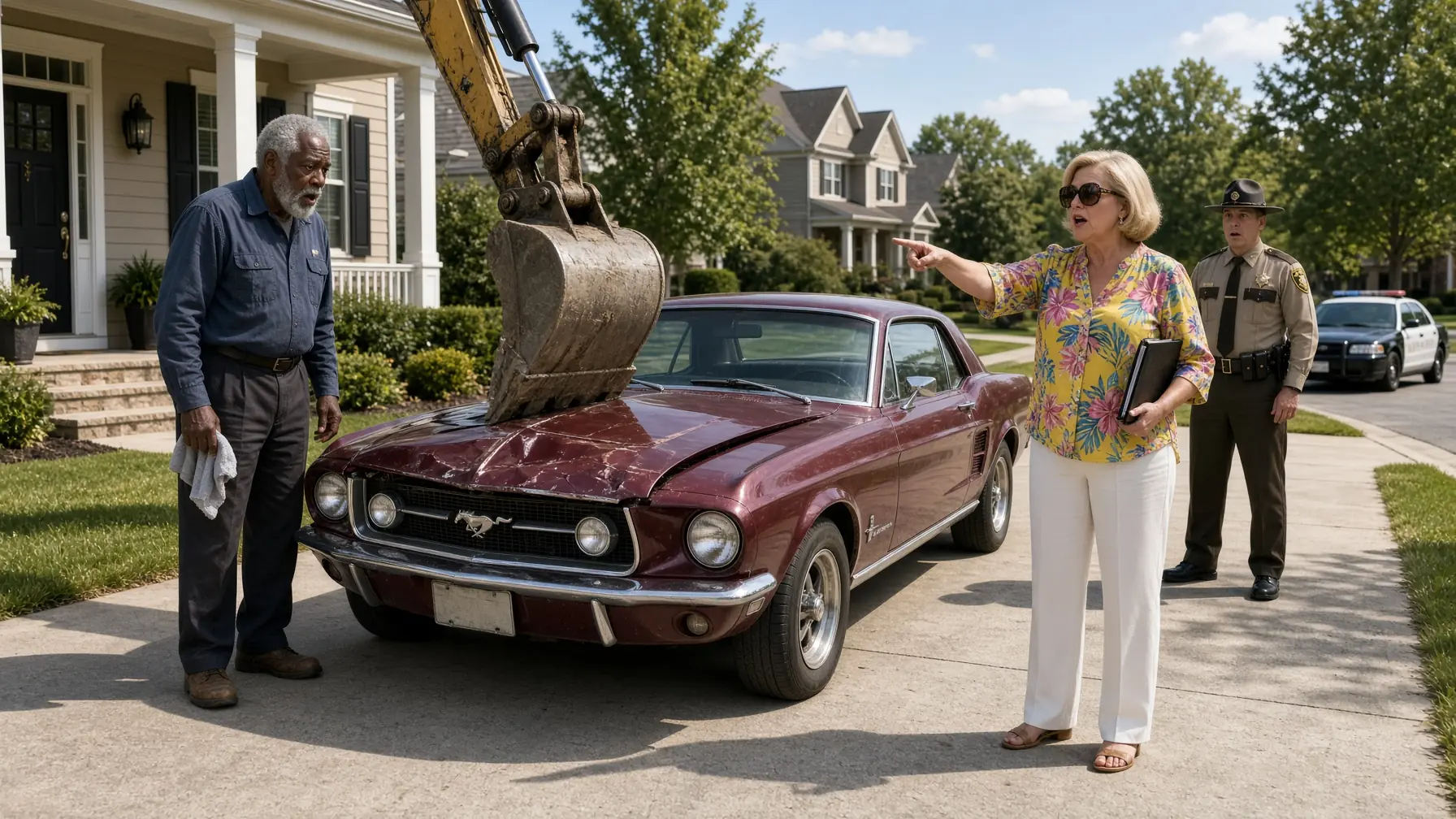
Now steel hung above it.
Karen Whitmore stood safely to one side, pointing.
The operator looked toward her from the cab.
Thomas had the sudden, sick feeling that they had already decided something terrible and were waiting only for the signal to do it.
The cloth was folded into a neat square against his palm.
He could not remember folding it.
That morning had begun with ordinary work.
There had been no appointment, no delivery expected, no reason for anyone to enter his driveway. Thomas had stepped outside in a faded navy work shirt and charcoal trousers, carrying the cloth and a few things he intended to put away when he finished.
The light was good for checking the paint.
He liked the hour before the neighborhood became busy. There were fewer engines, fewer voices, and enough coolness left in the air to make working beside the car pleasant.
He had not planned to spend long on it.
That was what he usually told himself.
A small task would lead to another. He would notice a trace of dust near the trim or a spot he had missed the last time, and the few minutes he intended to spend would become an hour without feeling wasted.
At sixty-four, Thomas no longer hurried through work he enjoyed.
The Mustang gave him work worth taking slowly.
It was a 1967 Ford, burgundy with polished chrome, and familiar to him in ways that went far beyond knowing where each mark had been. He knew the curve of the hood beneath his hand. He knew how the color changed between shade and direct sun.
He could look at a finished section and remember the effort beneath it.
There had been stubborn fasteners, parts that looked right until he tried fitting them, and jobs he had repeated because the first attempt had not met the standard he wanted. The car had taught him patience through consequences rather than advice.
He had made mistakes on it.
He remembered those too.
A task rushed because he was tired. An adjustment that seemed harmless until it created another problem. Hours spent correcting something he should have left until morning.
Eventually, he learned to stop when he could no longer tell whether he was improving a thing or merely refusing to admit he was done for the day.
The Mustang had survived all of that.
Under the morning light, it looked whole.
Thomas had been especially pleased with the hood.
It held the reflection of the trees in a smooth, dark sweep, interrupted only when a breeze moved the branches overhead. He stood back after polishing it and studied the finish from an angle.