“Forty-six thousand seven hundred? For a dead engine?”
Grant Voss pointed at the combine and laughed.
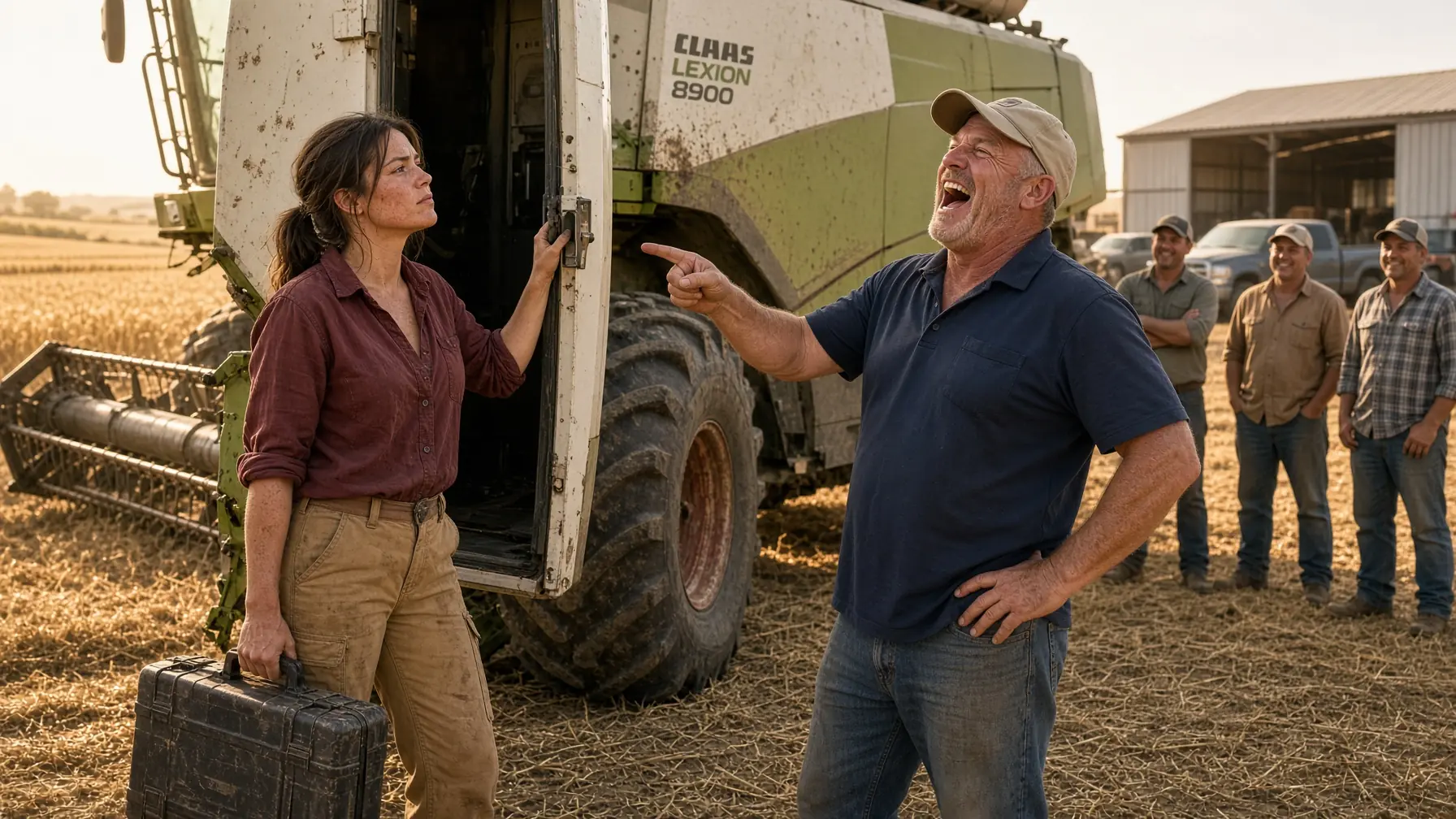
Three neighboring farmers stood behind him, smiling at the enormous green-and-white machine as though Banning’s mistake had become large enough to cast a shadow over all four of them.
Banning set her compact tool case on the ground.
“Give me twelve minutes.”
She spoke steadily, which was fortunate. Her stomach had been tightening since the auctioneer accepted her bid, and there was no reason to give Grant that information too.
He folded his arms.
The machine had not started in eleven months. Dust covered its panels, the detached draper header rested beside it, and the afternoon outside Haven Crest, North Dakota, was bright enough to expose every mark of neglect.
None of that changed because Banning now owned it.
Neither did the amount she had paid.
She put one hand on the electrical access panel’s latch and paused just long enough to remember the decision that brought her there.
That morning, she had almost driven past the auction entrance.
The yard was already busy. Pickups moved slowly between rows of equipment, and people walked in loose groups toward machines they had discussed before leaving home.
Banning had come alone.
At twenty-nine, she was accustomed to people treating that as evidence she had overlooked something. A woman looking at large equipment by herself often received advice before anyone asked whether she wanted it.
Some advice was useful.
She tried not to reject it merely because of the way it arrived.
But she had learned to ask a second question.
What did the person actually know?
That question mattered more than the confidence with which the first answer was delivered.
She parked, switched off the engine, and looked through the windshield at the equipment shed.
For a moment, she remained in the seat.
The auction was an opportunity.
It was also a place designed to make a person confuse wanting a machine with needing to buy it before someone else did.
Banning had no interest in discovering how expensive that confusion could become.
She took a folded sheet of paper from the seat beside her.
On it, she had written a limit.
Not an amount she hoped to spend.
An amount beyond which the answer would be no.
The distinction seemed easy while she sat inside her pickup.
She knew it might become harder with an auctioneer looking at her and another bidder making the next decision appear urgent.
Below the number, she had written several reminders.
Transport would cost something.
Time would cost something.
A machine that started could still need work.
A machine that did not start might need far more work than anyone at the auction could reasonably predict.
She read the reminders, folded the page, and put it into her pocket.
Then she got out.
Her faded burgundy work shirt was clean that morning, though she did not expect it to remain that way. The sleeves were rolled above her forearms, her brown hair gathered in a practical ponytail.
She wore tan canvas work trousers and scuffed boots.
Clothes chosen for looking closely at equipment, not standing beside it for photographs.
The registration process was ordinary.
She gave the information requested, listened to the sale arrangements, and checked what she needed to check before moving into the yard.
She did not head directly toward the combine.
That was deliberate.
She had seen enough of the listing to know it would occupy her attention if she let it.
Instead, she walked past smaller equipment, watched people inspect attachments, and reminded herself that useful purchases did not have to become stories.
Some of the best things a person bought were unremarkable.
They worked.
They fitted the job.
They did not require anyone to recognize the buyer’s vision.
Banning liked those purchases.
She also knew she was thinking about the combine while pretending not to.
The 2024 CLAAS LEXION 8900 stood near the open shed, towering above the people walking around it.
Its size was difficult to ignore.
So was the silence.
Other equipment in the yard attracted the ordinary sounds of prospective buyers discussing hours, condition, and what they might need to spend after taking it home.
Near the combine, the conversations kept returning to the same fact.
It would not start.
Someone said the engine was finished.
Another person said it had been sitting too long.
A third remarked that anything left untouched for eleven months was probably left that way for a reason.
Banning listened.
Then she walked closer.
The draper header was detached.
Dust lay across the green-and-white panels in a thin, dull film, interrupted where somebody had wiped a hand or leaned against the metal.
The machine looked less like something abandoned than something repeatedly examined without being put back to work.
That was an observation.
She kept it separate from a conclusion.