At 2:03 on a Thursday afternoon, Ava Monroe stood in a glass-walled boardroom forty-seven floors above Manhattan and extended her hand across a table worth $2.4 billion.
Victoria Sloan looked at it.
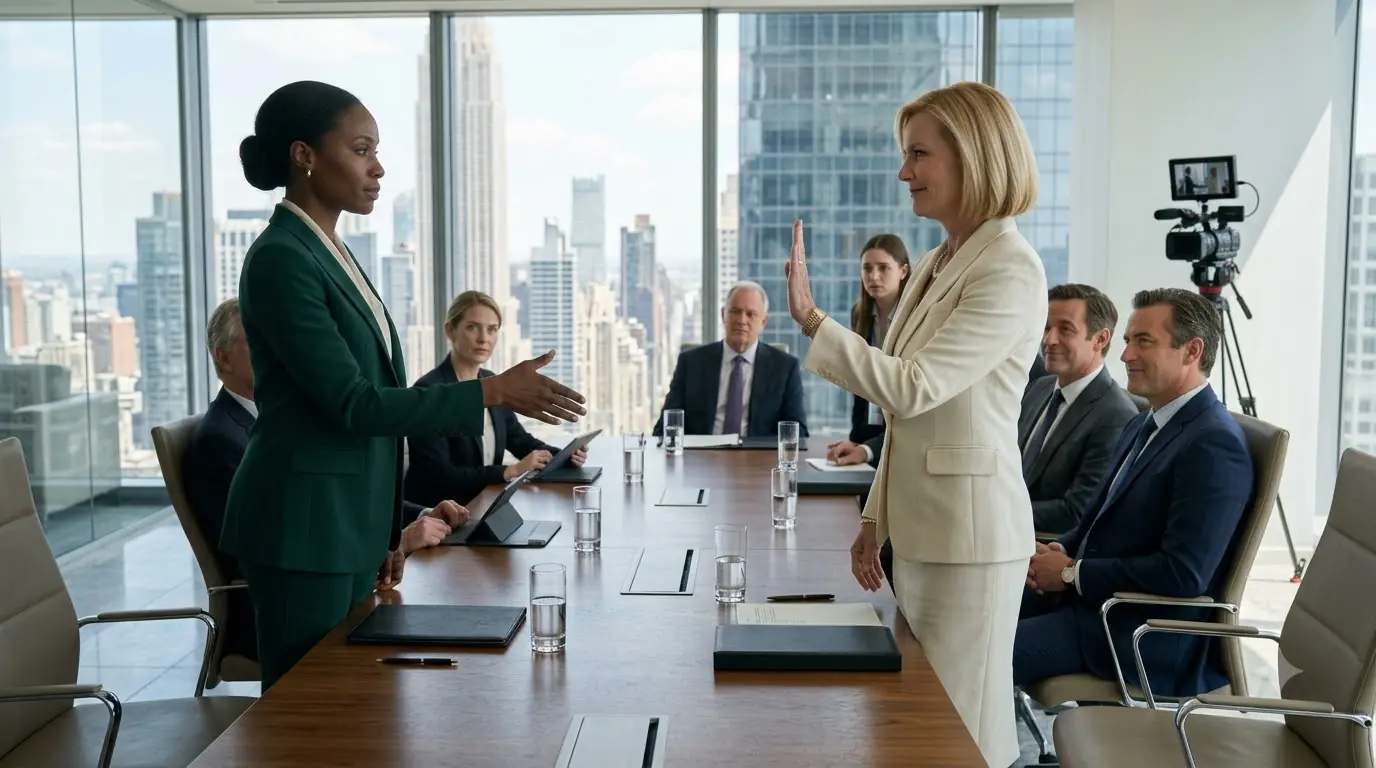
Then she looked at Ava.
A small smile appeared at the corner of the chairwoman’s mouth.
Not friendly.
Not nervous.
Satisfied.
Victoria lifted one hand, palm outward, as though stopping a waiter from placing the wrong plate in front of her.
“We don't shake hands with people like you.”
For one second, nobody in the room moved.
Twelve executives sat around the polished walnut table.
Four lawyers occupied chairs against the wall.
Two investor-relations specialists stood near the rear screens.
Three cameras mounted beneath the ceiling continued streaming the meeting to institutional investors, analysts, lenders, and several thousand registered shareholders who had been invited to watch what Sloan Industries had advertised as the final strategic presentation before the largest transaction in company history.
Every microphone was live.
Every face was visible.
And Ava Monroe’s right hand was still suspended between them.
She was forty-two years old, Black American, founder and chief executive officer of Monroe Capital Partners, and one of the most disciplined people in the room.
That discipline saved her.
Because for half a second, something inside Ava wanted to answer Victoria immediately.
Not loudly.
Not emotionally.
Precisely.
She had spent most of her professional life learning how to dismantle an insult with one sentence.
But she also knew something more valuable.
Silence could force people to live inside what they had just said.
So Ava did nothing.
She left her hand there for one heartbeat longer.
Long enough for everyone watching to understand that the refusal had not been accidental.
Then she lowered it.
A nervous laugh came from the far end of the table.
Martin Hale, Sloan Industries’ head of global operations, looked down almost immediately afterward, as though embarrassed that the sound had escaped him.
Another executive smiled briefly.
Someone coughed.
Sloan Industries’ general counsel, Rebecca Chen, went completely still.
Ava returned to her chair.
“Understood,” she said.
That was all.
Victoria leaned back.
“Good.”
She rearranged the papers in front of her.
“Now that we're clear on protocol, perhaps we can finally discuss the transaction without unnecessary ceremony.”
Ava opened her leather portfolio.
She uncapped a pen.
Across the table, Victoria smiled again.
She thought she had established the hierarchy.
She had no idea she had just activated the mechanism that could end the deal.
Three weeks earlier, the merger looked almost inevitable.
Sloan Industries was one of those companies whose name appeared everywhere without most people understanding how large it had become.
Founded fifty-eight years earlier by Victoria’s father, Charles Sloan, the company began as a regional industrial-controls manufacturer in Ohio.
By the time Victoria became chairwoman, Sloan Industries controlled businesses in manufacturing automation, warehouse robotics, logistics software, specialty components, and industrial energy systems.
Revenue exceeded $18 billion annually.
The company employed more than forty thousand people across eleven countries.
Its headquarters occupied the top sixteen floors of Langston Tower in Midtown Manhattan.
From the outside, Sloan looked powerful.
Inside, it had a problem.
Actually, several.
The company had expanded too quickly during a decade of cheap borrowing.
Management purchased competitors.
Built new facilities.
Entered markets it did not fully understand.
Debt accumulated quietly because revenue kept growing fast enough to make the leverage look manageable.
Then interest rates rose.
Two large product launches missed expectations.
A European acquisition underperformed badly.
One of Sloan’s logistics subsidiaries lost a government contract analysts had assumed would renew automatically.
Cash flow tightened.
None of those problems alone threatened the company.
Together, they changed what Sloan could afford.
The board needed capital.
Not emergency cash.
Strategic capital large enough to refinance upcoming obligations, fund a restructuring program, and complete Sloan’s acquisition of Vector Dynamics, a fast-growing industrial software company whose technology was essential to Victoria’s long-term strategy.
Without the acquisition, Sloan risked falling behind.
Without new capital, it could not complete the acquisition safely.
That was where Ava Monroe entered.
Monroe Capital Partners was much younger than Sloan Industries.
Fifteen years old.
No founder’s surname engraved into half a century of corporate history.
No thirty-story manufacturing complexes.
No family dynasty.
Ava built the firm from a rented office in Atlanta after leaving a global investment bank at twenty-seven.
Her first fund had barely $18 million under management.
Her first employees consisted of one analyst, one accountant working three days a week, and Ava herself.
People who met her later liked to describe the firm as an overnight success.
Ava hated that phrase.
Nothing about the first eight years had happened overnight.
She remembered sleeping on the office sofa during her first fundraising cycle because she could not justify paying for a hotel after late meetings.
She remembered flying coach to Chicago with a cracked laptop held together at one corner with clear tape.
She remembered investors telling her she was too young.
Too specialized.
Too ambitious.
Too cautious.
Too aggressive.
Sometimes all within the same week.
She remembered a pension consultant asking who the real decision-maker was after Ava had already introduced herself as managing partner.
She remembered an executive looking past her toward a white male analyst and answering questions Ava had asked.
She remembered a bank chairman saying:
“You're very articulate.”
As though he had expected otherwise.
Ava learned early that direct anger cost her more than it cost the people provoking it.
So she became surgical.
Every number checked twice.
Every agreement read.
Every assumption challenged.
Every meeting documented.
Every optional exit preserved until the last responsible moment.
Her investors rewarded that discipline.
The first fund performed well.
Then the second.
Then a distressed industrial investment made enough money to establish Monroe Capital as a serious operator rather than a diversity story financial magazines liked to feature every February.
By forty, Ava oversaw more than $31 billion across private equity, structured capital, and strategic investment vehicles.
She employed hundreds of people.
Major pension funds trusted her firm.
Insurance companies trusted it.
University endowments trusted it.
Family offices that once refused her meetings now competed for allocation.
Ava rarely mentioned any of that in negotiations.
She preferred people to reveal themselves before they understood how much leverage she possessed.
Sloan Industries had approached Monroe nine months earlier.
Officially, the proposed transaction was called a strategic combination.
In practice, Monroe Capital would lead a consortium providing approximately $2.4 billion in equity and structured financing.
In exchange, the consortium would receive a significant ownership position, preferred governance rights, board representation, protections around capital allocation, and influence over Sloan’s restructuring program.
Victoria hated that part.
She wanted Monroe’s money.
She did not want Monroe’s influence.
From their first meeting, that tension had been obvious.
Victoria Sloan was sixty-one.
White American.
Educated at Princeton and Wharton.
She had spent nearly her entire career inside the company her family founded.
Brilliant in many areas.
Relentless.
Immensely experienced.
And deeply accustomed to being the most powerful person in every room she entered.
People adjusted around Victoria.
Assistants learned her preferences without being told twice.
Executives changed presentation language after one raised eyebrow.
Board members knew which disagreements could be voiced publicly and which required a private lunch three days later.
Victoria did not scream often.
She did not need to.
Power had taught everyone around her to anticipate displeasure.
Ava did not.
That bothered Victoria almost immediately.
Their first disagreement concerned capital allocation.
Victoria wanted the entire $2.4 billion committed at closing.
Ava insisted a portion remain contingent on debt reduction and operating milestones.
Victoria said:
“You're asking us to accept training wheels.”
Ava replied:
“I’m asking my investors not to finance promises as though they're performance.”
The room had gone quiet.
Victoria never forgot it.
The second disagreement concerned board seats.
Victoria wanted Monroe limited to one observer.
Ava required two voting directors under specified conditions.
“We've managed this company for nearly sixty years without outside supervision,” Victoria said.
Ava responded:
“You also approached us for $2.4 billion.”
Rebecca Chen had looked down at her notes to hide a smile.
By the third month, Victoria had stopped pretending she liked Ava.
She referred to Monroe Capital as “your little firm” during one private conversation.
Ava corrected her once.
“Our firm.”
Victoria ignored it.
During another meeting, she asked whether Monroe’s investment committee would be more comfortable if Ava brought “someone with deeper industrial history” to the next session.
Ava brought the same team.
When Victoria interrupted a junior Black associate three times, Ava waited until the fourth.
Then said:
“She is answering your question.”
Victoria replied:
“I prefer concise answers.”
Ava said:
“Then let her finish one.”
The tension became obvious enough that Rebecca Chen warned Victoria.
They were alone in the chairwoman’s office two months before closing.
Rebecca placed a marked copy of the transaction agreement on Victoria’s desk.
“You need to stop personalizing this.”
Victoria removed her glasses.
“I’m not personalizing anything.”
“You are.”
“She’s difficult.”
“She is protecting her investors.”
“She behaves as though we're desperate.”