“You’re a swamp girl,” Gideon Blackwell said from the barn doorway. “Those birds belong to me.”
Rowan Mercer stood in the middle of nearly two hundred yellow goslings, their tiny bodies crowding the straw-covered floor around her worn boots. Wooden crates filled with empty shells and unhatched eggs lined the walls, while afternoon sunlight poured past Blackwell and the three people standing behind him. Rowan tightened her grip on the leather ledger containing every date, expense, and hour she had spent keeping the discarded eggs alive. “You threw them away.”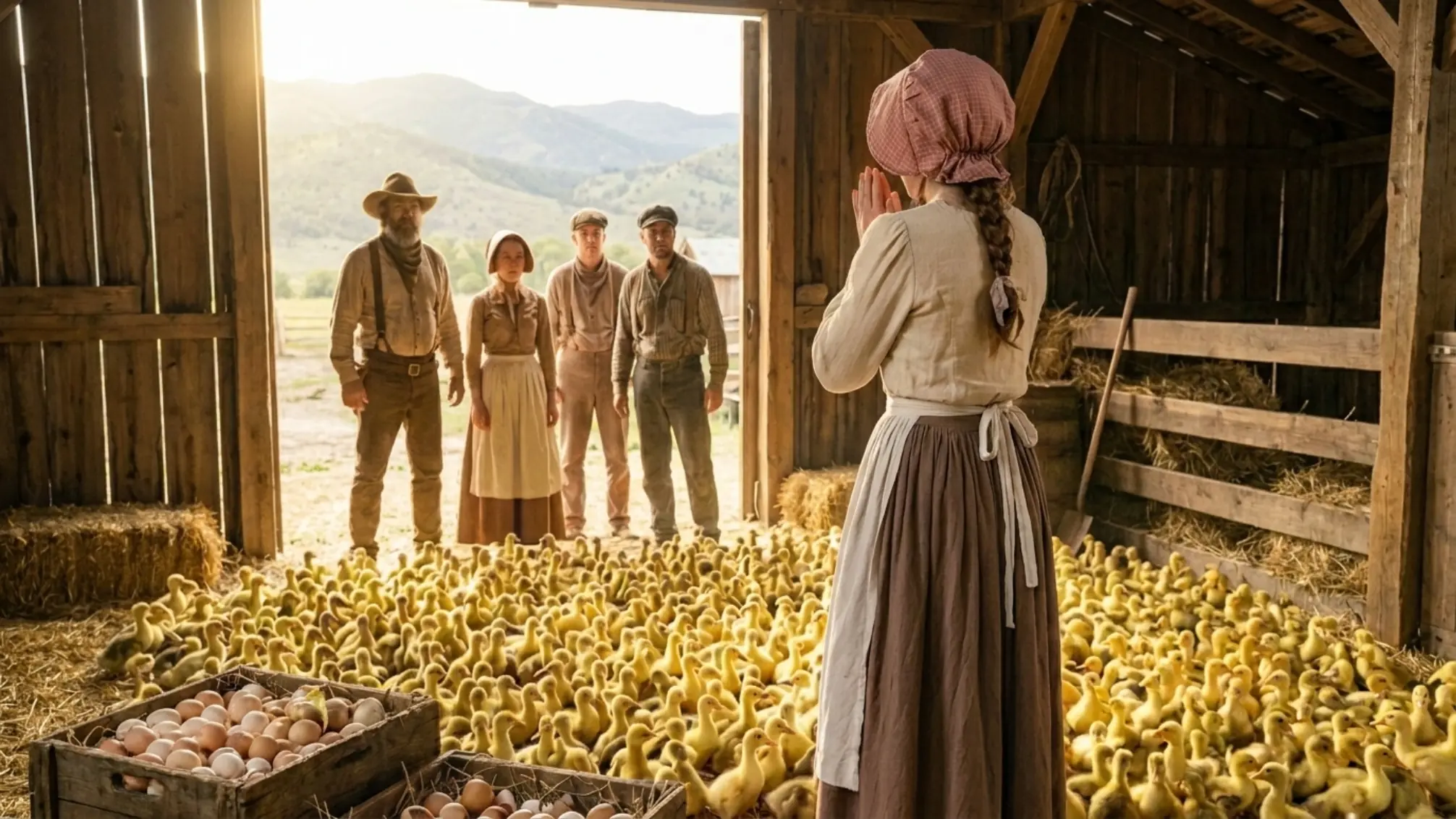
Blackwell stepped into the barn, his polished boots crushing clean straw beneath them. He wore an expensive brown hat, a fitted tan coat, and the relaxed expression of a man who believed money could transform lies into ownership. “Refuse, and I’ll empty this barn.”
Rowan raised the ledger against her chest. Her voice remained calm even as fear moved coldly through her. “Try it—and leave in chains.”
Six months earlier, Rowan had arrived in Caldwell Flats with eighty-three dollars, two dresses, and a deed to ten acres everyone called the Sink. The land sat at the bottom of a natural basin where rainwater gathered, turning the ground dark, wet, and nearly useless for wheat or cattle. Her late uncle had left it to her because no one else in the family wanted it. The men outside the county attorney’s office called the inheritance an apology.
The house was little more than a crooked wooden shed. Its roof leaked in two places, one window had been boarded shut, and the floor sloped so badly that Rowan’s money pouch slid across the room when she placed it down. She watched it move three feet before stopping against the wall. Then she picked it up, set it down again, and laughed because the alternative was crying.
Rowan had nowhere else to go. Her parents were gone, the factory where she had worked had closed, and the landlord in St. Louis had given her thirty days to leave. The Sink was not a good opportunity, but it was hers. On her first night, she slept on a canvas bag because the broken bedframe could not support her weight.
The next morning, she walked every acre of the property. Cattails grew around the basin, red-winged blackbirds nested in the reeds, and thick sedge grass covered the wettest ground. Nothing about it resembled traditional farmland. Yet something was alive there, and Rowan believed land should be judged by what it could support, not by what people had failed to force it to become.
Her nearest neighbor was Matias Volker, a seventy-two-year-old immigrant farmer who raised geese on forty acres north of the Sink. He appeared one morning at Rowan’s fence, studying her marsh with pale blue eyes beneath heavy white brows. When she told him the townspeople considered the property worthless, he looked almost offended. “Worthless is what people call things they don’t understand how to use.”
Matias showed her how his geese thrived on wet pasture. They ate sedge, insects, and water plants that cattle ignored, while their waste slowly improved the soil. He had started with four birds twenty years earlier and now owned sixty. The same waterlogged ground that ruined crops gave geese everything they needed.
Rowan spent nearly half her remaining money buying four breeding birds from him. People laughed when they saw the geese wandering across her marsh. Cleat Burroughs, who owned the feed store, told a customer that the Mercer girl had inherited a swamp and decided to fill it with noise. Rowan heard him but kept walking.
The freight wagon arrived three weeks later.
It stopped beside the southern road on a cold April afternoon. The driver climbed down, released the rear gate, and dumped hundreds of goose eggs into the ditch. They struck mud and one another in a terrible rolling collapse, leaving pale shells scattered across the roadside.
Rowan ran toward him. “What are you doing?”
“Rejected shipment,” the driver said. “Buyer in Mil Haven won’t accept cracked shells.”
Several eggs were visibly broken, but many carried only thin fractures. Rowan knelt and lifted one carefully. It remained warm, and the membrane beneath the shell appeared intact.
“How long have they been incubating?”
“Two or three weeks.”
“Then some could still hatch.”
The driver laughed. “They’ll rot before morning.”
“Who owns them now?”
“Nobody. They’re trash.”
Rowan looked at the ditch. Three hundred fifty eggs had been discarded because delivering them safely was no longer profitable. She saw cracks, mud, and uncertainty, but she also felt faint warmth against her palms. “Then they’re mine.”
It took four trips to carry them home. She filled buckets, her apron, and the canvas bag that once held her clothes. Men riding past slowed to watch her collecting broken eggs from the mud, and one called out that she should save room in her house for the smell. Rowan ignored them.
By sunset, the eggs covered the back corner of her tilted home. She arranged them in straw and wrapped them with the only blankets she owned. Then she walked north to Matias’s property and told him what she had done.
He came carrying beeswax, warm sand, a thermometer, and extra wool blankets. Neither of them mentioned that he had brought exactly the things needed to attempt the impossible. They spent the night inspecting each shell by lantern light. Eggs with broken membranes were removed immediately, while hairline cracks were sealed with thin layers of beeswax.
Out of three hundred fifty eggs, two hundred eighteen still had a chance.
Rowan slept beside them for the next three weeks. She maintained the temperature with a small clay warming box Matias built from scrap metal and stovepipe. Every few hours, she checked the thermometer, adjusted the heat, and turned each egg by hand. Her fingers became so familiar with them that she could identify several by weight alone.
The town learned what she was doing.
People began stopping near the southern road, pretending to inspect wagon wheels while looking toward the shed. Cleat Burroughs asked whether she understood that a professional hatchery would have rejected those eggs for good reason. Rowan told him she understood that professional hatcheries could afford to waste possibilities.
Some nights, the temperature dropped dangerously low. Rowan burned furniture from the ruined back room when her firewood ran short. During one heavy rain, water leaked through the roof and nearly flooded the sandbed. She climbed onto the roof in darkness and covered the holes with canvas while Matias moved the eggs away from the dripping water.
On the twenty-first day, one egg rocked beneath her fingertips.
She stopped breathing and waited. A second egg moved, then a third. By evening, the shed filled with faint tapping as goslings began breaking through their membranes.
The first one emerged shortly after two in the morning. It was wet, gray, and too weak to stand for more than a second. Rowan watched it fall, rise, and fall again until it finally remained upright. She pressed both hands over her mouth to keep from waking Matias, who had fallen asleep against the wall.
By sunrise, nineteen goslings crowded beneath the warming blanket.
The hatching continued for four days. Thirty-one embryos failed, and each loss hurt despite Rowan’s efforts to prepare herself. Yet when the final count was finished, one hundred eighty-seven goslings remained alive.
Matias counted twice because neither of them trusted the number.
“Is that good?” Rowan asked.
He stared at the loud, stumbling flock filling the shed. “You started with broken eggs from a ditch. It is more than good.”
Rowan stepped outside and looked across the Sink. The morning sun touched the basin, reeds, and green sedge the town had dismissed as evidence of useless ground. For the first time, she saw not ten unwanted acres but a farm designed for exactly the animals now calling from inside her house.
The goslings grew quickly.
Rowan built a rough brooder using salvaged lumber and wire donated by Matias. She spent her final money on grain, then traded labor for more feed. She repaired fencing for one neighbor, cleaned stalls for another, and helped Cleat Burroughs unload a shipment in exchange for salt and cracked corn.
The people who had laughed slowly became curious.
By June, the yellow goslings had become awkward young geese moving in a noisy white-and-gray mass through the marsh. They ate the sedge, searched the wet ground for insects, and gathered around the basin every morning. The Sink stayed green even as drought began burning the surrounding valley.
Cattle operations failed first. Wells dropped, grass browned, and several ranchers sold their herds because they could no longer afford feed. Cornfields curled beneath a white sky that refused to rain. Yet Rowan’s marsh held water, and her geese continued growing.
That was when Gideon Blackwell appeared.
He owned part of the Mil Haven Livestock Exchange and controlled several processing facilities across Kansas. He had purchased failed farms for decades, usually shortly before discovering resources their owners had overlooked. His clothing was too clean for drought country, and his eyes moved across Rowan’s property as though everything visible already had a price.
“I heard about your birds,” he said from the fence.
Rowan continued carrying feed. “People enjoy talking.”
“One hundred eighty-seven, if the count is accurate.”
“It was accurate this morning.”
Blackwell looked toward the basin. “You built a valuable flock from nothing.”
“I built it from work.”
He smiled without warmth. “Work becomes valuable only when someone can sell the result.”
His first offer sounded generous. He would buy the entire flock, arrange transport, and pay Rowan enough to repair the house and survive for several years. In exchange, he demanded exclusive rights to purchase every goose she raised afterward.
Rowan refused.
Blackwell increased the offer. When she refused again, his smile disappeared. He told her drought would dry the basin before the birds reached full market weight. If they died, she would own nothing but feathers and regret.
Rowan asked how he knew so much about her water.
He did not answer.
Days later, she discovered a narrow channel east of her property had been blocked with a low clay berm. The channel carried seasonal runoff toward the Sink, and its restriction explained why her basin had begun dropping faster than expected. The land containing the berm had recently been purchased by a company connected to Blackwell.
Rowan recorded everything.
She measured the basin every morning and wrote the water level beside the date. She sketched the drainage channel from her side of the fence, collected copies of property deeds, and documented Blackwell’s offers. Matias taught her that powerful men depended on frightened people reacting before collecting proof.
Meanwhile, Rowan began selling a limited number of geese directly to struggling families. She charged what they could afford and accepted labor when money was unavailable. One rancher helped complete a secondary catch basin. Another repaired her roof. A carpenter built proper nesting boxes in exchange for four birds.
The town that once mocked her slowly became invested in her success.
Blackwell’s next move came through official paperwork. An anonymous complaint claimed Rowan’s basin was a public water source that should be opened to nearby ranching operations during the drought. If the county approved the claim, Blackwell could move cattle onto her land, destroy the wet pasture, and force her to sell.
Rowan had no money for an attorney.
Matias introduced her to Elias Abelson, a careful county lawyer whose wife’s garden was dying from lack of water. Rowan offered him partial payment in cash, six geese, and controlled access to her secondary catch basin. Abelson accepted after reviewing the records she had kept.
“You have better documentation than most corporations,” he told her.
“I learned from eggs.”
The county hearing filled with twenty-three residents from Caldwell Flats. Families Rowan had helped sat behind her, along with men who had once laughed from the feed store window. Cleat Burroughs testified that her water system was privately maintained. A former surveyor explained how the eastern berm had reduced the natural inflow.
Blackwell did not attend. His attorney argued that public necessity outweighed private ownership. Abelson answered by presenting the dates of Blackwell’s purchase offers, the connected land company, and Rowan’s water measurements.
The commission dismissed the complaint.
Afterward, Blackwell’s company removed the berm and quietly offered a settlement. Rowan accepted protection for the drainage channel rather than a large payment. The restriction was permanently attached to the neighboring deed, ensuring no future owner could block the water again.
She believed the conflict had ended.
Then, near the end of summer, Blackwell discovered where the original eggs had come from.
His livestock exchange had been the intended buyer of the rejected shipment. The driver had dumped them after Blackwell’s manager refused delivery. The exchange had recorded the eggs as destroyed and claimed a loss against the freight company.
But now those supposedly destroyed eggs had become a valuable flock.
Blackwell arrived at Rowan’s barn with his assistant, an inspector loyal to his exchange, and a ranch hand carrying ropes and transport crates. He brought a purchase record showing that the exchange had once paid for the shipment. He intended to argue that the eggs remained his property even after being discarded.
Rowan listened while hundreds of goslings moved around her feet.
“You’re a swamp girl,” he told her. “Those birds belong to me.”
“You threw them away.”
“Refuse, and I’ll empty this barn.”
“Try it—and leave in chains.”
Blackwell laughed. “You think that notebook protects you?”
“No. Your own records do.”
Rowan opened the ledger to a folded statement signed by the freight driver. After learning Blackwell was trying to seize the flock, the man had returned to Caldwell Flats and admitted the truth. His instructions had been to destroy the rejected eggs wherever convenient because the exchange considered them contaminated waste.
The county sheriff entered the barn behind Blackwell’s group.
He was followed by Abelson, Matias, Cleat Burroughs, and several families who had heard transport wagons approaching the Sink. Blackwell turned and found the doorway no longer open behind him.
The sheriff held a copy of the exchange’s insurance claim. Blackwell had declared all three hundred fifty eggs destroyed and accepted compensation for the loss. Claiming the living birds now meant admitting the earlier declaration had been false.
“You cannot call them destroyed when collecting insurance,” Abelson said, “then call them property when someone else makes them valuable.”
Blackwell’s inspector stepped backward and lowered his folder.
The sheriff ordered the ranch hand to drop the ropes. When Blackwell refused to leave, he was warned that removing even one bird would lead to charges for attempted theft and trespassing. The exchange’s insurance records were forwarded to state investigators that same afternoon.
The resulting inquiry uncovered more than one suspicious claim. Blackwell had repeatedly reported livestock shipments destroyed while selling salvaged animals through private buyers. He had also used shell companies to pressure farmers into selling land below market value.
His exchange lost its operating license. Blackwell faced fraud charges, civil lawsuits, and the collapse of the network that had protected him for years. The wealthy man who entered Rowan’s barn intending to seize everything left beneath the watch of the county sheriff.
Rowan did not celebrate his destruction.
She returned to feeding the flock because living animals did not care about courtroom victories. They still required clean water, grain, shelter, and attention. Success had not reduced the work. It had simply ensured the work remained hers.
By autumn, the rescued geese reached full size.
Rowan sold them through direct agreements with local families, restaurants, and neighboring counties. She kept twenty-five of the strongest birds for breeding. Her first profitable season paid every debt, repaired the house, and allowed her to build a proper barn over the brooder where the eggs had once rested beneath borrowed blankets.
Matias continued visiting most evenings.
Sometimes they sat near the basin and watched the remaining geese move through the reeds. He rarely praised her directly, but one evening he looked across the green marsh and said his late wife would have admired what Rowan had built.
“That may be the kindest thing you’ve ever said to me,” Rowan replied.
“It is not kindness,” Matias said. “It is accurate.”
The following spring, Rowan hired Eli Henderson, the seventeen-year-old son of a rancher she had helped during the drought. She taught him incubation, pasture management, pricing, and the importance of documenting every agreement. When he suggested throwing away an egg with a thin crack, Rowan handed him the beeswax.
“Look beneath the damage first,” she said.
Not every cracked egg could be saved. Rowan knew that better than anyone. Some were already lost when she found them, and no amount of warmth or effort could reverse that truth.
But cracks were not proof that something had no value.
Wet land was not failed land.
A poor woman was not a foolish woman.
And discarded life did not belong to the powerful man who regretted throwing it away only after someone else helped it survive.
Years later, visitors came to Caldwell Flats to study Rowan’s goose farm and the water-pasture system she developed on the Sink. They often asked how she recognized the opportunity everyone else had missed.
Rowan always gave the same answer.
“I didn’t know those eggs would hatch,” she said. “I only knew they were still warm.”
Then she would look toward the barn, where a new generation of goslings crowded the straw beneath the morning light.
Three hundred fifty eggs had been dumped beside a road because someone saw only broken shells.
Rowan carried them home because she was willing to look closer.