"She doesn't belong here!"
The accusation was loud enough to reach the windows of the great cream-colored mansion behind the black iron gates. It rose above the quiet afternoon traffic and the low rustle of carefully trimmed hedges, sharp and certain, as if volume could settle the question of who was entitled to stand on a public sidewalk.
The woman shouting was blonde, fifty-five, dressed in a mint polo shirt and white cropped trousers. Her name was Barbara Whitmore, and she had arrived with a police officer after making a report about a suspicious stranger near the entrance of a private estate. She pointed so aggressively that her finger almost brushed the enormous white hat worn by the stranger she had accused.
The other woman did not step back.
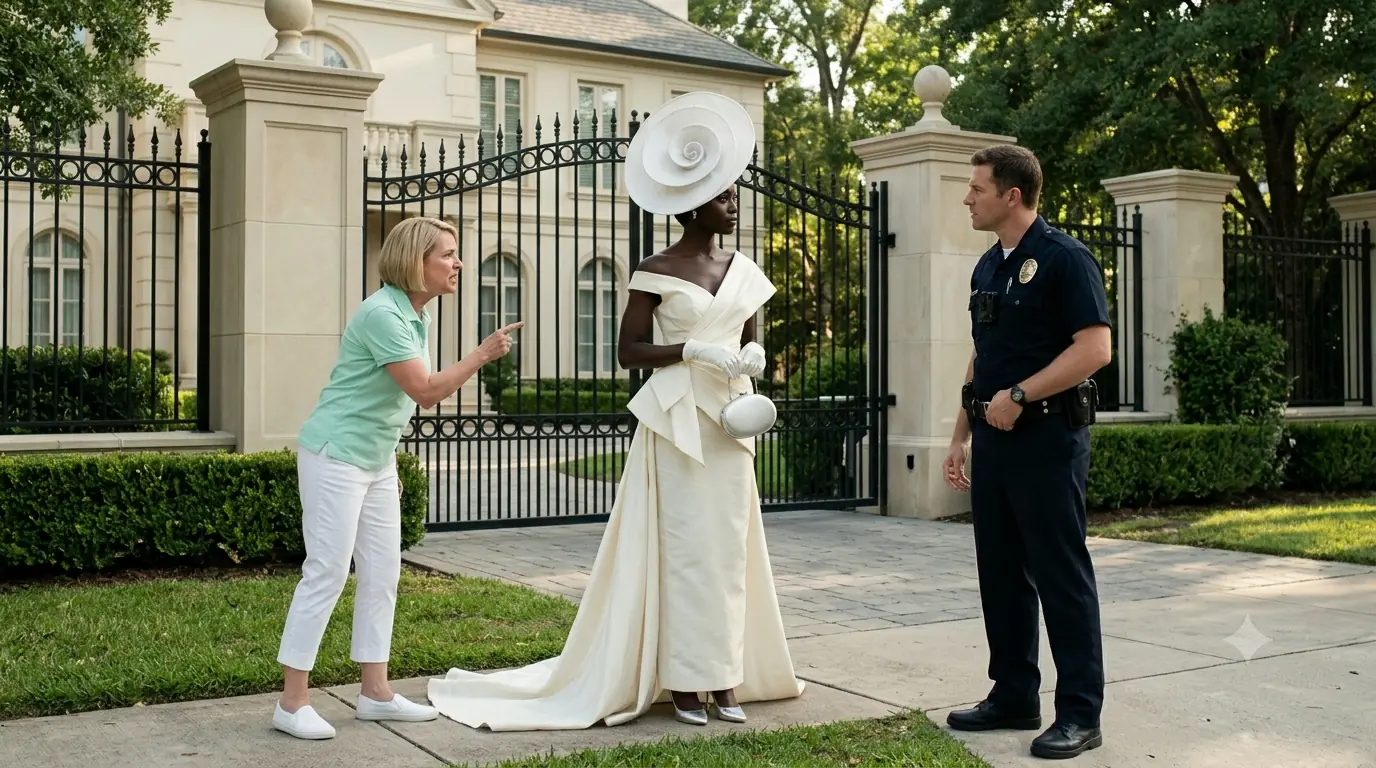
At thirty-two, Amara Bennett had learned that stillness could be an act of self-defense. She stood tall in an ivory formal gown with a sculpted asymmetrical neckline, one shoulder exposed beneath a structured white lapel, the waist draped into a precise, elegant shape. A long train pooled over the pale stone pavement behind her. White gloves covered her hands, one resting lightly around a small oval silver clutch. Metallic silver heels flashed beneath the slit of the dress when she shifted her weight. Her hat, an extraordinary spiral of white fabric and sculptural curves, rose above her face like something designed to be noticed from across a ballroom.
Every part of her appearance suggested an important event. Barbara treated it as evidence of a deception.
Officer Daniel Reeves stood between them, a thirty-eight-year-old patrolman wearing a navy uniform and body camera. He was trying to understand why a call about possible trespassing had become an argument between a furious homeowner-association volunteer and a woman who appeared to have stepped out of a fashion editorial.
"Ma'am," he asked Amara, "is this your property?"
Amara looked at him rather than at Barbara. Her voice was quiet and unmistakable.
"Yes. I live here."
Barbara stopped pointing.
For one moment the sidewalk held three very different expressions: the officer's uncertainty, Barbara's disbelief, and Amara's composure. Then Barbara gave a short, offended laugh.
"That's impossible."
Amara looked toward the gate. Through the ironwork she could see a narrow strip of the drive and the great oak tree on the lawn. She knew precisely which window caught the morning sun first, which stair creaked softly beneath a particular runner, and where the old gardener had once planted roses that refused to bloom until they were moved six feet east.
But she knew something Barbara did not. Proving she lived there would be the easy part. Explaining why Barbara had spent the last six weeks trying to prevent anyone like her from coming through that gate would be far harder.
That was why Amara had returned dressed for a celebration instead of a fight.
Six weeks earlier, the house had been quiet enough to hear the fountains from the second-floor landing. Amara walked through its rooms in jeans and a soft cotton shirt, a folder of renovation photographs under one arm, and tried to decide whether she had made a mistake.