Late November 1881, the storm reached Black Alder Creek before dark, driving snow sideways across the Judith Basin.
By the time Sarah "Sadi" Harland barred the west shutter, the road had vanished.
Sadi was 29 and alone at Harland Ranch. Her father, Wesley, had died in September.
His coat still hung from a wooden peg. His mug sat untouched on the shelf. His auger rested on the bench. His chair remained angled toward the stove, as if he might return before supper.
She left everything where it was. Outside, the cattle huddled behind the barn wall. The snow wasn't falling. It was being flattened and swept across the ground by the wind ripping off the northwest ridge.
Sadi tightened the shutters, twisted wool into the cold gap along the sill, banked the stove, and pulled on her coat. The spring box had been slowing for days. The cattle still needed water. After checking the trough, she was turning back toward the cabin when a horse cried out beyond the fence, sharp and terrified against the storm.
Sadi stopped. Then it cried again. No rider with sense should have been out there. Sadi took the lantern from its hook, looped a rope over one shoulder, and pushed back into the storm.
The horse stood beyond the cottonwood fence. A bay mare pressed against the rails with her reins dragging through the snow. She could have run. She had not.
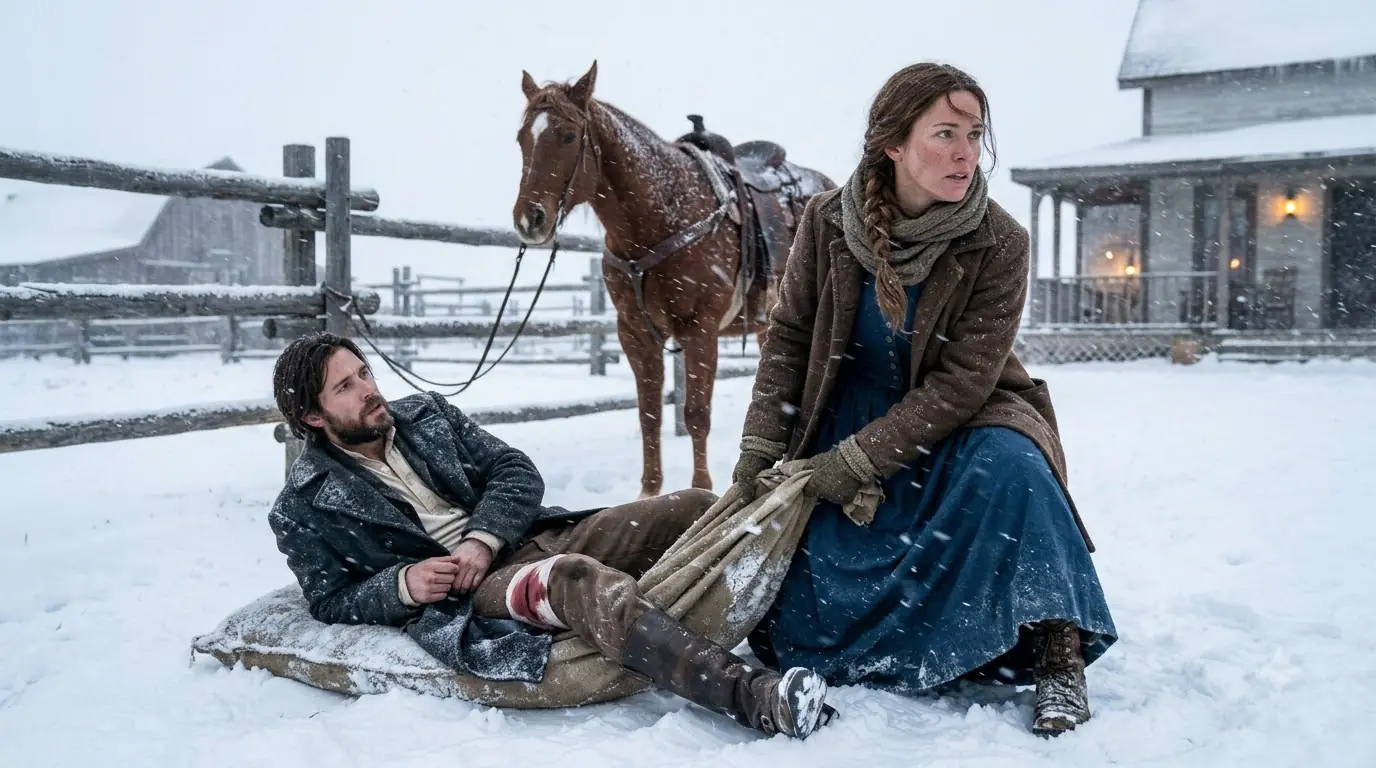
A man hung sideways from the saddle. One boot was trapped in the stirrup. His left shoulder sagged at a bad angle. Blood had dried black along one trouser leg, and his gloves were stiff with ice.
Sadi touched his neck. A pulse answered, weak but steady. She could not carry him. She tied the rope around his chest, passed it over the saddle horn, and took some of his weight before freeing the trapped boot.
He slid down slowly instead of falling. Wind struck hard. Sadi spread an empty feed sack over a folded piece of canvas, rolled him onto it, and dragged him toward the porch. The mare followed as far as the gate.
Sadi opened the barn, led her inside, then returned. Firelight reached across the doorway as she pulled the stranger over the threshold. Fresh blood had now soaked through his trouser leg. The cold was no longer the greatest danger.
Sadi cut the frozen cloth away from the stranger's thigh. The wound was deep, but the blood did not pulse. That gave her time. She boiled water, let it cool, then washed away dirt and dried blood without digging into the torn flesh.
Clean cloth went over the wound. She pressed until the bleeding slowed, then tied the dressing firmly in place. His left shoulder worried her next. It sat wrong, and any attempt to force it back might do more harm.
Sadi folded a strip of wool into a sling and bound the arm against his body. She moved him nearer the stove, but not against it. His soaking wet coat came off. Dry wool and quilts went on.
She wrapped heated stones in cloth and placed them near his chest and sides. When he stirred enough to swallow, she gave him warm broth a little at a time. Only then did she pull on her coat again. Brindle was waiting in the barn.
Sadi removed the saddle, ran her hands down the mare's legs, found no serious injury, and pushed hay into the manger. Before dawn, the stranger opened his eyes. "The mare? Barn." His face loosened. He breathed out and closed his eyes again.
Sadi remained beside him until his breathing settled. Then she looked across the stove. Wesley's chair stood empty, turned toward the door where Sadi had left it after the funeral. For the first time since September, another man was sleeping beneath her father's roof.
The storm held Black Alder Creek for three days. Snow covered the road, buried the lower fence rails, and left Sadi and the stranger with nowhere to go. By the second morning, he could stay awake long enough to speak. His name was Elias Boon.
He was 34, a horse buyer and breaker who had spent years moving between ranches, freight camps, and stockyards. He offered little more unless Sadi asked. She answered the same way. Elias did not need many questions to understand the cabin.
One plate remained apart from the others. Wesley's saddle gathered dust in the barn. The ranch ledger stopped for several days after September. When Sadi opened it to count winter expenses, he caught one figure before she closed the book: $3,160.
The haystack told him the rest. By then, he had also noticed the loose brace on the north barn wall, the cold slipping through the northwest sill, and the broken latch on the feed chest. His left arm was useless, but his right still worked. He found a scrap of hardwood and carved a new catch with Sadi's knife.
When he reached toward Wesley's auger on the bench, his hand stopped. He set it back exactly where it had been. "May I?" Sadi looked at the tool, then at him. She nodded.
That evening, she served supper without mentioning the repair. Elias found more broth in his bowl than he had the night before. He noticed that, too. Outside, the wind kept pressing at the walls.
Inside, neither of them found much reason to fill the silence. The basin remained closed beneath snow, and Elias recovered by degrees. His shoulder still would not bear weight, so he worked around it. With one hand, he replaced the bent lantern hook near the door.
He shaved the cracked edge from Sadi's axe handle, whittled a wooden peg for a loose harness strap, and adjusted the door latch until it caught without being lifted. Sadi spent those hours mending tack and dividing the remaining hay by animal and week. They rarely spoke unless the work required it. At night, they sat on opposite sides of the stove.
One evening, Elias looked through the window toward the barn. "Why does it sit crooked to the cabin?" "It isn't crooked." He glanced at her. Sadi set down the strap she was stitching.
Wesley had followed the slope when he built the barn, she explained. The northwest ridge complicated everything. Wind might seem to come straight across the basin, but snow showed where the air slowed, curled, and dropped what it carried. She pointed toward a pale ridge forming beyond the corral.
"Snow tells more truth than wind does." Elias said nothing. He rose, crossed to the window, and watched the drifting line. He studied where snow gathered behind the fence and where ground remained bare.
Then he returned to his chair and picked up the wood he had been shaping. Sadi went back to her stitching. The stove settled between them. Silence inside the cabin did not feel like something that needed fixing.