Most people at gate C14 did not look up because they cared about justice.
They looked up because humiliation has a strange way of pulling eyes toward it.
Rolling suitcases slowed, coffee cups paused halfway to mouths, and conversations died in the crowded terminal.
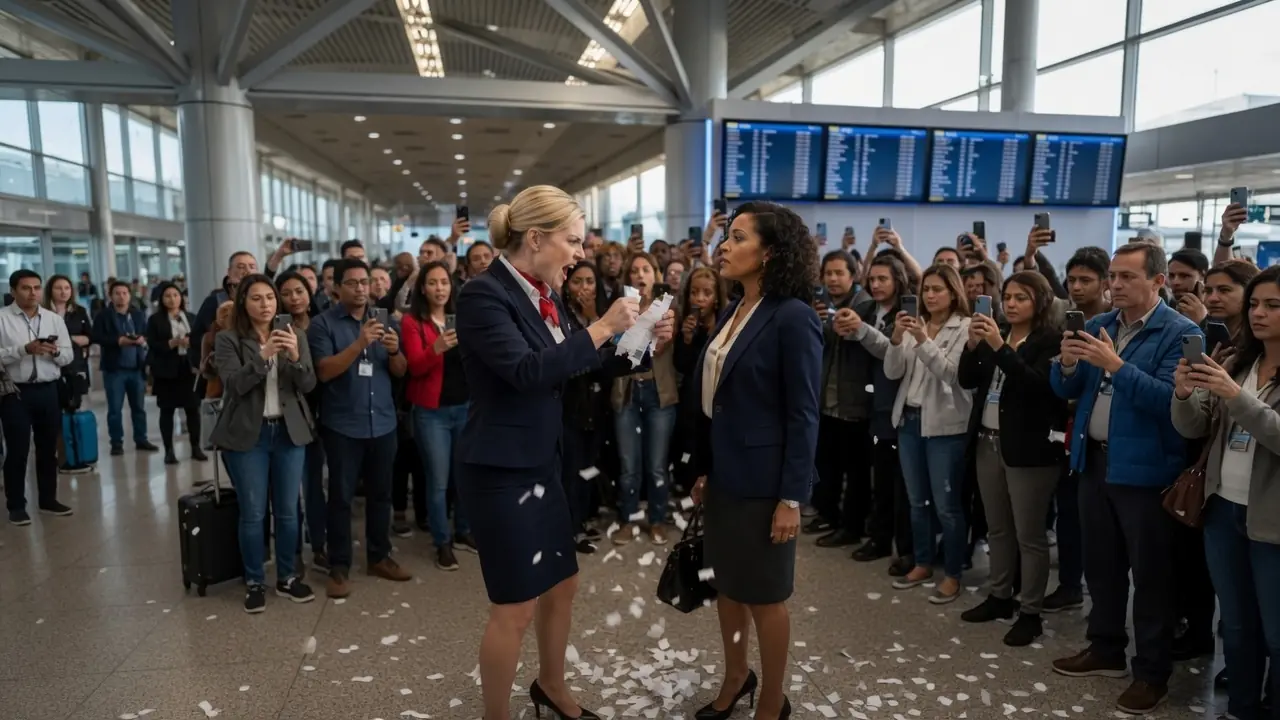
At the center of it all stood Dr. Kesha Washington, a Black CEO in a navy blazer, holding herself so still that her calmness made the entire gate uneasy.
Across from her, Bethany Walsh stood behind the airline counter with a first-class boarding pass pinched between two manicured fingers.
Bethany was the kind of gate supervisor who mistook a badge and a red scarf for authority over people’s dignity.
Her blonde hair was pulled into a tight bun, her smile was sharp, and her voice carried far beyond the counter.
“Come on,” she snapped, lifting the boarding pass higher. “We both know this seat was never meant for you.”
A few passengers shifted uncomfortably, but no one spoke.
Some looked down at their phones, pretending not to hear while recording everything.
Others stared openly, waiting to see whether Kesha would become angry, embarrassed, or small.
But Kesha Washington did not give them the reaction they were expecting.
She had built a career out of walking into rooms where people assumed she did not belong.
At forty-three, she was the CEO of Washington Equity Systems, a national aviation compliance firm that reviewed discrimination, accessibility, and passenger safety complaints for airports and airlines.
She held two graduate degrees, a federal compliance appointment, and a reputation for finding problems powerful people thought they had buried.
But that morning, she had dressed like any traveler: navy blazer, cream blouse, black skirt, small carry-on, and no visible title.
That was the point.
For months, complaints had come from gate C14 at Northlake International Airport.
Passengers of color, disabled travelers, elderly passengers, and customers with lower-priced tickets all described the same pattern.
Extra questioning, sudden “document issues,” lost seat assignments, public embarrassment, and staff using procedure like a weapon.
Kesha had read every complaint twice.
One elderly man had written that Bethany Walsh told him his oxygen machine made “real customers nervous.”
A college student had said her boarding pass was checked six times while others walked through untouched.
A Black business owner had reported being told his first-class upgrade “must have been a system mistake.”
The airline called each incident isolated.
The airport authority called the reports concerning but inconclusive.
Bethany’s internal file described her as “firm, efficient, and protective of premium cabin standards.”
Kesha knew language like that often meant someone had learned to make bias sound like professionalism.
So she came in person.
Her first-class ticket was real, purchased under her legal name with an approved federal audit marker hidden in the reservation system.
Her bag carried a sealed audit order, a federal aviation compliance badge, and a small folder of passenger complaints.
But none of those things mattered until Bethany showed who she was when she thought no one important stood in front of her.
Bethany looked at Kesha’s boarding pass again and scoffed.
“A first-class seat?” she said loudly. “That’s ambitious.”
A soft nervous laugh escaped from somewhere near the coffee stand.
Bethany heard it and grew bolder, feeding on the silence around her.
Kesha kept her hands relaxed at her sides.
“My boarding pass is valid,” she said.
Her voice was low, controlled, and clear enough for nearby passengers to hear.
“If there is a document issue, you can scan it again and call a supervisor.”
Bethany’s smile widened.
“I am the supervisor at this gate.”
She leaned forward, lowering her voice just enough to sound personal but not enough to hide it.
“And I know when something doesn’t look right.”
The crowd thickened around the gate.
A teenager in a gray hoodie lifted his phone from the third row of seats.
An older woman near the window covered her mouth, already sensing something ugly was about to happen.
Behind the counter, a younger airline employee named Mara Chen glanced at Bethany, then at Kesha, her fingers frozen above the keyboard.
Kesha noticed Mara’s fear.
She noticed everything.
The way Mara wanted to speak but did not.
The way another employee suddenly turned away, choosing not to become involved.
Bethany tapped the boarding pass against the counter.
“Where did you get this?”
Kesha’s expression did not change.
“From the airline, when I checked in.”
Bethany rolled her eyes.
“Cute answer.”
She turned the pass toward the crowd as if presenting evidence.
“People try all kinds of tricks for premium seats now.”
Kesha took one slow breath.
“Are you accusing me of fraud?”
Bethany tilted her head, smiling like she had been waiting for that question.
“I’m saying this ticket needs to be verified, and based on your attitude, I’m not comfortable allowing you to board.”
Kesha looked at the gate screen above them.
Flight 447 to Washington, D.C., was scheduled to board in forty-seven minutes.
The delay gave Bethany time, and Bethany clearly believed time belonged to her.
She lifted the boarding pass again, her fingers tightening around both ends.
Then, before anyone could stop her, she ripped it in half.
The sharp tearing sound cracked through the terminal.
Several passengers gasped instantly.
Mara Chen’s face went pale behind the counter.
The teenager’s phone rose higher.
Bethany was not finished.
She ripped the pieces again, then again, letting the scraps drift down like cruel white confetti.
They landed across the polished floor near Kesha’s heels.
Then Bethany stepped forward and crushed several pieces under her designer shoe.
“There,” she said proudly. “Problem solved.”
No one moved.
The entire gate seemed to hold its breath.
Kesha looked at the torn pieces on the floor, then at Bethany’s face.
She did not shout, did not reach across the counter, and did not ask why Bethany had done it.
Instead, she lowered herself to her knees.
The movement was so graceful and deliberate that the crowd grew even quieter.
One by one, she gathered the torn pieces from the floor with steady hands.
Her blazer remained smooth, her posture dignified, and her face unreadable.
That silence made people more uncomfortable than anger would have.
A man near the window whispered, “Something’s wrong here.”
His wife whispered back, “With the airline employee?”
He shook his head. “No. With how calm that woman is.”
Bethany looked irritated that Kesha had not broken.
She snatched the desk phone from beside the scanner and pressed a button.
“Security to gate C14 immediately,” she barked.
Then she looked at Kesha and added loudly, “We have a passenger attempting to board with fraudulent documents.”
The word fraudulent spread through the crowd like smoke.
More phones appeared.
Mara Chen took one step back from the counter, her eyes flicking toward the overhead security camera.
Bethany stood straighter, mistaking the crowd’s attention for support.
Kesha rose slowly with the torn pieces in her palm.
Her knees did not shake.
Her hands did not tremble.
She looked at Bethany as if she were examining a final answer on a test Bethany had already failed.
Bethany crossed her arms.
“I’ve seen enough,” she said coldly.
“You are not getting on that plane.”
The passengers behind Kesha waited for the explosion.
Instead, Kesha asked, “Are you finished?”
The question landed harder than shouting.
Bethany blinked once, then laughed.
“Excuse me?”
Kesha stepped closer to the counter, still holding the torn ticket scraps.
“I asked if you were finished.”
Bethany’s jaw tightened.
“Yes,” she snapped.
“You’re done here.”
Kesha looked down at the torn boarding pass, then smiled slightly.
“Good,” she said softly. “Because now it’s my turn.”
At that exact moment, two airport security officers hurried toward gate C14.
Bethany turned toward them with visible relief, pointing at Kesha before they even reached the counter.
“This passenger presented suspicious boarding documents, became difficult, and refused to cooperate.”
Her voice was practiced, clean, and official enough to sound convincing to anyone who had not watched what happened.
Officer Daniel Reyes looked from Bethany to Kesha, then to the scraps in Kesha’s hand.
His partner, Officer Collins, noticed the phones recording.
“Ma’am,” Reyes said to Kesha, careful but firm, “we need to understand what happened.”
Bethany interrupted. “What happened is simple. She tried to board fraudulently.”
Kesha reached into her handbag.
Bethany’s expression sharpened.
“Don’t reach for anything,” she warned.
Kesha paused and looked at Officer Reyes. “May I remove my identification?”
Reyes nodded cautiously.
Kesha pulled out a black leather credential case and opened it.
Inside was a federal aviation compliance badge, her photograph, her name, and the authority seal that made Officer Reyes’s face change immediately.
Bethany’s smile vanished.
Kesha then removed a sealed document from her bag.
“This is an active federal compliance audit order for gate C14, airline staff behavior, discriminatory boarding practices, passenger handling, and document verification abuse.”
She placed it on the counter beside the torn scraps.
“Dr. Kesha Washington, CEO of Washington Equity Systems, appointed federal aviation compliance investigator for this review.”
The crowd erupted into whispers.
Bethany stared at the badge, then at the audit order, then at the torn pieces of boarding pass.
Her mouth opened, but the confidence had drained out of her face.
Mara Chen covered her mouth with one hand, her eyes filling with sudden relief.
Officer Reyes straightened.
“Dr. Washington, were you conducting a review at the time your boarding pass was destroyed?”
Kesha looked at Bethany.
“Yes. And the entire interaction occurred within the active audit window.”
She turned toward the ceiling camera. “With airport cameras, passenger recordings, and witnesses present.”
Bethany stepped back.
“I didn’t know who she was.”
The sentence left her mouth before she understood how badly it condemned her.
Kesha’s eyes sharpened.
“That is exactly the problem, Ms. Walsh.”
The older woman near the window whispered, “My God.”
A man with a suitcase muttered, “She just said the quiet part out loud.”
The teenager in the gray hoodie kept recording, his mouth hanging open.
By now, people from neighboring gates had begun drifting closer.
Bethany tried to recover.
“I followed procedure.”
Kesha held up the shredded boarding pass.
“Procedure does not authorize you to rip a passenger’s valid ticket, publicly accuse her of fraud without verification, or make comments about who a first-class seat is meant for.”
Her voice remained calm, which made every word more devastating.
Bethany turned toward Officer Reyes.
“You heard me ask questions.”
Reyes looked uncomfortable.
“I also heard you say the seat was never meant for her.”
Bethany’s face flushed. “That’s being taken out of context.”
Kesha placed the torn ticket pieces into a small evidence sleeve from her folder.
“I have the full context,” she said.
She looked toward Mara Chen. “Ms. Chen, please do not delete or alter the gate activity log.”
Mara nodded quickly. “I won’t. I swear.”
Bethany snapped her head toward Mara.
“You don’t answer to her.”
Mara’s fear flickered, but then something changed in her posture.
“Yes, I do right now,” she said quietly.
The crowd heard it, and a few murmurs of approval moved through the gate.
A senior airport operations manager arrived five minutes later, breathing hard from rushing through the terminal.
His name was Thomas Greer, and his face tightened the moment he saw Kesha’s badge.
“Dr. Washington,” he said, extending a hand.
Kesha shook it once. “Mr. Greer, please preserve all footage from gate C14, including audio if available, staff scans, passenger service notes, and radio communications for the last ninety days.”
Thomas Greer nodded.
“Of course.”
Bethany looked between them, realizing the situation had moved far beyond one torn boarding pass.
“I want union representation,” she said suddenly.
Kesha nodded. “You should have it. And every passenger you handled should have had dignity.”
That sentence ended Bethany’s last attempt to look powerful.
Her face hardened with panic.
“I did not discriminate against anyone.”
Kesha opened her folder and removed several printed complaints.
“Then you will have no difficulty explaining why twelve separate passengers described nearly identical treatment at this gate.”
Mara Chen spoke again, her voice trembling.
“There are more than twelve.”
Everyone turned toward her.
Bethany’s eyes widened in warning, but Mara did not look away this time.
“I reported three internally. They never went anywhere.”
Thomas Greer’s expression darkened.
“To whom?”
Mara glanced at Bethany, then at the floor.
“Bethany said I was too sensitive and needed to learn how premium boarding worked.”
The silence that followed was heavy enough to change the room.
Kesha looked at Mara with quiet respect.
“Thank you for saying that.”
Mara wiped under one eye quickly.
“I should have said it sooner.”
Kesha shook her head. “You are saying it now. That matters.”
Bethany was removed from the counter pending investigation.
She did not leave with the confidence she had shown while tearing the boarding pass.
She walked away with Officer Collins beside her, her red scarf crooked, her hands clenched, and the entire gate watching.
For the first time, she looked like someone learning what public humiliation felt like from the other side.
The passengers remained unsettled.
Some looked ashamed.
Some looked fascinated.
Some still held their phones, unsure whether to keep recording or lower them out of respect.
Kesha turned toward the crowd and addressed them without raising her voice.
“I want everyone who recorded this incident to preserve the footage,” she said.
“If you are willing to submit it, airport operations will provide instructions.”
Then she looked across the rows of seats. “And if you have ever been mistreated at this gate, today is the day you stop carrying it alone.”
A woman in a green sweater stood first.
“She did it to my father last month,” she said, voice shaking.
“He uses a cane, and she told him wheelchair preboarding was for people who really needed it.”
A man near the coffee stand raised his hand. “She made my wife show three forms of ID when our upgrade cleared.”
Then another voice.
And another.
The gate became something Bethany had never expected: not a crowd watching humiliation, but witnesses stepping out of silence.
Thomas Greer called for additional staff to take statements.
Officer Reyes remained near Kesha, no longer guarding against her, but protecting the evidence she had revealed.
Flight 447 was delayed.
The airline sent a replacement supervisor and reissued Kesha’s boarding pass with shaking apologies.
Kesha accepted the new pass but did not board immediately.
She stayed until every passenger who wanted to speak had been given a form, a contact, and a promise that their statement would be reviewed outside local gate management.
When boarding finally resumed, the terminal felt different.
Passengers looked at Kesha differently now, but not because she was a Black CEO or a federal investigator.
They looked at her with the uneasy respect people give someone who has forced a room to see itself.
That kind of respect is not comfortable at first.
Mara approached her before boarding ended.
“Dr. Washington,” she said softly, “I’m sorry.”
Kesha looked at the young employee’s anxious face.
“For what part?”
Mara swallowed.
“For not stopping it.”
Kesha’s expression softened.
“You were afraid of losing your job.”
Mara nodded, ashamed. “Yes.”
Kesha placed one hand gently on the counter between them.
“Fear is what systems like this depend on.”
Mara’s eyes filled again.
“But today, you told the truth while you were still afraid. That is not nothing.”
Mara nodded, wiping her face.
Kesha handed her a card.
“Call this number. Directly. Not through your supervisor.”
Mara looked at the card like it was heavier than paper.
“Thank you.”
When Kesha finally walked down the jet bridge, the teenager in the gray hoodie called after her, “Ma’am?”
She turned.
He lowered his phone, suddenly shy. “I recorded the whole thing. I’ll send it.”
Kesha nodded. “Thank you for not looking away.”
On the plane, Kesha sat in seat 2A.
First class was quiet when she boarded.
Some passengers recognized her from the gate and looked down quickly, embarrassed by their earlier silence.
A flight attendant approached with careful professionalism and said, “Dr. Washington, we are very sorry for what happened.”
Kesha looked out the window at the workers loading luggage beneath the aircraft.
“An apology is a beginning,” she said.
“Not a repair.”
The flight attendant nodded, understanding she had not been dismissed, but instructed.
During the flight, Kesha opened her laptop and began writing the preliminary report.
The title was simple: Gate C14 Active Audit Event and Escalation Findings.
She included the destroyed boarding pass, witness count, staff conduct, passenger statements, camera preservation orders, and immediate risk recommendations.
But beneath the formal language, her mind kept returning to one sentence: I didn’t know who she was.
That sentence was the heart of the whole problem.
Bethany believed respect depended on recognizing power.
Kesha believed respect mattered most when no power was visible.
A system that only behaved properly for CEOs, investigators, celebrities, or wealthy passengers was not a respectful system at all.
By the next morning, the video had gone viral.
Millions watched Bethany rip the boarding pass, crush it under her heel, and then go pale when the badge appeared.
People argued online, as people always do, but the footage did not bend.
It showed cruelty, composure, and consequence in one clean sequence.
The airline’s public statement came by noon.
Bethany Walsh was suspended pending termination review.
Gate C14 operations were placed under external audit.
The airline announced mandatory anti-discrimination retraining, but Kesha knew training alone was often the easiest promise to make and the easiest to forget.
So she pushed harder.
Her full report required independent complaint review, random mystery-passenger audits, protected reporting channels for employees, and public quarterly data on denied boarding document disputes.
It also required disciplinary review of managers who ignored earlier complaints.
A gate did not become cruel because of one person alone; it became cruel because many people learned silence was safer than correction.
Three weeks later, Kesha returned to Northlake International.
This time, she arrived openly, wearing her badge and walking beside airport executives who looked nervous enough to listen.
Gate C14 had new staff, new procedures, and a temporary supervisor who greeted every passenger by name when possible.
But Kesha cared less about the performance of improvement than the structure beneath it.
Mara Chen was still there.
She stood taller now, her voice clearer as she helped a passenger with a mobility device preboard without making him explain himself twice.
When she saw Kesha, she smiled nervously but did not look away.
Kesha considered that a good sign.
Thomas Greer met her near the counter.
“We reviewed the ninety-day footage,” he said quietly.
“And?” Kesha asked.
His face tightened. “You were right. It was a pattern.”
Kesha did not look pleased. Patterns were never satisfying when they confirmed harm.
Bethany was terminated the following week.
Two managers received formal discipline for failing to escalate complaints.
The airline created an independent passenger dignity board, not because executives suddenly became noble, but because evidence had forced accountability into the room.
Kesha accepted the progress without mistaking it for victory.
Months later, Flight 447 boarded again from gate C14.
An elderly man with a cane approached the counter slowly, his daughter walking beside him.
Mara smiled, scanned his pass, and said, “You are welcome to board early, sir. Take all the time you need.”
The man’s daughter looked almost surprised by the kindness.
Kesha watched from a nearby seat during a follow-up review.
No one at the gate knew she was auditing that day except airport leadership.
She saw ordinary patience, ordinary respect, and ordinary dignity offered without drama.
That was what systems were supposed to do: make decency routine.
Before leaving, Kesha stood near the same spot where Bethany had torn her boarding pass.
She remembered the scraps falling across the floor, the heel crushing them, and the crowd watching without moving.
She also remembered the moment people began to speak, one after another, until silence no longer protected the wrong person.
That part mattered most.
Public humiliation had drawn the crowd in.
But truth had changed what the crowd became.
They started as spectators.
They ended as witnesses.
Kesha picked up her bag and walked toward her next gate, the federal badge hidden again inside her purse.
Not because she wanted another confrontation, but because the work required seeing people as they were when they thought nobody powerful was watching.
That was where real culture lived.
And if someone like Bethany Walsh ever again decided a first-class seat was “never meant” for someone standing in front of her, Kesha wanted the system to answer before cruelty could finish its sentence.
Not with a viral video.
Not with applause.
But with a standard strong enough to protect the next passenger who did not happen to be a Black CEO, a federal investigator, or anyone famous at all.