The slap sounded louder than the engines.
Vanessa Crowe’s palm struck Curtis Henderson across the face inside the polished cabin of a $68 million private jet preparing to depart Los Angeles. The sharp crack cut through the low turbine hum, stopping the co-pilot halfway through a checklist and making the young cabin assistant near the galley cover her mouth. Curtis’s head turned slightly, but the small white espresso cup in his hand remained perfectly steady.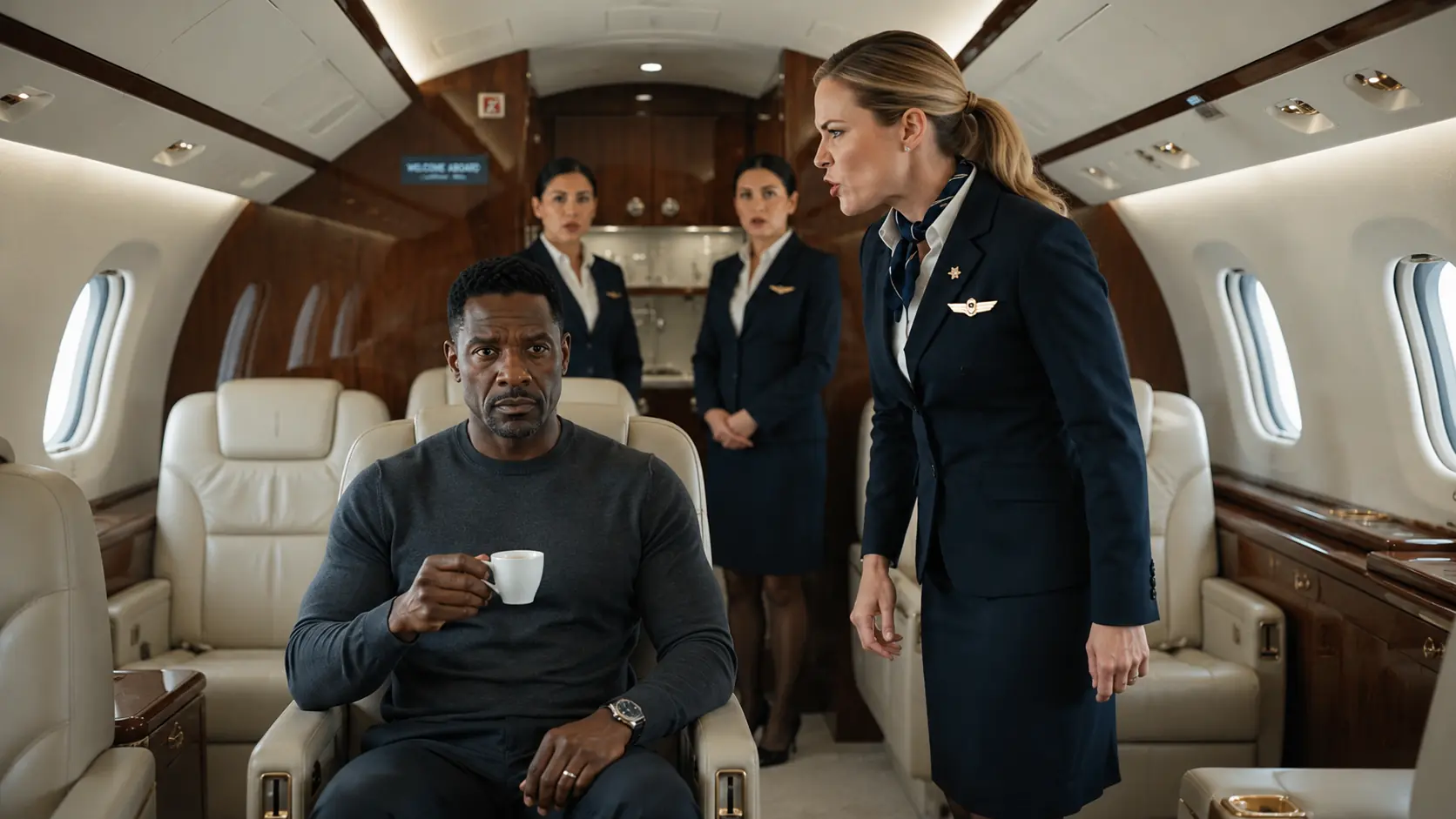
For one frozen second, no one breathed.
Curtis slowly faced Vanessa again. He was a powerful 47-year-old Black American businessman with deep-brown skin, steady dark eyes, close-cropped black hair, and the athletic build of a man who still trained before sunrise. His charcoal sweater, tailored black trousers, discreet watch, and worn leather portfolio looked restrained beside the luxury surrounding him.
Vanessa stood over him with one hand still raised.
Her blonde hair was pinned into a flawless bun, her navy private-aviation uniform was sharply tailored, and polished gold wings gleamed above her heart. She had served celebrities, billionaires, politicians, and professional athletes during twelve years in private aviation. That experience had convinced her she could recognize power on sight.
Curtis did not match the picture in her mind.
“Stand up,” Vanessa ordered, stepping closer. “Or I’ll drag you out myself.”
Curtis placed the espresso carefully on the walnut side table.
“Touch me again.”
His voice was quiet, but every crew member heard it.
Vanessa leaned into his space. “You think I’m scared of you?”
Curtis rose from the cream leather chair until he stood several inches taller than her.
“You should be,” he said. “This jet, this crew, and your badge belong to me.”
Vanessa stared at him before releasing a short, contemptuous laugh. She believed he was bluffing because accepting the truth would mean admitting she had just assaulted the most powerful person aboard the aircraft. Behind her, the junior flight attendant, Maribel Santos, remained motionless beside the galley tablet.
The flight technician near the rear compartment looked down.
Captain Roland Price appeared in the cockpit doorway.
“What happened?”
Vanessa turned immediately, transforming her rage into practiced authority.
“This man boarded without authorization, took the principal passenger’s seat, touched confidential materials, and became aggressive when I asked him to leave.”
Curtis looked at her without expression.
A red mark was developing across his cheek.
Captain Price’s eyes moved from the mark to Vanessa’s still-raised hand.
“Did you strike him?”
“He grabbed me.”
“I did not,” Curtis said.
Vanessa pointed at him. “There. That tone. He’s been threatening me since I found him sitting here.”
Curtis glanced toward Maribel.
The 24-year-old Mexican American cabin assistant looked terrified. She had witnessed the entire confrontation, but Vanessa controlled her schedule, performance reports, and future in private aviation. One statement could protect Curtis and destroy her own career.
Vanessa understood that fear.
“Maribel,” she said sharply, “tell the captain what happened.”
Maribel’s lips parted.
Nothing came out.
Curtis did not pressure her.
Instead, he turned to Captain Price. “Open the passenger manifest.”
Vanessa folded her arms. “I don’t need a manifest to recognize someone who doesn’t belong.”
Curtis’s eyes hardened.
“That sentence is going into the report exactly as you said it.”
Vanessa laughed again, though the sound had weakened.
“What report? You think you’re going to complain to my supervisor?”
Curtis removed his phone from the armrest.
“No. I’m calling yours.”
He selected one contact.
The line connected before the first full ring.
“Elias,” Curtis said. “Freeze departure clearance. Preserve every cabin recording. Lock the crew manifest and send legal counsel to aircraft HGA-One.”
The confidence drained from Captain Price’s face.
Only a handful of senior executives knew the aircraft’s internal designation.
Vanessa looked between Curtis and the captain.
“Who is Elias?”
Curtis ignored her.
“Also notify airport security that no one leaves this aircraft until the passenger-assault report is documented.”
Vanessa stepped toward him again.
“You can’t detain the crew.”
Curtis’s gaze shifted to her raised hand.
“Try the door.”
The jet’s electronic locks engaged with a soft mechanical click.
Maribel looked down at the galley tablet as the screen refreshed. The passenger manifest opened automatically, and a large executive-security notice appeared above seat 1A.
Her eyes widened.
“Captain,” she whispered.
Vanessa spun toward her. “Don’t.”
Maribel read the display anyway.
“Curtis Henderson. Owner and chief executive officer of Henderson Global Aeronautics. Principal passenger. Seat 1A.”
Silence swallowed the cabin.
Captain Price straightened.
The technician near the rear compartment took one involuntary step backward. Vanessa stared at the screen as though the name might change if she refused to blink.
Henderson Global Aeronautics was not merely a charter company.
It manufactured aircraft systems, managed international aviation assets, operated private terminals in six American cities, and employed more than 18,000 people. The company had purchased this aircraft only four months earlier as the flagship of its executive fleet.
The silver plaque beside the entrance displayed its initials.
Vanessa had walked past it hundreds of times.
Curtis picked up his espresso.
“You told me men like me don’t own jets like this.”
Vanessa swallowed.
“I didn’t know who you were.”
“That is not a defense.”
“There was confusion about the manifest.”
“You refused to read it.”
“You looked like—”
She stopped.
Curtis waited.
“Finish the sentence.”
Vanessa glanced toward the crew members, now watching her with open alarm.
“I thought you were unauthorized.”
“Because of my sweater?”
She said nothing.
“My portfolio?”
Still nothing.
“Or my face?”
Captain Price closed his eyes briefly.
Vanessa’s chin lifted. “I protect high-value clients. We encounter people who pretend to belong in restricted environments.”
Curtis gestured around the cabin.
“I boarded through my company’s private terminal, using my biometric clearance. I sat in the seat assigned to me and drank the espresso your junior attendant served me.”
Vanessa looked at Maribel.
The younger woman lowered her eyes.
Curtis continued. “You entered, looked at me, and decided security had failed.”
“I made a mistake.”
“You made several.”
Vanessa’s expression tightened.
“I was doing my job.”
“No. You were performing power for an audience.”
The cockpit radio crackled. An operations controller informed Captain Price that departure clearance had been suspended by executive command. A legal response team and airport-security supervisor were approaching the aircraft.
Vanessa heard the message.
Her posture changed immediately.
The hand that had struck Curtis dropped fully to her side. Her voice softened, losing the sharp authority she had used moments before.
“Mr. Henderson, I sincerely apologize.”
Curtis looked at her.
The apology had arrived only after his identity did.
“You’re sorry I own the aircraft.”
“No. I’m sorry the situation escalated.”
“You escalated it.”
“I felt threatened.”
“I was seated.”
“You refused a direct instruction.”
“An instruction to leave my own jet.”
Vanessa’s eyes moved toward Captain Price, searching for support.
The captain remained near the cockpit entrance, but his face showed no willingness to rescue her.
She tried another approach.
“This environment requires heightened security judgment. I may have interpreted the circumstances incorrectly, but my intention was to protect the passenger.”
Curtis lifted one eyebrow.
“The passenger was me.”
Vanessa had no answer.
The cabin door opened from outside.
Elias Brooks entered first. He was a 52-year-old Black American attorney and chief legal officer of Henderson Global Aeronautics, dressed in a dark suit and carrying a secure tablet. Behind him came an airport-security supervisor, a company human-resources executive, and two members of the executive-protection team.
Elias saw the red mark on Curtis’s cheek.
His expression became colder than the cabin air.
“Was medical assistance requested?”
“No,” Curtis said.
Elias looked at Vanessa. “Who struck him?”
No one spoke.
Maribel’s hands trembled.
Vanessa stepped forward. “There was a misunderstanding.”
Elias turned toward Captain Price. “Was there physical contact?”
The captain took a measured breath.
“I entered after the incident. Mr. Henderson had a visible mark, and Ms. Crowe’s hand was raised.”
Elias looked toward Maribel.
“You were present?”
She nodded.
“Tell me what you witnessed.”
Vanessa’s head turned sharply.
“Maribel, remember that you were busy in the galley.”
Curtis spoke before the younger woman could shrink away.
“That sounded like coaching a witness.”
Vanessa’s face paled.
The human-resources executive began recording notes.
Maribel clasped her hands to stop them shaking.
“Mr. Henderson boarded correctly,” she said. “I checked his biometric confirmation and served his espresso.”
Vanessa stared at her.
Maribel continued.
“Ms. Crowe came from the rear preparation area and asked why he was in seat 1A. I told her I thought she should check the manifest.”
“You said no such thing,” Vanessa snapped.
“I did.”
“Careful.”
Curtis took one step forward.
“You will not threaten her again.”
Vanessa turned toward him. “I’m trying to stop her from lying.”
Maribel’s fear gave way to something firmer.
“I’m not lying.”
The technician near the rear raised his head.
“She told Vanessa to check the manifest,” he admitted. “I heard it.”
Vanessa looked betrayed.
“You were adjusting the cabin panel.”
“I was pretending to.”
The admission surprised everyone.
He continued quietly. “I knew Mr. Henderson was the owner. I recognized him from the company’s annual safety address.”
Curtis studied him.
“Why didn’t you say anything?”
The technician looked ashamed.
“Because she has had employees removed from flight rotations for challenging her.”
Elias entered another note into the tablet.
Captain Price looked at Vanessa. “Is that true?”
“No.”
Maribel spoke again.
“She controls the service evaluations. Three attendants transferred after reporting her.”
Vanessa’s professional composure shattered.
“So now this is a conspiracy?”
“No,” Curtis said. “It’s what happens when fear disappears.”
Elias requested the cabin recording.
The jet’s internal security system stored audio automatically whenever the main door was open or a safety dispute was reported. Vanessa had assumed the system was inactive before engine start.
It was not.
Elias played the recording through the cabin speakers.
Vanessa’s voice filled the aircraft.
“A Black man on a sixty-eight-million-dollar jet? Please. You probably clean the seats for a living.”
No one moved.
The recording continued.
“I’ve served actual billionaires. They don’t look like you.”
Then came Curtis’s calm instruction not to touch his portfolio.
Vanessa’s response followed.
“You don’t give orders on this aircraft.”
The slap sounded again through the speakers.
This time, Vanessa flinched.
Elias stopped the recording.
“That establishes racial harassment, refusal to verify passenger identity, interference with the principal passenger, physical assault, false reporting, retaliation against a subordinate witness, and potential tampering with employee testimony.”
Vanessa’s eyes filled with panic.
“I lost my temper for one second.”
Curtis looked at her steadily.
“You had several minutes to stop.”
She turned toward him.
“I have worked twelve years for this career.”
“And how many people have you humiliated during those twelve years?”
“This was the first incident.”
Elias swiped across the tablet.
“No.”
He displayed a file containing employee complaints, passenger-service concerns, and transfer requests connected to Vanessa. Several had been classified as personality conflicts and closed by a former operations manager.
One Black American technology executive reported being asked repeatedly whether he was an assistant.
A Latino American family was questioned three times about payment after booking a charter.
A casually dressed white American software founder was ordered to wait outside until another employee recognized him.
The pattern was not limited to one race, but race shaped its cruelty.
Vanessa respected visible status.
Anyone who failed to display wealth in a form she recognized became disposable.
Curtis read the first page.
“How did these complaints remain unresolved?”
The human-resources executive answered cautiously.
“They were reviewed by flight operations.”
“Who supervised that review?”
A name appeared in the file.
Graham Crowe.
Vanessa’s older brother.
He had served as a regional flight-services director until retiring six months earlier.
Vanessa looked toward the floor.
Elias understood immediately.
“Your brother closed complaints against you.”
“He determined they lacked evidence.”
“The evidence was buried.”
Vanessa shook her head. “You’re making this bigger than it was.”
Curtis finally set down his cup for the last time.
“You struck a seated passenger because you believed he was beneath you.”
“I didn’t know you were the owner.”
“That makes it worse.”
She looked confused.
Curtis stepped closer, his voice controlled but unforgiving.
“If you had known my name, you would have smiled, served the espresso, and called me sir. Your behavior changed only when power became visible. That means the problem was never stress or confusion.”
He pointed toward seat 1A.
“The problem was what you believed a man in that seat should look like.”
Vanessa’s mouth trembled.
“Please don’t destroy my life.”
Curtis’s expression did not soften.
“You tried to have me arrested on my own aircraft.”
“I was angry.”
“You described me as aggressive after assaulting me.”
“I panicked.”
“You ordered witnesses to support a lie.”
She had no new excuse left.
Curtis turned toward the human-resources executive.
“Terminate her access immediately.”
Vanessa inhaled sharply.
“Mr. Henderson—”
“Collect her company identification, airport credentials, security badge, and aircraft keys.”
“You can’t fire me without a formal hearing.”
Elias answered.
“You are suspended without access pending immediate termination review. Given the recorded assault and witness interference, the company has cause to end employment today.”
Vanessa looked toward Captain Price.
“Roland, say something.”
The captain’s face was grim.
“I should have verified Mr. Henderson’s identity before you ever reached him.”
“You weren’t even here.”
“I knew you had a history of escalating situations, and I continued assigning you lead authority.”
Curtis turned toward him.
“We will discuss that separately.”
Captain Price nodded.
He understood that silence and negligence carried consequences too.
The airport-security supervisor approached Vanessa.
“I need your statement regarding the assault.”
Her eyes widened.
“Assault?”
“The victim has a visible injury, witnesses, and an audio record.”
Vanessa looked at Curtis.
“You’re pressing charges?”
Curtis considered her.
Every person in the cabin waited.
“I haven’t decided.”
She moved toward him.
One of the executive-protection officers stepped between them.
Vanessa stopped.
Curtis looked at Maribel.
“Are you prepared to provide a written statement?”
“Yes, sir.”
“You will not lose flight hours for telling the truth.”
Her eyes filled with relief.
“Thank you.”
“No,” Curtis said. “The company should thank you for doing what senior people refused to do.”
Vanessa was escorted from the jet eight minutes after the slap.
Her gold wings were removed before she reached the terminal.
From the cabin window, Curtis watched her cross the private ramp between two security officers. She no longer looked like the woman who had ruled the aisle as though it were her private kingdom.
Seat 1A remained behind her.
Untouched.
Curtis returned to it, but he did not immediately sit.
He looked around the cabin at the remaining crew.
“This flight is canceled.”
Captain Price nodded. “Understood.”
“Not because I’m afraid to fly with you.”
The captain met his eyes.
“Because this aircraft was supposed to carry us to announce the largest acquisition in our history, and I will not celebrate expansion while our internal culture is rotting.”
The company had been scheduled to acquire Northwest Meridian Aviation, a deal that would add 4,000 employees, three maintenance centers, and a major West Coast terminal network to Henderson Global Aeronautics.
Curtis had spent fourteen months preparing it.
The announcement could wait.
Accountability could not.
He ordered a company-wide review of executive-flight services. Every complaint from the previous five years would be reopened. Current and former crew members would be interviewed by an independent team, and no regional manager could control the process.
Captain Price surrendered command voluntarily pending review.
The technician admitted he had witnessed two previous incidents and remained silent.
Maribel provided a complete statement.
Before leaving the aircraft, Curtis asked her one final question.
“Why did you tell the truth?”
She looked toward the galley tablet.
“Because you called me by my name.”
He waited.
“Most powerful passengers don’t notice junior crew,” she said. “She treated me like I was invisible too. When you told me to do my job, you didn’t sound like you were ordering me around. You sounded like you believed I could make the right choice.”
Curtis nodded.
“Keep making it.”
The next morning, Henderson Global Aeronautics issued a private internal notice confirming Vanessa’s termination. The company did not release Curtis’s name publicly or turn the incident into a marketing campaign.
He refused to profit from humiliation.
Instead, he addressed employees through a live company broadcast.
He appeared without makeup, the faint mark still visible on his cheek.
“Yesterday, I was assaulted aboard an aircraft owned by this company,” he said. “The employee responsible did not know my identity. That detail does not make the incident more shocking.”
He paused.
“It reveals the real problem.”
Thousands of employees watched from offices, maintenance hangars, terminals, manufacturing facilities, and homes across the United States.
“Our standards cannot depend on whether an employee recognizes wealth, title, or influence. A guest who owns nothing deserves the same basic dignity as the person who owns the aircraft.”
Curtis did not mention Vanessa by name.
He spoke instead about systems that rewarded silence, managers who buried complaints, and employees who believed they had to choose between truth and their livelihoods.
“Respect that appears only after status is revealed is not respect,” he said. “It is fear wearing good manners.”
The message spread beyond the company despite being intended for employees.
A short excerpt reached social media.
Industry publications began asking questions.
Curtis declined every request for an interview.
He did not want the story reduced to a powerful owner delivering revenge against an employee. The real issue was larger than one dramatic moment.
His company had failed long before the slap.
It failed when complaints were closed because the accused employee had family in management. It failed when crew members learned that protecting themselves mattered more than protecting passengers. It failed when a junior assistant believed telling the truth could end her career.
Curtis changed the structure.
Independent reporting channels replaced regional complaint reviews. Cabin recordings from serious service disputes could no longer be accessed or deleted by local management. Retaliation against witnesses became grounds for immediate termination.
Executive-flight training also changed.
Employees were shown anonymized scenarios in which passengers wore ordinary clothes, arrived without assistants, or did not match stereotypes associated with wealth. The purpose was not to teach staff to identify hidden billionaires.
It was to stop them from believing hidden billionaires deserved more respect than everyone else.
Maribel was promoted six months later.
Not because she defended Curtis.
Because she demonstrated judgment under pressure.
Captain Price completed an accountability program and returned to flight duty at a lower command level. He accepted the decision without complaint, later admitting that Vanessa’s behavior had continued partly because senior people found confronting her inconvenient.
The technician who remained silent received disciplinary action but kept his position after cooperating fully with the investigation.
Vanessa faced criminal charges for misdemeanor assault.
Curtis did not demand the harshest possible punishment. He provided the evidence and allowed the legal process to proceed without interference.
She eventually entered a plea agreement requiring probation, counseling, and community service.
Her civil claim for wrongful termination failed when the audio recording was introduced.
Months later, Curtis boarded the jet again.
The cabin looked unchanged.
Cream leather.
Polished walnut.
Fresh white orchids.
A silver plaque beside the entrance displaying the initials of Henderson Global Aeronautics.
Maribel greeted him at the door, now wearing senior-flight-service wings.
“Welcome aboard, Mr. Henderson.”
He smiled.
“Curtis is fine.”
She guided him to seat 1A.
A fresh espresso waited beside the armrest.
Curtis sat and looked through the oval window as evening settled over Los Angeles. The Northwest Meridian acquisition had finally closed, strengthening the company without allowing the delayed announcement to damage the deal.
Maribel paused beside him.
“Do you still want the espresso before takeoff?”
“I do.”
She nodded and turned toward the galley.
“Maribel.”
She looked back.
Curtis rested one hand on the worn leather portfolio beside him.
“Who does seat 1A belong to?”
She glanced at the embossed seat number.
“The passenger assigned to it.”
Curtis smiled.
“Exactly.”
The cabin door closed.
The engines rose smoothly, and the jet began moving toward the runway.
Curtis did not think of seat 1A as a throne.
A throne existed to raise one person above everyone else.
To him, the seat represented responsibility.
The power to own an aircraft meant nothing if the people serving aboard it believed dignity depended on appearance. Authority meant little if it protected only the person powerful enough to reveal a name.
Vanessa had looked at a quiet Black man holding an espresso and decided he was an intruder.
Eight minutes later, she learned he owned the aircraft, the company, and the seat from which she had tried to remove him.
But the lesson Curtis carried forward was not that she should have recognized him.
It was that she should never have needed to.