“If you don’t like it, then leave.”
Alyssa didn’t even look up from her phone when she said it.
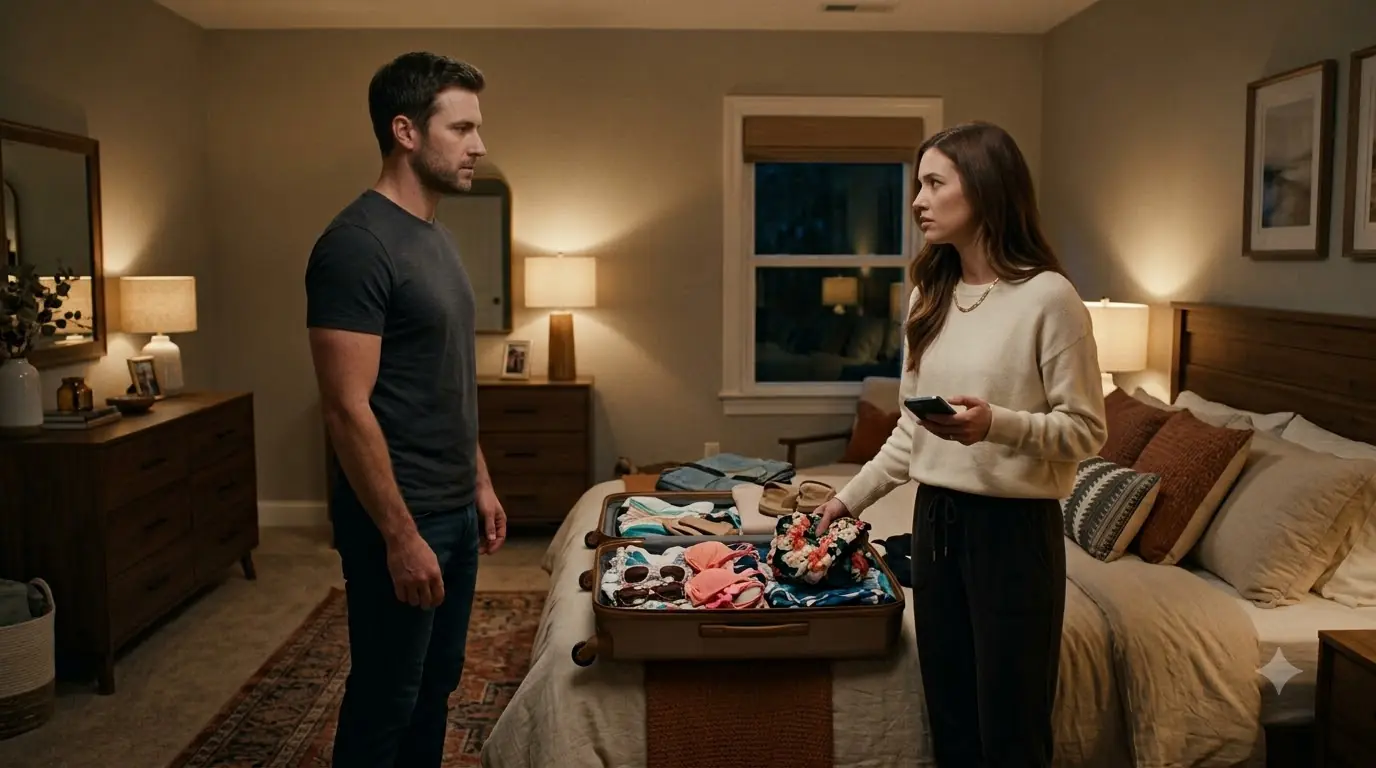
That was the part I remembered most clearly afterward.
Not the words themselves.
Not the argument.
Not even the fact that her half-packed suitcase was sitting open on the kitchen counter while she stood there scrolling through beach clubs and restaurant reservations for a four-night girls’ trip I had mostly paid for.
It was the way she said it.
Casual.
Practiced.
Certain.
Like she was telling me to move out of the way so she could open a cabinet.
“If you don’t like it, then leave.”
The overhead light above our kitchen buzzed faintly, the same way it had for almost a year because Alyssa kept saying the warm designer fixture she wanted to replace it with was “only” eight hundred dollars and I kept refusing to spend eight hundred dollars on a light that already worked.
Her phone screen reflected against her face.
Instagram.
Of course.
She was comparing two white linen outfits while I stood across from her trying to understand how we had gone from a conversation about a three-thousand-two-hundred-dollar resort charge to her casually inviting me to move out of the apartment I paid for.
I’m Jake Morrison.
I was thirty-one when this happened.
Alyssa was twenty-nine.
We had been together a little over three years and living together for just under one.
If you had asked me six months earlier whether I was happy, I probably would have said yes.
Not because that was true.
Because I had become very good at lowering the definition.
Happy meant we hadn’t argued that day.
Happy meant Alyssa had liked the restaurant I picked.
Happy meant I had remembered to comment on one of her posts before she noticed I hadn’t.
Happy meant the electricity was on, the rent was paid, she was in a good mood, and I wasn’t currently being accused of “bringing weird energy” into the apartment because I had asked an inconvenient question.
That night, my inconvenient question had been:
“Why is there a thirty-two-hundred-dollar resort charge on my card?”
Alyssa had sighed before answering.
That sigh.
I hated that sigh.
It made every question sound childish before she even responded.
“I told you about Tulum.”
“You told me you were going.”
“Right.”
“You didn’t tell me you were booking the hotel on my card.”
She looked up for maybe half a second.
“You knew I had to book somewhere.”
“That isn’t the same thing.”
“Jake, don’t start.”
“I’m not starting anything. I’m asking why you charged thirty-two hundred dollars without asking me.”
“It’s split between four people.”
“Then why is the whole amount on my card?”
“We were going to settle it after.”
“When?”
She set her phone down.
That should have felt like progress.
It didn’t.
Alyssa only put her phone down when she wanted to escalate.
“You always do this.”
“Do what?”
“Make everything about money.”
I almost laughed.
“We’re discussing thirty-two hundred dollars.”
“That’s exactly what I mean.”
“What do you think we should discuss instead?”
“The trip.”
“What about it?”
“That I need this.”
“For what?”
“A reset.”
Alyssa said the word with such seriousness that I almost forgot she was talking about four nights at a beach resort with three women she saw twice a month.
“You need a three-thousand-dollar reset?”
“See?”
She pointed at me.
“This is why talking to you is exhausting.”
I stared.
“Because I asked what I’m paying for?”
“You’re obsessed with control.”
There it was.
Control.
One of Alyssa’s favorite words.
If I asked why the grocery bill had doubled, control.
If I wanted to discuss a budget, control.
If I suggested she pay half the streaming subscriptions she used more than I did, control.
If I didn’t immediately say yes to something expensive, control.
Meanwhile, I paid the rent.
Utilities.
Internet.
Groceries.
Her phone bill.
My phone bill.
Most dinners.
Most travel.
Streaming.
Insurance on a few shared items.
Household supplies.
And increasingly, whatever appeared on the supplementary credit card I had given her when we first moved in together.
Alyssa worked.
That was important.
She was not unemployed.
She worked in social media marketing for a boutique fitness company and made around fifty-five thousand dollars a year.
Not huge money for our city.
Not nothing either.
But somehow, over time, her salary became hers.
Mine became ours.
Nobody sat down and declared that arrangement.
It formed slowly.
Like mold.
At first, I paid more because I earned more.
That seemed fair.
I worked in project management for a software company and made almost twice her salary.
When we first moved in, we had agreed I would cover about sixty-five percent of shared expenses.
She would handle the rest.
For the first two months, that is exactly what happened.
Then her student loan payment increased.
“I’m tight this month.”
No problem.
I covered groceries.
Then she wanted to invest more aggressively in her retirement account.
“Technically, this is good for our future.”
Fine.
I covered utilities.
Then she started getting more serious about creating lifestyle content online.
Nothing major.
Outfits.
Restaurants.
Weekend trips.
Fitness.
“Having more disposable money helps me build the page.”
I didn’t fully understand the logic, but I supported her.
Another bill moved to me.
Then another.
Eventually, whenever I brought up the imbalance, she would say:
“You make more.”
As if income erased responsibility.
Then:
“Why does everything have to be transactional?”
Then:
“I thought we were building a life.”
Then the final weapon:
“You’re acting like my dad.”
Alyssa’s father had apparently controlled every dollar in their household when she was growing up.
At least that was how she described it.
So anytime I asked for basic accountability, she treated it as if I were repeating her childhood.
I didn’t want to be that man.
So I backed down.
Over and over.
That was my part in it.
People like to tell stories about toxic relationships as if one person becomes unreasonable overnight while the other remains completely innocent.
Usually, it is more complicated.
Alyssa became entitled.
I became accommodating.
She pushed.
I moved.
She pushed again.
I moved again.
Eventually she no longer recognized any boundary as real because every time she crossed one, I redrew it farther back.
The first year of our relationship had been completely different.
We met through mutual friends at a brewery.
She was funny.
Not curated funny.
Actually funny.
She made fun of the chalkboard menu because half the beers had names that sounded like rejected indie bands.
She worked hard.
Paid for her own drinks.
Drove a compact Mazda with a dent in the rear bumper.
Our first weekend away together was a cabin three hours outside the city.
We split the cost.
She cooked breakfast.
I cleaned.
We hiked.
She wore the same sweatshirt both days and didn’t care how she looked in photos.
That version of Alyssa was the woman I fell in love with.
The change was gradual enough that I kept waiting for her to return.
Maybe work was stressful.
Maybe social media was affecting her.
Maybe moving in had been harder than expected.
Maybe I was being too rigid.
There was always another explanation.
By the third year, nearly every disagreement ended the same way.
Alyssa would escalate until I apologized for bringing it up.
Once, she spent nine hundred dollars on designer luggage because, in her words, she was “tired of looking broke at airports.”
I asked why she had used my card.
She said:
“You offered it for shared expenses.”
“Luggage is not a shared expense.”
“You travel with me.”
“That doesn’t make the suitcase mine.”
“You are exhausting.”
I ended up apologizing.
Another time, she agreed to a twelve-hundred-dollar dinner table for the apartment without asking.
When I objected, she called me cheap.
I paid it anyway.
So on the night of the Tulum argument, Alyssa had every reason to believe the pattern would repeat.
She would push.
I would protest.
She would accuse.
I would doubt myself.
Eventually I would apologize.
Then pay.
That was why she said it so casually.
“If you don’t like it, then leave.”
She didn’t think it was a decision.
She thought it was a threat she controlled.
I looked at her.
For maybe ten seconds, neither of us said anything.
The old version of me was already forming a response.
I could explain that I wasn’t trying to control her.
I could say I supported the trip but needed communication.
I could apologize for my tone.
I could offer some compromise.
Maybe she reimbursed me over three months.
Maybe I covered half.
Maybe we agreed to discuss large purchases in the future.
I had given versions of that speech dozens of times.
Then something inside me went quiet.
It wasn’t rage.
I wish it had been.
Rage would have been easier to understand.
It felt more like reaching the end of a contract and realizing there was nothing left to negotiate.
I looked around the kitchen.
At the apartment.
At her suitcase.
At the expensive skincare products spread across the counter because she was packing.
At the phone I paid for.
At the bottle of wine I had bought.
At the refrigerator full of groceries I had purchased that afternoon.
Then I looked back at her.