The first silver fish struck the muddy water, disappeared, and left a widening circle beneath Walter Patterson’s tractor.
For a moment, he seemed too surprised to laugh.
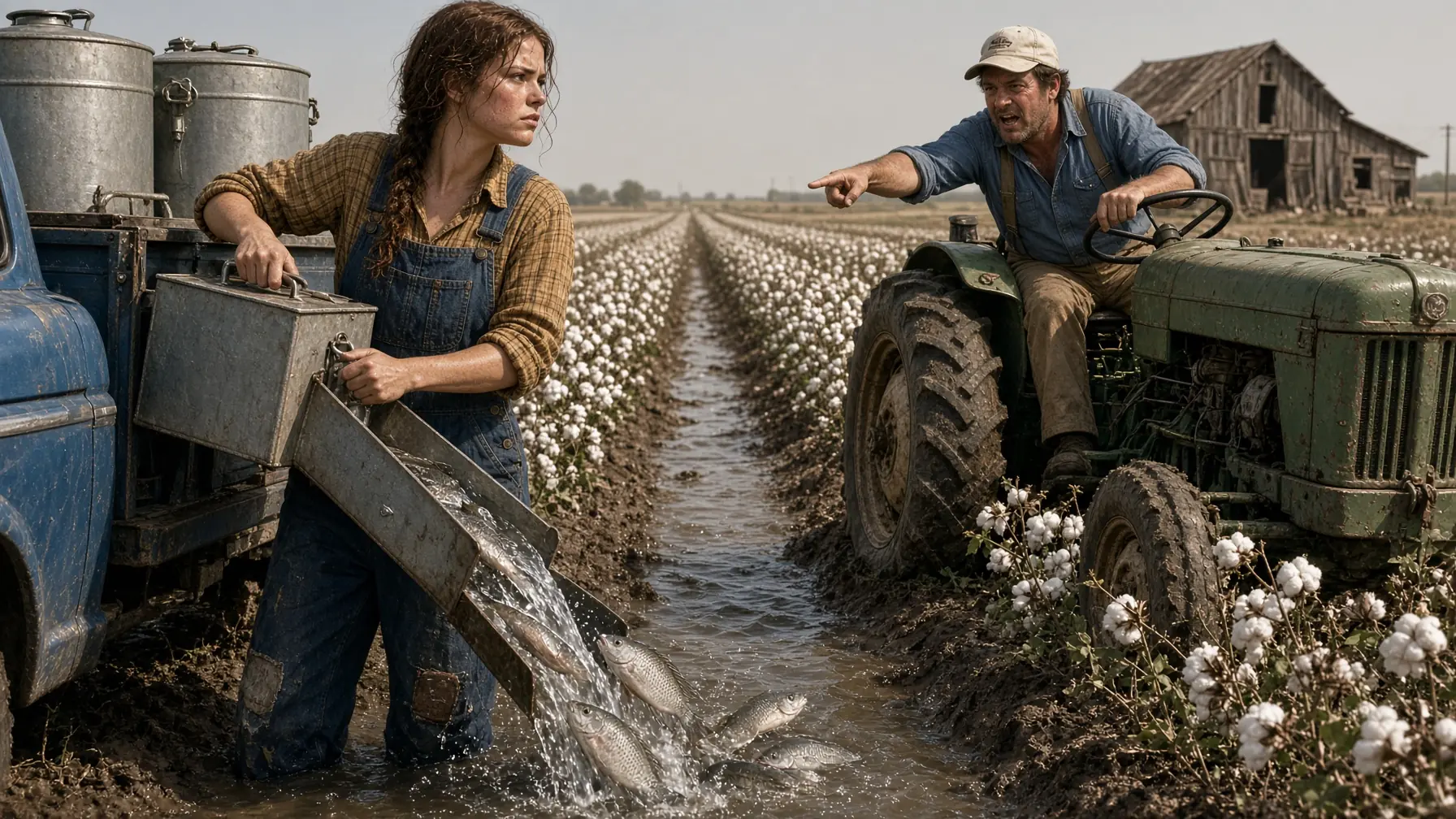
Della Marsh stood beside her father’s old Ford pickup with both hands on the tank’s release handle. Transport water rushed through the short chute, carrying flashes of silver down the gentle slope into the irrigation ditch. Her patched overalls were wet below the knees, and a loose strand of chestnut hair clung to her freckled cheek.
Then Walter settled back on his tractor seat.
“Your last dollar, dumping fish into a dead cotton ditch?”
His voice carried across the pale rows toward the leaning barn. Della kept her eyes on the chute, watching to make sure no fish caught against its edges.
She had spent three weeks preparing for this moment.
Walter had spent three weeks making certain everyone knew it would ruin her.
“I’m replacing what men like you poisoned,” she said.
The amusement left his face.
Three weeks earlier, Della had found her father sitting at the kitchen table with an unopened envelope beneath his coffee cup.
He had placed the cup carefully over the bank’s name, as though covering the printing might prevent her from recognizing the paper. His injured right hand rested in his lap. With his left, he was trying to turn a spoon that had already stirred the coffee enough.
Della set down the basket of washing.
“How long has that been here?”
“Since yesterday.”
“The postman didn’t come yesterday.”
Her father stopped moving the spoon.
Outside, heat pressed against the screen door. The cotton nearest the house should have looked stronger by then, but its leaves hung pale above dry, uneven ground.
Della walked around the table and lifted the coffee cup.
“I was going to tell you,” he said.
She opened the envelope.
She read the first page standing. Before she reached the second, she pulled out a chair.
The letter did not say they had lost the farm. It said enough other things that the distinction offered very little comfort.
There were missed payments. There was an amount required to bring the account current. There was a date printed halfway down the page, and beneath it language her father had circled so lightly that she nearly missed the pencil.
“You spoke to them?” she asked.
He nodded.
“What did they say?”
“That I ought to consider an arrangement.”
“With whom?”
Her father looked toward the window.
A tractor was moving beyond the far boundary, raising a thin veil of dust.
“Walter.”
Della laid the paper flat.
Her father had injured his hand in the spring, badly enough that ordinary work now required more time, more care, and sometimes help he did not want to request. The accident had not created every problem on the farm, but it had removed the small margin that used to keep the other problems manageable.
A repair had waited too long. Planting had been delayed in one section. Money borrowed against a promising year had gone toward surviving an ordinary bad one.
Now Walter Patterson had an arrangement.
“What kind?” Della asked.
“He works the place.”
“And we do what?”
“Stay in the house.”
“For how long?”
Her father said nothing.
She looked at the letter again. The date seemed closer each time she read it.
That afternoon, she found Walter beside his equipment shed, sorting tools on a board laid across two oil drums. He wore a faded blue work shirt, and his cream cap was dark around the band.