"Put it back," Zuri Hail said. "You didn't even ask."
The nine-year-old strained against her seat belt, one hand gripping the armrest between her and her twin sister. Across the aisle of Kestrel Air Flight 812, a woman in cream cashmere had just taken a plate from Immani's tray and set it in front of herself. On that plate was a slice of chocolate birthday cake, crowned with a strawberry. The woman was smiling as though she had done something amusing.
"This cabin costs more than your mother makes in a month, sweetheart," she told the girls.
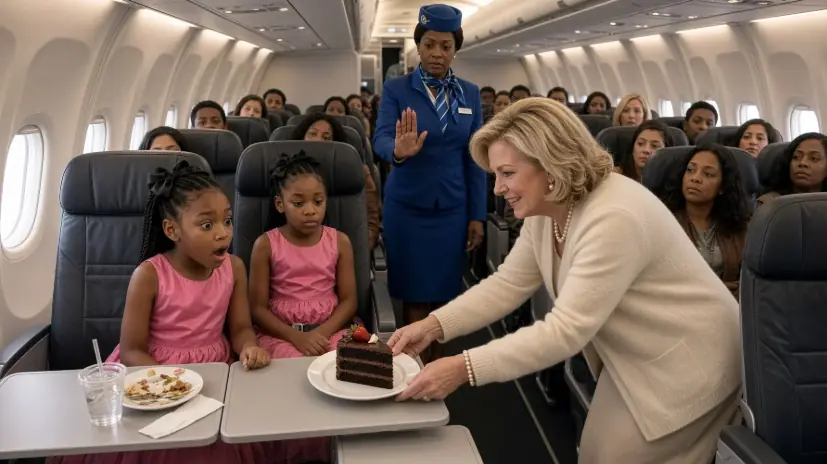
Immani sat perfectly still. The plate was gone, but her eyes remained fixed on the space where it had been. At thirty-six thousand feet, with their mother hundreds of miles away and nobody they knew seated nearby, the twins suddenly felt very small.
The flight attendant stopped in the aisle. Other passengers began to turn. The woman picked up a fork, pressed its point into the cake, and told Zuri to sit down.
Then Immani spoke, so softly the nearest passengers leaned forward to hear.
"That wasn't dessert. That was the only thing my mom could give us today."
The fork went still. The flight attendant raised one hand and stepped between the rows. A few minutes later she would tell the woman that someone would be waiting at the aircraft door after landing. But the consequences of that afternoon would extend far beyond the flight, and none of the people watching understood why the cake mattered so much.
Eleven days earlier, in a small kitchen illuminated by a laptop screen, the twins' mother was trying to make an impossible birthday feel special.
Her mother had been discharged from a rehabilitation facility on the 11th and could not be left alone. Ada's shift rotation at the hospital could not be moved again. She had already moved it twice that quarter and had been told kindly but unmistakably that there would not be a third time. So the twins were going to their aunt Cecilia's for the week alone on a plane for the first time in their lives on the day they turned nine. Ada had cried about it exactly once in her car in a parking garage for 4 minutes and had then stopped and gone back inside.
So she did what she knew how to do: she worked the numbers. She was not a person with money. She was a person with a spreadsheet, a nursing salary, and a talent for finding the exact place where a small amount of money produced a disproportionate amount of good. She had upgraded exactly one thing about that trip, and she had thought about it for 6 days before she did it. She'd upgraded their seats.
Not for the leg room, not for the free drinks she wasn't there to have. She upgraded because the unaccompanied minor policy put them in the forward cabin where the crew could see them. Because the seats were adjacent instead of split and because, and this was the part she would never have said out loud to anyone, she wanted her daughters to spend their 9th birthday somewhere that felt like being taken care of. It cost $481. It came out of the account she'd been putting $11 a week into since the twins were four.