“It’s a navigational aid.”
James Hodges stopped on the sidewalk and turned toward the deputy who had called to him. At sixty-one, he had become accustomed to explaining the folded cane in his pocket, though usually the explanation ended with a nod and an apology.
This time, the deputy kept asking questions.
He could make out the shape of her uniform and the movement of her hands more easily than the details of her face. His vision was limited, but his understanding of what she was saying was not.
She thought he had a gun.
He told her she was looking at a walking aid.
Then he asked what crime she suspected him of committing.
The question changed the encounter. What had begun with an object in his pocket was becoming an argument about his willingness to accept her authority.
James could feel it happening, even before he fully understood where it would lead.
He would show the cane.
He would show it again to her supervisor.
And despite the fact that both deputies would have the opportunity to see what it was, he would leave the sidewalk in handcuffs.
The morning had not begun with anything that resembled trouble.
James was walking in Lake City, Florida, on October 31, 2022. A legally blind veteran, he used a folding navigational cane when he needed it, and that morning the aid was secured in his back pocket. Deputy Jayme Gohde stopped him because she believed the object might be a firearm. The encounter was captured by her body camera. news4jax.com
To somebody unfamiliar with visual impairment, the folded cane could raise a question.
Why was he carrying it instead of using it?
Why could he walk a section of sidewalk without sweeping it in front of him?
How much could he see?
For James, those questions belonged to ordinary life. They became exhausting only when someone treated an explanation as an excuse.
Legal blindness did not mean the world disappeared completely.
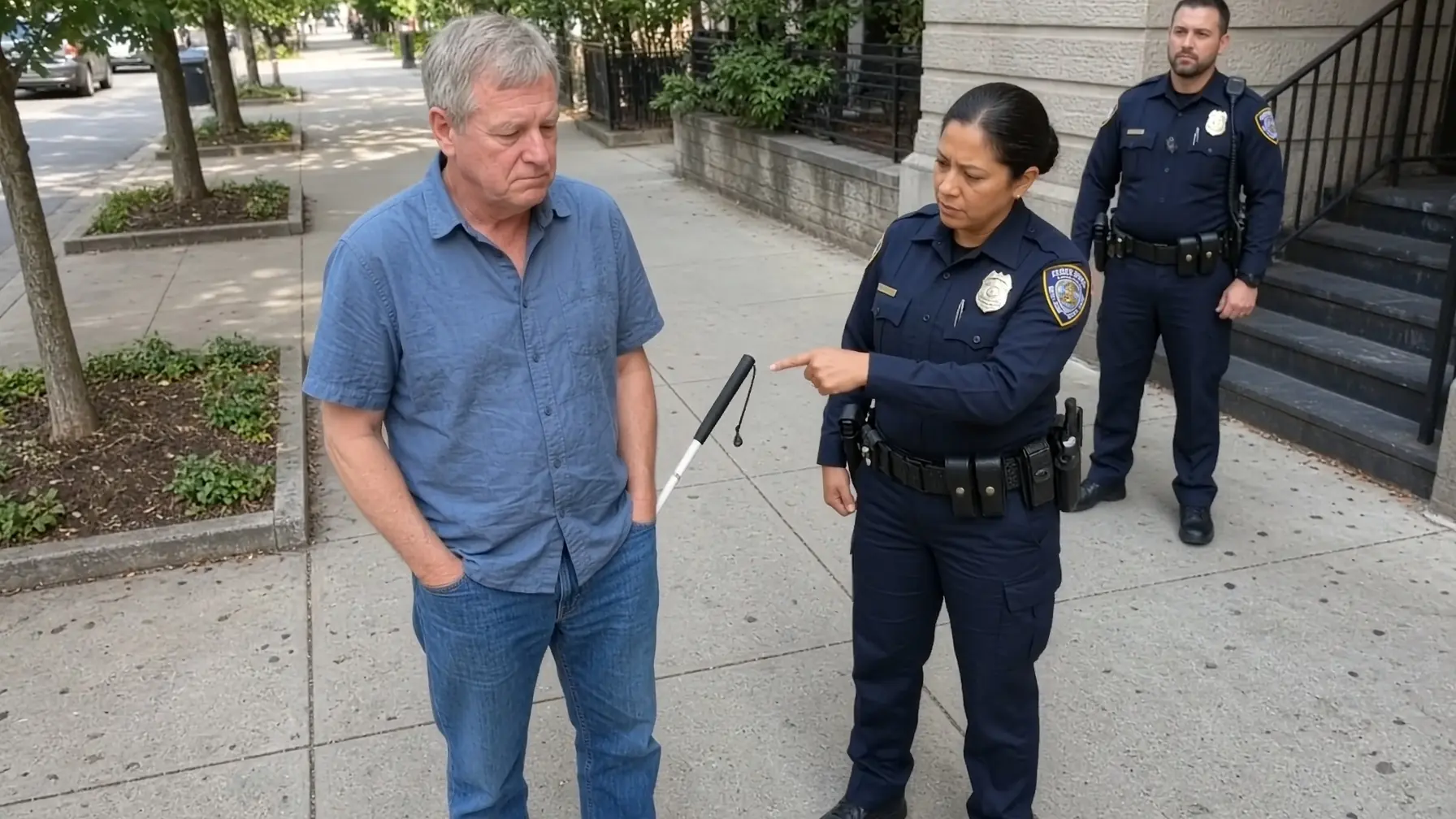
It meant the information his eyes gave him was limited and unreliable. Shape, contrast, movement, and familiarity could help him navigate one place while offering little assistance in another.
He could recognize a route without being able to read a small sign.
He could find his way along a familiar sidewalk and still need help detecting an obstacle or judging an unfamiliar crossing.
The cane was there for the moments when the visual information was not enough.
Folding it did not remove his disability.
Carrying it in his pocket did not transform it into something else.
He had learned to judge when he needed it, just as he had learned to pause when the light changed or the ground ahead became uncertain. Those judgments were part of his independence.
That morning, he was making them for himself.
Then a deputy began making a different judgment about him.
James turned when she addressed him.
He expected a question he could answer.
The object in his back pocket had caught her attention. She wanted to know what it was, and he told her.
A navigational aid.
There should have been room in the encounter for that answer to matter.
Instead, the conversation moved quickly toward his name and date of birth.
James asked why.
He did not answer with the deferential ease the deputy appeared to expect. His tone was irritated, and he challenged the way she was treating him.
He was not trying to charm her.
He wanted to understand why an ordinary walk had become an investigation.
The distinction would matter later.
A person did not have to be pleasant for the object in his pocket to be a cane. James’s sharpness could make the exchange uncomfortable, but it could not change what he was carrying.
Gohde continued speaking.
James asked about her suspicion.
She explained that the object looked like a firearm and that she had stopped him to check it.
He asked whether she had determined that it was not one.
She had not.
There it was: a question still open, with an answer available.
James removed the folded aid and presented it.
He did not reveal a weapon.
He revealed the thing he had already named.
The cane’s sections, joints, and folded shape could now be examined outside the pocket that had obscured them. Whatever uncertainty had existed at a distance, the object was no longer hidden.
James waited for the encounter to change.
He expected the deputy to acknowledge what he had shown her.
Instead, the discussion continued.