Nathan Carter knew something was wrong before he even shut the driver’s door.
It was the backpack.
Bright pink.
Sophie had chosen it herself at the beginning of the school year after spending almost forty minutes comparing every backpack in the store.
Nathan remembered standing beneath harsh fluorescent lights while his seven-year-old daughter moved from one rack to another with the seriousness of someone choosing equipment for an expedition across Antarctica.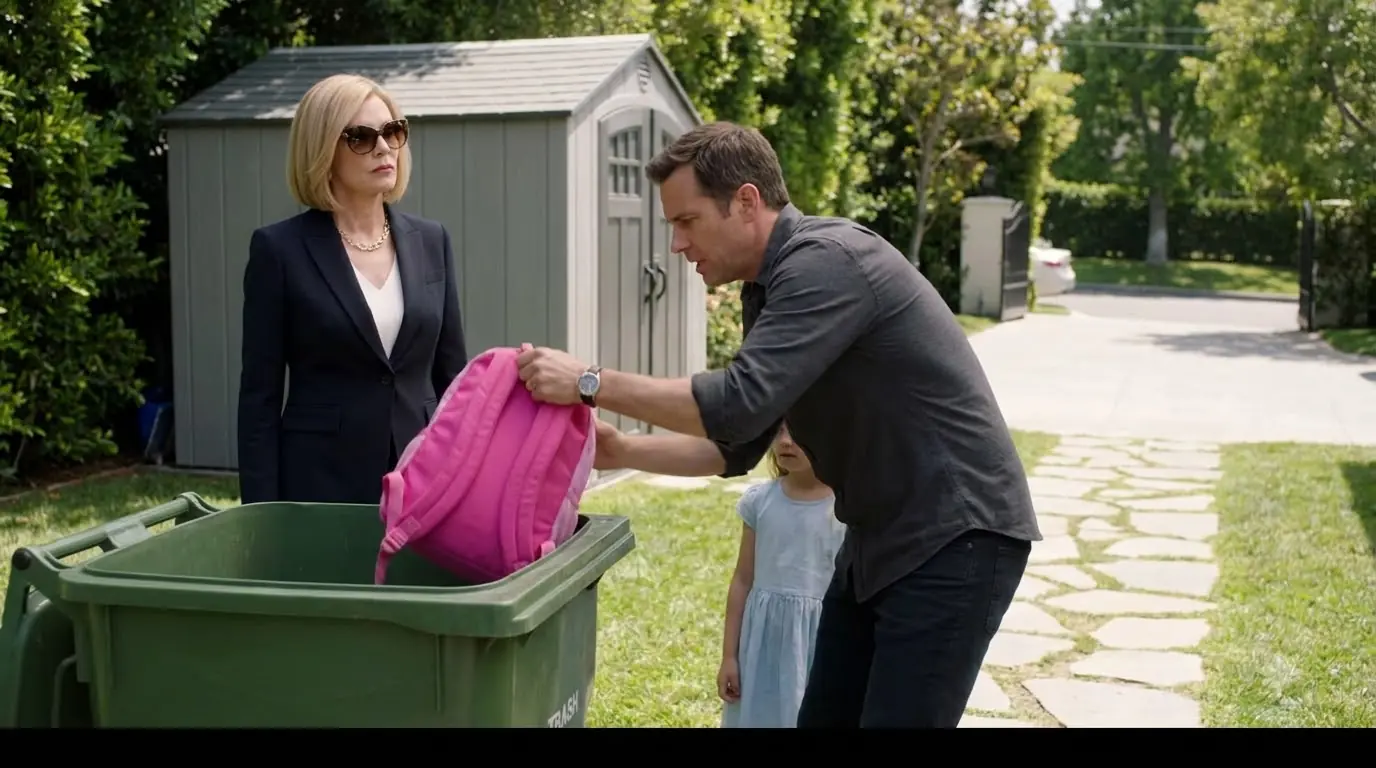
The blue one had too few pockets.
The purple one was “too shiny.”
A gray backpack with stars had almost won until Sophie discovered the zipper was shaped like a heart.
Then she found the pink one.
Not pale pink.
Not soft rose.
Bright, almost impossible-to-miss pink.
It had two large front pockets, silver zipper pulls, and a tiny embroidered sunflower near the bottom.
Sophie hugged it against her chest and announced, “This one looks happy.”
Nathan bought it immediately.
Now that same backpack was hanging halfway out of the green trash bin beside the garden shed.
Nathan stared at it from the driveway.
His first thought was that Sophie must have spilled something on it.
Paint.
Juice.
Mud.
Something children could turn into a disaster in under thirty seconds.
Then he heard crying.
Not ordinary frustration.
Not the dramatic sobbing Sophie occasionally produced when she lost a board game or was told she had to stop drawing and take a bath.
This was quieter.
Broken.
Nathan slammed the car door and started down the stone path.
“Sophie?”
The crying stopped instantly.
That frightened him more.
He rounded the corner of the house.
His daughter stood beside the shed.
Her long light-brown hair was tangled around her face.
Her cheeks were red.
Her hands were clenched into the front of her pale-blue school dress.
Rebecca stood three feet away.
Burnt-mustard blazer.
Crisp white blouse.
Black trousers.
Large dark sunglasses.
Perfect blonde bob.
Even in the middle of their own backyard, Rebecca looked prepared to walk into a charity luncheon.
She turned toward Nathan.
Her entire expression changed.
Only for a second.
But Nathan saw it.
The tension disappeared.
Her shoulders lowered.
The sharpness around her mouth softened.
“Nathan.”
He kept walking.
“What happened?”
Rebecca answered first.
“Nothing.”
Sophie looked at him.
Nathan stopped beside her.
His daughter’s lower lip started shaking again.
He immediately dropped to one knee.
“Sophie.”
She stepped toward him.
Not enough to hug him.
Enough to place him between herself and Rebecca.
Nathan noticed.
He had noticed similar things before.
Small things.
Sophie leaving the kitchen when Rebecca entered.
Sophie asking whether Nathan would be home before dinner.
Sophie suddenly becoming quiet when Rebecca came near.
Every time Nathan had asked, Rebecca had an explanation.
She’s adjusting.
She misses having you to herself.
She’s testing boundaries.
She’s seven.
Nathan had believed some of it.
Maybe too much.
“What happened?” he asked again.
Sophie pointed toward the green trash bin.
“She threw my backpack away.”
Rebecca exhaled loudly.
“Sophie.”
Nathan turned.
Rebecca removed her sunglasses.
Her pale eyes were irritated rather than concerned.
“She’s being dramatic.”
Nathan looked toward the trash.
“Her school backpack is in the garbage.”
“Yes, because she put it there.”
Sophie’s head snapped up.
“No!”
Rebecca’s eyes hardened.
Nathan saw the change.
Rebecca said:
“Enough.”
Sophie recoiled.
Nathan stood slowly.
“Rebecca.”
“What?”
“Let her speak.”
“I’m trying to stop her from lying to you.”
Sophie grabbed the back of Nathan’s shirt.
Nathan felt the fabric tighten.
His stomach turned.
Rebecca pointed toward the child.
“This is exactly what I’ve been telling you about. The second you walk through the door, she turns everything into a performance.”
Nathan looked at Sophie.
Seven years old.
Shoulders shaking.
Fingers locked around his shirt.
He looked back at Rebecca.
“What happened before I got here?”
Rebecca folded her arms.
“She was angry because I told her she couldn’t keep leaving junk around the house.”
“My backpack isn’t junk,” Sophie whispered.
Rebecca ignored her.
“She carried it outside, tossed it near the bin, and now that you’ve arrived, suddenly I’m the villain.”
Sophie’s voice rose.
“No!”
Nathan held up one hand.
“Okay.”
He went to the trash bin.
Rebecca followed.
“Nathan, seriously?”
He opened the lid.
The smell of grass clippings and garden soil came up first.
The pink backpack sat on top.
Not near the bin.
Inside it.
He lifted it carefully by one strap.
The bottom had a smear of dirt, but otherwise it appeared undamaged.
Nathan set it on the stone path.
Sophie ran toward it.
Rebecca said sharply:
“Leave it.”
Sophie stopped instantly.
Nathan turned.
Rebecca seemed to realize what she had done.
Her voice softened.
“I mean, Nathan hasn’t checked what’s in it.”
Sophie looked at him.
“My school papers.”
Rebecca rolled her eyes.
Nathan noticed that too.
“What papers?”
Sophie hesitated.
Rebecca answered:
“Old worksheets.”
Sophie shook her head.
“Not just worksheets.”
Nathan looked down at her.
“What else?”
Rebecca stepped closer.
“Can we please go inside and have a normal conversation without encouraging this?”
Nathan did not move.
Sophie whispered:
“My teacher gave me something.”
The backyard seemed to become quieter.
Nathan said:
“What?”
Sophie swallowed.
“For you.”
Rebecca gave a short laugh.
“There is nothing in that bag for you.”
Sophie looked frightened again.
Nathan saw it.
“Who is your teacher?”
Sophie looked confused.
“You know Miss Ellis.”
“I know.”
“I’m asking because I want you to tell me.”
“Miss Ellis.”
“And she gave you something for me?”
Sophie nodded.
Rebecca interrupted.
“She’s confused.”
Nathan stared at his wife.
“How do you know?”
Rebecca’s mouth tightened.
“Because teachers email parents.”
“Sometimes.”
“And I check the school app.”
Rebecca’s eyes flickered.
A small movement.
Nathan almost missed it.
For months, Rebecca had handled most school communication.
Nathan worked construction management for a regional development company. His days often started before seven and ended after six.
When he married Rebecca eighteen months earlier, her willingness to help with schedules initially felt like relief.
She remembered field trips.
Doctor appointments.
Parent forms.
Lunch accounts.
Nathan had been raising Sophie alone since the death of Sophie’s mother, Laura, four years earlier.
He had survived grief by turning life into lists.
Breakfast.
School.
Work.
Pickup.
Dinner.
Homework.
Bath.
Bed.
Repeat.
Rebecca seemed to understand structure.
At first.
Then things subtly changed.
Nathan stopped receiving school notifications.
Rebecca explained that she had updated the primary email because his inbox was too crowded.
Parent-teacher meetings appeared on the calendar after Rebecca had already attended.
She would summarize afterward.
Sophie is doing well.
A little sensitive.
Needs more consistency.
Nathan accepted it.
He wanted to believe that accepting help did not make him a worse father.
Now he looked at the backpack.
Then Rebecca.
“Where’s my phone?”
Rebecca frowned.
“What?”
“My phone.”
“In your pocket?”
Nathan pulled it out.
He opened the security application.
Three years earlier he had installed cameras after several package thefts in their neighborhood.
Front door.
Driveway.
Side gate.
Backyard.
The backyard camera mostly existed to monitor the pool when Sophie played outside.
Nathan rarely reviewed it.
Rebecca stared at the screen.