Margo Sullivan did not look at Byron Palmer’s invitation.
He offered it twice.
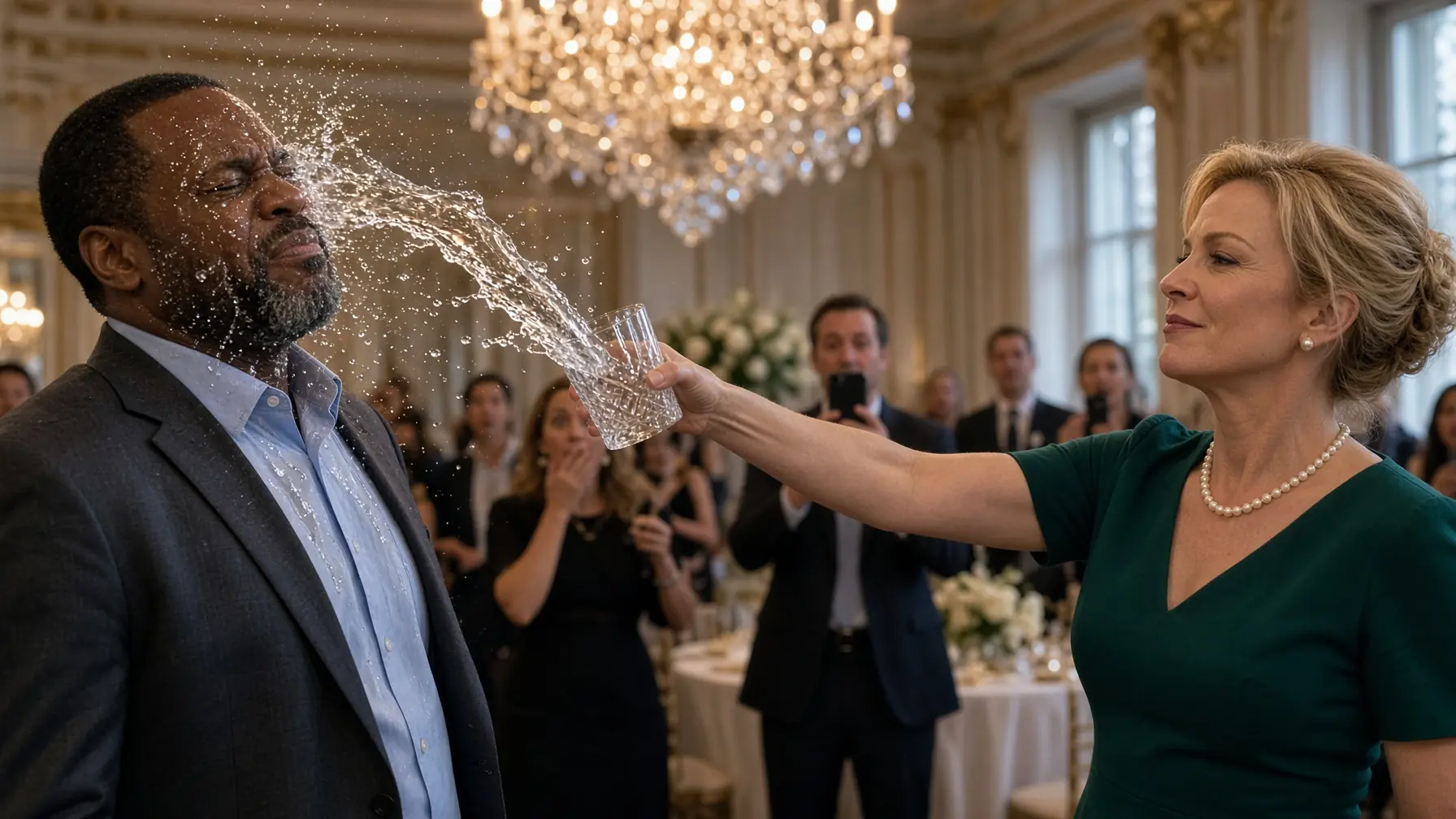
The first time, she kept her eyes on his suit. The second, she looked past him toward the other guests, as though allowing him to produce a piece of paper would make the conversation more important than she intended it to be.
“You need to leave.”
Byron lowered the invitation without putting it away.
Behind her, conversation continued beneath the crystal chandeliers. Someone laughed near the polished bar, and a server moved between white-linen tables with a tray balanced carefully in one hand.
The ballroom was large enough to hold several conversations at once.
Margo seemed determined to make theirs the one everyone remembered.
Byron had arrived at the Washington hotel with no expectation of becoming the center of attention.
He was forty-five, solidly built, with closely cropped hair and a neatly trimmed beard. His charcoal suit was simple, his pale blue shirt freshly pressed, and his black shoes plain.
He had chosen the clothes without much difficulty.
The morning required him to attend a reception.
He dressed for a reception.
Nothing about that seemed complicated until Margo began examining him as though the clothes were evidence in a case she had already decided.
He could still remember standing in front of the mirror before leaving.
He checked his collar, brushed something from one sleeve, and made sure he had what he needed.
There was a small crease near the bottom of the jacket.
He considered dealing with it.
Then he decided it did not matter.
The suit was clean.
It fitted.
He was not going to spend half the morning making an ordinary garment responsible for how other people chose to treat him.
He had learned that lesson slowly.
There were rooms where people noticed whatever they expected to find. If they wanted polish, they found it in a familiar face.
If they wanted a reason to dismiss someone, they could discover one in a shoe, a sleeve, a pause, or the way a person answered a question.
Byron did not arrive expecting that kind of room.
He also did not believe he could dress carefully enough to guarantee it was not one.
So he checked the invitation, placed it where he could reach it, and left.
The journey to the hotel was uneventful.
He had time.
That pleased him.
He disliked arriving at something already irritated by the route there.
A delay could become a tone.
A tone could become an impression.
Before a person knew it, the first conversation of the day was carrying frustration that belonged somewhere else.
He wanted to enter quietly.
Check where he needed to go.
Find a place to stand until the reception settled into whatever shape it was going to take.
He was willing to listen.
He had not come needing everyone to know who he was.
At the hotel entrance, a member of staff held the door for someone carrying more bags than hands.
Byron waited rather than step around them.
When there was room, he went inside.
The lobby was bright, with daylight reaching across polished surfaces and the soft, controlled sound of a place where people tried not to make ordinary business look hurried.
He paused near a sign directing guests toward the ballroom.
Then he followed the indicated route.
There was a reception table outside the doors.
A woman behind it asked for his name.
“Byron Palmer.”
She checked what was in front of her.
Looked again.
Then smiled.
“Good morning.”
“Morning.”
She gave him the information he needed without making the exchange difficult.
He thanked her.
She directed him toward the ballroom.
That mattered later.
Not because the welcome had been especially warm.
Because it was ordinary.
His arrival had already been handled by someone whose task was to handle arrivals.
He had not slipped through a side entrance.
He had not followed a group without checking in.
He had given his name and been directed inside.
Margo would later speak as though none of that could have happened unless he had somehow persuaded the building to make a mistake.
Byron entered the ballroom with the invitation still close at hand.
He did not put it away immediately because he assumed someone might ask for it again.
Large events could be disorganized.
He had no objection to helping an overworked person verify something twice.
The room looked carefully prepared.
Crystal chandeliers above the tables.
White linen falling in clean lines toward the carpet.
Glassware arranged with enough space between settings that the tables seemed deliberately unhurried.
Near the bar, people stood in small groups whose arrangements changed as others arrived.