The first thing the young woman noticed about the western country was how much room it gave a person to disappear.
The land stretched so far beneath the hard blue sky that a farmhouse could vanish behind one low ridge and leave nothing but dust, cactus, and wind.
She had imagined that kind of distance would make her feel free.
Instead, it made her feel exposed.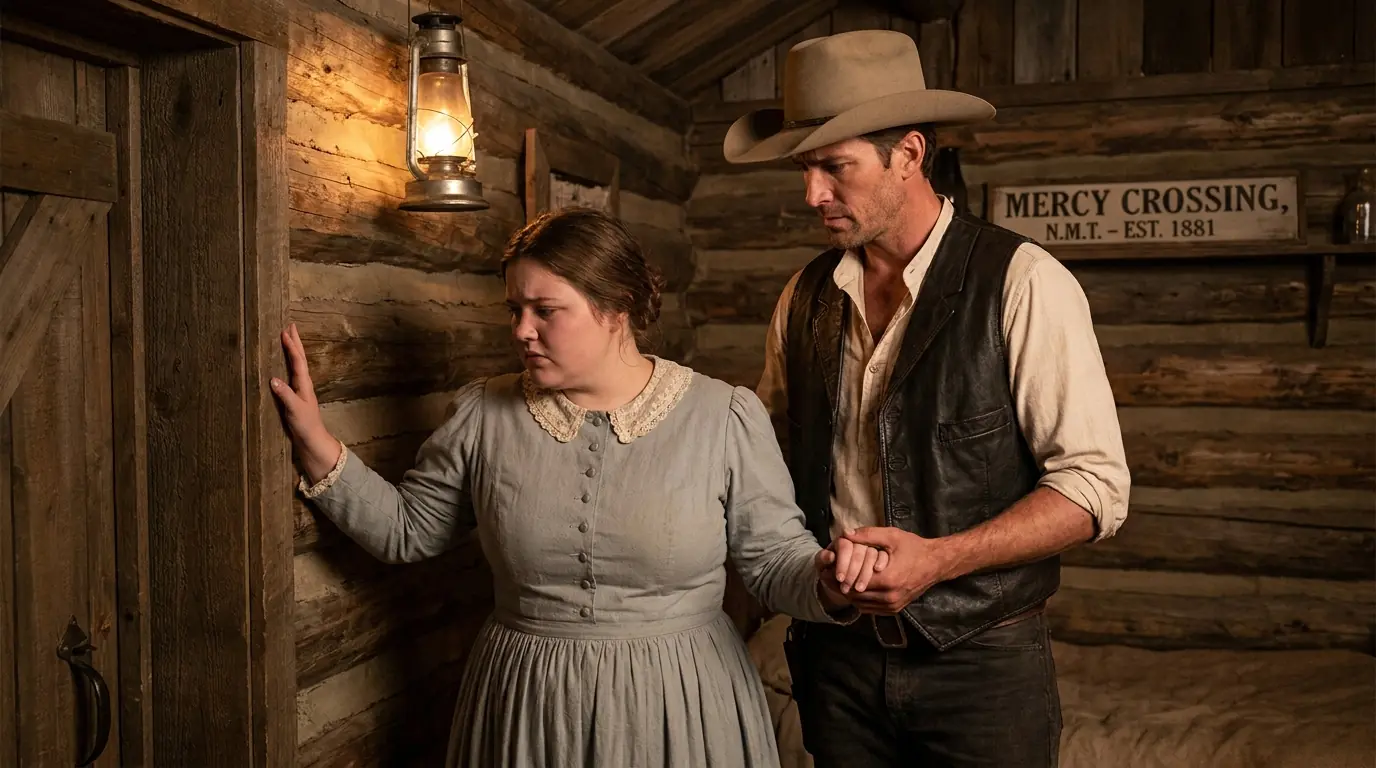
At nineteen years old, she had already learned what it meant to enter a room and know that people had noticed her before she had even taken three steps.
She was exceptionally large, weighing close to three hundred kilograms, with a soft round face, dark brown eyes, and thick wavy brown hair that her mother usually helped arrange each morning.
Back east, strangers had stared.
Some had whispered.
Others had decided that because she was large, she must also be slow, foolish, incapable, or desperate for any kindness offered to her.
She had learned to recognize pity before the person giving it understood they were being cruel.
She had also learned to recognize curiosity pretending to be concern.
The move west had not been her idea.
Her father had accepted a teaching post in a place called Mercy Crossing, a small settlement in New Mexico Territory where the school board apparently needed anyone willing to remain longer than one season.
Her mother’s health had provided the second reason.
Doctors back east believed the dry western climate might help the coughing that returned every winter and left her exhausted by spring.
So the family packed what they could.
Books.
Clothing.
Dishes wrapped in old newspapers.
Photographs.
Two quilts.
A tea set that her mother insisted had survived too much family history to be abandoned now.
The young woman brought only one object that nobody else knew about.
A small leather journal.
She kept it hidden beneath folded stockings inside her carpet bag.
She had begun writing in it because paper never interrupted.
Paper never stared at her body.
Paper never told her she should be grateful whenever a man spoke kindly to her.
Paper simply waited.
The stagecoach west was hotter than she expected.
Dust entered through every crack.
Leather seats held the day’s heat long after sunset.
Coffee tasted like burnt grain, and every roadside station seemed to offer the same dried meat, hard biscuits, and water that smelled faintly of iron.
Still, the young woman tried to enjoy the journey.
She watched mountains become larger.
She studied small towns.
She listened to strangers tell stories they had clearly told too many times.
Her father checked his pocket watch constantly, though the coach schedule had become meaningless two days into the trip.
Her mother slept whenever the road allowed it.
The young woman mostly watched the horizon.
On the final day, the road narrowed between low brown hills.
The driver had said Mercy Crossing was less than three hours away.
Her father smiled.
Her mother touched the young woman’s hand.
“Almost there.”
The young woman nodded.
She had no idea that those two words would become the last ordinary thing she remembered about the road.
The coach lurched so violently that her shoulder struck the wall.
Outside, horses screamed.
The driver shouted.
Then came laughter.
Not happy laughter.
The careless laughter of men who believed everyone around them had already lost.
The stagecoach door opened.
A white American man with a dirty neckcloth and red eyes climbed inside holding a revolver.
The young woman froze.
Her father raised both hands.
Her mother went pale.
The robber took valuables quickly.
A watch.
A brooch.
Money.
He knew where people hid things.
He worked like a man repeating a familiar task.
Then he looked at the young woman.
His attention changed.
She knew that look.
She had received versions of it her entire life.
Sometimes mockery.
Sometimes fascination.
Sometimes men daring one another to say something cruel because her body made them feel entitled to public commentary.
But this was different.
The robber smiled.
Her father shifted.
The revolver moved toward him.
“Sit still.”
Her father obeyed.
The young woman saw what that obedience cost him.
A father was supposed to stand between his daughter and danger.
But a weapon reduced all those promises to mathematics.
One movement.
One mistake.
One family destroyed.
The robber grabbed her wrist and pulled.
Her body struck the door frame as she stumbled partly outside.
Dust blew against her face.
She heard one of the other men laughing.
Another wore a gray coat that looked too expensive for someone robbing stagecoaches.
The robber lifted her chin.
She turned her face away.
He said something cruel.
She would later forget the exact words.
Memory had strange priorities.
She remembered the smell of whiskey.
She remembered the loose bell on the harness ringing again and again.
She remembered a fly crawling across the coach wheel.
She remembered her father breathing as though each breath hurt.
And she remembered the robber forcing a kiss she had never agreed to.
It lasted only seconds.
But seconds could divide a life.
Before.
After.
The young woman went completely still.
The robber mistook that for surrender.
It was not.
It was absence.
Some part of her had stepped away from the road because remaining inside the moment felt impossible.
Then a shot cracked from the ridge.
The robber fell away from her.
Another shot struck dirt near the other men.
A voice carried down from above.
“Drop them.”
The young woman barely heard it.
A rider descended the ridge on a buckskin horse.
He wore a plain hat, brown coat, ivory shirt, dark leather vest, worn trousers, and a silver deputy badge.
A rifle rested across the saddle.
The remaining robbers gave up.
Everything after that happened as though she were watching through thick glass.
The driver collecting weapons.
Her father climbing down.
Her mother reaching for her.
The cowboy deputy dismounting.
He checked the prisoners first.
Then the road.
Then her parents.
Only after ensuring the danger had passed did he look toward the young woman.
That mattered.
His eyes did not remain on her body.
They did not search for scandal.
He simply asked, “Are you hurt?”
She tried to answer.
Nothing came.
Her hand rose toward her mouth.
She hated herself for the movement immediately.
As if she could wipe something away.
The cowboy deputy saw it.
His jaw tightened.
But he did not ask what happened.
He did not approach her.
He removed his hat.
Then lowered his eyes.
“I’m sorry I was late.”
The young woman finally breathed.
Later, she would wonder why those words mattered so much.
He had not been late.
He had arrived before something worse happened.
He had saved all of them.
But he did not make himself the hero.
He saw the harm that remained and apologized because he wished he had prevented even that.
Her father thanked him repeatedly.
The cowboy deputy only said he had stopped what he saw.
The man in the gray coat laughed from where his hands had been tied.
“You don’t know what you just started.”
The cowboy deputy turned.
The prisoner told them the dead robber belonged to one of the richest families in the valley.
The young woman watched the cowboy deputy’s face.
Nothing changed.
But she felt that something had.
Mercy Crossing appeared near sunset.
The town looked smaller than she expected.
One main street.
A general store.
Blacksmith.
Boarding house.
Telegraph office.
Church.
Schoolhouse.
Courthouse.
Marshal’s office.
Jail.
A saloon with music leaking through swinging doors.
The stagecoach entered carrying prisoners, frightened passengers, and a story.
By the time the young woman stepped onto the dusty street, the story had already outrun her.
People stared.
She felt each pair of eyes.
Her size always attracted attention.
Now there was something else.
Whispers.
Someone had heard about the road.
Someone always heard.
Her mother took her arm.
“Come.”
The young woman followed.
She wished she could disappear into the earth.
The town marshal emerged from his office.
He was an older white American man with a gray mustache, heavy belly, and the tired expression of someone who had spent years learning which problems were safest to ignore.
The cowboy deputy explained the robbery.
Then named the dead man.
The marshal stopped chewing tobacco.
“You sure?”
The cowboy deputy looked at him.
“Yes.”
The marshal’s eyes went toward the young woman.
Her father spoke immediately.
“My daughter was attacked.”
The marshal looked uncomfortable.
“We’ll need a statement.”
“Tomorrow,” her mother said.
“The law doesn’t wait.”
The cowboy deputy spoke quietly.
“It can tonight.”