The train left Willa Hart behind in a cloud of steam, dust, and public pity.
For a long moment after the last car disappeared beyond the bend, the wooden platform still trembled beneath her boots.
The sound of the wheels faded into the open country, becoming smaller and smaller until there was nothing left but wind, cinders, and the silence of a town pretending not to stare.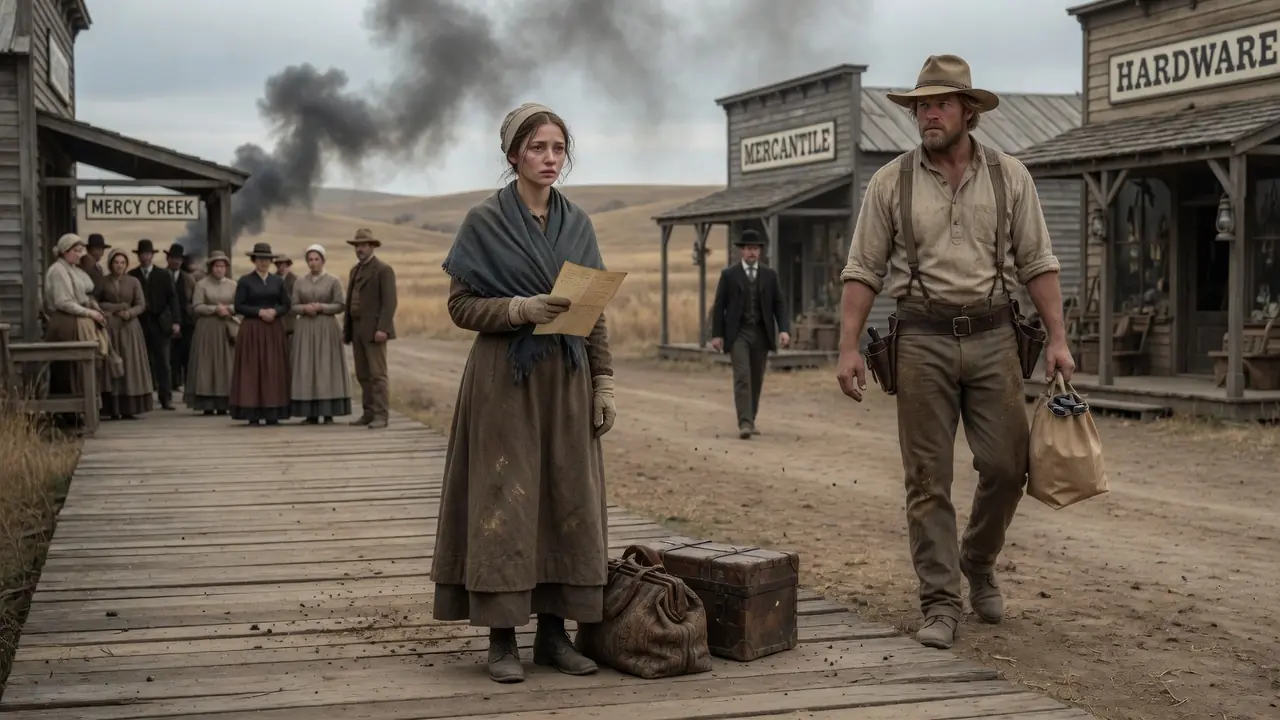
Willa stood very still with one travel bag at her feet, one folded contract in her gloved hand, and every eye in the small frontier town fixed on the humiliation she was trying not to show.
The man who had sent for her, Albert Pugh, had looked at her once, frowned as if she were a poor shipment delivered to the wrong address, then walked away before the stationmaster could even finish unloading her trunk.
He did not shout.
He did not apologize.
He did not give her a reason that could be called a reason.
He simply decided she was not what he wanted and left her standing there as if a woman could be returned like damaged goods.
The town was called Mercy Creek, though at that moment Willa thought the name had either been chosen by a liar or a man with a cruel sense of humor.
It sat in the Kansas Territory with its back to the prairie and its face toward the railroad, a scattering of wooden buildings, dust-blown boardwalks, hitching posts, canvas awnings, and people who looked as if nothing better had happened all week than the arrival of a woman publicly refused before suppertime.
Willa had traveled four days to reach that town.
Four days by rail through gray prairie and empty country.
Four days of cold nights spent sitting upright among strangers.
Four days of guarding her small bag beneath her feet, waking every time the train stopped, and holding the mail-order bride contract in her lap as if it were a ticket not merely to marriage, but to a life where she might finally belong somewhere.
She was twenty-five years old, though hard work and hunger had made her seem both older and younger depending on the light.
Her face was plain in the way poor women were often called plain when they had no silk, no ribbons, no soft hands, and no leisure to make themselves ornamental. Her brown hair was pulled tightly beneath a travel bonnet. Her cheeks were wind-chapped. Her dress was clean but mended twice at the cuff and once near the hem.
She was orphanage-raised and used to surviving on very little.
But hope had made her foolish in ways hunger never had.
That was the cruel thing about hope.
It did not always arrive decorated with dreams. Sometimes it came as a practical decision, a folded letter, a promise of work, a roof, a stove, a table, and a name someone might one day say without contempt.
Willa had not answered Albert Pugh’s advertisement because she was romantic.
She had answered because winter was coming in St. Louis, the boarding house where she worked had reduced her wages, and the woman who owned the building had begun hinting that a younger girl could scrub floors faster for less money.
Willa knew what those hints meant.
She had been hearing versions of them since she was twelve.
At the orphanage, the matron said Willa was not pretty enough to be adopted but strong enough to be useful.
In the laundry room, the older girls said useful was better than nothing.
In the boarding house, the cook said a woman without family had better learn to keep her head down and her hands busy.
Willa learned.
She learned how to turn collars before they were too worn to save.
She learned how to stretch stew.
She learned which men not to meet in hallways.
She learned how to hide hunger behind posture.
She learned to keep her voice respectful without letting it disappear entirely.
She learned that people called a woman plain when they wanted her grateful for whatever was offered.
Albert Pugh’s letters had been short, practical, and plain.
He had written with blocky script and very little sentiment. He did not speak of love. He did not flatter. He did not use poetry. He said he had a small house, a respectable trade, and need of a wife who could keep a home, cook meals, mend clothes, and stand steady beside him in a hard country.
Willa could do all of that.
She could bake bread from poor flour.
She could stretch salt pork through three meals.
She could mend a torn sleeve so cleanly no one saw the rip.
She could rise before dawn, haul water, scrub floors, tend a stove, mind children, manage accounts, and remain silent when silence was safer than complaint.
She had asked the marriage bureau twice whether Albert Pugh had been told the truth about her.
No fortune.
No beauty.
No family.
No expectation of romance.
Only skill, honesty, and willingness to work.
The bureau clerk, a woman with ink on her fingers and no patience for trembling, had said, “Miss Hart, men on the frontier do not require poetry. They require meals.”
Willa had believed her.
Now, standing on the platform in Mercy Creek, she understood that even practical men sometimes wanted poetry, so long as it arrived with a prettier face.
Albert had stood at the edge of the platform in a stiff black coat, looking her over from bonnet to boots. He was taller than she had expected, with a narrow face, thin lips, and pale hands that looked as if they disliked labor. His boots were polished. His collar was too tight. His eyes moved over her the way a merchant examined damaged cloth.
“You did not mention you were so plain,” he said.
The words had not been loud, but they carried in the cold afternoon air.
A woman near the general store covered her mouth.
Two men by the hitching post chuckled softly.
The stationmaster stopped with one hand on Willa’s trunk and suddenly became very interested in the label tied to its handle.
Willa felt the shame strike her face hot and fast, but she kept her chin level because dignity was the last shelter she owned.
“I mentioned I could work,” she answered.
Albert’s mouth twisted as if work were no longer enough now that he had seen her.
He said circumstances had shifted.
He said he had changed his mind.
He said perhaps the bureau could correct the matter.
Then he handed the contract back to her with two fingers, careful not to touch her glove, and walked across the street without looking over his shoulder.
No one knew what to say to an unwanted bride in a town small enough to remember the story forever.
So no one said anything useful.
The stationmaster shifted awkwardly beside her, cleared his throat, moved her trunk six inches, then moved it back again.
A young boy outside the livery pointed until his mother pulled his hand down.
Someone whispered, “Poor thing.”
Willa hated the pity more than the insult.
She did not chase Albert.
She did not plead.
She did not call after him.
She did not cry where the whole town could take comfort in watching her break.
The wind tugged at her brown shawl and pushed dust across the platform boards. Her one bag sat beside her, worn at the corners, packed with two dresses, a Bible from the orphanage matron, a sewing kit, a comb, one pair of stockings, and three coins tied into a handkerchief.
She had believed she was poor before.
Now she understood that poverty had layers.
There was hunger.
There was standing in a strange town with nowhere to go while people decided what your humiliation meant before you had time to breathe.
She looked down the street.
The hotel looked too expensive.
The church door was closed.
The general store porch was full of watching faces.
The saloon doors swung once in the wind, releasing a short burst of laughter that quickly died when several men realized she could hear them.
She could feel them measuring her, not cruelly perhaps, but with that hungry curiosity people have when someone else’s life has just collapsed in front of them.
Then a man stepped away from the hardware store across the street and came toward the platform.
He did not move like a gentleman.
He moved like a worker.
Broad-shouldered and tall, with a dusty hat pulled low and a paper bag of metal fittings in one rough hand. Sawdust clung to the cuffs of his trousers. His shirt sleeves were rolled to the forearms, showing brown skin, strong wrists, and the kind of hands that had built more things than they had broken.
He did not hurry.
He did not look at her as if she were a spectacle.
He looked at her as if she were a person standing in trouble.
That alone nearly undid her.
“Ma’am,” he said when he reached the platform steps.
His voice was quiet, not soft exactly, but steady.
“That man left you standing here alone.”
Willa met his tired blue eyes and felt the sting of the entire town sharpen behind her ribs.
“I noticed, sir,” she replied. “So did the whole town.”
Something like respect moved across his face.
He stepped onto the platform but stopped with enough distance between them to be proper.
“Name’s Seth Callan,” he said. “I’m a carpenter. Widower. I have two children and a house that needs keeping.”
Willa’s fingers tightened around the handle of her bag, not because she trusted him, but because she needed something to hold.
Seth glanced once toward the street where Albert had vanished, then back to her.
“I won’t pretend I know your business,” he continued. “But I know what it looks like when a person has nowhere clear to go.”
She studied him carefully.
Men were often kind in public and cruel in private.
The orphanage had taught her that charity could carry hooks. Boarding houses had taught her that a woman alone was often mistaken for prey. The marriage bureau had now taught her that a contract could be folded and handed back like a soiled napkin.
Yet Seth’s face held no smile of advantage.
Only grief, work, and a practical sort of decency.
“What are you asking me, Mr. Callan?” she said.
“One question first,” he replied. “Can you cook?”
A few people on the boardwalk leaned closer, as if this were another show beginning.
Willa lifted her chin.
The answer came out before she had time to dress it politely.
“Better than I can beg.”
Seth’s mouth twitched, almost a smile, but not quite.
“Good,” he said. “Because my daughter burned porridge yesterday, and my boy fed half the bacon to a stray dog because he thought it looked lonely.”
A startled laugh escaped Willa before she could stop it.
It was small, and it vanished quickly, but it warmed something inside her that Albert’s rejection had nearly frozen.
Seth noticed, but he did not make much of it.
“I can offer room and board,” he said. “No marriage. No promises beyond honest terms. You cook, help with the house, maybe keep my children from ruining themselves before spring. In return, you get a bed, meals, and wages small enough to insult us both but steady enough to count.”
Willa stared at him, waiting for the trick.
“Why?” she asked.
Seth looked past her for a moment toward the far road, where late afternoon light rested on low hills and scattered cottonwoods.
“Because my wife died two winters ago, and I learned what it means to have a house stop being a home,” he said. “Because my children need more gentleness than I know how to give. And because nobody should be left on a platform like a sack of flour.”
Willa swallowed.
Her throat was suddenly tight.
She had expected pity.
Pity made people feel tall.
This sounded more like recognition.
“What will people say?” she asked, though she hated herself for asking.
Seth looked toward the boardwalk, where several faces immediately pretended to be interested in the sky.
“People will say something either way,” he answered. “Let them tire themselves out.”
Willa looked at her bag, then at the empty stretch of track where the train had disappeared.
She had arrived to become a wife and instead received an offer to work.
Strange as it was, work had always been safer than promises.
She nodded once.
“I will come for one month,” she said. “If your children dislike me, or if your house proves unsafe, I leave.”
Seth accepted the terms without offense.
“Fair,” he said. “And if your cooking is worse than my daughter’s porridge, I reserve the right to complain politely.”
This time, Willa almost smiled.
She picked up her bag before he could reach for it, but he took her trunk when the stationmaster finally remembered he had one.
They walked through town side by side, not close enough to invite scandal but close enough to invite gossip.
Willa kept her gaze forward as whispers followed them from the boardwalk.
“Albert dodged trouble.”
“Callan’s found himself more.”
“Poor thing.”
“Plain as flour.”
“Carpenter must be desperate.”
Each word landed.
Willa did not turn her head.
Seth said nothing until they reached the edge of town, where the road turned toward low hills and scattered cottonwoods.
“My place is not fine,” he warned.
“I did not expect fine,” she replied.
“It has a roof that leaks over the washroom if the rain comes sideways.”
“Then it has a roof.”
He glanced at her, perhaps surprised by the answer.
“And a chimney that smokes if the wind comes north.”
“Then I will learn which way to open the door.”
“The latch on the pantry sticks.”
“I have lived with worse than stubborn wood.”
At that, he looked at her longer.
The road stretched ahead, rutted and pale in the evening light. Willa’s boots pinched from the journey, but she walked without complaint.
Seth’s cabin sat half a mile beyond town near a stand of cottonwoods, with a shed behind it, a workbench under a lean-to, and fresh-cut lumber stacked beside the porch. It was not fine, but it was standing. Smoke rose from the chimney, thin and crooked.
A small girl stood in the yard holding a wooden spoon like a weapon, and a younger boy crouched beside a brown dog that looked guilty and well-fed.
Both children froze when they saw Willa.
“This is Clara,” Seth said, nodding to the girl. “She’s eight and bossier than a church bell.”
Clara frowned.
“Pa.”
Seth ignored the warning.
“That’s Thomas. He’s six and cannot be trusted near bacon.”
Thomas stood quickly, wiping his hands on his trousers.
The dog wagged its tail with the confidence of a criminal loved by fools.
Willa stepped forward, suddenly more nervous than she had been in front of the whole town.
Children saw more than adults thought.
Clara looked her over with hard suspicion, from bonnet to boots, then asked, “Are you the bride who got left?”
Seth inhaled sharply.
“Clara.”
Willa held up one hand to stop the scolding.
“Yes,” she said. “But I am also the woman who may save you from burning porridge.”
Thomas’s eyes widened.
“Can you make biscuits?”
“If there is flour.”
“We have flour,” Clara said, still suspicious. “Bad flour.”
“Most flour is bad if no one knows what to do with it.”
Clara’s stern expression cracked for the briefest moment, then closed again.
Willa understood.
A motherless child did not welcome a strange woman just because adults were tired.
Inside, the cabin smelled of smoke, dust, old grief, and something scorched.
A pot sat on the stove filled with gray porridge so thick it looked capable of holding up a fence post. The table was cluttered with plates, tools, school slates, a child’s torn stocking, and three wooden pegs Seth had not yet taken to his workbench.
A woman’s presence had once lived there.
Willa could see traces of it in the faded curtains, the neatly carved shelf, the bundle of lavender tied near the window, and the careful way a blue cup had been placed high enough that no child could break it.
But loss had settled over everything like ash.
She put down her bag and rolled up her sleeves.
“Where is the flour?”
Clara pointed.
Thomas watched with open hope.
Seth stood awkwardly near the door, as if uncertain whether to help or flee.
Willa turned to him.
“Water?”
He moved at once, grateful for instruction.
That evening, Willa made biscuits, fried potatoes, and a thin onion gravy from almost nothing.
The children ate as if she had pulled a feast from the floorboards.
Thomas put butter on his biscuit, took one bite, and looked at his father with wonder.
“Pa, it’s soft.”
Seth gave him a warning look, but Willa had already heard.
She did not smile where the boy could see it.
Seth ate slowly, quietly, his eyes on his plate until Thomas asked if she could stay forever.
Clara kicked him under the table.
Willa pretended not to notice, but her chest tightened.
Forever was a dangerous word when even tomorrow had not been promised.
After supper, she washed dishes while Clara dried them without being asked. The girl was stiff with pride and grief.
“My mother made better biscuits,” Clara said after a while.
“I expect she did,” Willa replied.
That seemed to disarm her.
“You’re not going to say yours are better?”
“No. A daughter is allowed to think her mother made everything best.”
Clara stared at her for a long moment, then looked away.
“She died coughing.”
“I’m sorry.”
“Pa doesn’t talk about her.”
Willa rinsed a plate and placed it in the girl’s towel.
“Some men build walls when they do not know how to carry sorrow.”
Clara frowned at that, not fully understanding, but hearing enough to know it mattered.
From the table, Seth looked toward the stove, his jaw tight.
The first night, Willa slept in the small storage room off the kitchen.
Seth carried in a narrow cot without meeting her eyes, then placed a quilt at the foot of it.
“It was Ruth’s,” he said.
Willa touched the worn fabric carefully.
“Your wife?”
“Yes.”
“I can use my shawl.”
“The room gets cold.”
“I do not wish to take what belongs to your grief.”
He looked at her then, sharply but not angrily.
“Grief has had enough of this house.”
Then he left before she could answer.
Willa sat on the edge of the cot and looked at the quilt.
It was faded blue and white, stitched in careful squares. Some parts had been repaired. One corner smelled faintly of cedar and smoke. She folded it over herself slowly, as if asking permission from a woman she would never meet.
She did not sleep easily.
The wind moved around the cabin.
The children shifted in their beds.
Seth’s boots crossed the main room once after midnight, then stopped outside her door.
He did not knock.
After a long moment, he moved away.
Willa understood then that she was not the only person in the house unsure how to live with strangers.
Morning came cold.
Willa rose before the children and found Seth already outside chopping wood. He worked without a coat, breath rising around him, axe falling in steady rhythm. Each strike split the silence.
She stood at the kitchen window for a moment.
He was not a man of many words, but his movements spoke of contained pressure. He placed each split log with care. He stacked the wood properly. He paused only once, one hand braced on the chopping block, head bowed as if some thought had struck harder than the axe.
Then he straightened and went back to work.
Willa turned to the stove.
She rebuilt the fire, found cornmeal, flour, a lump of butter, and salt. By the time Clara came out rubbing her eyes, the kitchen smelled of johnnycakes and coffee.
Clara stopped in the doorway.
“You used the blue cup.”
Willa looked at the shelf.
“I did not know it belonged to anyone.”
“It was Ma’s.”
Willa turned away from the stove and carefully placed the cup back on the shelf.
“Then we will not use it without your permission.”
Clara blinked.
She had been ready for argument.
She had not prepared for respect.
Thomas stumbled in next, hair sticking up, face hopeful.
“Are there biscuits again?”
“Not this morning,” Willa said. “Johnnycakes.”
“Are they soft?”
“If you are kind to them.”
Thomas seemed to accept that food had feelings.
The first week passed like a test neither Willa nor the household had agreed to take aloud.
She rose before dawn, made breakfast, swept floors, washed clothes, mended socks, and learned where the cabin groaned in the wind. She discovered the flour barrel had a loose lid, the woodpile had not been stacked properly, the kettle handle burned if turned toward the wrong side, and Thomas could be trusted with eggs but not jam.
Clara challenged her at every turn.
She corrected Willa’s folding.
She refused to let Willa brush her hair.
She announced that her mother had never put onion in gravy, though Willa suspected she had.
She watched every motion with the grim attention of a child afraid that loving one person meant betraying another.
Willa did not push.
She did not call Clara ungrateful.
She did not say, “I am only trying to help,” because children in grief did not need adults to make their sorrow convenient.
Instead, she stayed steady.
If Clara refused breakfast, Willa left the plate near the stove.
If Clara said the bread was not as good as her mother’s, Willa said, “Then we must honor your mother by improving mine.”
If Clara snapped, Willa did not snap back.
If Clara cried, Willa gave her privacy without abandonment.
Thomas was different.
By the third day, he had attached himself to Willa’s apron strings and asked questions without breathing between them.
“Where were you born?”
“Do you know how to fix a kite?”
“Did the train have robbers?”
“Do you think dogs understand sermons?”
“Can ladies shoot?”
“Why did Mr. Pugh leave you?”
That last question came while Willa was kneading dough.
The room went silent.
Clara froze at the table.
Seth, who had been carrying firewood inside, stopped in the doorway.
Willa pressed her hands into the dough.
“Because he was not the right man to receive me.”
Thomas considered this.
“Like when Pa ordered the wrong hinges and had to send them back?”
Seth coughed.
Clara looked horrified.
Willa kept kneading.
“Something like that,” she said. “Except I am not hinges.”
Thomas nodded solemnly.
“No. You’re better at biscuits.”
That settled the matter for him.
Seth turned toward the woodbox so neither child could see his face.
Willa saw his shoulders move once and thought he might be laughing.
The town still talked.
Of course it did.
Mercy Creek was the kind of town where a new bonnet could sustain conversation for half a day, and an abandoned bride living in a widower’s cabin could feed speculation for months.
Willa went to the general store twice a week and felt every glance.
Mrs. Elkins, the storekeeper’s wife, watched from behind the counter with eyes sharp enough to cut string.
The first time Willa entered alone, conversation fell so suddenly that the silence became rude.
Willa bought flour, salt, molasses, lamp oil, and thread.
Mrs. Elkins tapped each item into the ledger under Seth Callan’s account.
“So,” she said at last, “you are keeping house for Mr. Callan.”
“I am employed by him, yes.”
“Some might find the arrangement unusual.”
“Some might find hunger usual enough to make employment preferable.”
A man near the pickle barrel snorted before pretending to cough.
Mrs. Elkins blinked.
“Well. I suppose you speak plainly.”
“I find it saves time.”
The second time Willa came in, Mrs. Elkins asked whether Clara still wore her hair tangled.
By the third visit, she set aside better flour without being asked.
The first trouble came on the fourth morning.
Albert Pugh arrived at the cabin just after breakfast.
Willa saw him through the window and felt her hands still over the bread dough.
He stood in the yard, hat in hand, looking less proud than he had at the station. He wore the same black coat, though dust had settled along the hem. His face held an expression he likely believed was humility, though Willa suspected it was embarrassment dressed in borrowed clothes.
Seth was at the workbench, planing a board.
Clara and Thomas were inside, watching Willa’s face more than the window.
Albert cleared his throat and called her name.
Willa wiped her hands on her apron and stepped onto the porch.
She did not walk into the yard.
“Mr. Pugh.”
Albert shifted his hat.
“I heard you were staying here.”
“The town has been generous with its observations.”
He flushed slightly.
“The town has been talking.”
“I imagine it has.”
“I may have acted too quickly at the station.”
Seth set down the plane but did not move closer.
Willa noticed and appreciated it.
Albert continued, “A man gets surprised, and people look on, and pride can make him foolish.”
“Pride did not sign the contract,” Willa said. “You did.”
Albert’s mouth tightened.
“I am offering to correct matters.”
The words hit her strangely.
A week earlier, she might have felt relief.
Now she felt only the cold memory of the platform, the returned contract, and the eyes of an entire town.
“Correct matters,” she repeated. “You mean you have decided I am acceptable after all?”
“I mean I am willing to proceed.”
Willa looked back through the doorway.
Clara stood stiff by the table.
Thomas stood beside her, silent and worried.
She looked at Seth, who did not speak for her.
That mattered more than Albert would ever understand.
She turned back to the man who had abandoned her in public.
“I am not a parcel misplaced by the railway, Mr. Pugh. You cannot refuse delivery and then request it again when the town begins to laugh.”
Albert’s face hardened.
“You think a carpenter’s charity is better?”
“I think honest work is better than a coward’s bargain.”
Albert took a step back as if struck.
Seth’s mouth tightened, but still he said nothing.
Willa folded her hands in front of her apron.
“Good day, Mr. Pugh.”
He left with his pride dragging behind him like a torn coat.
After he was gone, the cabin remained silent for several seconds.
Then Thomas whispered, “Does that mean you’re staying?”
Clara elbowed him, but not hard.
Willa returned to the dough.
“It means the bread still needs kneading.”
Seth picked up his plane again, but his eyes stayed on her with something new in them.
Not pity.
Not gratitude alone.
Respect.
By the end of the month, the cabin no longer felt like a place holding its breath.
The curtains were washed.
The table was cleared each evening.
Clara’s dresses were mended.
Thomas’s questions became less frantic.
The dog, eventually named Sheriff by Thomas despite having no lawfulness in him whatsoever, learned that bacon theft carried consequences.
Seth repaired the leak over the washroom after Willa placed a pot under it and said she disliked being rained on indoors.
She said it plainly, without complaint.
He fixed it before sunset.
That became their language at first.
Work.
Need.
Repair.
If Seth noticed a loose chair, he tightened it.
If Willa noticed the children had outgrown their stockings, she mended and stretched what could be stretched and told Seth what had to be bought.
If the pantry ran low, she made the food last without making the children feel the shortage.
If Seth came home late from a job, she left supper covered near the stove.
If Willa rubbed her wrist after long sewing, Seth quietly sharpened her scissors and brought better needles from town.
Neither called these things tenderness.
Not yet.
They were practical people.
They hid feeling inside usefulness because usefulness was safer.
The first real thaw between Willa and Clara came on a rainy afternoon.
Clara tore her mother’s old shawl while trying to pull it from a nail near the bedroom door. The sound of fabric ripping seemed to stop the whole house.
Willa found her standing beside the bed, face white and furious, the torn shawl clutched in both hands as if it were a wounded bird.
“I ruined it,” Clara said.
Willa closed the door halfway behind her.
“Then we mend it.”
“You can’t.”
“I can try.”
Clara’s eyes filled with tears she refused to let fall.
“It still won’t be hers.”
Willa sat beside her on the bed and held out one hand.
“No. But it can still keep you warm.”
Clara’s face crumpled.
She turned away quickly, angry at the tears, angry at Willa for seeing them, angry at the shawl for tearing, angry at her mother for dying, angry at her father for living, angry at the world for not asking her permission before changing.
Willa did not touch her.
She only sat beside her and waited.
After a long while, Clara pushed the shawl into Willa’s lap.
“If you ruin it worse, I’ll hate you.”
“That is fair.”
By lamplight that evening, Willa stitched the tear with thread pulled from the hem, so the color would match. Clara sat beside her until the last thread was knotted.
When Willa handed it back, the repair was visible only if one knew where to look.
Clara pressed the shawl to her chest.
“Thank you,” she whispered.
“You’re welcome.”
“My mother’s name was Ruth.”
“I know.”
“Pa says it less now.”
“Maybe you can say it for both of you until he remembers how.”
Clara looked toward the main room where Seth sat sharpening a plane blade.
“Do grown men forget things like that?”
“No,” Willa said softly. “They hide from them.”
That night, Seth found the shawl folded neatly at the foot of Clara’s bed.
He stood in the doorway for a long time.
Willa saw him from the kitchen but did not speak.
Spring came slowly, with mud first, then green.
The creek rose behind the cottonwoods.
Wildflowers appeared along the road.
Seth built a small chicken coop because Willa said buying eggs from town was foolish when they had space. Thomas named every chicken, which made supper conversations morally complicated. Clara began helping Willa bake without pretending she already knew how.
Seth laughed more often, not loudly, but enough that the house changed shape around the sound.
One evening in April, Thomas came running from the yard with blood on his chin and a tooth in his hand.
“It fell out,” he shouted, as if announcing a bank robbery.
Clara screamed.
Seth dropped a hammer.
Willa took one look and fetched a cloth.
Thomas insisted he was dying until Willa promised that dying boys rarely asked for molasses biscuits.
That calmed him considerably.
Later, Seth stood beside Willa at the washbasin while she cleaned the cloth.
“You handled that better than I did.”
“You looked as if you might faint.”
“I did not.”
“You dropped a hammer.”
“Out of concern.”
She glanced at him.
His face was serious, but his eyes were amused.
For the first time, they laughed together without surprise.
It was a small sound.
But it stayed in the room long after it ended.
That night, while Willa banked the fire, Seth stood near the shelf where Ruth’s blue cup rested.
He touched the rim with one finger.
“Ruth used to laugh at me when the children bled,” he said.
Willa stilled.
It was the first time he had spoken his wife’s name without someone else forcing it into the air.
“She said I could face a roof beam falling and not flinch, but a scraped knee turned me into a fool.”
“She sounds sensible.”
“She was.”
His voice softened.
“She would have liked you.”
Willa looked down at the fire.
“I do not know if that is true.”
“I do.”
The words were simple.
They unsettled her more than flattery would have.
Summer arrived hot and bright.
Willa planted beans.
Taught Clara to roll dough thin.
Made Thomas wash his hands before touching anything edible.
Seth built a proper pantry because she said their supplies were scattered like drunk churchmen after a dance. He also built her a small sewing table near the east window, though he claimed it was because he was tired of seeing thread on the dining table.
She ran her hand over the smooth wood and said nothing, because gratitude sometimes becomes too large for speech.
At church, people began nodding to her.
Not everyone.
Not warmly.
But enough.
Mrs. Elkins asked for her biscuit recipe and pretended it was for a cousin.
The schoolteacher, Miss Bell, said Clara’s handwriting had improved because someone at home was making her practice.
Hector Barnes at the livery asked whether she could mend a saddle blanket.
The town’s curiosity slowly shifted into acceptance, not because Mercy Creek had grown noble, but because people grow bored when scandal becomes steady work.
Albert Pugh did not grow bored.
A man whose pride has been wounded often mistakes persistence for justice.
He began speaking of Willa in ways meant to stain her without direct accusation. He said Seth had taken advantage. He said Willa had been too quick to settle under another man’s roof. He said respectable arrangements did not need defending.
The words reached Willa by way of Mrs. Elkins, who delivered them under the pretense of concern.
“There is talk,” she said one morning while weighing sugar.
“There is always talk.”
“Some of it is unkind.”
“Then I hope it tires itself soon.”
Mrs. Elkins studied her.
“You do not seem frightened by it.”
“I am frightened by hunger, sickness, and men who smile too easily. Talk is air.”
Mrs. Elkins’s mouth twitched.
“Still, a woman’s name matters.”
“So does the conduct of those speaking it.”
That answer traveled faster than scandal.
By evening, half the town had heard that Willa Hart did not fear talk because talk was air.
Seth heard it from the blacksmith and came home with a look on his face Willa could not read.
“You said that?”
“I said many things today. Which one reached you?”
“Talk is air.”
“It is.”
He leaned one shoulder against the doorframe.
“Albert was in the shop today.”
Willa set down the bowl she was drying.
“What did he want?”
“To inform me no decent woman would live in a widower’s house without marriage.”
Heat rose in her face.
Not shame this time.
Anger.
“And what did you say?”
Seth looked toward the yard where the children were chasing Sheriff around the woodpile.
“I said no decent man would abandon a woman at a station and then lecture others on decency.”
Willa looked at him sharply.
He met her eyes with a quiet fire she had not seen before.
“Thank you,” she said.
“I didn’t say it for thanks.”
The room fell quiet.
Something passed between them then, strong enough to feel and too fragile to name.
Neither reached for it.
Not yet.
The harvest fair came in September.
Mercy Creek held it every year at the edge of town, with tables of preserves, quilts, pies, tools, livestock, ribbons, music, and enough gossip to feed people longer than the food did.
Willa did not want to go.
Clara did.
Thomas declared that fairs were the reason God invented pockets.
Seth said they would attend for an hour.
They stayed all afternoon.
Willa wore her dark green dress, newly altered with cuffs made from fabric Mrs. Elkins had traded for mending. Clara wore her mother’s repaired shawl despite the heat. Thomas carried two biscuits in his pocket until Willa discovered them and made him give one to the dog.
At the pie table, Mrs. Pugh, Albert’s aunt, stood beside a lemon custard with a smile thin enough to cut bread.
“So this is the woman my nephew chose not to marry,” she said.
The women nearby went still.
Willa held a jar of apple butter in one hand.
Seth, standing three steps away, turned.
Before he could speak, Clara stepped forward.
“No,” the child said clearly. “This is the woman who chose not to marry him when he came crawling back.”
The silence cracked open.
Someone gasped.
Thomas, inspired, added, “And she makes better biscuits than anybody.”
“Thomas,” Seth said, though not very firmly.
Mrs. Pugh’s face flushed.
Willa put one hand gently on Clara’s shoulder.
“That is enough.”
But it was too late.
The story spread across the fair before sunset.
By evening, Albert Pugh had become not the man who rejected a plain bride, but the man who crawled back and was refused in front of a carpenter’s porch.
Small towns love humiliation best when it changes direction.
Willa took no pleasure in it, though Clara looked deeply satisfied.
On the ride home in Seth’s wagon, Thomas fell asleep against a sack of flour. Clara leaned against Willa’s side and did not move away. Seth drove in silence until the town lights faded behind them.
“I should have spoken before Clara did,” he said.
Willa looked at him.
“You would have.”
“She is eight.”
“She is loyal.”
“She should not have to defend you.”
“No,” Willa said. “But it is something to be loved fiercely by a child.”
Seth’s hands tightened slightly on the reins.
“Yes,” he said. “It is.”
That night, after the children were asleep, Willa found a small bundle on her sewing table.
Inside was a length of blue ribbon.
Not new.
Not expensive.
She knew it at once as a scrap from Ruth’s old sewing basket.
There was no note.
Willa took it up carefully.
The next morning, Clara would not meet her eyes.
Willa tied the ribbon around the handle of her sewing basket and said nothing.
Some gifts are braver when no one makes a speech over them.
Winter came early that year.
The first snow dusted the cabin roof in late November. The chickens objected. Sheriff adored it for ten minutes, then changed his mind and demanded to be let inside. Thomas tried to catch snowflakes on his tongue until Clara told him they were sky dust, which made him suspicious of weather for a week.
Willa learned the rhythm of winter in the Callan house.
How much wood they needed before dawn.
Which windows had to be stuffed with cloth.
How to keep stew going for two days without anyone feeling punished by it.
How to dry mittens near the stove without scorching them.
How to tell when Seth had worked too long in the cold because his hands stiffened around his coffee cup.
In December, a fever went through town.
First the school.
Then the church.
Then half the houses east of the creek.
Clara fell ill first.
Then Thomas.
For three nights, Willa barely slept.
She cooled foreheads, changed sheets, boiled water, measured willow bark tea, and sat between the children’s beds while Seth moved like a haunted man from firewood to water bucket to doorway, unable to be still and unable to help enough.
On the second night, Thomas began coughing hard enough to frighten even Willa.
Seth stood in the doorway, face pale.
“Ruth died coughing,” Clara whispered from the other bed, feverish and half-awake.
Willa looked at Seth.
He looked as if the past had stepped into the room and put its hands around his throat.
“Seth,” she said firmly.
He did not move.
“Seth.”
His eyes found hers.
“Boil more water. Now.”
The order saved him.
He moved.
Willa sat beside Thomas and lifted him carefully, rubbing his back until the coughing eased. She sang under her breath, not a proper song, just a low thread of sound she remembered from the orphanage laundry when babies cried and no one had time to hold them long.
By dawn, Thomas’s fever broke.
Clara’s followed near noon.
Seth stepped outside and stood in the snow behind the cabin for nearly an hour.
Willa found him there with no coat.
“You will catch your death.”
He turned.
His eyes were red.
“I thought I was losing them.”
“I know.”
“I couldn’t move.”
“You did move.”
“Because you told me to.”
“Then remember you can.”
The wind moved between them.
His voice came rough.
“When Ruth died, I was holding the basin. Useless thing to be holding. She was coughing, and I was standing there with water like a fool. I keep thinking if I had done something different—”
“You were not God, Seth.”
He flinched.
Willa stepped closer.
“You were a husband with a basin and a breaking heart. That is not failure.”
His face twisted.
For one moment, she thought he might turn away.
Instead, he bowed his head.
Willa reached out and took his hand.
His fingers were cold.
He held on as if he had been falling for two years and only just found something solid.
Neither spoke of that moment when they returned inside.
But after that, Seth said Ruth’s name more often.
Not easily.
Not without pain.
But enough that Clara stopped listening for it like a child waiting outside a locked door.
By Christmas, the cabin was poor in the way most frontier homes were poor, but it no longer felt empty.
Willa hung dried orange slices near the window after Mrs. Elkins gave her two bruised oranges no one would buy. Clara stitched a small cloth angel, though she complained about the wings. Thomas carved a horse from scrap wood with more enthusiasm than accuracy. Seth made each child a toy from leftover lumber and gave Willa a new thimble wrapped in brown paper.
She stared at it longer than such a small object required.
“It fits,” she said.
“I measured your old one.”
“You measured my thimble?”
“Not in a suspicious way.”
She laughed.
He looked pleased.
On Christmas night, after the children fell asleep near the fire with Sheriff stretched shamelessly between them, Seth and Willa sat at the table drinking weak coffee.
Snow pressed against the window.
The cabin was quiet.
But not lonely.
Seth turned the mug slowly between his hands.
“When I first saw you on that platform,” he said, “I thought you looked as if the whole world had stepped back from you at once.”
Willa looked into her cup.
“It felt that way.”
“I was afraid to speak.”
She looked up.
“You did not seem afraid.”
“I was. I thought you might think me another man trying to decide your life for you.”
“I did think that.”
He smiled faintly.
“Fair.”
“But then you asked if I could cook.”
“I needed to know.”
“I nearly struck you.”
His smile widened.
“I suspected as much.”
They sat in silence for a moment.
Then Willa said, “I am glad you asked.”
Seth’s eyes lifted to hers.
“So am I.”
Nothing more happened that night.
No confession.
No kiss.
No promise.
Only a look held a little longer than before.
For people who had both learned caution through pain, that was enough.
The proposal came the following August.
Not the way Willa might once have imagined as a girl.
There were no roses.
No grand declaration.
No kneeling in dust before a crowd.
Seth found her in the kitchen after the children had gone to bed. He stood near the table holding his hat in both hands like a nervous boy.
Willa was wiping flour from the counter.
“You look as if the barn fell down,” she said.
“It didn’t.”
“Then speak.”
He drew a breath.
“I know how you came here. I know what people said. I know you agreed to work, not to be trapped by gratitude.”
She set the cloth down slowly.
He continued, “I have tried to decide whether asking would be selfish.”
“Have you reached a verdict?”
“No.”
“That is inconvenient.”
His mouth twitched, but his hands tightened around the hat.
“I don’t need a cook, Willa. I mean, I do. We all do. But that is not why I’m asking.”
Her heart began to beat harder.
“I don’t need you to mother my children in Ruth’s place,” he said. “You have made your own place with them. I don’t need you because the house was falling apart. It stands better now because you are in it, but that is not the same thing.”
Willa could not speak.
Seth looked at her fully.
“I want you here. As my wife, if you can bear the thought. Not because Albert left you. Not because I found you. Because you are Willa Hart, and you have become the person I look for when I come through that door.”
Her throat tightened.
For a moment, the train platform returned.
The shame.
The whispers.
Albert’s cold assessment.
Then it faded.
In its place came Clara’s repaired shawl, Thomas’s biscuit-crumb grin, Seth’s steady hands, the sewing table by the window, Ruth’s quilt over her bed, snow melting on the stove, and the sound of laughter in a house that had once forgotten how.
“Ask me properly,” she said softly.
Seth swallowed.
“Willa Hart, will you marry me?”
She smiled then.
Small and real.
“Yes, Seth Callan. I will.”
They married two weeks later in the small white church with the door propped open against the heat.
Clara stood beside Willa holding wildflowers, proud and tearful. Thomas declared loudly that now biscuits would be permanent, which made half the congregation laugh. Sheriff escaped twice and had to be dragged back from the church steps by Deputy Holt, who claimed no wedding was legally complete without at least one fool dog.
Mrs. Elkins cried more than she admitted.
Martha Bell, the schoolteacher, played the hymn too slowly.
Seth wore a suit that had been brushed within an inch of its life.
Willa wore her green dress with new white cuffs and Ruth’s blue ribbon sewn carefully inside the bodice, close to her heart. Clara had given it to her that morning.
“She would not mind,” Clara said, fierce and trembling.
Willa kissed her forehead.
“No,” she said. “I do not think she would.”
Albert Pugh sat nowhere in the room.
Willa heard later that he had left Mercy Creek after losing money on a bad land deal.
She felt no satisfaction at that news.
Some people were not worth carrying, even in triumph.
Years passed.
The Callan house grew.
Not larger at first, but warmer.
Then Seth added a second room when Thomas became too tall to share properly with trunks and spare chairs. Then a new porch after Willa said sitting outside should not require leaning away from rotten boards. Then a pantry twice the size of the first because Willa had opinions about flour storage and had become a woman whose opinions altered buildings.
Clara grew into a sharp-eyed young woman who taught school for a time and then married a rancher who looked terrified of her in all the correct ways.
Thomas grew tall, kept stray animals, and eventually became a carpenter under his father’s instruction, though he still could not be trusted near bacon without supervision.
Willa bore one more child, a little girl named Ruth Anne, who had Seth’s blue eyes and Willa’s stubborn chin.
Every year, on the anniversary of the day Willa arrived by train, Seth brought home a paper bag of metal fittings from the hardware store and set it on the table.
The first time, Willa stared at him.
“What is that?”
“Tradition.”
“Hardware is not tradition.”
“It was there at the beginning.”
She laughed until she had to sit down.
After that, she expected it.
One year it was hinges.
One year nails.
One year a fine brass latch for the pantry door.
On their twentieth anniversary, Seth brought her a small carved wooden box instead.
Inside was the folded mail-order bride contract Albert had handed back to her on the platform. Willa had not known Seth had kept it after she nearly burned it the week after their wedding.
She looked at the paper for a long time.
“Why did you save this?”
Seth sat beside her.
“So you could see it one day and feel nothing.”
Willa touched the old crease in the paper.
He was right.
It was a strange thing, to hold the object of an old humiliation and find it had no teeth left.
She folded it again and placed it back in the box.
Then she handed the box to Seth.
“Put nails in it.”
He smiled.
“As you wish.”
Years later, people still told the story differently.
They said Seth Callan saved the abandoned bride at the station, as if Willa had been only waiting to be rescued.
She never corrected them unless they said it in front of her children.
Then she would set down whatever she was holding and say, “No. He asked if I could cook. I decided whether he deserved an answer.”
Seth would smile from across the room and never disagree.
Willa learned that a second chance does not always arrive dressed as a dream.
Sometimes it looks like a dusty carpenter holding hardware fittings, asking a practical question on a public platform while everyone waits to see if you will break.
Sometimes a new life begins not with being chosen, but with choosing what you will no longer accept.
She had come west looking for a home and lost the one promised to her before she ever crossed its threshold.
In losing it, she found a better one.
A home built not on a contract, but on respect, work, patience, grief spoken aloud, bread pulled warm from an oven, children laughing after supper, and a man who did not mistake usefulness for love but understood that love often began by being useful and stayed by becoming true.
The train that abandoned her became a memory.
The platform became a story.
The shame became something she could hold without bleeding.
And in the cabin where grief had once sat at every chair, Willa Hart Callan built a life that smelled of bread, sawdust, rain, and children laughing after supper.
She was not the bride Albert Pugh rejected anymore.
She was the woman who had answered, “Better than I can beg,” and meant it.
And whenever the westbound train passed Mercy Creek in a cloud of dust and steam, Willa sometimes stood on the porch and listened until the sound faded.
Not because she wished to leave.
Because she remembered the day it left without her.
And she thanked God, quietly and with both feet planted firmly on her own porch, that it had.