The kitchen they handed Hetty Marsh had no door, no glass in the window, and a stove so eaten through with rust that a man could push his thumb clean into the firebox.
It sat behind the freight barn in Hollow Fork, Wyoming Territory, and for 2 years the only things that had cooked in it were summer flies.
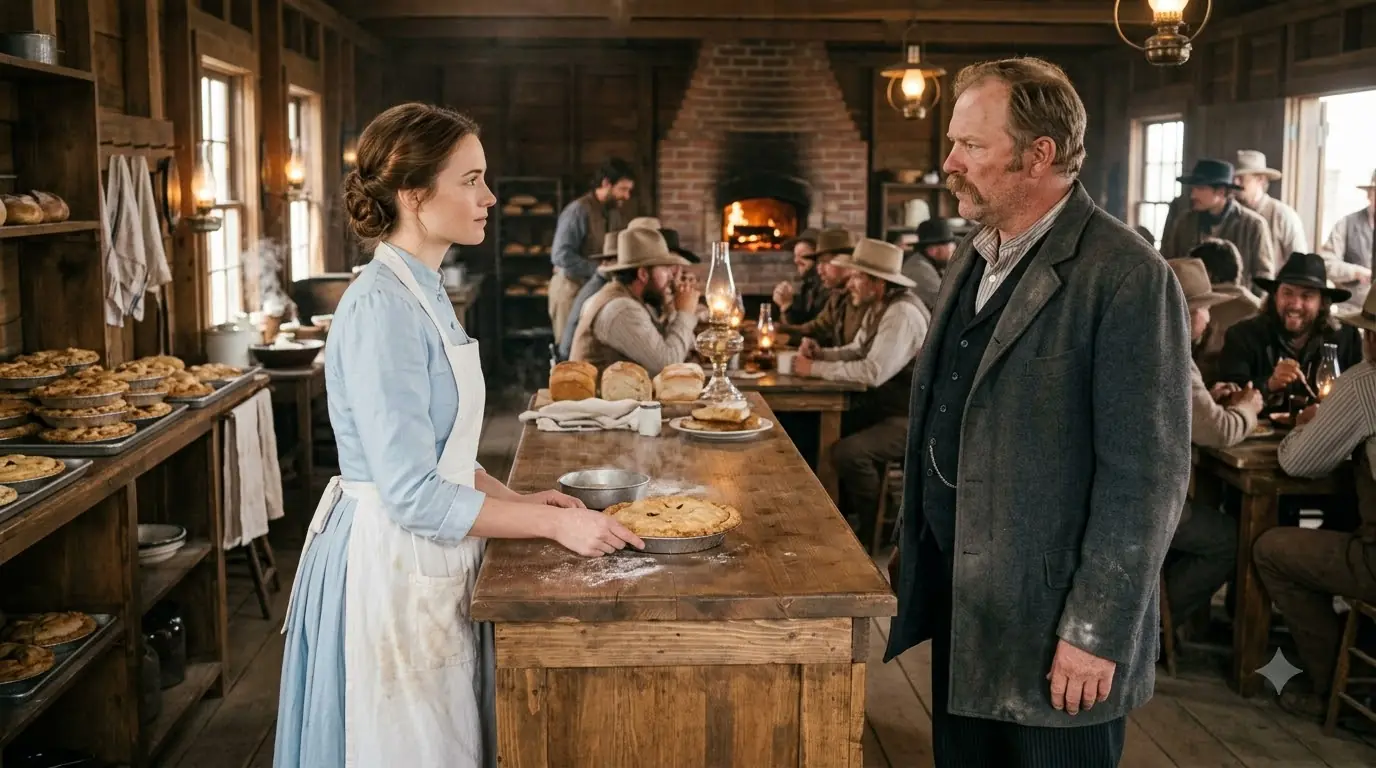
Orville Kettleman gave her the key with a smile that did not reach his eyes. "It's yours, ma'am," he said loud enough for the four men on the hotel porch to hear him.
"Rent's $2 a month. Nobody else has wanted it." They laughed. Hetty Marsh, 56 years old, 3 weeks widowed of a husband who had died peacefully in his sleep in Missouri, closed her hand around that key and said, "Then I'll take it."
She did not know yet that in 6 weeks' time freighters would ride 40 miles across the flats just to sit down at her table. She did not know that the man laughing loudest on that porch would be the one standing at her step in the dark, hat in his hands, asking if there was room for one more.
Hollow Fork in the autumn of 1889 was a town of one street and 111 people. It had a hotel, a mercantile, a smith, a church that doubled as a schoolhouse, and a stage road that ran east to Bitter Creek and west to nowhere anybody wanted to go.
Hetty had come out on that stage with one carpet bag, $41, and her mother's cast-iron skillet wrapped in a wool shawl. She had come because her husband, Ellis, had left her the house, and the house had been mortgaged, and when the bank finished being sorry for her, there had been nothing left but the skillet and the ticket west.
She had 34 years of feeding men behind her, threshing crews, church suppers, a husband who had never once told her the food was good because he had assumed, the way men do, that it would simply always be there. She stood in that ruined kitchen on her first morning and looked at the soot climbing the wall like ivy and the dirt floor and the shelf that had come loose at one end and hung there like a broken wing. Then she rolled her sleeves to the elbow.
That is the part the town never saw. The part that came before the wagons, a woman alone in a burned-out room with a bucket and a stiff brush, scrubbing until her knuckles split because she did not have anywhere else to go and had decided, somewhere on the stage road, that she was done being handed things and calling them charity.
The first thing she needed was a stove that would hold fire. The smith, a wide, quiet man of 48 named Dorsey Pike, listened to her describe the firebox and then walked back with her and looked at it a long while without saying anything.
"That's a Bartlett," he said finally. "Good iron once. Somebody let water sit in her." "Can she be brought back?" "Some." "Then I'd like some."
Dorsey Pike had a wife who had passed two winters before, gone gently in the spring after a long, slow decline, and he had not much cared for talking since. He patched that firebox with plate and rivet over three evenings and would not name a price. Hetty fed him instead, salt pork, fried potatoes with the onion cooked down soft and sweet, and a slab of cornbread with the crust gone gold in the skillet. He ate the whole plate without a word.
Then he set his fork down and sat there staring at it. "Ma'am," he said, "I've not eaten like that since my wife." Hetty looked away and busied herself with the coffee because she could hear what it cost him to say it. But she remembered it.
She would remember it every day of that first hard month. And there were days when it was the only thing that kept her from selling the skillet for stage fare home.
By the end of the first week, she had a table. It was two freight doors laid over sawhorses, and she scrubbed it with sand and lye until the wood came up pale. She had four chairs, three of them mended. She had a curtain of flour sacking where the window glass should have been, and a blanket nailed across the doorway because there was no door.
She had no sign. She could not afford paint. So she cooked and let the smell do the advertising.
That is a thing men who have lived on beans and hardtack cannot walk past. Onions going soft in bacon fat, bread coming out of a hot oven, coffee that has not been boiled to tar.
The first freighter came in because his horse stopped. He was a big Swede named Anders Holm, 43, hauling ore wagons on the Bitter Creek run, and he stood in that doorway with his hat off looking at the blanket and the sawhorses and the woman in the apron. "You serving?" he said. "I am."
"How much?" "35 cents." He sat down at a table made of doors and ate two helpings of beef stew with dumplings and a wedge of dried apple pie with the crust worked in cold lard so it broke into flakes on the fork. When he was finished, he sat back and looked at the empty plate the way a man looks at a letter from home.