The stagecoach lurched to a stop in the middle of nowhere, and Winona Reynolds knew that staying inside meant dying with everyone else when the bandits came.
So she grabbed her carpetbag and ran into the gray December dawn without looking back.
Her boots hit the frozen earth hard as she stumbled away from the road, her breath coming in ragged clouds that disappeared into the bitter Arizona morning.
Behind her, angry voices shouted, and a gunshot split the air.
She did not turn around.
She just kept running across the scrubland, her heavy skirts catching on sage and mesquite, the wind cutting through her wool coat like it was made of paper.
Winter had come early to the Arizona Territory in 1883, and Winona had thought she was running from the snow that buried her past in Kansas.
She had thought distance would ease the ache in her chest where her heart used to be.
Back before Thomas died and his family blamed her for it.
Back before the fever took him and left her with nothing but accusations and a town that wanted her gone.
But winter followed her, and so did the pain, sharp and persistent as the wind that scraped her cheeks raw.
She ran until her lungs burned and her legs trembled.
She ran until the voices behind her faded and all she could hear was the wheeze of her own breathing and the crunch of frost beneath her feet.
When she finally stopped, bent double with her hands on her knees, she realized she had no idea where she was.
The stagecoach road was gone, hidden behind rolling hills of brown grass and scattered rocks.
The sun was rising somewhere behind the thick clouds, turning the sky from black to pewter, but it gave no warmth.
Winona straightened slowly, looking around at the empty landscape.
Empty except for the cold.
Empty except for her mistakes.
Empty except for a single rider sitting motionless on a bay horse about fifty yards away, watching her.
Her heart jumped into her throat.
She took a step backward, then another, her hand instinctively reaching for the small pocket of her skirt, where she kept nothing useful.
No weapon.
Nothing but a handkerchief and the last letter Thomas had written her before he got sick.
The rider did not move.
He sat easy in the saddle, one hand resting on his thigh, the other holding the reins loosely.
He wore a dark coat and a wide-brimmed hat pulled low.
Even from this distance, she could feel him looking at her.
“Stay back,” Winona called out, her voice raw from running and cold. “I have nothing worth taking.”
The rider nudged his horse forward, slow and deliberate.
As he came closer, she could see he was young, maybe her age or a bit older, with a lean build and a face shadowed by his hat.
He stopped about ten feet away and pushed the hat back, revealing dark hair and eyes somewhere between brown and hazel, sharp with intelligence but not unkind.
“You running from those men back at the stage?” he asked.
His voice was low and calm, with a slight drawl that spoke of Texas or maybe farther south.
“That is none of your concern,” Winona said, trying to sound braver than she felt.
Her whole body was shaking now, from cold or fear or exhaustion.
She could not tell which.
“It is if they are coming this way,” the man said. “And they usually do after they finish with whatever business they started.”
He looked past her, back toward where she had come from, his eyes scanning the horizon.
“You hurt?”
“No.”
“You got anywhere to go?”
Winona hesitated.
The honest answer was no.
She had been heading to Tucson, where a distant cousin had promised her work in a boarding house, but that was still two days away by stage, and she had no idea how far she had run or in what direction.
“I can manage,” she said instead.
The man looked back at her, and something in his expression shifted, became gentler somehow.
“Madam, it is about twenty degrees out here. You are shaking so hard I can see it from here. And those men are going to spread out looking for survivors to rob, or worse. You cannot manage. Not alone. Not out here.”
“I do not need help from a stranger,” Winona said.
But even as she said it, she knew how foolish it sounded.
She needed help desperately.
She just did not trust it anymore.
The man studied her for a long moment, then did something unexpected.
He dismounted slow and easy, keeping his hands visible.
He was tall, she realized, with broad shoulders and the lean strength of someone who worked hard for a living.
He took a step closer, and she took a step back.
“My name is Isaac Sutton,” he said. “I work for the Double R Ranch, about five miles east of here. I was riding fence line when I heard the commotion on the road. I came to see if anyone needed help.”
He paused, his eyes steady on hers.
“Looks like someone does.”
“I told you I can manage.”
“You keep saying that,” Isaac said, tilting his head slightly. “But you are running from something. Maybe lots of things. And you look about ready to drop. Winter is hard out here, madam. Pain is hard everywhere. But you do not have to face both alone. Not today.”
Something in his words cracked the shell Winona had been holding around herself so tightly.
Her eyes burned with sudden tears, and she blinked them back furiously.
“You do not know anything about me.”
“No, madam, I do not,” Isaac agreed. “But I know what it looks like when someone is at the end of their rope, and I know it is my job as a decent human being to offer help when I can give it.”
He took another careful step forward.
“So here is what I am proposing. You let me take you back to the ranch. The foreman’s wife, Mrs. Chen, she is a good woman, and she will give you a warm place to sit, some hot food, and time to figure out your next step. No strings, no expectations. Just help because you need it.”
Winona wanted to refuse.
But she was so cold and so tired, and the thought of a warm place and hot food was almost more than she could resist.
“Why would you do this?” she asked quietly. “What do you want from me?”
Isaac’s expression softened even more.
“I do not want anything from you, madam. But if I had to guess, I would say you have been running from winter and pain probably for a while now, and I am here to tell you that running only works for so long.”
He held out his hand, palm up, an invitation, not a demand.
“So maybe instead of running from something, you could try running to something. Run to help. Run to safety. Run to me instead, at least long enough to get warm and catch your breath.”
The tears came then, hot and fast, and Winona could not stop them.
She covered her face with her cold hands and wept, all the grief and fear and exhaustion pouring out of her in great shaking sobs.
She cried for Thomas, who had loved her and died too young.
She cried for his family, who blamed her for not saving him as if love alone could cure fever.
She cried for the town that turned against her, for the whispers that followed her, for the loneliness that had become her constant companion.
She cried for the cold and the running and the endless, terrible weight of being alone.
And then there were arms around her, strong and warm, and a voice saying, “It is all right. It is going to be all right.”
She leaned into the stranger who had stopped her.
She let him hold her up when her legs would not.
She let him take some of the weight she had been carrying alone for so long.
After a while, the tears stopped, and Winona became aware of several things at once.
She was pressed against Isaac Sutton’s chest.
His coat smelled like leather and wood smoke, and she was warmer than she had been in days.
She pulled back quickly, embarrassed, wiping at her face with shaking hands.
“I am sorry,” she said. “I should not have.”
“You do not have anything to apologize for,” Isaac said firmly.
He pulled a handkerchief from his pocket and offered it to her.
“Everybody needs to fall apart sometimes. Better to do it with someone who can catch you than alone in the cold.”
Winona took the handkerchief and dried her face, then looked up at him.
In the growing light, she could see his features more clearly.
Strong jaw.
Straight nose.
A small scar above his left eyebrow.
His eyes were kind, though, and that was what decided her.
“My name is Winona Reynolds,” she said quietly. “And I would appreciate the help you offered, Mr. Sutton, if the offer still stands.”
“It does,” Isaac said. “And you can call me Isaac.”
He walked back to his horse and patted the animal’s neck.
“This is Jasper. He is steady and strong, and he can carry both of us back to the ranch without any trouble. You ever ridden before?”
“A little,” Winona said.
She had ridden as a girl, before her father died and money got tight, before everything fell apart the first time.
Isaac mounted smoothly, then held down his hand.
“Put your foot in the stirrup and grab my hand. I will pull you up behind me.”
It took some awkward maneuvering with her skirts, but eventually Winona was seated behind Isaac, her arms wrapped around his waist to keep from sliding off.
She could feel the warmth of him even through their coats.
She could feel the steady movement of his breathing.
“Hold on,” Isaac said, and nudged Jasper into a smooth walk.
They rode in silence for a while, heading east as the sun finally broke through the clouds in weak golden shafts.
The land here was beautiful in its own harsh way, all red rock and scrub, with mountains rising purple in the distance.
Winona had never been this far west before.
She had never seen anything like the vast open spaces of the Arizona Territory.
“You said you work for a ranch,” she asked after a while, as much to distract herself from how close she was holding this stranger as from genuine curiosity.
“The Double R,” Isaac confirmed. “It is a good spread. About a thousand head of cattle, a couple dozen horses. The owner, Mr. Reed, he is a fair man. I have been working there for about three years now.”
“You are a cowboy, then.”
Isaac chuckled.
A low, rumbling sound she could feel through his back.
“I suppose I am, though I do not much like the term. Makes it sound more romantic than it is. Mostly I mend fences, move cattle, and fix whatever breaks, which is everything eventually.”
“Where are you from originally?” Winona asked. “Your accent sounds like Texas.”
“Grew up outside San Antonio,” Isaac said. “Left when I was seventeen, worked my way north and west. Been in the territory about five years now.”
He paused.
“What about you? You do not sound like you are from around here either.”
“Kansas,” Winona said quietly. “A town called Eldridge, near Lawrence. I left six months ago.”
She felt Isaac nod, but he did not press for more information, and she was grateful for that.
They rode on, and gradually, the warmth of the horse and Isaac’s body heat, and the simple relief of not being alone anymore, made Winona’s eyes grow heavy.
She caught herself starting to doze off and jerked awake, tightening her grip.
“You can sleep if you need to,” Isaac said. “I will not let you fall.”
“I should not,” Winona said, but her eyes were already closing again.
“Sometimes you should do things even when you think you should not,” Isaac said gently. “Sleep. We have another hour before we reach the ranch.”
This time, when her eyes closed, Winona let them stay that way, trusting this stranger in a way she had not trusted anyone in a long time.
She dreamed of warmth and safety, of arms that held her steady, of a voice that said everything would be all right.
When she woke, they were riding into a ranch yard surrounded by low buildings made of adobe and wood.
Smoke rose from a chimney, and she could see several men working near a large barn, their breath misting in the cold air.
Everything looked neat and well-maintained, prosperous in the way of a place that was loved and cared for.
Isaac reined Jasper to a stop near the largest building, which Winona guessed was the main house.
A woman came out onto the porch, wiping her hands on her apron.
She was Chinese, Winona realized, probably in her forties, with graying hair pulled back in a neat bun and sharp, intelligent eyes that took in the situation immediately.
“Isaac,” the woman said. “What have you brought us?”
“This is Miss Winona Reynolds,” Isaac said.
He dismounted, then helped Winona down, keeping a steadying hand on her elbow until she found her balance.
“She was on the stage that got hit by bandits this morning. She needs a place to warm up and some food, if you can spare it, Mrs. Chen.”
Mrs. Chen’s expression shifted from curious to concerned.
“Of course. Come inside, dear. You look half frozen.”
She bustled down the steps and took Winona’s arm, guiding her toward the house.
“Isaac, you tell Mr. Reed what happened and send someone to check on that stage. See if there are other survivors who need help.”
“Yes, madam,” Isaac said.
He caught Winona’s eye and gave her a small, reassuring smile.
“You are in good hands now.”
Then he was gone, leading Jasper toward the barn, and Winona was being swept into the warm interior of the house, into a kitchen that smelled like bread and coffee and safety.
Mrs. Chen sat her down in a chair near the stove and immediately began fussing over her, removing her damp coat, wrapping a blanket around her shoulders, pressing a cup of hot coffee into her cold hands.
“Drink,” she commanded. “Then you can tell me what happened, if you want to.”
Winona drank.
The coffee was strong and sweet, and it burned going down in the best possible way.
Feeling began to return to her fingers and toes, painful prickling that made her wince.
“The stage was stopped,” she said after a moment. “Men with guns. I did not wait to see what they wanted. I just ran.”
Mrs. Chen nodded, her face grim.
“Bandits have been getting bolder. The law does not reach far enough out here to scare them much.”
She moved to the stove and ladled something that smelled wonderful into a bowl.
“But you are safe now. Eat this. Then we will see about getting you properly warm and finding you some dry clothes.”
The soup was beef and vegetables, thick and rich, and Winona ate it without tasting it, driven by a hunger she had not realized she had.
Mrs. Chen watched her with approval, refilling the bowl once without being asked.
“Where were you heading?” Mrs. Chen asked after a while.
“Tucson,” Winona said. “I have a cousin there who offered me work.”
“Tucson is still two days away, and you have lost your stage.”
Mrs. Chen paused thoughtfully.
“You are welcome to stay here while you figure out what to do next. We can always use help around the place, especially with winter coming on hard.”
“I could not impose,” Winona started, but Mrs. Chen waved her hand dismissively.
“It is not imposing if we need the help and you need the work. Besides, Isaac would never forgive me if I sent you back out into the cold before you were ready.”
Mrs. Chen’s eyes twinkled slightly.
“He has a soft heart, that one, though he tries to hide it under all that stoic cowboy business.”
Winona felt her cheeks warm and knew it was not just from the fire.
“He was very kind to me.”
“Isaac is a good man,” Mrs. Chen said simply. “One of the best I have known. You can trust him.”
Those words settled something in Winona’s chest, some tight knot of fear that had been there since Isaac first approached her in the scrubland.
She had been right to accept his help.
She was safe here, at least for now.
The rest of the day passed in a blur of warmth and kindness.
Mrs. Chen gave her dry clothes, a simple brown skirt, and a white shirtwaist that had belonged to the previous housekeeper.
She showed Winona to a small room off the kitchen, barely bigger than a closet, but clean and cozy, with a narrow bed and a window that looked out over the ranch yard.
She gave her soap and water to wash with.
And when Winona emerged clean and dressed in dry clothes, Mrs. Chen sat her back down by the fire and braided her long brown hair, humming softly as she worked.
It was such a motherly gesture, so unexpected and tender, that Winona felt tears threaten again.
She blinked them back and focused on the warmth of the fire, the gentle tug of Mrs. Chen’s hands in her hair, the simple comfort of being cared for.
By evening, more details about the stage attack had come in.
Two passengers had been killed, and the driver was badly wounded, but expected to live.
The bandits had taken everything of value and disappeared into the badlands to the south.
The sheriff in Fort Yuma had been notified, but nobody expected much to come of it.
This was the territory, and justice was a scarce commodity.
Winona sat through dinner in the ranch house’s big dining room, surrounded by the foreman, Mr. Chen, and several of the ranch hands, including Isaac.
The men were polite but curious, sneaking glances at her when they thought she was not looking.
Isaac sat across from her and down a few seats, and whenever she looked up, she found him watching her with those steady hazel eyes, his expression thoughtful.
After dinner, Mr. Reed, the ranch owner, came to speak with her.
He was a man in his sixties with silver hair and a weathered face, kind but shrewd.
“Mrs. Chen tells me you might be willing to stay on for a while, help around the house,” he said.
“If you would have me,” Winona said. “I can cook and clean, and I am a hard worker.”
“I do not doubt it,” Mr. Reed said. “Anyone who survives what you survived today has backbone. We can offer you room and board and fifteen dollars a month. It is not much, but it is fair. You can stay as long as you need, and when you are ready to move on, we will help you get to Tucson or wherever else you want to go.”
Fifteen dollars a month was more than fair.
It was generous.
Winona felt something loosen in her chest, some tight band of anxiety that had been there for months.
“Thank you,” she said quietly. “I accept.”
Mr. Reed smiled.
“Good. Welcome to the Double R, Miss Reynolds.”
That night, lying in her small room with a full stomach and warm blankets, Winona stared at the ceiling and thought about the strange turns life took.
This morning, she had been running, terrified and alone, convinced that winter and pain would follow her forever.
Tonight, she was safe, fed, and employed, all because a cowboy on a bay horse had stopped her and offered her a different path.
“Run to me instead,” Isaac had said.
And she had.
And everything had changed.
In the days that followed, Winona settled into life on the Double R Ranch with surprising ease.
Mrs. Chen was a patient teacher, showing her the routines of the household, the preferences of the various ranch hands, and the rhythms of ranch life.
Winona learned to make biscuits that did not taste like rocks, to wash clothes in the big copper tub behind the house, to mend the endless tears in shirts and trousers that came from working with barbed wire and rough cattle.
She saw Isaac every day at meals and sometimes in passing around the ranch yard.
He always nodded to her, always asked how she was settling in, but he kept a respectful distance that she appreciated even as some part of her wanted him to come closer.
He had seen her at her worst, broken and weeping, and she was not sure how she felt about that, about him knowing that much of her pain.
But as the days turned into weeks, Winona began to notice things about Isaac Sutton.
She noticed how the other ranch hands respected him, how they asked his opinion on things and listened when he spoke.
She noticed how he was always the first to volunteer for the hardest jobs, the coldest rides, the most dangerous work with the half-wild horses.
She noticed how he was gentle with the animals, patient with the younger hands, unfailingly polite to Mrs. Chen.
And she noticed how he looked at her when he thought she was not paying attention, with an expression she could not quite read, but that made her heart beat a little faster.
Winter settled in properly about three weeks after Winona arrived.
Snow fell on the mountains and sometimes dusted the ranch itself, melting quickly in the pale sunlight, but making everything slippery and cold.
The ranch hands spent their days breaking ice on water troughs and making sure the cattle had enough food.
It was hard, brutal work, and the men came in every evening exhausted and frozen, tracking mud and melting snow across Mrs. Chen’s clean floors.
On Christmas Eve, which fell on a Sunday that year, Mr. Reed declared a half day of work and announced that there would be a party that evening in the barn.
Mrs. Chen spent the day cooking, and Winona helped make pies and cakes and a huge pot of stew.
Some of the ranch hands brought out instruments: a fiddle, a harmonica, and a guitar.
As the sun set, everyone gathered in the barn, which had been swept clean and decorated with pine branches.
It was not fancy, but it was joyful.
The men danced with each other and with Mrs. Chen and with Winona, swinging each other around to lively tunes, laughing and singing.
Winona found herself laughing too, genuinely happy for the first time in months.
She danced with Mr. Chen and with a young hand named Billy, who blushed furiously the whole time, and with Mr. Reed, who was surprisingly light on his feet.
But she did not dance with Isaac, who stood against the barn wall, nursing a cup of punch and watching the festivities with a small smile.
Finally, during a break in the music, Winona walked over to him.
“You do not dance, Mr. Sutton?” she asked.
Isaac looked down at her, his eyes warm in the lantern light.
“I do, Miss Reynolds. Just not often.”
“Why not tonight? It is Christmas Eve.”
“I suppose I am waiting for the right partner,” Isaac said.
And the way he looked at her made it clear who he meant.
Winona felt her breath catch.
“You should have asked, then.”
“Should have,” Isaac agreed. “But asking means risking a no, and I have been working up to it.”
“That is foolish,” Winona said, surprising herself with her boldness. “You pulled me out of the cold when I had nowhere else to go. You think I would say no to a dance?”
Isaac’s smile widened into something genuinely happy.
He set down his cup and held out his hand.
“Then may I have this dance, Miss Winona Reynolds?”
“You may,” Winona said, and placed her hand in his.
The music started again, something slower this time, and Isaac led her to the center of the barn.
He held her properly, one hand on her waist and one holding her hand, keeping a respectable distance between them.
But even that small contact sent warmth through Winona’s body, made her hyper-aware of everywhere they touched.
“You are a good dancer,” she said as they moved together, easier than she expected.
“My mother insisted all her boys learn,” Isaac said. “She said any man who could not dance was only half civilized.”
“Wise woman, she was.”
Isaac’s expression grew distant for a moment.
“She died when I was fifteen. Fever took her, same as it took my little sister a year later.”
Winona’s hand tightened on his.
“I am sorry. I know what it is like to lose people to fever.”
Isaac looked at her searchingly.
“Is that what you were running from?”
“Loss, partly,” Winona said.
She had not talked about Thomas to anyone here, but something about the way Isaac looked at her, like she was someone worth listening to, made her want to tell him.
“My husband died of scarlet fever last spring. Thomas. We had only been married two years.”
“I am sorry,” Isaac said quietly. “That must have been terrible.”
“It was. But that was not the worst part.”
Winona took a breath.
“His family blamed me. They said I should have nursed him better, should have called the doctor sooner, should have prayed harder. They said if I had been a better wife, God would have spared him. The whole town started whispering it, and eventually, I could not stay anymore. So I left.”
Isaac was quiet for a moment, still moving them in time to the music.
Then he said, “People say cruel things when they are grieving. It does not make them right.”
“I know. But knowing it does not make it hurt less.”
“No,” Isaac agreed. “It does not. But Miss Reynolds, may I tell you something?”
“Please.”
“I have only known you for a few weeks, but in that time, I have seen how hard you work, how kind you are to everyone here, how much strength it takes for you to keep going after everything you lost. And I can say with certainty that your husband’s death was not your fault. Fever takes who it wants. No amount of nursing or praying changes that.”
He paused.
“And anyone who could not see what a gift you were, who blamed you instead of supporting you, well, they were fools.”
Winona felt tears prick her eyes again, but they were different tears than before, warmer somehow.
“You barely know me.”
“I know enough,” Isaac said firmly. “And I would like to know more, if you would let me.”
The music swirled around them, and Winona realized they had stopped moving.
They were just standing in the middle of the barn, holding each other while couples danced around them.
She looked up at Isaac, at his honest face and kind eyes, and felt something shift inside her, some locked door beginning to open.
“I would like that too,” she said softly.
Isaac smiled, that genuine, happy smile that transformed his whole face.
And Winona felt her heart do something it had not done in a very long time.
It opened just a little, just a crack, but enough to let in the possibility of something new.
They danced the rest of the evening together, and when Isaac walked her back to the house through the cold, starlit night, he took her hand and held it gently, his calloused thumb rubbing small circles over her knuckles.
“Thank you for telling me about your husband,” he said when they reached the door. “I know that was not easy.”
“Thank you for listening,” Winona said. “And for not treating me like I am made of glass.”
“You are not glass,” Isaac said. “You are steel, tested by fire and still standing.”
He squeezed her hand gently, then let go.
“Good night, Miss Reynolds.”
“Merry Christmas, Isaac,” Winona said, using his first name deliberately, watching his smile widen at the sound of it.
She went inside feeling lighter than she had in months.
She went to sleep that night dreaming of strong hands and kind eyes and the possibility of healing.
Winter deepened through January and into February.
The work on the ranch continued, harder in the cold but necessary.
Winona learned more about ranch life, about the constant battle against weather and predators and bad luck.
She also learned more about Isaac.
She learned that he sent money home to his younger brothers in Texas, helping to pay for their schooling.
She learned that he could read and write well, unusual for a cowhand, because his mother had been a schoolteacher and insisted on education.
She learned that he had a dry sense of humor that caught her by surprise and made her laugh when she least expected it.
And she learned that he was courting her in his quiet, deliberate way.
It started with small things.
Isaac began appearing in the kitchen in the early mornings, ostensibly to get an early start on his day, but really to talk to her while she helped Mrs. Chen prepare breakfast.
He would lean against the counter, cradling a cup of coffee, and tell her stories about the ranch, about the territory, about the strange and beautiful things he had seen in his years out west.
Then he started bringing her things.
A smooth river stone he found that was almost perfectly round.
A feather from a red-tailed hawk.
A handful of early wildflowers, the first she had seen since coming to Arizona.
Tiny purple blooms that smelled like spring.
“I saw these and thought of you,” he would say, shy and earnest.
And Winona would take the gifts and treasure them, lining them up on the windowsill of her little room like promises.
On Valentine’s Day, which nobody on the ranch particularly celebrated, Isaac asked her to walk with him after dinner.
They bundled up against the cold and walked out past the barn toward a small hill that overlooked the ranch and the valley beyond.
The sun was setting, turning the sky orange and pink and gold, painting the landscape in colors so vivid they almost hurt to look at.
They stood side by side on the hilltop, not quite touching, and watched the day end.
“I have been thinking,” Isaac said after a long silence.
“About what?”
“About how you said you were running from winter and pain. About how I told you to run to me instead.”
He turned to look at her, his expression serious.
“I want you to know that offer still stands. Not just for a day or a week, but for as long as you want. You can stay here. You can stop running.”
Winona’s heart was pounding.
“Isaac…”
“I am not asking for anything you are not ready to give,” Isaac said quickly. “I know you are still healing. I know it has not even been a year since you lost your husband, but I need you to know that I care about you. Winona, I have cared about you since the day I found you in the cold, and every day since has only made me care more. So whenever you are ready, if you are ever ready, I am here. I am not going anywhere.”
Winona looked at him, at this good man who had shown her nothing but kindness and patience, who had given her space to grieve and heal while still making it clear he was interested, who never pushed but was always there, steady as the ground beneath her feet.
“I am not who I used to be,” she said quietly. “I am not the girl who got married at nineteen believing love could conquer anything. I am harder now, more guarded.”
“I do not want who you used to be,” Isaac said. “I want who you are now, exactly as you are.”
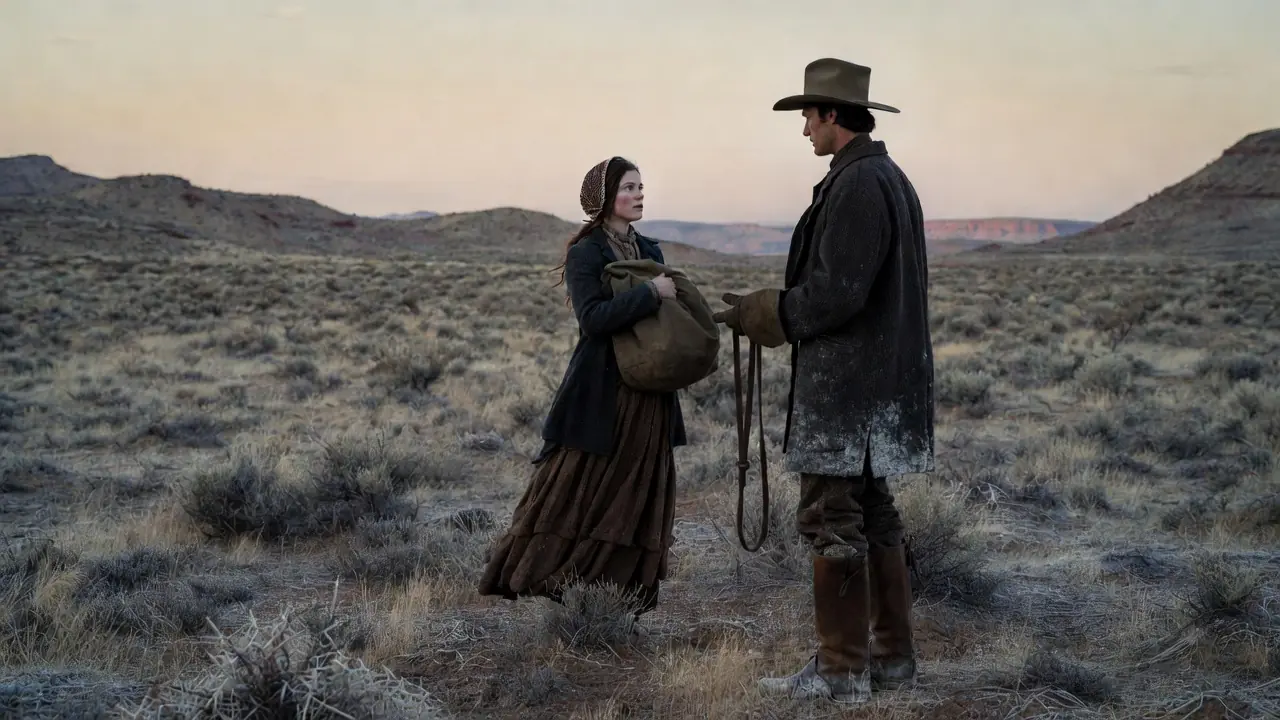
“I am afraid,” Winona admitted. “Afraid of losing someone again. Afraid of being hurt. Afraid that if I let myself care, something terrible will happen.”
“Those are all reasonable fears,” Isaac said. “And I cannot promise nothing bad will ever happen. Life does not work that way. But I can promise that whatever happens, we will face it together. You will not have to carry the weight alone anymore.”
The sun had set fully now, leaving them in the purple twilight.
Somewhere nearby, a coyote called out, its voice lonely and wild.
Winona shivered, and Isaac immediately shrugged out of his coat and draped it around her shoulders.
It was warm from his body and smelled like him, like leather and wood smoke and home.
“I care about you too,” Winona said, her voice barely above a whisper. “I have been trying not to, trying to protect myself, but I do. You have been so kind to me, Isaac, so patient. And every time I see you, I find myself wanting to see you again, wanting to hear your voice, wanting to know everything about you.”
Isaac’s face transformed with hope.
“That is a start.”
“It is more than a start,” Winona said. “It is me being terrified and doing it anyway.”
She took a step closer to him, closing the distance between them.
“It is me choosing to run toward something instead of away from it. Running to you, like you said.”
Isaac reached up slowly, giving her plenty of time to pull away, and cupped her face in his rough, gentle hands.
“May I kiss you?”
“Yes,” Winona breathed.
Then his lips were on hers, warm and soft and perfect.
The kiss was gentle, reverent, like Isaac was trying to convey with touch what he had already said with words.
Winona leaned into it, into him, letting herself feel the warmth and safety and possibility of it.
Her hands came up to rest on his chest, feeling the steady thump of his heart beneath her palms.
When they finally pulled apart, both breathless, Isaac rested his forehead against hers.
“I have wanted to do that for weeks,” he admitted.
“You should have,” Winona said, then laughed softly. “But I am glad you waited. I needed the time.”
“I would have waited years if that was what you needed,” Isaac said. “I meant what I said. I am not going anywhere.”
They walked back to the ranch house hand in hand.
And when they reached the door, Isaac kissed her once more, brief and sweet.
“Good night, Winona.”
“Good night, Isaac.”
Mrs. Chen was sitting in the kitchen when Winona came in, darning socks by lamplight.
She looked up with knowing eyes and a small smile.
“I take it your walk was pleasant.”
Winona felt her cheeks heat.
“It was good.”
“Isaac is a good man. He will treat you right.”
Mrs. Chen went back to her darning.
“Your husband. Did you love him?”
The question caught Winona off guard.
“Yes. Very much.”
“Then you know what love can be,” Mrs. Chen said thoughtfully. “But you also know it can end. That makes it harder to try again. Scarier.”
“Yes,” Winona said quietly. “It does.”
“My first husband died too,” Mrs. Chen said.
Winona looked at her in surprise.
She had assumed Mr. Chen was Mrs. Chen’s first and only husband.
“In China, before I came here. Cholera took him and our baby daughter. I thought I would never love anyone again. But then I met Mr. Chen, and he was patient with me. Let me heal. And eventually I learned that you can love someone with your whole heart even when part of that heart is scarred. The scars do not make the love less. They make it precious because you know how rare it is.”
Winona felt tears sting her eyes.
“Thank you for telling me that.”
“Thank you for listening,” Mrs. Chen said with a gentle smile. “Now go to bed. Tomorrow is another early morning.”
Winona went to her little room and lay in bed, her fingers touching her lips where Isaac had kissed her.
She thought about Thomas, about the young, uncomplicated love they had shared, and she let herself remember the good parts without the pain that usually came with the memories.
He would have wanted her to be happy, she realized.
He had loved her, and people who truly loved you wanted your happiness even after they were gone.
And Isaac made her happy.
The thought of him made her smile.
The sight of him made her heart beat faster.
The touch of him made her feel alive in a way she had not felt in a long time.
Maybe Mrs. Chen was right.
Maybe you could love again, even with a scarred heart.
Maybe the scars just meant you understood how precious and fragile and worth fighting for love really was.
Spring came slowly to the Arizona Territory, creeping in with warmer days and sudden bursts of wildflowers that turned the scrubland into a carpet of yellow and purple and red.
The ranch came alive with new calves being born, with foals wobbling on stick legs, with the constant work of branding and fence mending and all the thousand tasks that came with running a successful cattle operation.
Winona and Isaac’s courtship deepened through March and April.
He took her riding on her days off, teaching her to sit a horse properly, to read the land, to see the beauty in the harsh desert landscape.
They talked about everything.
Their childhoods.
Their dreams.
Their fears.
Isaac told her about wanting to have his own ranch someday, a small place where he could raise horses and cattle and maybe a family.
Winona talked about her love of reading, about wanting to start a library in whatever town she settled in.
A place where anyone could come and borrow books, regardless of whether they could afford to buy them.
“We could do both,” Isaac said one afternoon as they sat by a creek, watching the water run clear and cold over smooth stones. “If I had a ranch, we could have a library there. Fill a whole room with books. You could manage it, and people could come from miles around.”
Winona looked at him, at the serious, hopeful expression on his face.
“That sounds like something you would do with a wife,” she said carefully.
“It does,” Isaac agreed.
He reached over and took her hand, lacing their fingers together.
“Is that something you might want eventually?”
Winona’s heart raced.
They had been courting for three months.
She had been at the ranch for five.
It was fast, faster than made conventional sense.
But she was not a girl anymore, and neither of them were playing games.
They knew what they wanted.
“Yes,” Winona said. “Eventually. When the time is right.”
Isaac smiled and raised her hand to his lips, kissing her knuckles gently.
“Then I will wait for the right time.”
The right time came in May, under a sky so full of stars it looked like someone had spilled diamonds across black velvet.
Isaac had taken Winona up to the hilltop where he had first kissed her, where they had watched the sunset together so many times over the past months.
This time, he had brought a blanket and a basket of food, and they had a picnic dinner as the sky turned from blue to purple to black.
When the stars came out in full force, Isaac lay back on the blanket, pulling Winona down beside him.
She rested her head on his shoulder, feeling the solid warmth of him, listening to the steady beat of his heart.
“Winona,” Isaac said after a long, comfortable silence.
“Yes?”
“I love you.”
The words hung in the air between them, simple and enormous all at once.
Winona lifted her head to look at him and found him watching her with an expression so open and vulnerable it made her chest ache.
“I have loved you for a while now,” Isaac continued. “Maybe since that first day when you were so scared but still so brave. Maybe since I realized you smile more on your right side than your left. Maybe since the first time you laughed at one of my terrible jokes. I do not know exactly when it happened, just that it did, and I do not want to keep it to myself anymore.”
He reached up and tucked a strand of hair behind her ear.
“You do not have to say it back. I just needed you to know.”
Winona felt her eyes well with tears, but they were good tears, happy tears.
“I love you too,” she said, and watched his whole face light up. “I have been afraid to say it, afraid that admitting it would somehow jinx it, but I do. I love you, Isaac Sutton. You are the kindest, most patient, most wonderful man I have ever known, and I love you.”
Isaac pulled her down and kissed her deep and thorough, pouring all his feeling into it.
Winona kissed him back with equal fervor, her hands tangling in his hair, her body pressed against his.
When they finally broke apart, both breathing hard, Isaac rolled them so he was propped on his elbow, looking down at her.
“Marry me,” he said.
Winona laughed, breathless and giddy.
“That was not a question.”
“No, it was not,” Isaac agreed. “Because I am not asking if you will marry me someday. I am telling you I want to marry you as soon as possible because I have waited long enough, and I know what I want, and it is you. Every day for the rest of my life, I want you.”
He paused, then added with a small grin.
“But if you need it to be a question, Winona Reynolds, will you marry me?”
“Yes,” Winona said, joy bubbling up inside her like champagne. “Yes, yes, yes.”
Isaac kissed her again and again and again until they were both laughing and kissing and tangled together on the blanket under a sky full of stars.
They were married three weeks later on a Sunday in late May, when the weather was perfect and the whole ranch turned out to celebrate.
The ceremony was simple, held in the ranch yard with Mr. Reed officiating, since he was a justice of the peace in addition to being a rancher.
Winona wore a new dress that Mrs. Chen had helped her make, pale blue calico with white lace at the collar and cuffs.
Isaac wore his best shirt and trousers and a string tie, and he looked so handsome standing there waiting for her that Winona’s breath caught.
Mrs. Chen walked her down the makeshift aisle since Winona had no family there to do it.
When she placed Winona’s hand in Isaac’s, she whispered, “Be happy, daughter.”
Winona squeezed her fingers gratefully.
The ceremony was short.
They exchanged simple gold bands that Isaac had ridden all the way to Fort Yuma to buy.
They promised to love and cherish each other in sickness and health, for better or worse, as long as they both lived.
And when Mr. Reed pronounced them husband and wife, Isaac kissed her like she was the most precious thing in the world.
The celebration afterward was lively and long.
Someone had roasted a pig, and there was more food than any of them could eat, and the ranch hands brought out their instruments and played late into the night.
Winona danced with her new husband, with Mr. and Mrs. Chen, with Mr. Reed, and all the ranch hands until her feet ached and her face hurt from smiling.
Finally, as the moon rose high and the party showed no signs of slowing, Isaac took her hand and led her away from the crowd.
They had been given one of the small cabins on the ranch property, newly cleaned and furnished with a real bed and a table and chairs and a stove.
It was not much, but it was theirs.
Isaac carried her over the threshold, making her laugh, and set her down gently inside.
Someone, probably Mrs. Chen, had lit candles throughout the room, casting everything in soft golden light.
“Hello, wife,” Isaac said, his voice rough with emotion.
“Hello, husband,” Winona replied, and pulled him down for a kiss.
That night, they came together as husband and wife, tender and passionate, and a little awkward in the way of people still learning each other’s bodies.
But it was perfect because it was them.
Because they loved each other.
Because they had both been through darkness and found each other on the other side.
Afterward, lying tangled together in the narrow bed, Isaac traced patterns on Winona’s bare shoulder with his fingertips.
“Are you happy?” he asked quietly.
Winona turned to look at him, at this man who had stopped her from running, who had offered her safety and warmth and eventually love, who had been patient while she healed and brave enough to tell her what he wanted.
“I am happier than I ever thought I would be again,” she said honestly. “You saved me, Isaac. Not just that first day, but every day since. You showed me that I could love again, that I could trust again. You gave me hope when I had none left.”
Isaac’s eyes were bright in the candlelight.
“You saved me too. You know, I was drifting before you came, just working and existing, but not really living. You gave me a reason to want more, to be more. You made me feel like building a future was worth the effort.”
“Then we saved each other,” Winona said, and kissed him softly. “And now we build that future together.”
“Together,” Isaac agreed, and held her close as they drifted off to sleep.
Two people who had found each other in the cold and chosen to create warmth together.
The first years of their marriage were hard but happy.
They continued to work on the Double R Ranch, saving every penny they could toward buying their own land.
Isaac worked himself to the bone, taking on extra jobs, breaking horses for neighboring ranches, doing anything that would bring in extra money.
Winona continued to help Mrs. Chen and also started taking in sewing, mending, and altering clothes for the other ranch families in the area.
In the spring of their second year of marriage, Winona realized she was pregnant.
She told Isaac on a Sunday morning when they were lying in bed watching the sun rise through their small window.
“I have news,” she said, taking his hand and placing it on her still-flat belly.
Isaac looked at her, his eyes widening as understanding dawned.
“A baby?”
“A baby,” Winona confirmed, and watched as his face transformed with wonder and joy.
“We are going to be parents,” Isaac said, his voice choked with emotion. “You are going to be a mother, and I am going to be a father, and we are going to have a baby.”
“We are,” Winona said, laughing and crying at the same time. “Are you happy?”
Isaac pulled her into his arms and held her tight.
“I am terrified and thrilled and happier than I have any right to be. Yes, I am happy. So very happy.”
The pregnancy was not easy.
Winona was sick for the first three months, could barely keep anything down.
Mrs. Chen made her special teas that helped a little, and Isaac hovered anxiously, trying to make her comfortable.
As her belly grew, Winona found herself thinking about Thomas, about the baby they had wanted but never had time to make.
She grieved for that lost possibility, even as she rejoiced in this new one.
Isaac understood, held her when she cried, and never once made her feel guilty for mourning, even while she was happy.
“You can love what was and still be excited for what will be,” he told her. “The two things do not cancel each other out.”
Their son was born in November of 1885 during the first cold snap of winter.
The labor was long and difficult, and there were moments when Winona was sure she would not survive it.
Moments when she could see the fear in Isaac’s eyes as he held her hand and whispered encouragement.
But finally, after eighteen hours, their baby came into the world squalling and red-faced and perfect.
“A boy,” the midwife said, placing the tiny bundle on Winona’s chest. “A healthy baby boy.”
Winona looked down at her son, at his tiny fingers and scrunched-up face and shock of dark hair, and felt her heart expand in a way she had not known was possible.
“Hello, little one,” she whispered. “We have been waiting for you.”
Isaac sat on the edge of the bed, his arm around Winona, staring at their son with an expression of absolute awe.
“He is perfect,” he said hoarsely. “You are amazing. Look what you did. Look what we made.”
They named him James after Isaac’s father, with the middle name Thomas for the man who would have loved to see Winona happy again.
Little James was a good baby, quiet and observant, with his father’s hazel eyes and his mother’s determined chin.
Caring for a newborn while working was exhausting, but Mrs. Chen helped, watching James while Winona did her work, teaching her the tricks of motherhood that only came with experience.
The ranch hands doted on the baby.
These rough, hard men turned soft and silly whenever they held him, making faces to get him to smile, carving toys for him out of scraps of wood.
Isaac was a devoted father, coming home every evening exhausted from work, but always finding energy to hold his son, to walk with him when he fussed, to sing off-key lullabies that somehow always worked.
Winona would watch them together, her husband and her son, and feel overwhelmed with love and gratitude.
When James was six months old, Mr. Reed called Isaac and Winona into his office.
He was getting older, he said, and thinking about slowing down.
The ranch was too big for one man, even with a good foreman, and his own children had no interest in running it.
He had a proposal.
“There is a section of land on the northeast corner of the property,” Mr. Reed said. “About three hundred acres, with a creek running through it and good grazing. I am willing to sell it to you, Isaac, for a price you can afford. You have been a good hand and a loyal employee, and I would rather see that land go to you than to some stranger.”
Isaac looked stunned.
“Sir, I do not have enough saved for three hundred acres.”
“You have enough for a down payment,” Mr. Reed said. “The rest you can pay over time as you are able. Consider it an investment in the future. Your future and the future of this ranch.”
It was more than generous.
It was life-changing.
With the help of the other ranch hands, Isaac built a house on their new property.
A simple two-room cabin with a loft and a porch that looked out over the valley.
It was not fancy, but it was theirs, bought and paid for with their own hard work and sacrifice.
They moved in when James was eight months old, and Winona cried as she walked through her own front door into her own home on her own land.
She thought about the girl she had been, running through the cold with no hope and no plan.
She thought about how far she had come, how much she had gained.
“Thank you,” she said to Isaac that night as they stood on their porch watching the sun set over their land.
“For what?”
“For stopping me. For giving me a reason to stop running. For building this life with me.”
Isaac pulled her close, his arm around her waist.
“You do not have to thank me for doing what I wanted to do anyway. Loving you has been the easiest thing I have ever done.”
They called their property Sunrise Ranch because the view of the sunrise from their porch was the most beautiful thing either of them had ever seen.
It was not much at first, just three hundred acres and twenty head of cattle and a lot of hard work ahead of them.
But it was theirs, and they were building it together, and that made all the difference.
The next few years were a blur of work and growth.
Isaac hired two hands to help with the cattle, and Winona took over the books, managing their finances with a careful eye toward expansion.
She also started the library she had dreamed of, filling one corner of their small living room with books she bought or traded for, and soon people from neighboring ranches were stopping by to borrow them.
It was not much, but it was a start.
James grew into a bright, curious toddler, always underfoot, always asking questions.
When he was two, Winona became pregnant again, and this time the pregnancy was easier.
Their daughter, Mary, was born in the spring of 1888, a tiny, perfect thing with blonde hair and her mother’s brown eyes.
“Two children,” Isaac said, holding his daughter while his son climbed on his back. “We are outnumbered now.”
“We are blessed,” Winona corrected.
And he grinned and agreed.
Life was not always easy.
There were droughts that killed grass and made the cattle thin.
There were cold winters that tested everyone’s endurance.
There were sick children and injured animals and equipment that broke at the worst possible times.
But through it all, Winona and Isaac had each other, and that was enough.
On their fifth wedding anniversary, they went back to the hilltop where Isaac had first kissed her, where he had proposed, where they had looked at stars and dreamed of the future.
They left the children with Mrs. Chen and rode out together in the late afternoon, just the two of them.
“Do you remember the first time we came here?” Isaac asked as they stood looking out over the valley, watching the sun paint the sky in shades of fire.
“I remember everything about our beginning,” Winona said. “I remember being so cold. I thought I would never be warm again. I remember thinking I had nothing left to run toward. And then there you were.”
“There I was,” Isaac agreed. “And there you were, the bravest, most stubborn woman I had ever met, running away from pain and loss and refusing to give up even when you had every reason to.”
“I gave up,” Winona said quietly. “That day when I left the stagecoach, I thought about just lying down in the cold and letting it take me. I was so tired of hurting.”
Isaac turned to look at her, his eyes serious.
“But you did not. You kept running.”
“Because you told me to run to you instead,” Winona said. “You gave me something to run toward instead of away from. You saved my life, Isaac. In every way a person can be saved.”
Isaac cupped her face in his hands the way he had that first time he kissed her.
“And you saved mine. You made me want to be better, do better, build something that mattered. Every good thing in my life came from the moment I decided to ride toward that stagecoach instead of away from it.”
They kissed as the sun set.
Two people who had found each other in the darkness and built a life in the light.
The years continued to pass, marked by the rhythms of ranch life and family.
James grew tall and serious with his father’s steady temperament.
Mary was wild and joyful, always laughing, always moving.
When James was seven and Mary was five, they welcomed another son, Robert, and two years after that, twin girls, Clara and Catherine.
Their little two-room cabin was bursting at the seams, so Isaac built an addition, then another, until the house sprawled in several directions, full of life and noise and love.
The ranch grew too, expanding to a thousand acres with a hundred head of cattle and some of the finest horses in the territory.
Winona’s library grew as well, until it filled a whole room and people came from towns fifty miles away to borrow books.
She taught all her children to read before they were five, instilling in them a love of stories and learning that she knew would serve them well in life.
Mrs. Chen passed away in the winter of 1892, and both Isaac and Winona mourned her deeply.
She had been a second mother to Winona, a friend and teacher and source of endless wisdom.
At her funeral, Winona held Isaac’s hand and thought about how Mrs. Chen had told her that you could love again, even with a scarred heart, that the scars just made the love more precious.
“She was right,” Winona whispered to Isaac. “About everything.”
“She usually was,” Isaac agreed, his voice rough with grief.
Mr. Reed died two years after Mrs. Chen, and the Double R Ranch was split up and sold to various buyers.
But by then, Sunrise Ranch was well established, prosperous, and respected throughout the territory.
Isaac had a reputation as a fair boss and an honest man, and Winona was known for her kindness and her library and her skill with managing the ranch’s finances.
Arizona became a state in 1912, and Isaac and Winona celebrated by holding a huge party at their ranch, inviting everyone they knew.
Their children were grown by then, all healthy and happy, and starting families of their own.
James had married a schoolteacher and was running his own spread west of theirs.
Mary had married a lawyer in Tucson and had three children already.
Robert was working as a foreman on a ranch in New Mexico, and the twins were still at home helping with the ranch and driving their father crazy with their constant mischief.
That night, after all the guests had gone home and the twins had finally gone to bed, Isaac and Winona sat on their porch, the same porch they had stood on so many times over the years.
“We did it,” Winona said, taking Isaac’s hand. “We built the life we wanted.”
“We did,” Isaac agreed.
His hair was gray now, and there were deep lines around his eyes, but his smile was the same one that had made her heart flutter all those years ago.
“Though I seem to recall the original plan was just a small place to raise a family.”
Winona laughed.
“Plans change. Dreams grow. That is life.”
“That is our life,” Isaac corrected. “And I would not trade a single moment of it.”
They sat in comfortable silence, watching the stars come out one by one.
Winona thought about the girl she had been, running through the cold, convinced her life was over.
She thought about how wrong she had been, how much life had been waiting for her on the other side of that dark moment.
“You ever think about that day?” Isaac asked, as if reading her thoughts. “The day we met?”
“Sometimes,” Winona said. “I think about how scared I was, how hopeless I felt. How sure I was that I would never be happy again. And now, now I know that even when you think you have lost everything, there is always a chance to find something new, someone new, a whole new life if you are brave enough to reach for it.”
She squeezed his hand.
“Thank you for being there that day. Thank you for stopping me from running. Thank you for giving me a reason to stay.”
“Thank you for saying yes,” Isaac said. “To help, to courting, to marriage, to all of it. You made every day of the last thirty years worth living.”
They kissed, soft and sweet and full of the comfortable love that came from decades of partnership.
Inside the house, one of the twins laughed at something, and they both smiled.
“Come on,” Winona said, standing and pulling Isaac up with her. “Let us go to bed. Tomorrow is another day, and there is always work to be done.”
“Always,” Isaac agreed, but he was smiling.
They went inside together into the warm house they had built, surrounded by the evidence of the life they had created.
And as Winona settled into bed beside her husband, she thought about running, about how she had spent so long running from pain and loss and fear.
But then Isaac had told her to run to him instead.
She had.
And everything had changed.
She had found love again, deeper and richer for the pain that came before it.
She had found home, not in a place, but in a person, in the strong, steady man who had stopped her in the cold and offered her warmth.
She had found herself again too, the parts she thought were lost forever, pieced back together with patience and kindness and love.
As she drifted off to sleep, Isaac’s arm around her waist and his breath warm on her neck, Winona Reynolds Sutton thought about one last thing.
She was not running anymore.
She had no reason to.
She had found everything she needed right here.
Isaac lived to be seventy-three, dying peacefully in his sleep in the summer of 1930 with Winona holding his hand and his children and grandchildren gathered around.
At his funeral, Winona stood dry-eyed and straight-backed, strong even in her grief, because that was what Isaac would have wanted.
“He was the best man I ever knew,” she said in her eulogy. “He stopped me when I was running from everything and convinced me to run toward something instead. He gave me a reason to live when I had forgotten how. He loved me through my worst moments and celebrated my best ones. He built this ranch and this family with his own two hands, and his legacy will live on in every one of us.”
After the funeral, James came to find her standing on the porch of the ranch house, looking out over the land Isaac had loved so much.
“Are you all right, Mother?” he asked gently.
Winona nodded.
“I am sad. I will miss him every day for the rest of my life. But I am also grateful, James. So grateful for every moment we had together. Your father and I got forty-five years together. That is more than many people ever get. It is more than I ever thought I would have after Thomas died.”
James put his arm around her shoulders.
“He loved you very much.”
“I know. And I loved him. I still do.”
Winona smiled through her tears.
“Love like that does not end just because someone is gone. It stays. It shapes you. It makes you who you are.”
She lived for another eight years after Isaac died, staying active and involved in the ranch until the very end.
She spent her days reading, gardening, and spoiling her twenty-three grandchildren and seven great-grandchildren.
She kept Isaac’s library going, still lending books to anyone who asked, and every evening she would sit on the porch and watch the sunset, remembering the man who had loved her, who had given her a second chance at life.
Winona Reynolds Sutton died in her sleep in the spring of 1938 at the age of seventy-eight.
She went peacefully with no pain, surrounded by the love of her family.
At her funeral, James read from a letter she had written to be opened after her death.
“I want you all to know that I lived a happy life. It was not always easy, and there were moments when I thought the pain would break me. But I survived, and I thrived because I was blessed with people who loved me and whom I loved in return.
Isaac was the greatest gift of my life. But all of you, my children and grandchildren and great-grandchildren, you are his legacy and mine. You are proof that love wins, that choosing hope over despair and connection over isolation is always the right choice.
I am so proud of all of you. Live good lives. Love fiercely. And when you see someone running from pain, offer them a hand and show them there is something worth running toward. That is how we change the world, one person at a time.”
There was not a dry eye in the church when James finished reading.
They buried Winona next to Isaac on a hill overlooking Sunrise Ranch, under a sky so blue it looked like heaven had opened up just for her.
The grave marker read:
Winona Reynolds Sutton
1860–1938
Beloved wife, mother, and grandmother.
She ran toward love.
And on Isaac’s marker beside hers, added after Winona’s death, were the words:
Isaac Sutton
1857–1930
Beloved husband, father, and grandfather.
He showed her the way.
The ranch stayed in the family for generations, each new owner adding their own touches but always maintaining the library Winona had started and the values Isaac had instilled.
And every generation told the story of how their ancestors met.
The young widow running from pain and the cowboy who stopped her and offered her a different path.
It became a family legend, a reminder that even in our darkest moments, there is always hope.
That love can find us when we least expect it.
That sometimes the best thing we can do is stop running from our pain and start running toward something better.
And in the end, that was the real legacy of Winona and Isaac Sutton.
Not the land they accumulated or the wealth they built, but the love they shared and the example they set.
They proved that it was possible to survive loss and find joy again.
To build a new life from the ashes of the old one.
To love with an open heart even when that heart had been broken before.
They ran toward each other on that cold Arizona morning so many years ago.
Two people who needed saving and ended up saving each other.
And from that moment of connection, of choosing hope over despair, came a whole new world.
Children and grandchildren.
A thriving ranch.
A library that touched hundreds of lives.
And most importantly, a love story that would inspire generations to come.
Because in the end, that is what matters most.
Not how we fall, but how we choose to rise.
Not what we lose, but what we find the courage to reach for again.
Not the winter and pain we run from, but the warmth and love we run toward.
Winona ran toward Isaac that cold morning.
And he ran toward her.
And together, they built something beautiful.
Together, they proved that even when you think your story is over, sometimes it is just beginning.
Sometimes the best chapters are still unwritten, waiting for the moment when you are brave enough to stop running away and start running toward your future instead.
And that, in the end, is the greatest love story of all.