Her father sold her to a duke to pay his debts.
Three years.
That was the deal.
But the duke had one rule.
She could never fall in love with him because the last woman who loved him had died because of it.
But some rules are meant to be broken.
The carriage wheel scraped against frozen gravel as Lara pressed her face to the frost-covered window, watching the manor gates swing open like the jaws of some great iron beast.
She knew what was coming next.
She knew what her father had agreed to in that dimly lit tavern three weeks ago.
But knowing did not make it any easier to breathe.
Her father’s hand trembled against hers, the dampness of his palm seeping through her worn gloves.
He had not spoken since they left the village at dawn, and the silence between them carried the weight of every unsaid apology.
Every moment of love that would soon be ripped away.
Lara wanted to scream at him, to demand why he had gambled away their farm, why he had borrowed money from a duke known for collecting debts in the cruelest ways possible.
But when she looked at his face, gray and hollowed out like a candle burned to nothing, the words died in her throat.
The carriage lurched to a stop, and she felt her stomach drop.
Duke Matias Valamont stood at the top of the stone steps, his figure dark against the pale morning sky.
Even from this distance, she could see he was not the monster from her father’s whispered warnings.
He was younger than she had imagined, maybe thirty-five at most, with dark hair that fell just past his collar and a face that might have been handsome if it were not so completely empty of expression.
His eyes, though, those were different.
They held something she could not quite name.
Something that made her skin prickle with an instinct older than thought.
“Stay in the carriage,” her father whispered, his voice cracking. “Let me talk to him first.”
But before Lara could respond, the carriage door swung open, and a servant in crisp black livery stood waiting.
There would be no negotiation.
No last-minute reprieve.
Her father had signed the papers, pressed his thumbprint into red wax, and traded his only daughter for another year of survival.
The manor was even colder inside than out.
She noticed small details that felt wrong.
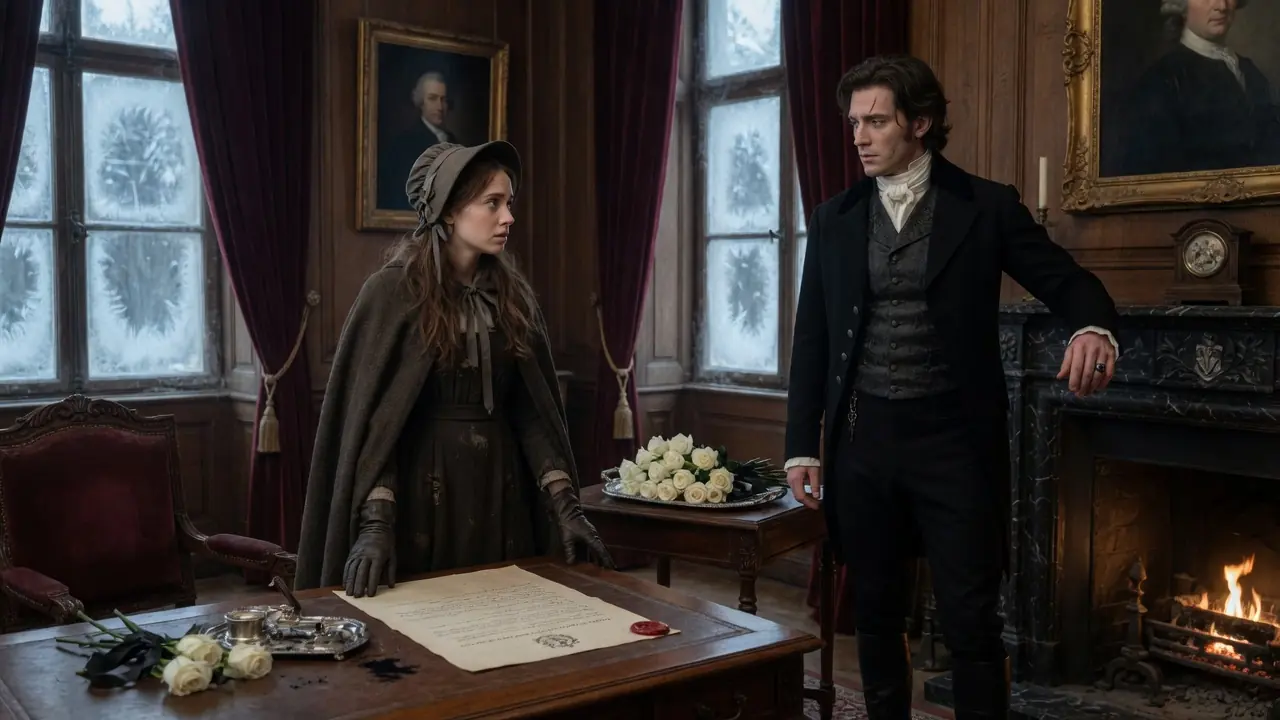
A fresh bouquet of white roses on a side table that smelled too sweet, almost sickly.
A child’s wooden toy abandoned near a doorway.
A woman’s shawl draped over a chair as if someone had just left the room.
The house felt lived in but also emptied out, like a stage set after all the actors had gone home.
The duke led them to a study paneled in dark wood that absorbed the firelight rather than reflecting it.
He gestured for her father to sit, but remained standing himself, one hand resting on the mantelpiece.
Lara noticed his fingers were long and elegant, the hands of a pianist or a surgeon.
Not a man who crushed farmers under the weight of impossible debt.
“Mr. Thorne,” the duke said, his voice surprisingly soft, almost gentle. “You understand the terms?”
Her father nodded, unable to meet his eyes.
“Yes, Your Grace. One year of service from my daughter, and the debt is forgiven. All of it.”
“Three years,” the duke corrected.
Lara’s heart stopped.
“The original agreement was three years.”
“But you said,” her father started, his face going pale. “In the tavern, you said one year if I brought her before the first snow.”
The duke’s expression did not change.
“I said the debt would be manageable with one year, forgiven with three. The choice, Mr. Thorne, has always been yours.”
Lara watched her father’s shoulders collapse inward.
She watched him age another ten years in the space of a breath.
She knew what he would choose because she had known it from the moment he had come home that night, reeking of cheap wine and cheaper decisions.
He would choose survival.
He would choose the farm, the land that had been in their family for four generations, even if it meant sacrificing her.
“Three years then,” he whispered.
Something flickered across the duke’s face, something that might have been disappointment or maybe satisfaction.
Lara could not tell.
He moved to his desk and pulled out a fresh sheet of parchment.
The paper was so thick and cream-colored it probably cost more than her father made in a month.
His handwriting was precise as he wrote out the new terms, each letter perfectly formed.
“Your daughter will serve as my companion,” the duke said without looking up. “She will dine with me, walk the grounds with me, and sleep in the room adjoining mine. She will not be harmed. She will not be forced into anything against her will. She will be provided with clothing, food, and education befitting her new station. At the end of three years, she will be free to leave with a dowry of five hundred crowns.”
Lara’s father nearly choked.
Five hundred crowns was enough to buy three farms.
“Why?” Lara heard herself ask, her voice sounding strange and distant in the quiet room. “Why would you pay so much for a companion? You could hire anyone. Someone trained. Someone who actually wants to be here.”
The duke finally looked at her directly, and Lara felt the full weight of his attention like a physical thing pressing against her chest.
His eyes were gray.
She realized they were the color of storm clouds before the rain came.
And in them, she saw something that made her breath catch.
A loneliness so deep and vast it had its own gravity.
“Because everyone who comes to me wants something,” he said simply. “Money, status, favor, power. You are the first person in five years who wants nothing from me except to leave. That honesty is worth more than you can possibly understand.”
He turned back to her father.
“Sign here, Mr. Thorne. Then I suggest you leave quickly, before your daughter realizes what you have done and before I change my mind about my generosity.”
Her father’s hand shook so badly he could barely hold the pen.
The scratch of quill against parchment sounded like claws on glass.
When he finished, he stood slowly, his joints creaking like old wood.
He looked at Lara, and she saw tears streaming down his weathered cheeks.
“I’m sorry,” he whispered. “Lara, I’m so sorry.”
But sorry did not change anything.
Sorry did not unlock the gates or turn back time.
Sorry was just another word people used when they had already made their choice.
She watched him walk away down that long hallway, his footsteps getting quieter and quieter until finally there was only silence.
She did not cry.
She would not give him that.
Instead, she turned to face the duke, lifting her chin in defiance even as her hands shook at her sides.
“I want to see the contract,” she said. “All of it. Every word.”
Something that might have been respect crossed the duke’s face.
He handed her the parchment without argument.
Lara read through it carefully, looking for the trap she knew had to be there.
But the terms were exactly as he had stated.
Three years of companionship, not servitude.
Freedom at the end with enough money to start a real life.
“What happened to the last one?” she asked suddenly, remembering the child’s toy and the woman’s shawl.
“The last companion?”
The duke’s face went completely blank.
For the first time since she had arrived, Lara felt true fear curl in her stomach.
When he spoke again, his voice was so quiet she had to strain to hear it.
“She fell in love with me,” he said. “And I destroyed her for it.”
The room they gave Lara was bigger than her entire cottage back home.
A four-poster bed dominated the space, draped in deep burgundy velvet that looked like it had never been touched by sunlight.
There was a writing desk by the window, a wardrobe that could fit ten versions of her old life, and a door that connected directly to the duke’s chambers.
That door had no lock on her side.
She stood in front of it for a long time that first night, her hand hovering over the brass handle.
She wondered if he was on the other side doing the same thing.
She wondered what kind of man paid a fortune for company he claimed not to want.
She wondered what had happened to the woman before her, the one who had made the mistake of falling in love.
Sleep did not come easy.
Every creak of the old manor sounded like footsteps, while every gust of wind against the windows felt like a warning.
When morning finally broke through the heavy curtains, Lara found a note slipped under her door.
The handwriting was the same precise script from the contract.
Breakfast at eight. Wear the blue dress in the wardrobe. We have much to discuss.
The blue dress fit perfectly, which bothered her more than if it had been too big or too small.
It meant he had looked at her carefully enough yesterday to guess her measurements.
It meant he had planned this, had the dress made or selected specifically for her before she had even arrived.
She tried not to think about what else he might have planned.
The dining room was absurdly large for two people.
The duke sat at one end of a table that could seat twenty, reading a newspaper that was already three days old by the date on top.
He did not look up when she entered, just gestured to the seat beside him, not at the far end where she had expected.
“I don’t bite,” he said, still not looking at her. “Despite what the village gossip probably told you.”
Lara sat down slowly, eyeing the spread of food that could have fed her entire village for a week.
Fresh bread.
Butter that actually smelled like cream.
Eggs cooked three different ways.
Bacon, sausages, and fruit she had only seen at the market during harvest festivals.
Her stomach growled traitorously.
“Eat,” the duke said, finally setting down his newspaper. “You look like you haven’t had a proper meal in months.”
“We managed fine,” Lara said defensively, even though it was a lie.
They had been eating thin soup and stale bread since autumn, rationing everything to make it through winter.
“Your father owes debts to six other merchants besides me,” the duke said matter-of-factly, spreading jam on his toast. “The butcher, the grain merchant, the tavern keeper. He has been borrowing from anyone foolish enough to lend to him for almost two years. Did you know that?”
Lara’s hand froze halfway to the bread basket.
“No.”
“He’s a gambler. A bad one. He’s convinced that one big win will solve everything. So he keeps doubling down, keeps borrowing more.”
The duke took a bite of his toast and chewed thoughtfully.
“Men like that don’t stop until they have destroyed everything they touch. I have seen it a hundred times.”
“Then why did you lend to him?” Lara demanded, anger flaring hot in her chest. “If you knew what he was?”
For the first time, the duke’s expression shifted into something that might have been human.
“Because he had something valuable enough to cover the loss. And because I needed someone.”
The honesty of it stung worse than any lie could have.
They ate in silence for a while, and Lara found herself stealing glances at him when she thought he was not looking.
In the morning light, she could see details she had missed yesterday.
A scar along his jawline, faded but still visible.
Dark circles under his eyes, as if he had not slept properly in years.
The way his hands moved with careful precision, as if he was always conscious of taking up too much space.
“What are the rules?” she asked finally, setting down her fork. “You said I’d be your companion. What does that actually mean?”
The duke leaned back in his chair, studying her with those storm-cloud eyes.
“It means you’ll spend your days with me. We’ll take breakfast together, walk the grounds, dine together in the evening. You’ll sit with me while I work. Read to me sometimes if I ask. You’ll sleep in your room with that connecting door open.”
“Open?”
Lara’s voice came out higher than she intended.
“I have nightmares,” he said flatly, like he was discussing the weather. “Bad ones. I need to know someone is there. That I’m not alone. But I won’t come through that door, Miss Thorne. You have my word on that, for whatever a duke’s word is worth to you.”
There was something broken in the way he said it.
Something that made her anger falter.
“What about the woman before me? The one who fell in love with you?”
The duke’s face went completely still.
“That is not a story for your second day here.”
“When then?”
“Maybe never.”
He stood abruptly, his chair scraping against the floor.
“Come. I’ll show you the library.”
The library was the most beautiful room Lara had ever seen.
Three stories of books reached toward a painted ceiling that depicted some ancient battle she did not recognize.
Ladders on rails connected the levels, and comfortable chairs were scattered throughout like someone actually read here, actually used this space instead of just keeping it for show.
“You can read anything you want,” the duke said, running his hand along a shelf of leather-bound volumes. “I have tutors who come twice a week. You’ll study mathematics, history, literature, even science if it interests you. By the time you leave here, you’ll be educated better than most noblemen’s daughters.”
“Why?” Lara asked again, that same question from yesterday. “Why does any of this matter to you?”
The duke pulled a book from the shelf, something old with gold lettering on the spine.
“Because I was married once,” he said quietly. “To a woman who loved me desperately, and I couldn’t love her back, no matter how hard I tried. She was kind and beautiful and deserved so much better than what I could give her. One winter, she walked out into the snow and didn’t come back.”
Lara felt her breath catch.
“She died?”
“They found her three days later in the woods. Frozen.”
His voice was completely flat now, emptied of all emotion.
“The doctor said it was an accident, that she had gotten lost in a storm. But I knew better. I knew I had killed her just by being incapable of loving her the way she needed.”
He turned to face Lara fully.
She saw something raw and terrible in his expression.
“So I made myself a promise. Never again would I bring someone into my life who wanted my love. Only someone who wanted to leave. Someone who could sit beside me without expecting anything I couldn’t give. Someone who would be honest enough to count down the days until they were free.”
“That is the saddest thing I have ever heard,” Lara whispered.
“Yes,” the duke agreed. “It is.”
They stood in silence, surrounded by thousands of stories.
Lara realized she was trapped in one of the strangest ones ever written.
A man so convinced of his own inability to love that he had built an entire prison out of loneliness, and now she was locked inside it with him.
“What was her name?” Lara asked softly. “Your wife.”
“Catherine.”
The word came out like a prayer.
“Her name was Catherine, and she deserved so much better than me.”
Outside the library windows, snow had started to fall again, soft and silent.
Three years suddenly felt like a lifetime.
Three months passed like pages turning in one of the duke’s countless books.
Lara learned things she had never imagined knowing.
How to speak basic French.
The names of constellations.
The proper way to hold a teacup that cost more than her father’s farm.
But more than that, she learned the rhythms of Matias Valamont’s carefully constructed loneliness.
She learned that he took his coffee black because Catherine had liked it sweet, and he could not bear the reminder.
She learned that he avoided the east wing entirely because it had been her favorite place to paint.
She learned that some nights his nightmares were so bad she could hear him crying through the open door, though he never once came through it like he had promised.
And slowly, without meaning to, without wanting to, Lara started to understand him.
It happened in small moments.
The way he left books on her desk that he thought she would enjoy, never saying anything, but always somehow knowing exactly what she needed to read.
How he slowed his walking pace on their daily walks around the grounds because her legs were shorter than his.
The time she mentioned missing her mother’s lavender soap, and three days later found a bar of it by her wash basin.
He was kind in the quietest ways possible, in ways that did not ask for anything back.
Winter gave way to early spring, and one morning Lara woke to find the connecting door closed for the first time since she had arrived.
Her heart jumped into her throat as she rushed through it, certain something terrible had happened.
Matias was sitting on the floor beside his bed, still in his nightclothes, his face buried in his hands.
The room was destroyed.
Books thrown from shelves.
A shattered vase bleeding water across the carpet.
Curtains half torn from their rods.
“Don’t,” he said when she moved toward him, his voice raw. “Please don’t come closer.”
But Lara had spent three months learning to read the space between his words.
She sat down on the floor across from him, far enough away that he would not feel crowded, but close enough that he was not alone.
“Tell me,” she said simply.
“It’s the anniversary,” he whispered. “The day they found her. Every year, it’s the same. I wake up and I’m back in those woods, seeing her face in the snow and knowing it was my fault.”
His shoulders shook.
“I killed her, Lara. As surely as if I had pushed her into that frozen lake myself.”
“You didn’t kill her,” Lara said firmly. “Grief killed her. Loneliness killed her. But you didn’t.”
“I couldn’t love her.”
“Maybe you loved her the only way you knew how. Maybe it wasn’t the way she needed, but that doesn’t make you a murderer.”
Lara wrapped her arms around her knees.
“My mother died when I was twelve. Fever took her in three days. And for years, I was angry at her for leaving me alone with my father, for not fighting harder to stay. It took me a long time to realize that sometimes people break in ways we can’t fix, no matter how much we love them.”
Matias looked up at her finally, his eyes red and swollen.
“You never talk about your mother.”
“You never asked.”
Lara managed a small smile.
“We’re quite a pair, aren’t we? Both carrying around dead people who won’t let us go.”
Something shifted in the air between them.
Something fragile and new.
Matias reached out slowly, giving her time to pull away, and took her hand.
His palm was warm and calloused in ways she had not expected.
“Thank you,” he said quietly. “For not running. For staying.”
But that was the problem, wasn’t it?
Lara realized it with a sudden clarity that stole her breath.
She was not staying because of the contract anymore.
She was staying because she wanted to.
The weeks after that anniversary were different.
Matias started smiling more.
Small, hesitant things that transformed his whole face.
He taught her to play chess and pretended not to notice when she started winning.
They stayed up late talking about everything and nothing, about philosophy and politics, and whether the moon really controlled the tides.
One evening in late spring, they were walking through the garden where early roses had started to bloom.
The air smelled like growing things and possibility.
Matias had been quiet for a while, and Lara had learned that his silences usually meant he was working up courage to say something.
“I’ve been thinking,” he said finally, stopping beside a fountain that was not running yet. “About the contract. About what happens when three years are finished.”
Lara’s heart started beating too fast.
“What about it?”
“I want to give you a choice.”
He turned to face her fully, and she could see fear in his eyes for the first time since she had known him.
“You can leave now, today, with the full dowry. No obligation to stay. Or you can stay, not as a companion fulfilling a contract, but as yourself. As Lara. Because you want to, not because you are trapped.”
“And if I stay?” she asked, her voice barely above a whisper. “What then?”
“Then we figure out what that means together.”
He took both her hands in his.
“I can’t promise I’ll be easy to love, Lara. I’m broken in ways I’m still discovering. But I can promise I’ll try. I’ll try to be the kind of man who deserves whatever you are willing to give me.”
Lara felt tears sliding down her cheeks, and she did not bother wiping them away.
“You idiot,” she said, laughing and crying at the same time. “Do you really think I would have stayed this long if I did not already love you?”
The look on Matias’s face was something between wonder and terror.
“But the contract. I thought you were just…”
“I was,” Lara interrupted. “At first, I counted every single day. But somewhere around month two, I stopped counting. I stopped seeing the walls and started seeing you.”
She squeezed his hands.
“You are not broken, Matias. You are just scared. And I’m scared too. But maybe we can be scared together.”
He kissed her then, soft and careful, like he was afraid she might disappear if he was not gentle enough.
Lara kissed him back, tasting salt from both their tears and feeling something in her chest crack open in the best possible way.
“I need to tell you something,” Matias said when they finally pulled apart. “Your father, the debt, all of it. I paid off everything he owed to everyone in the village six months ago. You could have left any time since then. I just couldn’t bring myself to tell you.”
Lara started laughing.
Really laughing, until she had to sit down on the fountain’s edge.
“We’re both idiots then. I found out about that two weeks ago from the housekeeper. I stayed anyway.”
Matias sat beside her, and for the first time since she had met him, he looked completely at peace.
“So what now?”
“Now we start over,” Lara said, threading her fingers through his. “No contracts, no debts, no dead people telling us how to live. Just us figuring it out one day at a time.”
The sun was setting behind the manor, painting everything gold and rose.
Somewhere in the distance, a bird was singing the first evening song of spring.
Two people who had thought they were broken beyond repair sat together in a garden, holding hands and learning how to heal.
Three years later, on their wedding day, Matias would tell everyone that he had fallen in love with Lara the moment she demanded to see the contract.
But Lara knew the truth.
They had both fallen slowly, carefully, like people learning to trust the ground beneath their feet after a lifetime of falling.
And that was exactly how it should be.