The afternoon heat hung over Savannah, Georgia, when Dr. Vanessa Cole stepped out of her rental sedan and looked toward the small brick house at the end of Willow Street. She wore a dark navy V-neck blouse with the sleeves rolled neatly to her forearms, blue jeans, pearl earrings, and a thin gold necklace, deliberately choosing clothes that made her look like an ordinary visitor rather than a state official. At forty-three, Vanessa had spent almost two decades investigating civil-rights violations, institutional misconduct, and public agencies that had become too comfortable policing themselves. What she did not expect was to become evidence in her own investigation before she even reached the front porch.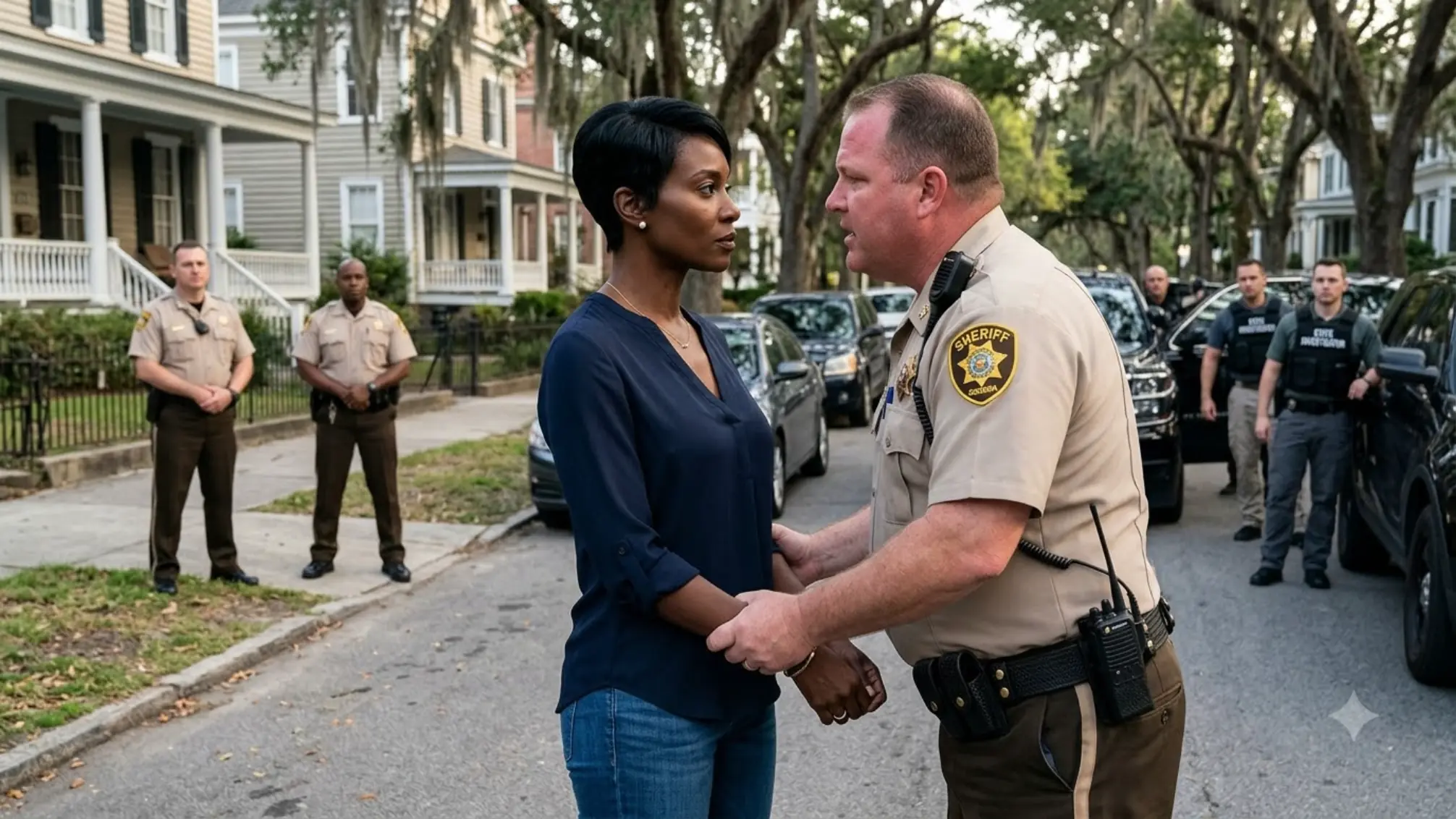
Vanessa had arrived in Savannah quietly because five separate complaints against the Chatham Ridge Sheriff’s Office contained the same disturbing pattern. Residents claimed deputies stopped people without clear cause, demanded identification from pedestrians visiting certain neighborhoods, threatened property owners who questioned them, and occasionally detained witnesses who tried to record encounters. The complaints were serious enough that the governor’s legal office had authorized an independent state review, but Vanessa wanted to understand the neighborhood before anyone knew investigators were there. Her first interview was supposed to be with sixty-eight-year-old Ruth Daniels, a retired school principal whose grandson had been detained outside her home after refusing to explain why he was visiting his own grandmother.
Vanessa had barely closed the car door when a tan sheriff’s cruiser rolled slowly around the corner. It continued past her, stopped twenty yards ahead, then reversed. She watched it through the reflection in the sedan window without reacting. The driver’s door opened, and Sheriff Wade Mercer stepped out.
Mercer was forty-eight, broad through the shoulders, with short brown hair and the heavy confident stride of a man who had spent years watching people move aside when he approached. His tan uniform was immaculate, the gold sheriff’s star centered on his chest, while a radio and duty belt rested against his waist. Vanessa recognized him immediately from the case file. She had studied his personnel history, public interviews, election campaigns, complaint statistics, and more than forty pages of internal correspondence before ever seeing him in person.
Mercer did not recognize her.
“You lost?” he asked.
Vanessa turned toward him calmly. “No.”
“Who are you visiting?”
She looked toward Ruth’s house. “Someone who lives here.”
“That wasn’t what I asked.”
Vanessa’s eyes shifted back toward him.
“I heard the question.”
Mercer moved closer. “Name?”
Vanessa’s expression remained neutral. “Why?”
His face hardened almost immediately. “Because I’m the sheriff, and I’m asking.”
Vanessa had conducted hundreds of interviews with officers accused of overstepping authority. She knew the moment when conversation stopped being about safety and became about obedience. Mercer had reached it within thirty seconds.
“Am I suspected of committing an offense?”
His eyebrows rose.
“You always answer questions with questions?”
“When the question concerns my legal obligation to identify myself, yes.”
Mercer glanced toward her car. “Rental?”
Vanessa said nothing.
“I asked if it’s a rental.”
“You can read the plate.”
His mouth tightened.
Two deputies arrived in another cruiser and parked behind him. Neither activated emergency lights. They stepped out slowly, watching Vanessa as though Mercer’s attention alone had transformed her into a threat.
Mercer crossed his arms. “We’ve had problems around here.”
“What kind?”
“Break-ins. People casing houses.”
Vanessa glanced at the quiet street. Children’s bicycles lay near one driveway, sprinklers clicked across manicured lawns, and an elderly man watered roses two houses away. “Do I match the description of a suspect?”
Mercer stared.
“You’re standing outside a house that isn’t yours.”
“That’s legal.”
“You’re getting smart with me.”
“No.”
Vanessa lowered her voice.
“I’m being precise.”
That irritated him more.
Mercer stepped closer until less than two feet separated them. “Around here, when law enforcement asks who you are, you answer.”
Vanessa met his eyes. “Around here?”
“You heard me.”
“Yes.”
She paused.
“That phrase appears in several complaints about your department.”
Mercer’s face changed.
Only slightly.
But Vanessa saw it.
“What did you say?”
She repeated herself.
“Several residents said deputies told them, ‘Around here, you answer when we ask.’”
One deputy behind Mercer shifted uncomfortably.
The sheriff looked toward him, then back at Vanessa.
“Who the hell are you?”
Vanessa almost answered.
Instead, she asked, “Why does that suddenly matter?”
Mercer reached toward her arm.
She stepped back.
“Don’t touch me.”
His hand closed around her wrist.
The movement was quick, unnecessary, and unmistakably deliberate.
Vanessa’s entire posture changed.
“Release me.”
Mercer grabbed her other wrist too.
One deputy looked alarmed.
“Sheriff…”
“Stay back.”
Vanessa did not pull away.
That mattered.
She planted both feet and allowed Mercer to hold her hands while looking directly into his face.
“You have no lawful basis to restrain me.”
Mercer leaned closer.
“I decide what basis I need.”
The deputy behind him looked toward his body camera.
Vanessa noticed.
“Is your camera active, Deputy?”
Mercer snapped his head toward her.
“Don’t talk to my men.”
Vanessa remained perfectly calm.
“You should want it active.”
Mercer’s fingers tightened around her wrist.
“I said stop talking.”
She looked down at his hands.
Then back at him.
“Enjoy your last minute of power, Sheriff.”
For the first time, Mercer hesitated.
“What?”
Vanessa’s expression did not change.
“You heard me.”
Mercer leaned closer until she could smell coffee on his breath. “You think one smart mouth is going to scare me?”
Vanessa looked over his shoulder.
“No.”
A low engine rumble entered the street.
Mercer heard it too.
Three black SUVs turned around the corner together.
Then a fourth.
The vehicles moved slowly, deliberately, and stopped behind the sheriff’s cruisers. Doors opened almost simultaneously.
Men and women in dark business suits stepped out.
One carried a state evidence case.
Another wore a visible badge clipped to his belt.
A third began photographing the scene before saying a word.
Mercer released one of Vanessa’s wrists.
“What is this?”
Vanessa looked at his remaining hand.
“Both.”
He let go.
The deputy standing behind him went pale.
A tall Black man in a charcoal suit approached from the first SUV.
Deputy Director Marcus Hale, Vanessa’s second-in-command at the Georgia Office of Civil Rights Compliance, stopped several feet away and looked at her wrists.
“Director Cole?”
Mercer stared at Vanessa.
“Director?”
Marcus ignored him.
“Are you injured?”
“No.”
Vanessa rubbed one wrist.
“Preserve every camera.”
The street became silent.
Mercer’s face changed completely.
“Wait.”
Vanessa looked at him.
He pointed toward the SUVs.
“State investigators?”
Marcus answered this time.
“Yes.”
Mercer looked back at Vanessa.
“You’re with the state?”
Vanessa reached inside the leather tote hanging from her shoulder and removed a black credential wallet.
She opened it.
Official seal.
Photograph.
Title.
Director, Georgia Office of Civil Rights Compliance.
Mercer stared.
Vanessa closed the case.
“You asked who I was.”
His mouth opened, but no words came.
“I was going to tell you after speaking with Mrs. Daniels.”
Mercer’s attention shifted toward Ruth’s house.
The curtain moved slightly.
Ruth had been watching everything.
Vanessa continued.
“Instead, you demonstrated one of the allegations before I could interview the first witness.”
Mercer recovered enough to step backward.
“This is being taken out of context.”
Marcus looked toward the deputies.
“Body cameras.”
One deputy touched his chest instinctively.
“Mine is recording.”
Mercer turned toward him sharply.
“Turn it off.”
Vanessa’s voice cut through the street.
“Do not.”
The deputy froze.
Marcus stepped between them.
“State preservation order. No deletion, no deactivation, no modification.”
Mercer’s face reddened.
“You can’t come into my county and start ordering my deputies around.”
Vanessa looked toward the investigators now spreading across the street.
“We can preserve evidence connected to an authorized state civil-rights review.”
“This is my jurisdiction.”
“Your jurisdiction is not immunity.”
Mercer stared at her.
Behind them, another vehicle arrived.
This one belonged to the county attorney.
Vanessa had not called him.
Marcus had.
That told her the investigation had already moved beyond the quiet preliminary phase she originally intended.
Ruth Daniels finally opened her front door.
“Director Cole?”
Vanessa turned.
“Yes, ma’am.”
Ruth looked at Mercer.
Then at Vanessa’s wrists.
Her face hardened.
“He did it to you too.”
Nobody spoke.
The sentence was devastating because of how ordinary Ruth made it sound.
Not surprise.
Recognition.
Vanessa walked toward her.
“Mrs. Daniels, I’d still like to speak with you.”
Ruth nodded.
“You better come inside.”
Mercer stepped forward.
“We’re not finished.”
Vanessa turned slowly.
“No, Sheriff.”
She looked toward the cameras.
“We’ve barely started.”
Inside Ruth’s living room, Vanessa listened while Marcus and the state team handled scene preservation outside. Ruth described the night her grandson Caleb Daniels, a twenty-six-year-old electrician, came by to fix her kitchen light. A deputy stopped him in the driveway and demanded identification because he was “moving around suspiciously.” Caleb asked whether he was being detained.
The deputy reportedly answered, “Around here, you answer first.”
Vanessa wrote nothing initially.
She listened.
Ruth continued.
Caleb produced identification eventually, but the deputy still placed him in handcuffs for what the report later called “officer-safety concerns.” No weapon was found. No crime had been reported.
The detention lasted forty-three minutes.
The sheriff’s office later described it as a reasonable investigative contact.
Ruth filed a complaint.
It disappeared into internal review.
“I called three times,” she said.
“What were you told?”
“That the matter had been handled.”
“What does that mean?”
“They never told me.”
Vanessa nodded slowly.
That matched every file.
Different citizen.
Same ending.
Complaint received.
Internal review opened.
No public result.
No explanation.
No pattern analysis.
Ruth looked toward the window.
“You know what scared me most?”
“What?”
“They acted like asking questions was the dangerous part.”
Vanessa stopped writing.
That sentence matched her encounter almost perfectly.
Outside, investigators downloaded body-camera footage from both deputies through proper evidence-preservation procedures. Mercer initially refused to surrender his device, claiming executive authority as elected sheriff. The county attorney arrived and advised him that interfering with a lawful preservation order would create a separate problem.
Mercer finally complied.
His camera had been active.
Every word existed.
Around here, when law enforcement asks who you are, you answer.
I decide what basis I need.
Then Vanessa’s sentence.
Enjoy your last minute of power, Sheriff.
Followed by the arrival of the SUVs.
The footage spread nowhere publicly.
Vanessa prohibited leaks.
She wanted evidence, not entertainment.
The state team spent the next six weeks reviewing complaints, dispatch records, arrest reports, body-camera footage, personnel files, traffic-stop data, and internal disciplinary records.
What they found was worse than Vanessa expected.
Mercer’s department had received thirty-seven citizen complaints involving unlawful detention, discriminatory language, excessive restraint, or retaliation over four years.
Twenty-nine were closed without discipline.
Six resulted in counseling.
Two remained unresolved.
The complaints appeared unrelated when viewed separately.
Together, they formed unmistakable patterns.
Residents from predominantly Black neighborhoods were stopped far more frequently for vague reasons such as “suspicious behavior” or “investigative contact.” People who questioned officers were significantly more likely to be detained longer or handcuffed.
Several reports contained nearly identical language.
Subject became argumentative.
Subject challenged lawful authority.
Subject refused to cooperate with reasonable questioning.
Vanessa requested the corresponding footage.
In multiple cases, “argumentative” meant asking why the person had been stopped.
In one video, a forty-seven-year-old Black teacher named Malcolm Price stood beside his own car and said, “Officer, am I free to leave?”
The deputy wrote that Malcolm became confrontational.
Another video showed a young mother asking why deputies were searching her son’s backpack.
The report called her “hostile and disruptive.”
Vanessa watched every clip.
No shouting.
No threats.
Questions.
That was the pattern.
The department had gradually transformed questioning authority into evidence of suspicious behavior.
Mercer defended the practice during his first formal interview.
“Our deputies operate in difficult environments.”
Vanessa sat across from him inside the state office.
“That’s not responsive.”
“We train them to maintain control.”
“Control over what?”
“Encounters.”
Vanessa opened a folder.
“In fourteen incidents, deputies extended detention immediately after someone asked the legal reason for the stop.”
Mercer leaned back.
“People get combative.”
She turned a page toward him.
“This woman asked, ‘Why am I being stopped?’”
“She had an attitude.”
Vanessa looked at him.
“That sentence is exactly why we’re here.”
Mercer’s attorney intervened.
“We’re not going to characterize tone as misconduct.”
Vanessa nodded.
“Agreed.”
She tapped the file.
“We’re characterizing detention without adequate legal basis as potential misconduct.”
Mercer said nothing.
The second breakthrough came from inside his own department.
Deputy Nathan Brooks, the younger officer present when Mercer grabbed Vanessa, requested a confidential interview.
He arrived looking exhausted.
“I should’ve stopped him.”
Vanessa did not respond emotionally.
“Why didn’t you?”
“He was sheriff.”
“That explains rank.”
She waited.
“It doesn’t explain your choice.”
Nathan looked down.
“He destroys people who challenge him.”
“How?”
“Assignments. Overtime. Promotion recommendations.”
He swallowed.
“Sometimes internal complaints appear.”
Vanessa’s eyes narrowed.
“Against deputies?”
“Yes.”
Nathan described a culture where loyalty to Mercer mattered almost as much as performance. Deputies who questioned aggressive stops found themselves working undesirable shifts.
Those who generated arrests received praise.
Those who ended encounters without enforcement were sometimes accused of lacking initiative.
Nothing written said to target residents unfairly.
The incentives did the teaching.
Vanessa understood.
Systems did not need explicit instructions to produce patterns.
They only needed rewards and punishments.
Nathan handed investigators a flash drive.
Inside were emails.
One from Mercer read:
If someone challenges your authority on the street, regain control immediately. Do not let civilians dictate the encounter.
Another said:
We are losing respect because deputies are explaining too much. Commands first. Explanations later.
That sentence became central to the state findings.
Three months after Vanessa’s confrontation on Willow Street, the Georgia attorney general announced a formal civil-rights action seeking court-supervised reforms within the Chatham Ridge Sheriff’s Office.
Mercer called it political revenge.
Vanessa never answered publicly.
The evidence did.
The complaint described patterns of unlawful detention, inadequate supervision, retaliatory enforcement, poor complaint tracking, and failure to correct repeated constitutional concerns.
It also included Vanessa’s encounter.
Not because she was special.
Because it demonstrated the same conduct under direct observation.
Mercer’s attorneys fought aggressively.
They argued deputies required flexibility to ensure public safety.
The state agreed.
Flexibility was not the issue.
Unreviewable discretion was.
The eventual settlement required significant reforms without requiring Mercer to admit every allegation.
Body-camera audits increased.
Complaint systems were centralized.
Repeated allegations involving the same officer triggered automatic supervisory review.
Stops required documented legal basis.
Supervisors received training on retaliation and constitutional limits.
External monitors reviewed compliance.
Then came the political consequence.
Mercer’s own county board demanded a public hearing.
Residents filled the auditorium.
Ruth Daniels sat in the front row.
So did Malcolm Price.
Caleb Daniels.
Several deputies.
Vanessa attended only as an observer.
Mercer took the microphone.
“I have served this county for nineteen years.”
Nobody interrupted.
“I made decisions intended to keep communities safe.”
Ruth called from the audience.
“Safe from who?”
The room erupted.
The chair restored order.
Mercer looked toward Vanessa.
For months he had insisted the investigation distorted his department.
Now dozens of residents sat behind her carrying copies of complaints the state had finally forced into daylight.
Mercer lost reelection five months later.
Not because Vanessa removed him.
She did not possess that authority.
Voters did.
His successor was Sheriff Elena Ramirez, a twenty-three-year law-enforcement veteran who had publicly criticized the department’s complaint system before running.
Her first policy memo contained one sentence deputies discussed for weeks:
Questions from citizens are not threats to officer authority.
Vanessa framed that line in her office.
One year after the incident, she returned to Willow Street.
No SUVs.
No investigators.
No cameras.
Just Vanessa in the same dark navy blouse and jeans, carrying peach pie for Ruth.
Ruth opened the door.
“You’re late.”
“Traffic.”
“You state people always blame traffic.”
Vanessa smiled.
“You sound like my mother.”
Ruth let her inside.
Caleb was already there repairing another light fixture.
He looked at Vanessa.
“Any sheriff grab you today?”
“Not yet.”
Ruth shook her head.
“Don’t encourage him.”
They laughed.
Later, Vanessa stepped onto the porch alone.
The street looked ordinary.
Children rode bicycles.
A delivery driver carried boxes toward a townhouse.
A patrol cruiser rolled slowly past.
The deputy driving raised one hand politely.
Vanessa returned the gesture.
Nothing happened.
That ordinary moment felt more meaningful than the black SUVs arriving a year earlier.
The SUVs had been dramatic.
Reform was quiet.
A resident asking a question without being punished.
A deputy explaining instead of escalating.
A complaint actually reviewed.
A supervisor noticing a pattern before another person was harmed.
Those were victories no camera would make viral.
Marcus Hale later asked Vanessa what she remembered most about the confrontation.
She did not say Mercer grabbing her wrists.
She did not mention his expression when the SUVs arrived.
She chose Ruth’s sentence.
He did it to you too.
Marcus understood.
“That bothered you.”
“It still does.”
“Why?”
Vanessa looked toward the framed policy statement on her wall.
“Because she wasn’t surprised.”
That was the part she never forgot.
People had lived so long with arbitrary authority that seeing the state civil-rights director treated the same way did not shock them.
It confirmed what they already knew.
Vanessa eventually used the case during training sessions for new investigators.
She displayed no dramatic photograph.
No footage of SUVs.
Instead, she showed two documents side by side.
One was the sheriff’s department report describing Vanessa as an “uncooperative unidentified subject.”
The other was the body-camera transcript.
“Which matters?” she asked.
Trainees usually answered both.
“Correct.”
She pointed to the report.
“Power writes stories.”
Then the transcript.
“Evidence tests them.”
That became the central lesson.
Mercer believed authority meant controlling the encounter.
Vanessa believed legitimate authority survived questions.
One version required obedience.
The other required accountability.
The difference between them changed an entire department.
Years later, Vanessa still occasionally heard people retell the story incorrectly.
Some claimed twenty SUVs arrived.
There were four.
Others claimed Mercer was arrested immediately.
He was not.
Some said Vanessa secretly planned the encounter to trap him.
She had not.
The truth was less theatrical and more important.
She arrived to investigate complaints.
Mercer approached her.
She asked ordinary questions.
He responded exactly the way residents said his department often responded.
And when consequences arrived, they came not because Vanessa possessed some secret personal power.
They came because evidence finally reached people who could not ignore it.
That distinction mattered deeply to her.
On the anniversary of the investigation’s conclusion, Ruth mailed Vanessa a small handwritten card.
Inside was one sentence.
The street feels like ours again.
Vanessa kept it beside her credentials.
Not the newspaper articles.
Not awards.
Not photographs.
That card.
Because the real measure of civil rights was never how government treated the powerful once officials recognized them.
It was whether an ordinary person could stand on an ordinary street, ask an ordinary question, and go home without being punished for refusing to act afraid.