Snow fell without mercy over Aspen that December night, thick and silent. The kind of snow that erases the world and replaces it with something that looks almost sacred.
The Grand Aurora Hotel rose from the white like a cathedral, all pale stone and blazing light, its crystal windows throwing gold across the buried street below.
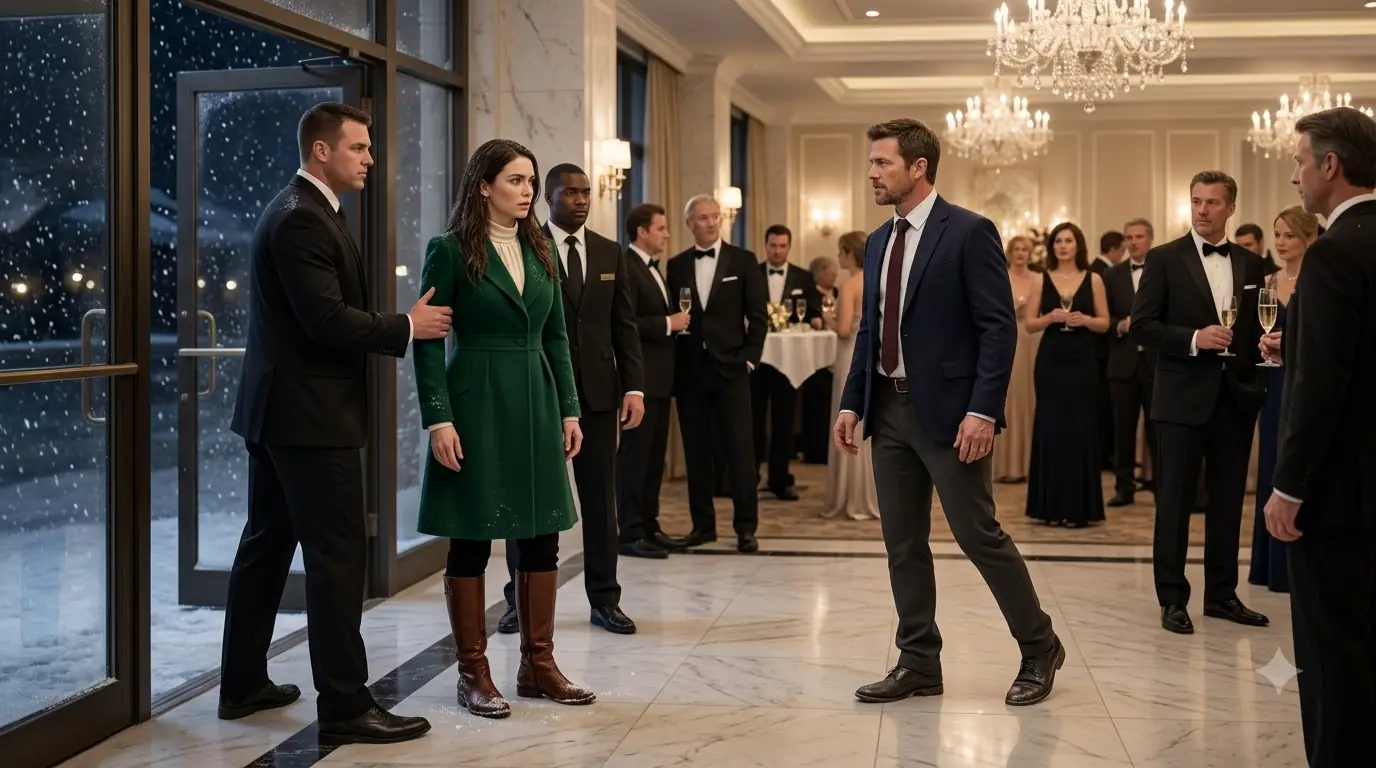
Inside, the charity gala was in full swing: strings of champagne flutes, men in dark tuxedos, women draped in silk and diamonds, the quiet roar of money moving between hands under the guise of generosity. Nobody noticed the woman standing at the edge of the marble lobby.
She wore a wool coat the color of old ash, damp at the hem from the walk through the storm. Snow still clung to the laces of her boots. She looked around the room with careful, searching eyes, not frightened, not confused, but looking for something specific. Someone specific. Then the music pulled back for just a moment, and the sound of heels on marble was very loud.
Two security guards moved toward her from opposite sides of the room. "Ma'am." One of them, broad-shouldered, his face professionally blank, stepped directly into her path. She didn't argue. She didn't raise her voice.
She simply said in a low, clear tone, "I'm looking for someone. You'll need to look somewhere else." Most of the room glanced over, then away. A few guests exchanged knowing half-smiles. A woman in a burgundy gown murmured something behind her champagne glass, and her companion laughed softly.
At a table near the back of the room, a man set down his drink and watched. He was not like anyone else at the gala. He wore a jacket that had been pressed but not recently bought. His hands, wrapped around a glass of water rather than wine, were the hands of a man who worked with them: faint calluses, a small scar along the left knuckle. He had been watching the door for the last 20 minutes, calculating the fastest route to it.
He was a single father from a town 40 minutes outside of Aspen, and he had no business being here. His old friend Marcus had sent him the invitation six weeks ago with a handwritten note: "Just come. One night. You need it." He had not wanted to come.
He had come anyway, and he had been trying to leave for most of the evening. Now, he was watching a woman being dragged toward the door in front of a room full of people who were looking carefully away. He stood up. Nobody saw him do it at first. He was quiet about it.
No chair scraping, no announcement. He just rose, straightened his jacket, and walked. Nathan Cole had learned a long time ago that belonging somewhere and being somewhere were two entirely different things. He had learned it the first time at his ex-wife's family Christmas, standing in a living room full of lawyers and architects while holding a plate of cheese and trying to remember the name of the man he was speaking to. He had learned it again when he drove his daughter Emma to her first day at the private school his ex-wife had insisted on, watching the other fathers in their clean SUVs and feeling like something that had been dropped there by accident.
But those times had at least involved people who knew him. This was different. Tonight, he was surrounded by 500 strangers who all seemed entirely confident that they deserved to be exactly where they were, and Nathan had not yet figured out how to feel that kind of confidence in a borrowed tie. The Grand Aurora Hotel was the most expensive building Nathan had ever stood inside. He had noticed the floor first: marble so polished he could see the inverted blur of his own reflection walking slightly ahead of him like a preview of where he was about to go.
Then the chandeliers, which were not chandeliers so much as small galaxies, suspended from the ceiling, casting light that made everyone below look expensive. He had arrived early because he was always early, a habit left over from years of opening the garage at 6:00 a.m. Before the mechanics arrived. He had collected a glass of water, found a table near the back, instinctively near an exit, and had spent the next two hours performing the subtle work of being invisible at a party where everyone else was performing the subtle work of being seen. His friend Marcus Whitfield had found him within the first 20 minutes, clapped him on the back with genuine warmth, introduced him to three people whose names Nathan immediately forgot, and then been swept away by the undertow of the evening. Nathan had not blamed him.
Marcus lived in this world now. He had married into it, built a small private equity firm, and wore confidence like a second skin. They had grown up in the same neighborhood in Denver, working summers at the same mechanics shop, but Marcus had always been going somewhere different. Nathan had always known that. He had loved him for it, and felt occasionally the particular loneliness of watching a good friend become someone you have to make an appointment to see.
The table Nathan had chosen seated eight. Seven of the chairs were empty. At some point, a man named Gerald had sat across from him and spoken at length about a ski resort development in Utah before drifting away toward the bar. After that, Nathan had been alone, which was fine. He was good at alone.
He was watching the door because Emma had texted him at 8:30. Just three words. Dad, forgot key. His neighbor Patricia was covering; she had the spare. But the text sat in the back of his mind the way his daughter always sat in the back of his mind, present, pulling slightly like a compass needle that never quite settled.
He was going to find Marcus, say goodbye, and be on the road by 9:30. That was the plan. He was watching the door when the woman in the wool coat came through it. He noticed her immediately, and not because she stood out in an obvious way. It was subtler than that.
She moved through the lobby entrance with the stillness of someone who had learned to take up very little space, but her eyes were quick and deliberate. She was looking for something, not lost, not confused. The coat was wrong for the room. The boots were wrong. The snow melting from her hem was wrong.
But her face was entirely composed. Nathan had a daughter. He had spent 8 years learning to read the difference between fine and fine, between a child who was okay and a child who was working very hard at seeming okay. He saw that difference now in a woman who was clearly an adult in a room full of people who were choosing not to see it. The guards moved in from both sides with the efficiency of people who had done this before.
Nathan put down his glass. He did not make a decision exactly. It was more that a decision had already been made somewhere quieter than his thoughts, and he was simply catching up to it. The guard's name, stitched on his breast pocket in small gold letters, was D. Hartley. He was not unkind by nature.
Nathan would understand this later looking back, but he had a job to do, and he was doing it. And the job required a certain decisive quality that did not leave room for hesitation. "Ma'am, I need you to come with me." His hand closed around her upper arm just above the elbow, not roughly but firmly, the grip of someone who had practiced steering people toward doors. The second guard, younger, took a flanking position just behind her left shoulder.
The woman did not pull away. That was the first thing Nathan noticed from across the room. She didn't fight it. She turned her head and said something to the first guard, her voice quiet enough that Nathan couldn't hear the words from where he was, only the tone. Measured, patient, not pleading.
The guard shook his head. She said something else. The guard's expression didn't change. A cluster of guests near the champagne table had turned to watch with the detached interest of people observing a minor incident that had nothing to do with them. A woman in a silver gown said something to her companion that made him smile.
Near the string quartet, a man in his 60s glanced over once and then directed his attention deliberately back toward his conversation. The way you pull your eyes away from something you've decided not to know about. Nathan was already moving. He didn't walk quickly. There was no drama in it, no striding through the crowd, no theatrical purpose.
He simply walked at his usual pace, steady and straight, toward the door where the two guards were maneuvering a woman in a wet wool coat out of a room where everyone had already forgotten she existed. He arrived before they reached the door. He stepped into their path, not blocking them aggressively, just standing there in the way with the calm of someone who has not yet considered the possibility of moving. The first guard stopped. He looked at Nathan with the mild professional irritation of a man who had been interrupted doing something he was certain was correct.
"Sir—" "Stop," Nathan said. One word. Quiet.
The kind of quiet that doesn't need volume because it isn't afraid of anything. The guard's jaw tightened slightly. "Sir, this woman is not a registered guest of this event. I need to ask you to—" "She's with me."
Three words. Nathan said them the way he said most things, simply and without performance. The way you state something you are not uncertain about. He had no idea who she was. He had never seen her before in his life.
He would think about that later driving back down the mountain in the snow and he would not be able to entirely explain it even to himself. The room, or at least that corner of it, had gone very quiet. The guard looked at him for a moment. Then he looked at the woman, then back at Nathan. "Do you know this woman?"
"Does it matter?" A pause. The guard's grip on her arm loosened fractionally. He was recalibrating this was outside the normal script of these situations, and normal scripts were all he had. A man calmly claiming a woman he clearly did not know in a room where half the people were watching now was a variable he had not been prepared for.
The woman herself was looking at Nathan. Her expression was difficult to read. Not shocked exactly, more like someone who has been surprised by something so completely that the emotion hasn't quite caught up yet. Her eyes were gray, or close to it. Her coat had a small tear along one pocket, barely visible, the kind of thing you would only notice if you were standing close.
Nathan met her gaze for a moment. He gave a small nod, the kind that means just follow along. The guard released her arm. He did it slowly. With the careful dignity of a man who wanted it, understood that this was a professional concession and not a defeat.
"I'll need your name," he said to Nathan. "Nathan Cole." "And you're confirming this woman is your guest?"
"Yes." The guard looked at him for another long second. Then he stepped back. The younger guard stepped back, too. The small drama of it was over.
As quietly as it had started, Nathan turned to the woman. He gestured very slightly back toward the room. "Would you like to sit down?" he said. They were not the center of attention for long. That was the nature of rooms like this.
Something small and human happened at the edges, and the center went on revolving around itself. By the time Nathan had walked back to his table with the woman beside him, the string quartet had resumed. The champagne glasses had refilled, and most of the people who had watched were already talking about something else. A few were not. Nathan felt the eyes without looking for them.
He was practiced at not performing for observers. He pulled out the chair beside his, the one that had been empty all evening, and waited. She sat. He sat. For a moment, neither of them spoke.