“Three dollars. That’s all I have for my birthday cake.”
The words barely rose above a whisper as Claire Donovan held the crumpled bills in one hand and her lukewarm coffee in the other. Outside the small bakery, snow fell gently, dusting the sidewalk and frosting the windowpanes.
She sat on a weathered wooden bench, shoulders hunched against the winter chill, eyes fixed on the smallest chocolate cake in the display. It was simple, adorned with a few delicate frosting stars, but it felt impossibly out of reach. Forty-one years old today, and she had no means to celebrate.
Claire’s morning had already been a relentless gauntlet. She had led a tense boardroom meeting, negotiating a multimillion-dollar acquisition with poise, logic, and the kind of precision only experience and reputation could command. Her office had been immaculate, her power absolute, her decisions decisive. Yet here, mere hours later, a simple human desire—savoring a small birthday cake—felt beyond her grasp.
Then the bakery door opened, letting in a puff of cold air. A man stepped out, holding a small cake box in one hand, his daughter tugging at his flannel sleeve with the other.
His eyes met Claire’s, and he immediately noticed the subtle slump of her shoulders, the longing glance at the cake, and the quiet resignation in her expression.
“Excuse me,” he said gently, crouching slightly. “Were you… planning to get that cake?”
Claire looked up, startled, caught between embarrassment and disbelief.
“I… I can’t,” she admitted. “I don’t have enough. It’s… my birthday today, but—”
He nodded, as if reading the weight behind her words. “I see. Some days, even the little joys seem out of reach.”
His daughter, a small girl of six with curly brown hair and eyes like her father’s, peeked around his side. “Daddy, maybe she wants cake?”
The man smiled down at her, then back at Claire. “How about this? We bought more than we could eat. Consider it a gift. Happy birthday.”
Claire blinked, hesitant. “I… I can’t—”
“Please,” he said, his voice steady, kind, carrying no condescension. “No explanation needed. Just enjoy it.”
For the first time that day, Claire felt a warmth that had nothing to do with the coffee in her hands. The gesture was simple, yet profound. She accepted the box, her fingers brushing his for a brief, grounding moment.
Inside, seated at a small table near the window, she carefully opened the cake and inhaled the rich chocolate aroma. Each bite melted on her tongue, and for the first time that day, she felt truly seen. She allowed herself a quiet smile, hesitant and fragile, as if savoring a treasure she hadn’t realized she had lost.
The man—Daniel Thompson—stood outside for a moment, watching the snow fall with his daughter, Sophie, bouncing beside him. His own life had not been easy. Four years ago, he had lost his wife, Sarah, to a sudden brain aneurysm, leaving him to raise Sophie alone.
His grief had been raw, jagged, yet he had learned to navigate life one small step at a time, grounding himself in the routines and joys of parenthood. Sophie, bright and fearless despite the shadow of loss, had inherited her father’s warmth and resilience.
The next morning, Claire returned to the bakery. She had spent the night replaying the encounter, feeling a strange mix of embarrassment and hope. She saw Daniel and Sophie outside, packing up after another early visit to the bakery.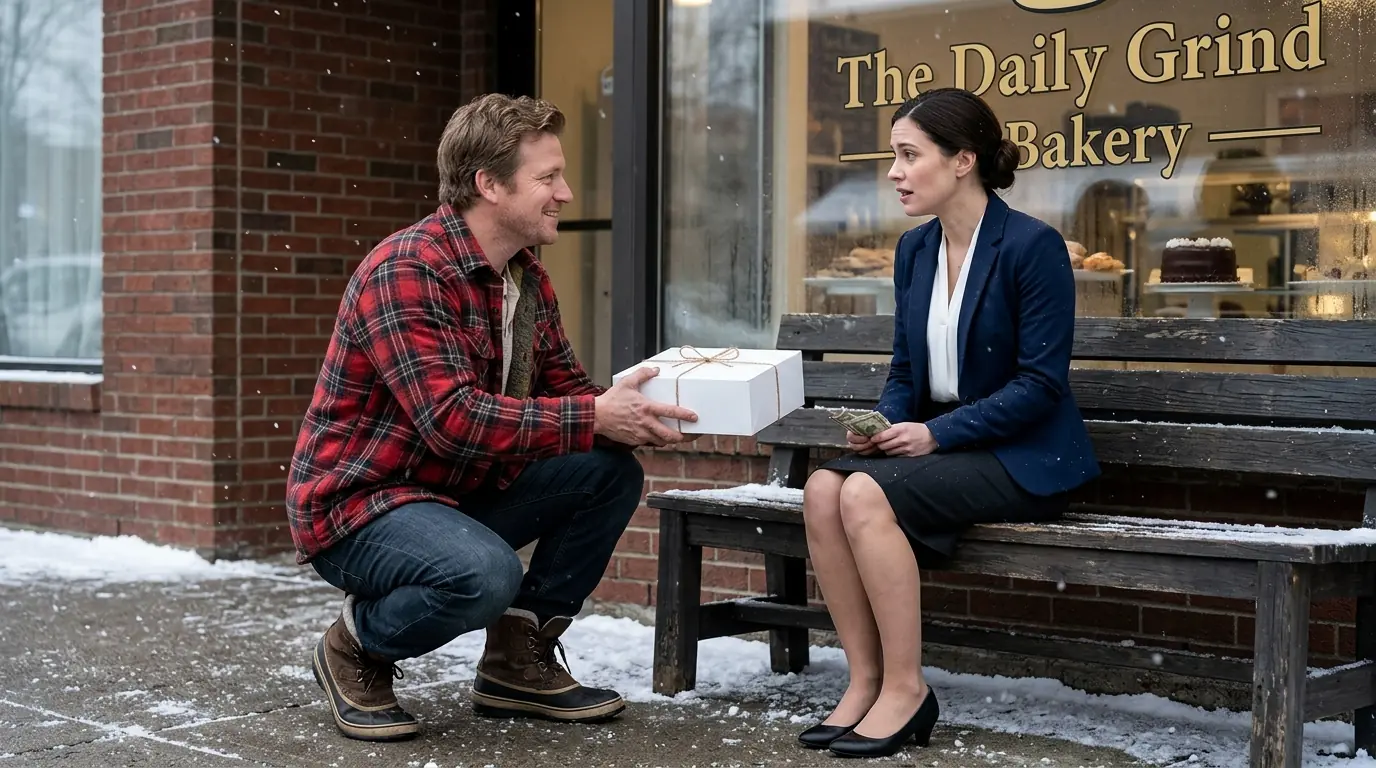
“Excuse me,” she called, approaching cautiously. “I… I wanted to thank you.”
Daniel turned, wiping his hands on a rag, curious. “For the cake?”
“Yes,” Claire said. “And for noticing. For… caring.”
Daniel’s smile softened, a quiet acknowledgment of understanding. “Some days, you just have to make someone else’s world a little brighter. That’s all.”
Sophie jumped in with unfiltered logic. “You should come to our house! Daddy’s cake is magical!”
That afternoon, they sat together on a park bench. Sophie chattered endlessly, describing her school, her friends, and the tiny moments of triumph in kindergarten that only a six-year-old could see as epic victories. Claire found herself laughing, engaging in the first genuine conversation she’d had in weeks.
Over the next few weeks, a rhythm emerged. Claire visited often, sometimes bringing pastries, sometimes simply sitting with Daniel and Sophie.
They shared meals, laughter, and quiet afternoons in the snow-dusted town square. Sophie’s curiosity was infectious, and Claire discovered that she could, for the first time in a long while, forget her stresses, her corporate pressures, and just exist in a moment of uncomplicated warmth.
One rainy day, Claire arrived at Daniel’s garage. Marking the end of a particularly grueling week, she noticed him struggling to lift a large box of parts. Without thinking, she stepped forward.
“Here,” she said. “Let me help.”
He looked at her, startled, then grateful. Together, they lifted it safely. Sophie clapped, cheering from the doorway.
“You’re stronger than I expected,” Daniel said, brushing rain from his hair.
“And you’re taller than I remembered,” Claire replied, laughing softly. “It’s good to see that the world still has people who show up.”
The small gestures—the shared laughter, the quiet attentiveness, the recognition of hardship—slowly drew Claire, Daniel, and Sophie together. Claire began to feel a weight lift from her shoulders, a warmth she hadn’t realized she had been missing.
Then came the day she could return the favor. Daniel had confided in her that he had been struggling to keep his small repair shop afloat. With a few careful conversations and introductions, Claire leveraged her network to connect him with a small business grant program. His shop was approved for funding, allowing him to hire a part-time assistant, renovate the space, and offer safer work conditions for himself and Sophie.
Mark’s gratitude was profound, expressed in quiet words, gestures, and evenings spent talking long after Sophie had fallen asleep. He repeatedly told her, “You didn’t just give me a grant. You gave me hope.”
Claire, too, felt healed. The corporate world, with its spreadsheets and deadlines, no longer consumed her entirely. There was now laughter echoing through a small garage, the smell of motor oil mingling with baking bread from Sophie’s kitchen, and evenings spent watching the snow collect on the roof as Sophie played at her father’s feet.
Seasons changed. Spring brought flowers and walks through budding neighborhoods. Summer afternoons were spent in the park, Daniel teaching Sophie how to ride her bike, Claire sketching small designs for the bakery’s new fundraiser. Autumn painted the streets gold, and winter returned with snow-covered rooftops, just like the first day they met.
On Claire’s next birthday, Daniel appeared at the bakery with Sophie in tow. They handed her a small cake, identical to the one from that first snowy day, and Sophie held out a hand.
“Happy birthday,” Daniel said warmly. “This time, we celebrate together.”
Tears brimmed in Claire’s eyes. “I… I don’t know what to say.”
“You don’t have to,” Daniel replied. “Just let us.”
The warmth of their presence, the genuine care, and the laughter of a child reminded her of the power of the smallest acts. What began as a simple gesture—a man noticing someone struggling to afford a cake—had grown into a network of human connection, healing, and shared joy.
Claire realized that life’s challenges, grief, and loneliness could be softened by kindness, sometimes from the most unexpected sources. And sometimes, a single act of empathy could ripple outward, transforming multiple lives forever.