“My late wife left this for you.”
Clare Donovan stared at the cream envelope in Luke Bennett’s grease-stained hand while the repaired engine of her silver SUV hummed beside them. Ten minutes earlier, she had been irritated by a failed electrical system, an unanswered roadside-assistance line, and the humiliating fact that a woman who controlled a billion-dollar logistics company could not make her own vehicle start outside a grocery store in Westfield, Ohio. Now the disabled car no longer mattered. Her name, written across the envelope in a woman’s careful handwriting, had made the entire parking lot seem unnaturally quiet.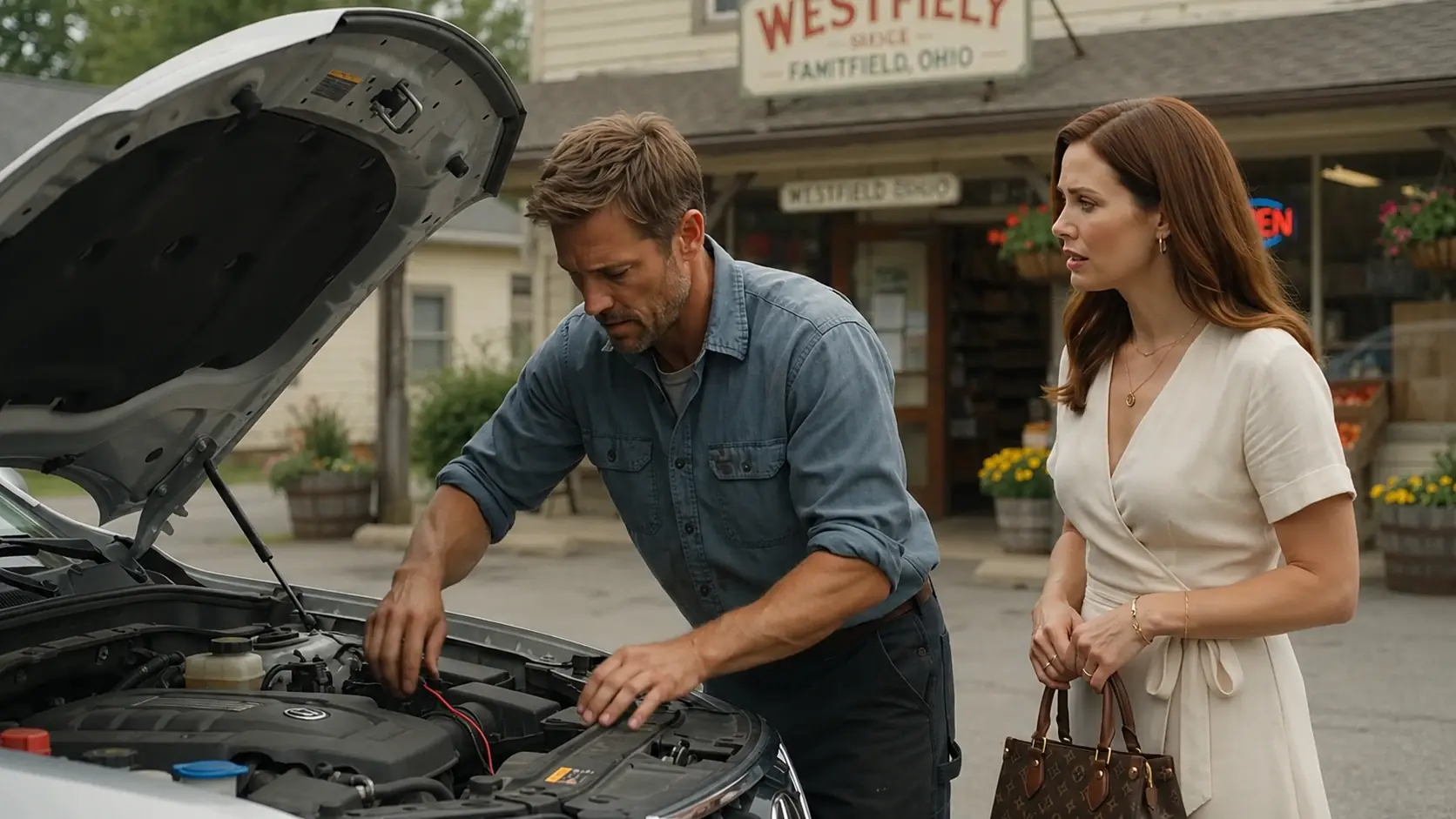
Luke did not move closer or pressure her to take it. He was thirty-eight, broad-shouldered, and tired in the way of a man who had learned to carry responsibility without complaining. His faded blue work shirt showed dark smudges from the engine, and a plain silver wedding band still rested on his left hand even though his wife had been gone for almost three years. Behind him, the open toolbox contained neatly arranged sockets, a voltage tester, and a small photograph of a smiling woman holding a little girl.
Clare looked from the envelope to the photograph. The woman had auburn hair similar to Clare’s, though her smile was softer and less guarded. The resemblance was not exact enough to be undeniable, but it was close enough to disturb her. Clare had spent her entire adult life learning to dismiss feelings that could not be measured, verified, or controlled, yet something in that photograph reached beneath every defense she had built.
“Who was your wife?” Clare asked.
“Rachel Bennett,” Luke answered. “Her maiden name was Rachel Donovan.”
Clare’s expression hardened immediately. “Donovan is not an uncommon name.”
“No,” Luke said calmly. “But Clare Elise Donovan, born in Columbus on October seventeenth, is specific.”
The blood drained from Clare’s face. She had never told him her middle name or her birthplace. She had introduced herself only because he needed a name for the handwritten repair receipt, and even then she had nearly given him her assistant’s information instead. Luke watched her absorb the detail without trying to use her shock against her.
“My wife searched for you for eleven years,” he continued. “She found enough to believe you were her younger sister, but she never found a way to reach you that didn’t get blocked.”
Clare finally took the envelope. It felt heavier than paper should have felt. The front carried her full name, and beneath it Rachel had written a second line: For the day someone finally finds her. The seal remained intact, yellowed slightly with age.
“I don’t have a sister,” Clare said.
Luke lowered his eyes for a moment. “Rachel spent most of her life being told she didn’t have one either.”
A gust of wind moved across the parking lot, carrying the smell of rain and fresh bread from the grocery store bakery. Clare’s driver was still more than an hour away, and her assistant had already sent six messages asking whether the afternoon acquisition meeting should be delayed. Normally, Clare would have answered immediately. Instead, she stood beside a stranger’s toolbox holding a letter from a dead woman who appeared to know facts about her birth that almost no one else knew.
Luke closed the hood of the SUV and wiped his hands on a clean cloth. “The battery ground had corroded beneath the mounting plate,” he explained. “The connection looked secure from above, but it was barely holding. You should have the cable replaced before winter, though it’ll get you home safely today.”
Clare barely heard him. “Why was the letter in your toolbox?”
“I keep it close because I promised Rachel I wouldn’t stop looking,” Luke said. “I was planning to bring it to Columbus next month. I finally found an address connected to your foundation, but I didn’t know whether it would actually reach you.”
Clare glanced at the black sedan pulling into the store entrance, then at the employees gathering shopping carts under the awning. She had built her reputation by making decisions faster than everyone around her, yet she could not decide whether to open the envelope. The controlled life waiting for her contained a penthouse overlooking Lake Erie, a carefully managed calendar, and hundreds of employees who treated every word she spoke as a directive. The envelope promised disorder.
“How much do I owe you?” she asked.
Luke understood the retreat for what it was, but he did not challenge it. “Forty dollars for the part and the time.”
Clare removed several bills from her handbag and held out three hundred. Luke took only two twenties and returned the rest. The refusal unsettled her almost as much as the letter because wealthy people often learned that generosity could be used to control the ending of an uncomfortable interaction, while Luke seemed determined not to let money change the meaning of what had happened.
“You don’t know me,” Clare said.
“No,” Luke replied. “But Rachel wanted to.”
Clare placed the envelope in her handbag without opening it. She gave Luke her business card, not because she intended to call but because leaving without offering any route back felt impossible. Then she entered her SUV, tested the ignition twice, and drove out of the parking lot while Luke stood beside his weathered pickup truck watching her disappear toward the highway.
For the first twenty miles, Clare told herself the encounter had been a coincidence amplified by grief. Rachel Donovan could have obtained public information, mistaken family stories, or believed something that was not true. Clare’s parents had been married for forty-two years, and her mother, Evelyn, had spoken often about the difficult pregnancy that nearly prevented Clare’s birth. There had never been mention of another daughter.
Yet Clare remembered the locked drawer in her mother’s bedroom. She remembered the shoebox Evelyn had thrown away after Clare’s father died, and the photograph Clare had once discovered inside it of a teenage girl holding an infant. When Clare had asked who they were, her mother had grabbed the photograph so quickly that the corner tore.
“Old neighbors,” Evelyn had said.
Clare had accepted the explanation because she was thirteen and because children usually believed the version of the world their parents needed them to believe. Now, twenty-four years later, the memory returned with frightening clarity. The teenage girl in the photograph had possessed auburn hair and a solemn expression. The baby had been wrapped in a pale-blue blanket.
Clare canceled the acquisition meeting before she reached Cleveland. Her assistant, Marissa, called within seconds, alarmed because Clare had never canceled a negotiation without explanation. Clare said only that a family matter had arisen, though even speaking the word family felt dishonest. She had not considered herself part of a true family since her father’s death and her mother’s withdrawal into a private assisted-living residence.
At her penthouse, Clare placed the envelope on the dining table and walked around it as though it might contain something dangerous. Floor-to-ceiling windows revealed the city below, orderly and distant. Every object in the room had been selected by a designer, every surface remained uncluttered, and no personal photographs interrupted the polished calm. Clare had always considered the apartment peaceful until that evening, when it suddenly felt like a place designed to prevent memory.
She opened the envelope shortly after midnight.
The first page began with an apology.
Dear Clare, if you are reading this, then either I finally found the courage to stand in front of you, or I ran out of time before I could.
Clare sat down slowly. Rachel explained that she had been born when Evelyn Donovan was seventeen and unmarried. Evelyn’s strict parents had forced her to surrender the baby through a private adoption arranged by a church-affiliated attorney, and Rachel had grown up believing her biological mother had chosen never to see her again. Years later, after the death of her adoptive parents, Rachel discovered sealed documents containing Evelyn’s maiden name.
The letter described eleven years of searches. Rachel had sent messages to old addresses, mailed letters to the Donovan Foundation, and even traveled to Columbus after finding Clare’s name in a newspaper article about a university scholarship. Every attempt had ended in silence or been returned by representatives who believed they were protecting Clare from strangers seeking money.
Rachel made no accusation against Clare. She wrote instead about Luke, their daughter, and the ordinary life she wished she could have shared with a sister. She described Sunday pancakes that always burned on one side, rainy afternoons spent painting with six-year-old Sophie, and Luke’s habit of pretending he disliked Christmas music while knowing every word.
The final page made Clare press one hand against her mouth.
You have a niece named Sophie Rachel Bennett. She has your eyes, though she has never seen you. I wanted to tell her she had an aunt, but I was afraid to give her another person to miss. If I cannot reach you, I hope Luke does. He is stubborn about promises and kind when no one is watching. Please believe that I wanted nothing from you except the chance to know whether you laugh like I do.
Clare read the letter three times. By dawn, the paper had become wrinkled beneath her fingers, and the controlled executive who had negotiated hostile mergers without blinking was crying alone at a table large enough for twelve people. The grief felt irrational because she had never met Rachel, but it was joined by something sharper: the realization that someone had spent years reaching toward her while other people had quietly closed the door.
At eight in the morning, Clare called her mother.
Evelyn answered after several rings, her voice fragile but alert. Clare did not ask about medication, the weather, or the garden outside the residence as she normally did. She spoke Rachel’s full name.
Silence followed.
“Who told you?” Evelyn whispered.
The question ended Clare’s last hope that the letter might be false. She drove to Columbus that afternoon with Rachel’s pages secured in a leather folder. Evelyn Donovan waited in a private sitting room overlooking a courtyard, her silver hair arranged neatly and her hands trembling around a teacup.
“You knew,” Clare said.
Evelyn closed her eyes. “I knew she existed.”
“That is not what I asked.”
Evelyn looked older than she had the previous month. She explained that Rachel had been taken two days after birth and that her parents had forbidden her to speak the child’s name. When Evelyn later married Clare’s father, she confessed the adoption, but he insisted the past remain buried because he feared scandal would damage his political career.
“Rachel found you,” Clare said. “She wrote to the foundation.”
“I received one letter,” Evelyn admitted. “Your father received the others.”
Clare felt the room tilt. Her father had died surrounded by praise, remembered as a civic leader who had funded libraries and scholarship programs. She had spent years extending the family foundation because she believed his public generosity reflected private integrity. Now she learned that he had intercepted a daughter’s attempts to reach her own mother.
“Why didn’t you answer the one letter you received?”
Evelyn’s eyes filled. “I was afraid she would hate me.”
“So you made certain she had every reason to.”
The words landed harder than Clare intended, but she did not withdraw them. Evelyn wept and said she had followed Rachel’s life from a distance after hiring an investigator. She knew Rachel became a nurse, married Luke, and had a daughter. She also knew Rachel had been diagnosed with ovarian cancer five years earlier.
Clare stood abruptly. “You knew she was dying?”
“I sent money anonymously for treatment.”
“She wanted her mother.”
“I did not know how to face her.”
Clare looked at the woman who had taught her that dignity meant never allowing emotion to interfere with appearances. For the first time, she understood that Evelyn’s composure had not been strength but fear refined into habit. Clare had inherited the same instinct and built an empire around it.
Before leaving, Clare asked for every document related to Rachel. Evelyn surrendered a key to a locked cabinet in her private storage unit. Inside, Clare found returned letters, photocopied school records, photographs obtained by the investigator, and a newspaper clipping showing Rachel and Luke at a hospital charity event. There was also a small knitted baby cap Evelyn had preserved for nearly six decades.
Clare spent the next week verifying everything. She hired an independent genealogist, requested court records, and submitted a DNA sample through attorneys who specialized in sealed adoptions. Luke cooperated but refused payment, providing Rachel’s birth certificate, medical records, and a lock of hair preserved inside Sophie’s baby book. The preliminary kinship result established a direct biological relationship beyond reasonable doubt.
Only then did Clare call him.
“I believe her,” she said.
Luke was silent for a moment. “Rachel would have been relieved.”
“I need to meet Sophie.”
Luke’s tone changed immediately. “She’s nine, Clare. She lost her mother when she was six, and she doesn’t need an adult entering her life out of guilt and disappearing when it gets difficult.”
Clare was accustomed to people agreeing before she finished speaking. Luke’s refusal should have offended her, yet she recognized the protection behind it. He was not trying to keep Sophie away from wealth or opportunity; he was making certain Clare understood that the child was not evidence in a family investigation.
“I don’t know what I’m capable of promising,” Clare admitted.
“Then promise only what you can keep.”
They agreed Clare would visit for lunch the following Saturday. She arrived at Luke’s modest house carrying no expensive gift, though she had spent hours fighting the urge to buy something impressive. Instead, she brought the original letter, copies of the adoption records, and a box of chocolate cupcakes from the grocery store where they had met.
Sophie opened the door before Luke could reach it. She was small for nine, with loose auburn curls, green eyes, and a serious expression that transformed when she smiled. Clare saw Rachel in the shape of the child’s face and something of herself in the way Sophie studied a stranger before deciding whether to trust her.
“You’re the car lady,” Sophie said.
Luke appeared behind her. “I may have described the meeting that way.”
“You’re also my aunt,” Sophie continued.
Clare’s prepared introduction vanished. “I think I am.”
Sophie considered this answer. “Dad says thinking carefully is better than pretending to know everything.”
Clare glanced at Luke. “Your father appears to have many opinions.”
“He does,” Sophie said. “Most of them are about tire pressure and homework.”
Lunch consisted of grilled cheese sandwiches and tomato soup because Sophie insisted that important conversations required simple food. Clare learned that her niece loved astronomy, hated peas, and kept a notebook filled with questions she wished she could ask Rachel. Luke never rushed her or softened answers into comforting lies.
After lunch, Sophie brought out a wooden memory box. Inside were hospital bracelets, photographs, Rachel’s nursing badge, and handwritten recipe cards. Sophie handed Clare a photograph of Rachel at twenty-five, standing beside a lake with wind-blown hair and an open laugh.
“Do I look like her?” Clare asked.
“A little,” Sophie said. “But you look more scared.”
Luke looked away to give Clare the dignity of pretending the observation had not struck deeply. Clare set the photograph down and admitted that she was scared. She told Sophie she had only recently learned Rachel existed and that she did not yet know how to be an aunt.
“You could start by coming back,” Sophie suggested.
So Clare did.
At first, she visited every other Saturday. She attended a school science fair and sat in the back row without arranging special treatment. She helped Sophie build a cardboard model of Saturn, though Luke had to repair the ring structure after Clare attempted to solve the problem with industrial adhesive.
Their relationship developed through small, imperfect moments. Sophie began sending Clare photographs of unusual clouds, and Clare answered even during board meetings. Luke brought Sophie to Cleveland for a museum weekend, and the three of them ate pizza on Clare’s pristine living-room floor because Sophie declared the dining table too formal.
Clare also began confronting the history her family had hidden. She suspended the foundation director who had ignored Rachel’s messages and ordered an audit of correspondence involving adoption inquiries. She discovered that her father had instructed staff to classify Rachel as a financial threat despite having no evidence she had ever requested money.
Rather than protect the Donovan name, Clare released a public statement acknowledging the concealed adoption and the foundation’s role in preventing contact. Her board warned that the admission could damage donor confidence. Clare replied that an institution claiming to support families could not build credibility by hiding the harm it had caused one.
She established a new program providing legal assistance to adults searching for relatives separated through closed or coercive adoptions. The initiative included counseling for both sides because Clare had learned that discovering the truth did not automatically teach people how to live with it. She named the program the Rachel Bennett Family Connections Project.
Evelyn asked to meet Sophie three months later.
Luke left the decision to his daughter. Sophie agreed only after Clare promised to remain beside her throughout the visit. When Evelyn entered Luke’s living room, she stopped at the sight of the child wearing Rachel’s old silver locket.
“You have her eyes,” Evelyn whispered.
Sophie touched the locket. “Clare says I have hers.”
Evelyn began crying. “You have both.”
The meeting did not erase what Evelyn had done. Sophie asked why she had never answered Rachel, and Evelyn told the truth without blaming her parents, her late husband, or the customs of another era. She said she had been a coward and that fear had cost her the chance to know her daughter.
“Mom waited for you,” Sophie said.
“I know.”
“You can’t fix that.”
“No,” Evelyn answered. “I can only stop lying about it.”
Sophie did not embrace her that day. She allowed Evelyn to look through the memory box, then asked Clare to drive her for ice cream. It was not forgiveness, but it was honest, and Luke believed honesty was the only foundation strong enough to support whatever came next.
As the months passed, Clare’s connection with Luke deepened in ways neither expected. He never treated her wealth as a solution, and she never treated his modest life as something to improve. They argued about work, grief, and whether Sophie should be allowed to attend a summer astronomy camp four states away.
Luke still loved Rachel. Clare understood that loving him would never require replacing her sister, because Rachel remained present in the house through photographs, stories, and the child they were raising. What grew between Clare and Luke came not from forgetting the past but from facing it together.
One evening, nearly a year after the SUV breakdown, Clare joined them at the grocery store for a community fundraiser. Luke was beneath the hood of an elderly teacher’s car while Sophie sold cupcakes beside the entrance. Clare stood where she had first met him, remembering the woman she had been when a broken electrical connection seemed like the worst disruption of her day.
Luke closed the hood and walked toward her. “The teacher’s alternator is failing.”
“Can you fix it?”
“Tomorrow.”
Clare smiled. “You once fixed my car in ten minutes.”
“Your car had a loose connection.”
“So did my family.”
Luke studied her face. “That repair took longer.”
“It’s still taking time.”
Sophie ran over holding a cupcake with uneven blue frosting. She announced that Evelyn had agreed to attend her school concert and that Clare had been assigned the responsibility of making sure she arrived on time. Clare accepted the duty with exaggerated seriousness.
Later, as the sun lowered behind the grocery store, Luke handed Clare a small framed photograph. It showed Rachel standing beside him on their wedding day, laughing as the wind lifted her veil. On the back, Rachel had written a sentence Clare had never seen before.
Someday, I hope every missing piece of this family finds its way home.
Clare pressed the photograph against her chest. She had spent years believing control protected her from abandonment, when it had really protected her from belonging. Rachel’s letter had not simply revealed a sister she never knew. It had introduced Clare to a niece, forced a mother to tell the truth, transformed a foundation, and opened a door into a family that did not require perfection before offering her a place.
Luke reached for her hand. Sophie slipped between them and took the other.
For once, Clare did not calculate what might be lost by accepting the moment. She stood beside the man who had repaired her car, the child who carried her sister’s smile, and the life Rachel had tried so hard to share with her. Then Clare walked home with them, no longer protecting the controlled life she had built, but finally choosing the family that had been waiting.