The late afternoon rain drummed against the tin roof of the small garage in Portland, Oregon.
Marcus Thompson was wiping grease from his calloused hands when he heard the motorcycle engine sputter outside.
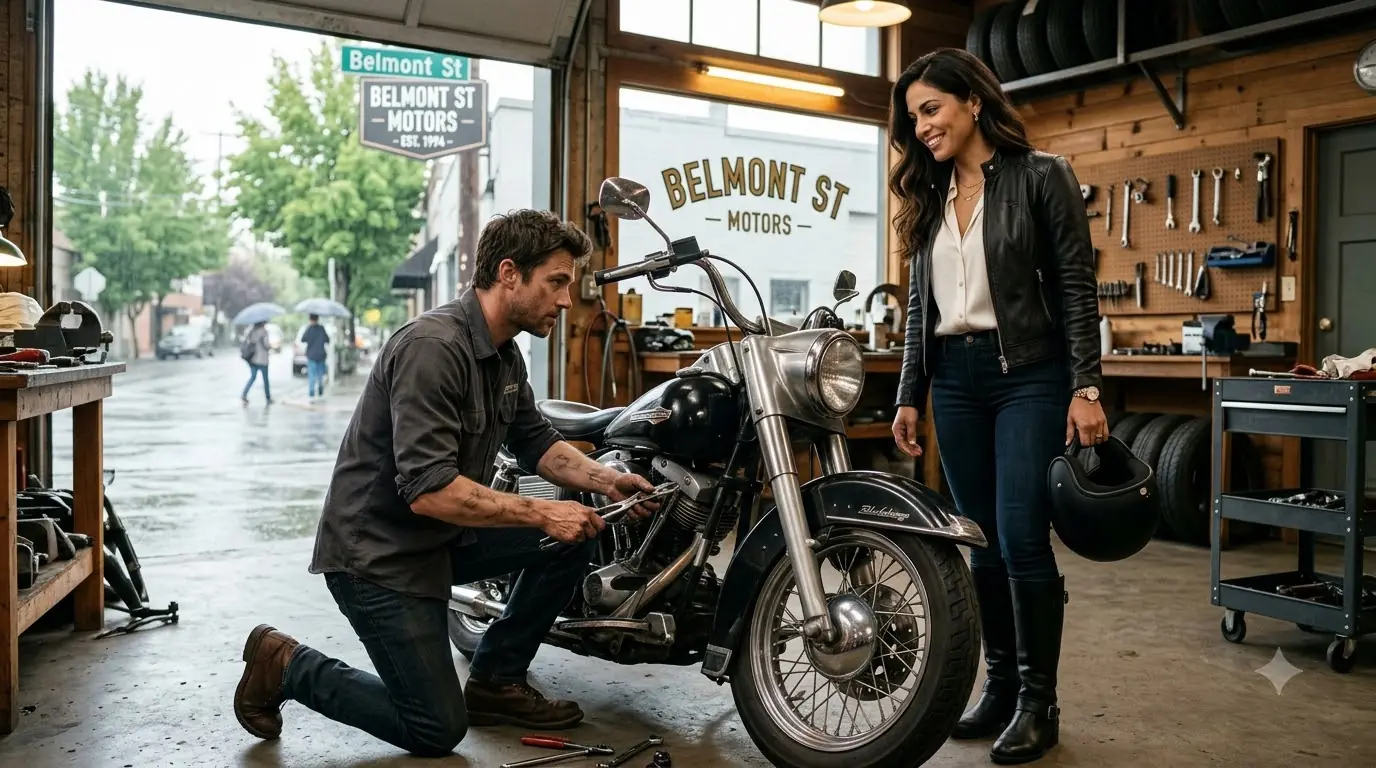
Through the foggy window, he saw a woman in a black leather jacket. Her dark hair soaked from the rain, crouched beside a vintage Harley-Davidson.
She wasn't screaming for help or frantically dialing her phone. She just stood there in the downpour, shoulders trembling slightly.
Marcus had been there before alone with broken machines and shattered dreams. He opened the door and stepped into the rain.
No one could have imagined that this simple act of kindness would forever change both their lives. One man who had lost everything, his wife, his dreams, his faith and love.
One woman who had everything, money, power, fame, but no one genuine by her side. Sometimes the most unexpected encounters bring the greatest miracles of all.
Marcus Thompson, 34 years old, owned Thompson Auto Care on Belmont Street. Quiet road nestled between cozy coffee shops and vintage stores.
The garage was small, barely fitting two cars, but it was clean and organized. On the wall hung customer appreciation letters and one faded photograph, a younger Marcus standing beside a red muscle car, his arm around a blonde woman with a radiant smile.
Two years ago, Sarah, his wife, had passed away from breast cancer. She was only 29.
Marcus still remembered those final nights in the hospital when Sarah gripped his hand tightly and whispered, "Teach Lily to be kind and don't forget to love yourself again." After that, he moved through life like a machine caring for his daughter, working, sleeping, then caring for her again.
During those first months, Marcus even forgot to eat, forgot to cut his hair, until six-year-old Lily asked, "Daddy, why don't you smile like when Mommy was alive?" Now, Marcus had learned to live again.
Every morning at 6:00, he woke up to brew coffee and prepare breakfast for Lily. Usually, heart-shaped pancakes or toasted bread with scrambled eggs.
The little girl always sat on her high chair, legs swinging, telling him about her dreams from the night before. "Daddy, I dreamed that Mommy taught me how to make cookies."
"She said, 'You're really good at fixing cars, but terrible at baking.'" Marcus would laugh, his heart tightening.
Sarah was right about that.
She always knew how to make him smile, even when she wasn't there anymore. The garage opened at 8:00 in the morning.
Marcus wasn't a wealthy mechanic and his customers were mostly working-class people, taxi drivers, delivery workers, students with old cars. He charged reasonable prices and often waived labor costs for struggling families.
"Mr. Thompson, I don't have money to fix my car right now." "Can I pay you next month when I get my paycheck?"
Marcus would simply nod. Sometimes he even used his own money to buy parts for customers who truly needed help.
In the afternoons, Marcus picked up Lily from school. She would sit in the garage doing homework, occasionally asking about mechanical parts.
"What does this part do, Daddy?" Lily pointed to the transmission.
"It helps the car change speeds, sweetheart." "Like human emotions, sometimes fast, sometimes slow, but they always need careful attention," Marcus answered, his hands gently maneuvering the wrench.
In the evenings, after Lily fell asleep, Marcus often sat in their small backyard, sipping beer and gazing at Portland's star-filled sky. He hadn't dated anyone since Sarah's death, not because he wasn't lonely, but because he was afraid.
Afraid of loving someone and losing them again. Afraid of Lily becoming attached to someone who might leave.
Afraid his heart wasn't strong enough to endure another loss. On weekends, Marcus and Lily would stroll through Powell's books or Washington Park, Lily rode on his shoulders, pointing at beautiful cars, "Daddy, when will you be able to fix cars like those?"
Marcus smiled. "My little girl, the most beautiful cars aren't determined by their price."
"They're determined by the love the mechanic puts into them." He didn't know that very soon.
These words would carry deeper meaning than he ever imagined. The small details of their life revealed Marcus's character.
The way he saved leftover sandwich crusts to feed the neighborhood birds. How he taught Lily to say please and thank you to everyone regardless of their job.
The careful way he folded Sarah's photo each night and placed it in the bedside drawer, whispering, "Good night, love!" before turning off the light.
His hands were permanently stained with motor oil, but they were gentle when braiding Lily's hair or checking her forehead for fever.
Marcus carried his loneliness like a familiar weight, not the bitter kind that turns people cold, but the quiet kind that makes someone more compassionate. He understood what it meant to need help, to feel invisible, to wonder if anyone truly saw you.
This understanding made him notice the woman in the rain outside his garage not because she was beautiful, though she was, but because she looked as lost as he had felt two years ago. Elena Vasquez, 31 years old, was the CEO of Vasquez Tech, valued at $2.8 billion with headquarters in San Francisco.
Forbes magazine had dubbed her the tech queen under 35. Elena's office sat on the 40th floor overlooking San Francisco Bay, decorated with expensive artwork and Italian designer furniture.
But at night, Elena often sat alone in her leather chair, staring at the city's colorful lights, feeling as empty as the skyscraper itself. Last week, Elena had called off her engagement to David Sterling, to a prestigious Wall Street banking family.
Not from lack of affection, but because she realized David loved her status more than her true self. You know, Elena, when we marry, my portfolio will increase by at least 30%.
Your company perfectly complements my family's investment portfolio. David had said during dinner at a three Michelin star restaurant, Elena set down her fork and looked directly into his eyes.
Do you ever remember what my favorite color is or my favorite food? David fumbled, forcing a laugh.
Color blue and food sushi. Elena actually hated sushi and her favorite color was earth brown, the color of the New Mexico fields where she grew up.
Elena's family was poor, her mother worked as a janitor, her father as a handyman. Elena had attended college on scholarships, working at a coffee shop throughout her four years at MIT to make ends meet.
She remembered those sleepless nights writing code, surviving on instant noodles and black coffee. Her only dream then was to create software that would help people and earn enough money to take her parents traveling.
When Vasquez Tech succeeded, Elena had accomplished that goal. Her parents now lived in a beautiful house in Santa Fe, traveling the world.
But success also meant Elena grew increasingly distant from herself. Endless meetings, fake social parties, relationships that all served purposes.
Elena felt like she was living in a glass cage. Everyone could see her, admire her, but no one truly understood her.
This week, Elena decided to disappear from San Francisco. She didn't notify anyone, only called her assistant.