Rain hammered the tin roof of Thompson Auto Care on Belmont Street in Portland, Oregon, while Marcus Thompson knelt over the dismantled engine of a vintage red Harley-Davidson. His muscular forearms were streaked with grease, and an open toolbox lay beside a tangle of cables, spark plugs, and worn fuel lines. Across from him, a striking woman in a tailored taupe pantsuit sat on a simple white plastic chair, resting her chin on one hand as she watched him work. She looked far too elegant for the cramped neighborhood garage, but her eyes held the tired loneliness of someone who had traveled much farther than the rain-soaked road outside.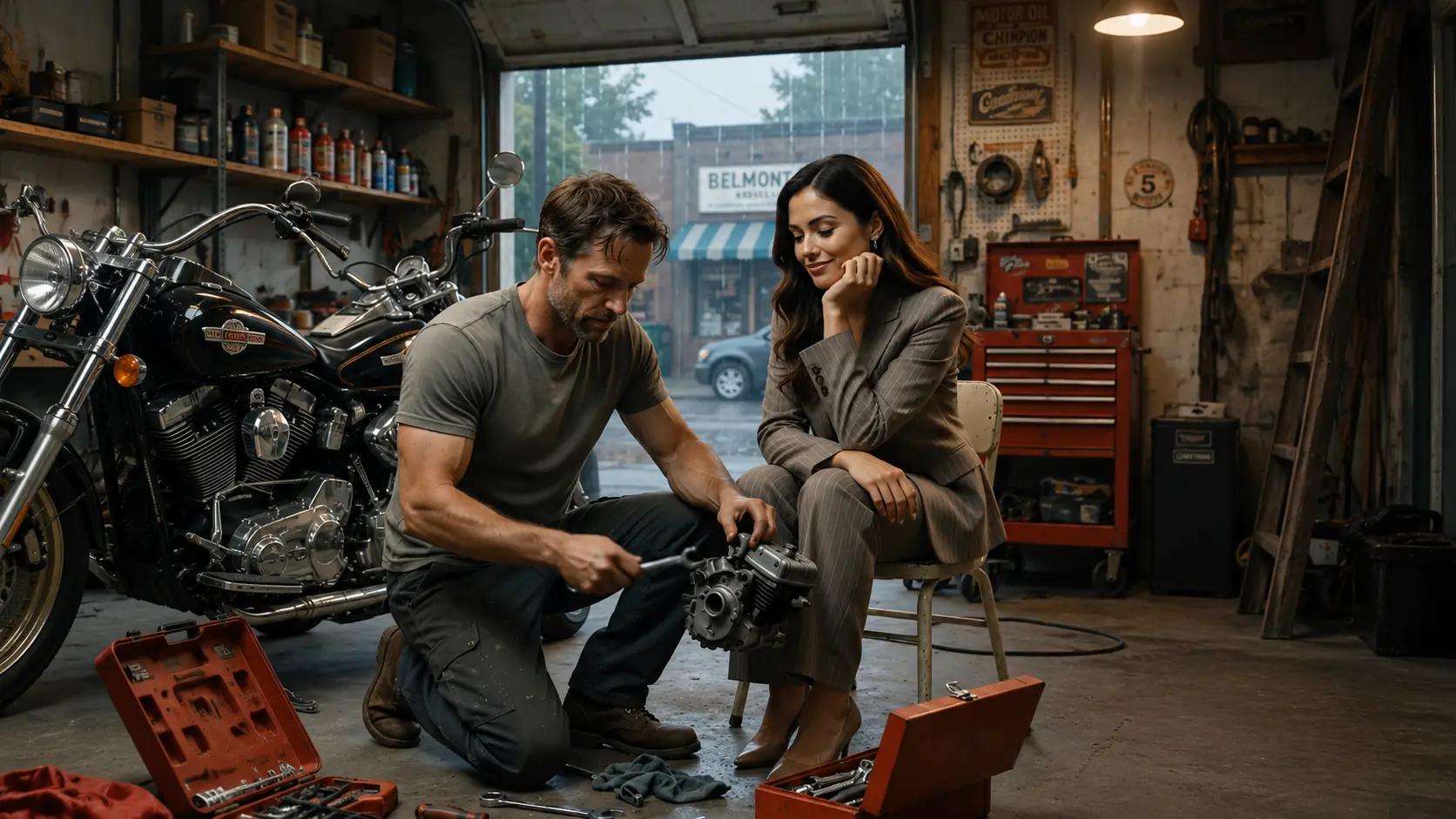
“Is the bike badly damaged?” the billionaire woman asked, watching him work.
“Nothing I can’t fix,” the single dad mechanic replied, tightening the final bolt.
She smiled softly. “And what if I keep finding reasons to come back?”
Marcus finally met her eyes. “Then I’ll always make room for you.”
The woman’s name was Elena Vasquez, although she had offered only her first name when the motorcycle sputtered to a stop outside the garage forty minutes earlier. Marcus knew nothing about the technology company she had founded, the private jet waiting in San Francisco, or the financial magazines that regularly placed her face on their covers. To him, Elena was simply a stranded traveler whose motorcycle had been neglected for too long. That anonymity was precisely why she remained seated instead of calling one of the assistants capable of replacing the bike within an hour.
Marcus was thirty-four and carried exhaustion differently from most men. It did not make him impatient or bitter; it made him quieter, gentler, and more attentive to people who looked lost. Two years earlier, his wife Sarah had died after a long fight with breast cancer, leaving Marcus to raise their six-year-old daughter alone. Since then, his life had narrowed into three responsibilities: keeping the garage open, paying the bills, and making sure Lily never doubted that she was loved.
The garage was small enough that Marcus could touch both walls if he stretched his arms inside the office. Most of his customers were delivery drivers, nurses, restaurant employees, and parents who needed their aging cars to survive another year. Marcus charged only what the work was worth, even when the customer drove something expensive. He had learned that a polished vehicle revealed nothing about the person standing beside it.
Elena had spent years surrounded by people who measured every kindness against a future advantage. At thirty-one, she was the founder and controlling owner of Vasquez Technologies, a software and robotics company valued at nearly three billion dollars. Investors praised her instincts, journalists admired her discipline, and board members feared the silence that came before she rejected a proposal. Yet none of them knew her favorite color, how she took her coffee, or why she sometimes stayed alone in the office long after the city lights came on.
A week earlier, Elena had ended her engagement to David Sterling during dinner at an exclusive San Francisco restaurant. David had described their marriage as a strategic combination of families, assets, and market influence. When Elena asked what food she hated most, he confidently answered sushi, although sushi had been his favorite and she had eaten it politely for years. She removed the engagement ring, set it beside his wineglass, and realized the man planned to marry a company rather than a woman.
The next morning, Elena canceled every appointment for two weeks and took the Harley from a private storage facility. She had purchased the motorcycle for her thirtieth birthday but rarely found time to ride it. Without informing the board, she traveled north along the coast, wearing ordinary clothes and ignoring the phone that never stopped demanding decisions. By the time she reached Portland, freedom had begun to feel less like escape and more like remembering who she had been before success transformed her into a valuable possession.
The motorcycle failed as the afternoon storm began. Elena tried the ignition repeatedly before pushing the heavy Harley beneath the awning of Marcus’s garage. He stepped outside carrying an oil-stained rag and asked whether she needed help without first examining her watch, clothing, or wallet. When Elena offered to pay whatever he wanted, Marcus said the fuel system probably needed cleaning and quoted fifty dollars.
“In San Francisco, they would charge me four times that,” she told him.
“Then San Francisco has expensive rain,” Marcus replied.
“You’re certain fifty is enough?”
“The work decides the price. Not the customer.”
The statement unsettled Elena because nothing in her world worked that way. Restaurants charged her more for private rooms, consultants raised their rates when they saw her name, and men became fascinated with childhood stories they had ignored before learning her net worth. Marcus returned to the engine without asking what she did or how much the motorcycle cost. For the first time in years, Elena felt visible without feeling assessed.
Small footsteps sounded from the rear doorway. Lily Thompson entered carrying half a peanut butter sandwich and wearing purple rain boots beneath a yellow school dress. Her dark-blonde hair had been gathered into uneven pigtails that clearly required more determination than skill. She stopped when she saw Elena, then looked at her father with the direct suspicion of a child protecting the center of her universe.
“Daddy, who is she?”
“A customer with a stubborn motorcycle.”
Lily approached Elena and studied the tailored suit. “You’re very pretty for someone whose bike broke.”
Elena laughed, and Marcus nearly dropped the screwdriver in his hand. It was the first genuine laugh she had produced since leaving San Francisco. Lily introduced herself, explained that her father could repair anything except pancakes, and offered Elena the untouched half of her sandwich. Elena accepted it as though the child had presented her with something priceless.
The rain continued after Marcus finished cleaning the fuel line and replacing a damaged connector. He started the Harley, and the engine settled into a steady rumble that filled the garage. Elena could have left immediately, but Lily asked whether she wanted spaghetti for dinner. Marcus began to refuse on Elena’s behalf, yet she answered before he could finish.
Their home occupied a modest apartment behind the garage. The furniture was old but carefully maintained, and Lily’s drawings covered the refrigerator in overlapping layers. Sarah’s photograph stood on a shelf beside a small vase of fresh flowers. Elena noticed the way Marcus glanced toward it before placing an extra plate on the table, as though inviting another woman into the room required permission from someone no longer there.
Dinner consisted of spaghetti, packaged salad, and garlic bread burned around the edges. Lily described her plan to become a veterinarian who treated wolves, horses, and possibly dragons. Elena listened without checking her silent phone and helped the little girl calculate how many rooms a dragon hospital would require. Marcus watched them from across the table, confused by how naturally the elegant stranger fit inside the ordinary evening.
Elena returned the following afternoon, claiming the motorcycle made a faint clicking noise. Marcus inspected it and found nothing wrong. She came back the next day asking him to teach her how to check tire pressure, even though the owner’s manual explained the process clearly. By Friday, neither of them pretended the motorcycle was the reason she kept entering the garage.
Elena arrived each morning wearing beautiful but practical clothing, usually tailored trousers, silk blouses, and low heels she exchanged for work shoes Marcus kept near the tool cabinet. He taught her to change oil, clean a carburetor, and identify the difference between an electrical failure and a fuel problem. She learned quickly, never complained about grease, and listened with the intense concentration she normally reserved for billion-dollar negotiations. Marcus found himself watching the curve of her smile whenever an engine responded to something she had repaired.
Lily became attached without caution. She saved Elena a chair at dinner, requested help with school projects, and insisted that the billionaire woman learn how to braid hair properly. Elena had negotiated with executives across four continents, yet Lily’s confidence frightened her because it came without legal protection or conditions. The child simply trusted that Elena would return the next day.
One evening, Marcus and Elena sat outside the garage after Lily had fallen asleep. Rainwater still shone beneath the streetlights, and the city smelled of wet concrete and cedar. Marcus told Elena about Sarah’s illness and the promise his wife had made him give during her final week. She had asked him to teach Lily kindness and to allow himself to love again.
“I managed the first part,” Marcus said.
“And the second?”
“I stay busy.”
“That wasn’t the question.”
Marcus looked at Elena, surprised by the softness in her voice. “Loving someone means giving life another way to take them.”
Elena understood the fear more than she admitted. Her losses had not involved death, but wealth had slowly erased the boundary between affection and ambition until she trusted neither. She wanted to tell Marcus who she was that night. Instead, she said she worked with computers and had taken time away after discovering that the people around her cared more about her usefulness than her happiness.
“That sounds lonely,” Marcus said.
“It is.”
“You don’t look lonely here.”
Elena smiled toward the warm light inside the apartment. “I don’t feel lonely here.”
The truth remained hidden for another four days. Elena ignored dozens of calls from her assistant, Jessica Moore, believing the company could survive without her constant supervision. On Friday afternoon, however, Jessica called fifteen times within an hour. Elena finally answered while Marcus repaired a customer’s alternator and Lily colored at the office desk.
“Elena, thank God,” Jessica said through the speaker. “The board has called an emergency meeting. The stock dropped twelve percent after reporters learned the CEO disappeared.”
Marcus stopped moving. Lily lifted her head, and Elena quickly turned off the speaker. The silence that followed felt heavier than the engine suspended from the hydraulic lift.
“You’re the CEO?” Marcus asked.
Elena placed the phone on the workbench. “I was going to tell you.”
“When?”
“I don’t know.”
“What company?”
“Vasquez Technologies.”
Marcus knew the name. Everyone did. He remembered seeing Elena’s face on a magazine cover while waiting at the grocery store, but the woman pictured there had looked cold and impossibly distant. He stared at the person standing in his garage and wondered which version was real.
Elena explained the broken engagement, the trip, and her desire to live briefly without every interaction being shaped by money. Marcus listened until she described the past week as the most honest experience she had known in years. That word finally broke his restraint.
“Honest?” he asked. “You lied every day.”
“I hid my job. I didn’t lie about how I felt.”
“You let my daughter believe you were staying.”
“I want to stay.”
“You run a corporation in San Francisco.”
“I can change how I run it.”
Marcus shook his head. He had opened his home to Elena because he believed she was a lonely traveler, not a billionaire experimenting with an ordinary family. Sarah’s death had taught him how quickly Lily could lose someone she loved. He refused to let another woman enter the child’s heart unless she understood the responsibility that came with it.
Lily began crying quietly at the office desk. Elena approached her, but Marcus stepped between them and asked his daughter to go inside. Lily obeyed after looking back at Elena with confusion and fear. That glance wounded Elena more deeply than anything Marcus said afterward.
“Was this entertainment for you?” he asked. “A vacation from being rich?”
“No.”
“Then what happens when your vacation ends?”
“I don’t know yet.”
“That’s the problem. Lily cannot build her life around what you might decide.”
Elena’s eyes filled, but Marcus did not soften. She picked up her bag, changed into her heels, and walked toward the repaired Harley. At the doorway, she turned and asked whether he would have trusted her if she had revealed the truth from the beginning.
“I would have known who I was trusting,” Marcus said.
Elena rode south that evening. She reached San Francisco after midnight and returned to the glass tower that carried her company’s name. The board expected apologies, explanations, and reassurance. Elena gave them a recovery plan, promoted Jessica to chief operating officer, and restored investor confidence within a week.
Professionally, she solved the crisis. Personally, she felt as though she had abandoned the only place where anyone had cared whether she ate dinner. Her office overlooked the bay, but each evening she imagined the warm garage, Lily’s laughter, and Marcus’s patient hands guiding hers around a wrench. Success had never appeared emptier.
In Portland, Marcus told himself he had protected Lily. Yet the child stopped drawing at the garage and began leaving an empty chair beside herself during dinner. She asked whether Elena had lied because rich people were bad. Marcus explained that people sometimes concealed the truth because they feared rejection, but he could not explain why fear made Elena’s absence hurt less.
Two weeks passed before the call came. Elena was reviewing an acquisition proposal when Maria, the owner of the coffee shop beside Marcus’s garage, reached her private number. Her voice shook as she explained that Lily had been struck by a car while riding her bicycle near Washington Park. The child had suffered a serious head injury and remained unconscious at Oregon Health and Science University Hospital.
Elena left the meeting without dismissing anyone. She boarded the first available flight and reached Portland before sunset. Marcus sat beside Lily’s hospital bed with his face buried in both hands. His beard had grown uneven, and his shirt was stained with coffee from a cup he had never finished.
When Marcus saw Elena, surprise gave way to exhaustion. “Maria shouldn’t have called you.”
“I’m glad she did.”
“The doctors say there’s swelling near her brain.”
Elena sat beside him. “What do they need?”
“A specialist recommends surgery, but the insurance company says the procedure is outside the network.”
Elena took out her phone. Marcus grabbed her wrist before she could make the call. He told her he would not let money become the price of her return. Elena pulled her hand free and looked directly at him.
“This is not a payment for forgiveness,” she said. “This is Lily’s life.”
Within minutes, Elena arranged for the hospital’s leading pediatric neurosurgeon to take the case. She transferred enough money to cover the operation, rehabilitation, and any future treatment. Then she placed the phone aside and remained in the same plastic chair for three days.
Elena slept in short intervals, ate vending-machine crackers, and read Lily stories even when the child could not respond. She brushed the girl’s hair around the bandages and spoke about places they would visit once she recovered. Marcus watched the billionaire become the same woman who had eaten burned garlic bread in his kitchen.
On the third morning, Lily opened her eyes. Her gaze moved slowly from Marcus to Elena, and a weak smile appeared. Elena leaned closer, tears streaming freely down her face.
“You came back,” Lily whispered.
“I’m here.”
“Are you leaving again?”
Elena held her small hand. “Not without telling you the truth first.”
Lily recovered slowly. During physical therapy, Elena attended appointments between remote meetings and rearranged her corporate schedule around school hours. She rented an apartment near the garage instead of returning immediately to San Francisco. Marcus remained cautious, but he could no longer claim that Elena treated their lives like a temporary adventure.
She made permanent changes at Vasquez Technologies. Jessica became CEO, while Elena moved into an advisory position that required travel only several days each month. The board objected until she reminded them that the company had been built to improve human lives, not consume hers. For the first time, Elena used her authority to create freedom rather than another obligation.
One afternoon, Marcus found her beneath the Harley, trying to reconnect a fuel line. Her beautiful taupe suit had been replaced by a faded T-shirt and work pants, and grease marked one cheek. Lily sat nearby offering unhelpful instructions while eating an apple.
“You installed it backward,” Marcus said.
“I was testing whether you were paying attention.”
“That excuse works better in boardrooms.”
Elena slid from beneath the motorcycle. “Are you still angry?”
“Yes.”
“Do you still want me here?”
Marcus looked toward Lily, who suddenly became extremely interested in the apple. “Yes.”
Elena stood and wiped her hands on a rag. She told him she did not expect trust to return simply because she had paid hospital bills or changed her job. She wanted the opportunity to earn a place in their lives through consistency, honesty, and time. Marcus admitted that his anger had partly come from fear.
“I started caring before I knew who you were,” he said.
“And after?”
“I cared enough to be terrified.”
Elena stepped closer. “I’m terrified too.”
Marcus touched the grease on her cheek with his thumb. “Good. At least this time we’re frightened honestly.”
Their relationship developed slowly. Elena never entered Lily’s life by replacing Sarah or pretending the child’s mother had not existed. She helped Lily choose flowers for Sarah’s photograph and listened when Marcus spoke about the woman he had loved. Her willingness to respect that grief allowed Marcus to imagine affection that did not require erasing the past.
Six months after the motorcycle first failed, Marcus invited Elena to the garage after closing. Warm lights had been strung across the ceiling, and Lily waited beside the Harley holding a small velvet box. Elena looked between them, immediately understanding why both appeared nervous.
Marcus took the box and knelt on the concrete floor where he had repaired the motorcycle. “You came here searching for a road away from your life.”
“I found a better one.”
“I cannot promise luxury.”
“I already had luxury.”
“I can promise burnt garlic bread, school projects, hospital scares, grease on expensive clothes, and a little girl who will ask personal questions before breakfast.”
Elena laughed through her tears. “That sounds perfect.”
Marcus opened the box. “Will you stay?”
Elena did not look at the ring first. She looked at Lily, then at the garage, and finally at the man who had repaired her motorcycle without caring what she owned. She knelt in front of him and placed both hands around his face.
“Yes,” she whispered. “And I’ll keep finding reasons to come back.”
They married inside the garage the following spring. Oregon wildflowers filled metal toolboxes, warm lights hung from the rafters, and the restored Harley stood beside Lily’s bicycle. There were no reporters, investors, or celebrity guests, only neighborhood customers, friends, and the people who had witnessed Marcus learning to smile again.
Elena wore an elegant ivory suit instead of a traditional gown. Marcus waited beside Lily, who carried the rings and announced loudly that she had introduced them even though the motorcycle deserved partial credit. Before the ceremony, Elena placed a white rose beneath Sarah’s photograph.
Marcus had once believed loving again would betray the wife he lost. Elena had believed wealth made genuine affection impossible. A broken motorcycle challenged both fears by bringing two lonely people into the same small garage during a storm.
Marcus repaired the machine for fifty dollars. Elena returned because his kindness had made her feel more valuable than her fortune ever had. Neither understood that the most important repair occurring inside the garage had nothing to do with the motorcycle.