The phone call came at 6:47 in the morning.
Thomas Reed was bent over the open side panel of an old pickup truck, one shoulder pressed against cold metal, his right hand buried near the alternator, when the phone on the workbench began to vibrate.
At first, he ignored it. Most calls before seven in the morning were either emergencies he could not afford to refuse or bills he could not afford to answer.
The phone kept ringing.
Thomas pulled his hand free, wiped grease across an already ruined shop towel, and reached for it with the tired caution of a man who had learned that bad news often arrived early.
“Reed Auto and Cycle,” he said. “Thomas speaking.”
A woman’s voice answered.
“Is this the man who repaired my son’s motorcycle yesterday?”
Thomas straightened.
The voice was controlled, precise, and quietly forceful, the kind of voice that did not ask twice because it was not used to needing permission. Beneath that control, though, he heard something else. Not anger exactly. Not fear either. Something sharper.
“Depends,” Thomas said carefully. “Who’s your son?”
“Ethan Whitmore,” the woman replied. “Eighteen years old. Brown jacket. Old blue motorcycle. He said you fixed it, drove him to his interview, and refused to take proper payment.”
Thomas looked toward the shop window, where morning light was beginning to spread thinly across the cracked pavement outside.
The boy.
He remembered him immediately.
The rain-soaked jacket. The shaking hands. The dented motorcycle with the loose chain, dead battery, bent foot peg, and a front brake line that made Thomas angry the moment he saw it. The way the kid had tried so hard not to look scared that his whole face had gone stiff from the effort.
“Yes,” Thomas said. “I helped him.”
“My name is Caroline Whitmore,” the woman said. “My driver will pick you up in thirty minutes.”
Thomas blinked.
“Excuse me?”
“My driver will pick you up in thirty minutes,” she repeated, as if the sentence explained itself perfectly. “Please be ready.”
Before Thomas could ask why, the line went dead.
He stood there for several seconds with the phone still against his ear, listening to silence.
Then the screen went dark, returning to the photo of his daughter Lily grinning in front of a birthday cupcake, one front tooth missing, her hair in two uneven braids. The picture had been taken two years ago, back when Thomas still believed the shop might survive if he worked hard enough, back when Lily still thought a cupcake with a candle was a proper party.
From the apartment above the garage, he could hear her moving around now, the faint creak of floorboards and the small thump of a drawer being opened. Lily was nine, old enough to notice money was tight, too young to have to. Her school backpack sat by the door upstairs with a permission slip tucked inside it, waiting for Thomas to find thirty-five dollars for the science museum trip.
Thirty-five dollars had become a mountain.
Thomas looked down at his grease-stained hands.
Thirty minutes.
Not a request.
An expectation.
He moved to the sink in the corner of the shop and scrubbed at the oil embedded in the lines of his palms. The water ran gray. The stains remained. They always did.
There were stains that came off with soap.
And then there were the kinds life pressed into you.
The wedding ring tan line had finally disappeared from his finger after three years, but sometimes he still rubbed the place where the ring had been. His wife, Hannah, had died of an aneurysm on a Tuesday morning while making Lily’s lunch. No warning. No long illness. No time for goodbyes. Just one ordinary morning split open forever.
After that, Thomas had stopped being a husband and became a system.
Wake Lily.
Pack lunch.
Open shop.
Fix cars.
Fix motorcycles.
Fix bicycles.
Fix lawn mowers.
Fix whatever people brought him.
Close late.
Pay what he could.
Apologize for what he couldn’t.
Start again.
“Dad?”
Lily appeared at the top of the stairs in an oversized sweatshirt, her hair sticking up on one side, a stuffed rabbit tucked under one arm. She had Hannah’s eyes, wide and thoughtful, with a way of looking at him that made Thomas feel both loved and inspected.
“Who was on the phone?” she asked.
Thomas forced a smile. “Customer.”
“At this time?”
“Important customer, apparently.”
Lily came down the stairs barefoot, hugging the stuffed rabbit against her chest. “Is it about the boy with the motorcycle?”
Thomas paused.
“How did you know about that?”
“I heard you talking to him yesterday when I was doing homework.” She leaned against the doorway. “You told him riding with bad brakes wasn’t brave. It was stupid.”
Thomas sighed.
“You were supposed to be doing math.”
“I was. I can listen and subtract at the same time.”
“That’s dangerous talent.”
Lily smiled, but it faded quickly. “Was he okay?”
Thomas remembered the young man standing in the doorway the evening before, soaked from the rain, pushing a battered motorcycle that looked like it had been loved, neglected, and resurrected too many times.
But the truth was, Ethan had not looked okay.
Not at first.
Yesterday had been one of those gray afternoons when the whole town seemed tired. Rain had fallen steadily since noon, turning the street outside Reed Auto and Cycle into a mirror of oil slicks and puddles. Business had been slow. Thomas had two unpaid invoices, one customer arguing over a repair bill, and a letter from the bank sitting unopened beneath the cash drawer because he already knew what it said.
He had been considering closing early to pick Lily up from Mrs. Chen’s apartment when the shop bell jingled.
At first, he heard the motorcycle before he saw the rider.
Not the healthy growl of an engine.
A coughing, uneven choke.
A desperate mechanical rattle.
Then the engine died right outside the bay door.
A second later, an eighteen-year-old boy pushed the motorcycle into the shop with his shoulder hunched against the rain. He was tall but still young in the face, with dark wet hair plastered to his forehead, tired eyes behind rain-speckled glasses, and a brown jacket that was too thin for the weather. One knee of his jeans was torn, and his left hand had a scrape across the knuckles.
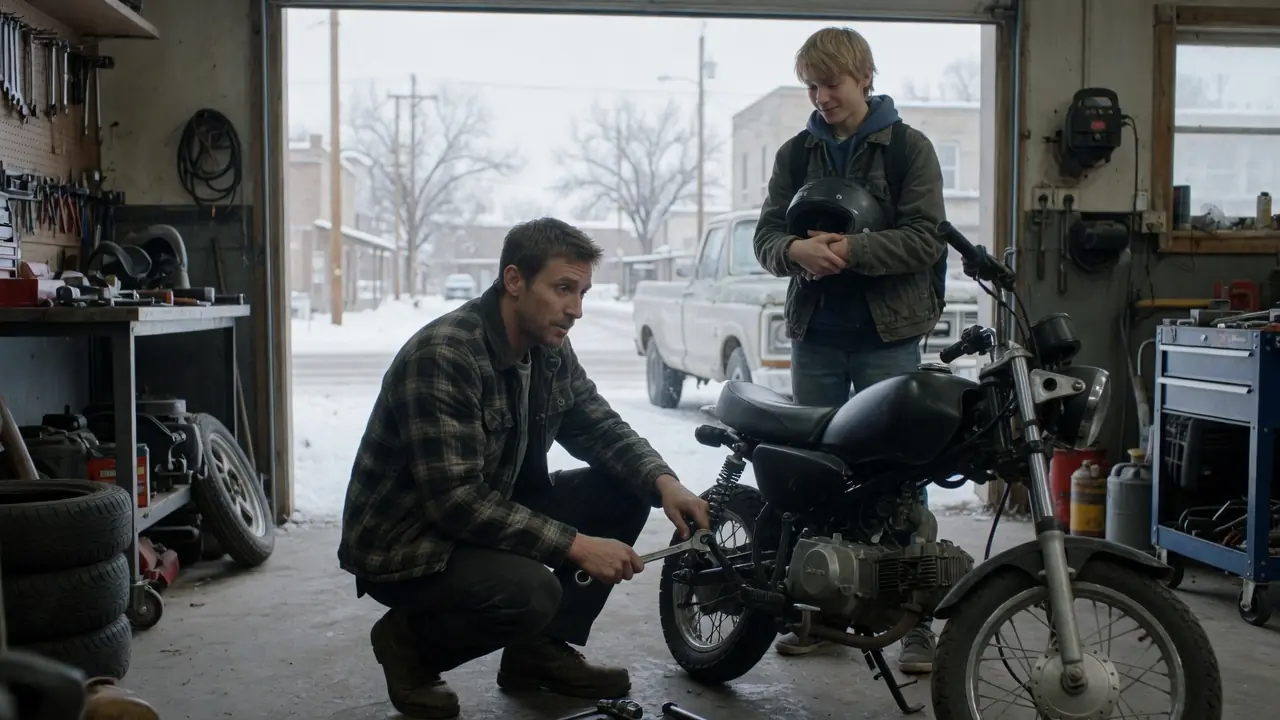
The motorcycle was an old blue Honda, maybe twenty years past its best days, with a dent in the fuel tank and a seat repaired with black tape. The chain sagged too low. The front brake lever felt wrong just by looking at it. One turn signal hung loose, and the battery sounded nearly dead.
The boy stood just inside the doorway, trying to look composed while water dripped onto the floor.
“Sir,” he said, voice tight. “Do you work on motorcycles?”
Thomas looked at the bike again.
“Sometimes.”
The boy swallowed. “I don’t have much money.”
That sentence told Thomas almost everything.
Not because poor kids said it.
Because proud kids said it quietly.
“How much is not much?” Thomas asked.
The boy reached into his jacket pocket and pulled out a few damp bills and coins.
“Twenty-three dollars and sixty cents.”
Thomas looked at the motorcycle again.
The chain needed adjusting. The brake line needed attention. The battery needed charging, at least temporarily. The loose turn signal had to be secured. The bent foot peg needed to be straightened enough for safe riding. It was far more than twenty-three dollars and sixty cents of work.
The boy knew that too.
His face tried not to fall.
Thomas leaned back against the workbench. “What’s your name?”
“Ethan.”
“Ethan what?”
The boy hesitated.
“Ethan Whitmore.”
The name meant nothing to Thomas then.
He nodded toward the bike. “What happened, Ethan Whitmore?”
“I hit a pothole near the railroad crossing,” Ethan said. “The back end slid. I didn’t go down all the way, but the bike tipped against the curb. After that the chain started slipping, and the brake felt wrong.”
“You hurt?”
Ethan shook his head too quickly.
Thomas looked at his torn jeans and scraped knuckles.
“Try again.”
Ethan looked down. “A little.”
Thomas grabbed the first aid kit from the shelf.
“I need the bike fixed,” Ethan said quickly. “I’m supposed to be somewhere.”
“Bike can wait thirty seconds. Hand first.”
“It’s really important.”
“So is not bleeding on my floor.”
That made Ethan blink.
Then, despite himself, he almost smiled.
Thomas cleaned the scrape while Ethan sat stiffly on an old chair, hands gripping the edges of the seat as if he was afraid the whole shop might vanish if he relaxed. The scrape was not serious, but it hurt enough to make his jaw tighten. He did not complain.
Thomas respected that.
He also hated it.
Young people should not have to be brave in ways that made adults proud.
“Where were you going in this weather?” Thomas asked.
Ethan hesitated.
“Hawthorne Technical Institute.”
“For what?”
“Interview.”
Thomas looked up.
“College interview?”
“Scholarship interview,” Ethan corrected. “Engineering track. Mechanical systems and robotics. They only offer five full scholarships in the state.”
Thomas stopped wrapping the bandage.
“Engineering?”
Ethan nodded. “I like building things. My dad used to say machines are puzzles that don’t lie.”
Thomas felt something move in his chest.
Hannah had once said the same thing about numbers.
“What time is the interview?”
“Four-thirty.”
Thomas looked at the clock.
Four-ten.
Hawthorne Technical Institute was fifteen minutes away by car in decent weather. Longer in rain. Dangerous on a motorcycle with bad brakes.
“Why didn’t your mother drive you?”
Ethan’s face closed.
“She was at work.”
“Does she know you were riding there alone in this weather?”
Ethan looked away.
That was answer enough.
Thomas said nothing for a moment.
Then he stood.
“Bike’s going on the lift.”
Ethan jumped up. “How much will it be?”
Thomas rolled the motorcycle forward. “Twenty-three dollars and sixty cents.”
The boy stared. “But you haven’t even checked everything yet.”
“I’ve checked enough.”
“Is that enough money?”
“No.”
“Then why—”
“Because I said so.”
Ethan frowned, clearly uncomfortable with generosity. “I can pay you back later.”
“Good. Pay me back by making that interview.”
The boy swallowed.
Thomas worked quickly.
His hands moved with the old confidence that hardship had not taken from him. Chain inspected and adjusted. Brake checked and made safe enough for temporary transport, though not enough for Thomas to approve a long ride. Battery jumped and tested. Turn signal secured. Foot peg straightened carefully. A proper repair would take longer, but Ethan did not need perfect at that moment.
He needed possible.
As Thomas worked, Ethan stood nearby, watching every movement with intense focus.
“You know what you’re doing,” Ethan said.
“I would hope so. My sign has my name on it.”
“No, I mean…” Ethan pushed his glasses up his nose. “You understand how the parts work together.”
Thomas glanced at him.
“That’s the point.”
“My dad used to show me stuff like that. He had an old Triumph in the garage. Said if you know how something moves, you can understand how it breaks.”
Thomas’s hand paused for half a second.
“Your dad sounds smart.”
“He was.”
Was.
The word sat quietly between them.
Thomas tightened the chain and tested the rear wheel.
“There,” he said. “It can move, but you’re not riding this to Hawthorne in the rain.”
Ethan’s head snapped up. “What?”
“The brakes need real work. I made it safe enough to roll around town at low speed, not safe enough for you to ride across wet roads in traffic.”
“I have to get there.”
“I know.”
“I can ride carefully.”
“No.”
Ethan’s face tightened. “Sir, I need this interview.”
“And I need you alive after it.”
The boy stared at him.
Thomas grabbed his keys from the hook.
“I’m driving you.”
Ethan’s eyes widened. “No, you don’t have to.”
“I know.”
“I can’t make you close your shop.”
“You’re not making me. I’m deciding.”
“I don’t want to be a problem.”
Thomas looked at him, and his voice softened despite himself.
“Kid, you came in here with a broken motorcycle, a bleeding hand, and twenty-three dollars. You’re already having a problem. Let somebody help before it gets worse.”
Ethan looked down.
For a second, Thomas thought he would argue again.
Then the boy whispered, “Okay.”
Thomas rolled the motorcycle into the back of the shop, locked it inside, and drove Ethan through the rain in his old pickup. Ethan sat rigidly in the passenger seat, backpack on his lap, one hand around the twenty-three dollars and sixty cents he still seemed determined to pay.
“You nervous?” Thomas asked.
“No.”
Thomas looked at him.
Ethan sighed. “Yes.”
“That’s good.”
“How is that good?”
“Means you care.”
Ethan stared out the windshield at the wet road. “My mom says caring too much makes things harder.”
“Sometimes.”
“My dad said caring is what tells you where to put your effort.”
Thomas smiled faintly.
“I like your dad’s version better.”
At Hawthorne, Ethan jumped out so quickly he nearly forgot his backpack. Thomas handed it to him, then pulled a granola bar from the glove compartment.
“Eat this before the interview.”
Ethan looked at it. “I’m not hungry.”
“Lies don’t help your brain.”
The boy almost smiled again.
He took the granola bar.
At the entrance, he turned back.
“Mr. Reed?”
“Yeah?”
“If I get the scholarship, I’ll tell you.”
“I expect a full report.”
Ethan nodded seriously, then disappeared inside.
Thomas had gone back to the shop, finished two small repairs, closed late, helped Lily with homework, and thought that was the end of it.
Now, less than twenty-four hours later, Ethan’s mother had ordered a driver to pick him up like Thomas was a delivery.
“Dad,” Lily said, pulling him back to the present. “Are we in trouble?”
Thomas looked at his daughter.
The question was too familiar.
Children in unstable homes learned to ask it quickly.
“No,” he said. “Nothing I can’t handle.”
Lily studied him.
“You say that when you don’t know.”
Thomas crouched in front of her.
“You’re getting too smart.”
“I made the advanced reading group.”
“I know. Terrifying.”
She smiled a little.
Thomas touched her shoulder. “Mrs. Chen will come down in a few minutes. She’ll make sure you get to school.”
“Are you coming to my presentation today?”
The question hit him low and hard.
Lily’s class was doing family history presentations at two. She had chosen to talk about Hannah’s grandmother, who had been a nurse during the Korean War. Thomas had promised he would come if the shop was slow enough.
He looked toward the phone.
Toward the workbench.
Toward the unpaid bills.
“I’ll try,” he said.
Lily’s face did not fall.
That was worse.
She had heard “I’ll try” enough times to know what it often meant.
Thomas pulled her into a hug.
“I’ll do everything I can.”
Her small arms tightened around his neck.
“Mom said showing up matters.”
Thomas closed his eyes.
“Yes,” he whispered. “She did.”
At exactly 7:17, an expensive dark sedan pulled up outside Reed Auto and Cycle.
It looked absurd beside Thomas’s faded pickup and the cracked concrete outside the garage. The driver stepped out wearing a pressed suit and opened the back door without speaking.
Thomas wiped his hands again, though it did not help much. He locked the shop, gave Lily one more hug, and climbed into the sedan.
The interior smelled like leather, rain, and money.
As the car pulled away, Thomas looked up at the apartment window and saw Lily standing there with her hand against the glass.
He lifted his own hand.
She waved once.
Then the car turned the corner.
The Whitmore estate sat on the northern edge of the city, behind stone walls and iron gates that opened before the sedan even stopped. Thomas had driven past neighborhoods like that but never through them. The houses were not really houses. They were statements made in brick, glass, and manicured lawns.
The sedan stopped in front of a modern home with tall windows overlooking a private lake. Everything looked intentional. Even the silence.
The driver led Thomas through a front entrance where the floor was polished stone and the walls displayed large abstract paintings that probably cost more than his garage. Thomas became painfully aware of his work boots, his old flannel jacket, and the oil stain near his cuff that no amount of scrubbing would remove.
A woman stood near the windows.
Caroline Whitmore was younger than he expected, maybe thirty-nine or forty, with dark hair pulled neatly back and a face composed with practiced control. She wore a cream blouse, tailored trousers, and a watch so understated that Thomas assumed it was expensive. She looked like someone who had learned to show no emotion until she decided it would be useful.
“Mr. Reed,” she said.
“Ms. Whitmore.”
“Thank you for coming.”
“You didn’t exactly ask.”
Something flickered in her eyes.
Not offense.
Interest.
“No,” she said. “I suppose I didn’t.”
Thomas stood awkwardly near the doorway until she gestured toward a seating area.
“Coffee?”
“No, thank you.”
She sat.
He sat only after she did, choosing the edge of the chair because he was not convinced he belonged on furniture that clean.
“My son told me what happened yesterday,” Caroline said.
“He had a damaged motorcycle.”
“He also had a scraped hand.”
“I cleaned it.”
“And you drove him to Hawthorne Technical Institute.”
“He was going to miss the interview.”
“And you refused proper payment.”
Thomas looked at her.
“He had twenty-three dollars and sixty cents.”
“That was not an answer.”
“It’s the only one I have.”
Caroline studied him for a long moment.
“Most shops would have taken the money, told him the repair was impossible, and left him to figure out the rest.”
“I’m not most shops.”
“No,” she said softly. “Apparently not.”
She reached for a folder on the table and opened it.
Thomas immediately disliked the folder.
“I had my assistant look into you.”
“Of course you did.”
Her eyes lifted. “That bothers you.”
“It would bother most people.”
“I needed to know who had been alone with my son.”
Thomas leaned back, his voice cooling.
“Your son walked into my shop soaked, injured, and scared he was going to miss an interview that could change his life. I fixed what I could, told him the truth about what was unsafe, drove him there, and gave him a granola bar. If that sounds suspicious to you, maybe you’ve been living around the wrong people.”
Caroline’s mouth tightened.
For a second, Thomas thought he had gone too far.
Then she closed the folder.
“I have lived around the wrong people,” she said.
The admission surprised him.
She looked out toward the lake, where morning light made the water look like polished steel.
“Ethan’s father died two years ago,” she said. “Before that, people came near us for money, influence, introductions, favors. After he died, it became worse. Some wanted sympathy. Some wanted access. Some wanted to use Ethan because they thought a grieving teenage boy would be easier to manipulate than me.”
Thomas said nothing.
He understood grief.
He also understood the way people circled it.
“Yesterday,” Caroline continued, “my son left school without telling his driver, rode across town in freezing rain, and nearly missed the most important interview of his life because he wanted to prove he could do something without help.”
Thomas thought of Ethan’s stiff little face.
That made sense.
“Why?” he asked.
Caroline’s expression tightened.
“Because he thinks help means weakness.”
“Where would he get that idea?”
She looked at him then.
The silence answered before she did.
“From me, probably.”
For the first time since entering the house, Thomas saw something behind her control. Exhaustion. Fear. A loneliness dressed as competence.
“Ethan’s father was an engineer,” she said. “A brilliant one. He restored motorcycles as a hobby. Old Triumphs, Hondas, dusty machines he found half-dead in barns. He and Ethan spent every Sunday in the garage. Ethan learned to hold a wrench before he learned to tie a tie.”
Thomas listened carefully.
“After his father died, Ethan stopped going into the garage. I thought removing the motorcycles would help. They hurt him too much. So I sold most of them, except one old Honda his father had wanted to rebuild with him. Ethan found it in storage three months ago and started working on it alone.”
“The blue one,” Thomas said.
Caroline nodded.
“That motorcycle was his father’s last unfinished project.”
The room went quiet.
Thomas thought of Ethan pushing that motorcycle through the rain, desperate not only to reach an interview, but to arrive on a machine that connected him to someone he had lost.
Suddenly the old Honda was not just transportation.
It was memory with an engine.
“Yesterday, when Ethan came home,” Caroline said, “he was different. Not happy exactly. But alive in a way I haven’t seen in a long time. He talked about how you adjusted the chain. He repeated something you said about machines needing patience before power. Then he told me he made it through the first scholarship interview.”
Thomas sat up slightly.
“He did?”
“He did.”
A warmth moved through him before he could stop it.
“Good kid.”
“Yes,” Caroline said. “He is.”
She opened a second folder and slid it across the table.
Thomas did not touch it.
“What is this?”
“A proposal.”
“That sounds expensive.”
“It is.”
He looked at her.
Caroline continued, “The Whitmore Foundation has been planning to fund a practical engineering and vehicle repair program for young adults. We have space, equipment, donors, and partnerships with technical schools. What we do not have is someone who can teach mechanical work without making students feel small for not already knowing it.”
Thomas stared at her.
“You want me to teach?”
“I want you to run the program.”
He laughed once, not because it was funny, but because the sentence had no place in the world he lived in.
“I fix brakes, chains, engines, and whatever desperate people drag through my door.”
“You were a mechanical engineer before you opened your shop.”
His face hardened.
The folder again.
“You looked into me.”
“Yes.”
“Then you know I lost that job when Crestline Manufacturing collapsed.”
“I know you were one of the few engineers who warned the board that their cost-cutting measures would cause catastrophic product failures.”
Thomas went still.
Caroline held his gaze.
“I also know they blamed the engineering department when those failures happened.”
The room seemed to shrink.
Thomas had not heard anyone say it that plainly in years.
After Hannah died, after the lawsuits, after the layoffs, after the shop became survival instead of choice, his old career had begun to feel like a life that belonged to another man. He had stopped explaining. Stopped defending himself. Stopped saying he had been right because being right had not paid the hospital bills.
“How do you know that?” he asked quietly.
“My husband served on a review committee after Crestline’s bankruptcy,” Caroline said. “He said one engineer had told the truth early and paid for it anyway. I did not know the name until yesterday.”
Thomas looked away.
His throat felt tight.
Caroline’s voice softened. “Mr. Reed, my offer is not charity.”
“People always say that before offering charity.”
“This is not charity,” she repeated. “It is work. Paid work. Meaningful work. You would run repair workshops for young adults, oversee the motorcycle restoration lab, teach basic mechanical safety, mentor students like Ethan, and help develop a practical engineering curriculum.”
Thomas’s mind ran faster than his emotions could follow.
Paid work.
Steady income.
Something with his old skills.
Something that might let him keep the shop.
Something that might let Lily go on field trips without Thomas counting quarters at midnight.
“How much?” he asked.
Caroline named a salary.
Thomas blinked.
Then she named the operating budget.
He looked at her as if she had spoken another language.
“That’s more than my shop makes in a year.”
“I know.”
“And you trust me with that because I fixed one motorcycle?”
“No,” Caroline said. “Because of how you fixed it.”
Thomas did not answer.
Caroline leaned forward.
“You did not make Ethan feel helpless. You made him feel capable. You did not rescue him by taking over. You repaired what was broken, told him what still needed work, and got him safely where he needed to be. That is rare.”
The words landed somewhere deep.
Thomas thought of Lily’s presentation.
Showing up matters.
He looked at the clock on the wall.
It was 8:05.
“What time would this meeting be over?”
Caroline seemed surprised.
“Why?”
“My daughter has a school presentation at two. I told her I’d try to come.”
Caroline studied him.
Then, unexpectedly, she smiled.
A small smile.
But real.
“Then we will finish before two.”
The program was supposed to start with paperwork.
Instead, it started with Ethan.
Caroline led Thomas down a hallway to a garage larger than his entire shop. Inside sat polished cars, tool cabinets arranged with painful perfection, and in the center of it all, the old blue Honda motorcycle.
Ethan stood beside it, wearing a clean sweater and jeans, his dark hair still slightly messy despite the obvious attempt to tame it. When he saw Thomas, his face lit up, then immediately tried to become serious.
“Mr. Reed.”
“Ethan.”
“I passed the first interview.”
“I heard.”
“They asked about a mechanical problem I had solved. I talked about the chain tension.”
“Solid answer.”
“I also told them you said power doesn’t matter if control is gone.”
Thomas looked at him.
“I said that?”
“About brakes.”
“Sounds smarter when you repeat it.”
Ethan almost smiled.
Caroline stood behind them, watching quietly.
Thomas walked over to the motorcycle and crouched near the front wheel.
“This brake line needs real attention.”
“I know,” Ethan said quickly. “I didn’t ride it after you dropped me off. Mom sent a trailer.”
“Good.”
“I wanted to ride it.”
“I figured.”
“But I didn’t.”
Thomas nodded. “That’s called learning.”
Ethan looked down at the motorcycle.
“My dad and I were supposed to rebuild it together.”
“I heard.”
“I thought if I got it running by myself, then maybe…” He stopped.
Thomas waited.
Ethan swallowed.
“Maybe it would feel like finishing something with him.”
Thomas looked at the boy, eighteen years old and still young enough for grief to make him sound like a child.
“That makes sense,” he said.
Ethan looked surprised. “It does?”
“Yes.”
“Mom thinks I’m trying to get myself killed.”
“I think your mom is scared.”
Ethan glanced toward Caroline.
“She doesn’t act scared.”
“Neither do you.”
That silenced him.
For the next hour, Thomas showed Ethan how to inspect the front brake assembly, check cable movement, examine the chain and sprocket wear, and identify what could be repaired safely versus what needed replacement. He did not do everything for him. He guided Ethan’s hands, corrected his grip, let him struggle enough to learn, and stepped in only when frustration began turning into shame.
“I’m doing it wrong,” Ethan muttered after the same bolt resisted him for the third time.
Thomas stopped him.
“No.”
Ethan looked up.
“You’re doing it not-yet-right,” Thomas said. “There’s a difference.”
Ethan stared at him.
Then nodded slowly.
Behind them, Caroline turned toward the window.
Thomas saw her wipe quickly beneath one eye.
The lesson ended at 10:15, but the conversation lasted longer. Caroline showed Thomas the building she planned to use for the new program, a former transportation warehouse near the technical institute that could become classrooms, motorcycle bays, tool storage, welding stations, safety rooms, and a vehicle donation center.
Thomas walked through it with a mechanic’s eyes and an engineer’s mind, seeing what needed wiring, ventilation, layout changes, tool access, safety markings, drainage, noise control, and insurance restrictions.
For the first time in years, his brain did not feel trapped inside survival.
It opened.
By noon, Thomas had filled four pages with notes.
By 12:30, Caroline’s assistant had sent him a revised proposal.
By 1:00, Thomas asked for one condition.
“My shop stays open,” he said.
Caroline looked surprised. “You would not need it.”
“I know. But it’s mine.”
She nodded once. “Then the program can partner with Reed Auto and Cycle. Your shop becomes the first training site until the warehouse is ready.”
Thomas swallowed.
There it was.
Not the death of his old life.
A bridge.
At 1:35, Caroline’s driver brought him back to town.
At 1:52, Thomas walked into Lily’s classroom just as her teacher was adjusting the projector.
Lily saw him from the front row.
Her whole face changed.
Not big.
Not loud.
Just enough.
Thomas sat in the back with grease still under one fingernail and a contract offer folded in his jacket pocket.
Lily stood in front of the class and spoke about her great-grandmother the nurse, her voice trembling at first, then growing stronger. When she looked at Thomas, he gave her a thumbs-up. She smiled and kept going.
Showing up matters.
After school, they walked home together.
Lily held his hand longer than usual.
“Did your important customer yell at you?” she asked.
“No.”
“Did you fix something?”
Thomas looked down at her.
“Maybe.”
“What?”
He squeezed her hand.
“Maybe more than a motorcycle.”
Over the next few weeks, everything began to change.
Not all at once.
Life rarely changes cleanly.
The roof at Reed Auto and Cycle still leaked. The bank still called. The bills still existed. But now Thomas had a contract, a plan, and a reason to look beyond the next emergency. Caroline moved quickly, the way powerful people did when they decided obstacles were temporary. Workbenches arrived. Tool donations came in. Safety gear was ordered. The old warehouse near Hawthorne Technical Institute began transforming from a cold storage space into something bright and useful.
Ethan came twice a week.
So did Lily.
At first, she sat in the corner with homework, pretending she was not interested. Then Thomas caught her watching Ethan clean a carburetor with intense curiosity.
“You want to try?” he asked.
“I don’t know how.”
“That’s why people try.”
She joined them at the workbench.
Ethan explained the parts with great seriousness.
Lily corrected his math when he measured wrong.
Thomas stood back and watched two young people, both missing a parent in different ways, argue over a motorcycle part as if the world had become simple enough to fix with tools.
Caroline visited often, though she claimed she was only checking progress. She stood in expensive coats beside metal shelves and tried not to look moved when students learned to identify worn chains, understand torque, label engine parts, or rebuild a small motor for the first time. She and Thomas argued over budgeting, safety policies, insurance, donation logistics, and whether eighteen-year-olds needed stricter supervision than younger kids.
“They need rules,” Caroline said.
“They need rules that make sense,” Thomas replied.
“Those are usually more expensive.”
“That’s how rich people solve disagreements?”
“When possible.”
He laughed despite himself.
Ethan changed too.
He grew less guarded. He spoke more. He asked questions that had been trapped inside him for years. One afternoon, while he and Thomas worked on the old blue Honda, Ethan said quietly, “My dad would have liked you.”
Thomas kept his eyes on the wrench.
“I would have liked him.”
“He used to say a machine remembers how it was treated.”
“Smart man.”
“My mom doesn’t like talking about him.”
“Maybe it hurts too much.”
“It hurts me too.”
Thomas stopped working.
Ethan looked down at the motorcycle chain.
“I think she forgets that.”
Thomas set the wrench down.
“Adults forget things when they’re scared.”
“My mom isn’t scared.”
Thomas looked toward the office window, where Caroline was on the phone, one hand pressed against her forehead.
“Yes,” he said. “She is.”
Ethan watched his mother through the glass.
For the first time, maybe, he looked at her not as a wall, but as a person behind one.
The official opening of Whitmore Motor Lab happened three months later.
Caroline wanted a small event.
The town made it large.
Students arrived with old motorcycles, scooters, small engines, and nervous parents. Local reporters took photos. The mayor gave a speech that was too long. Mrs. Chen brought dumplings and told everyone she had discovered Thomas before the rich people did. Lily wore a denim apron with her name stitched crookedly across the pocket. Ethan stood beside the old blue Honda, nervous and proud.
Thomas stood at the front of the shop with Caroline on one side and the students behind him.
He had not planned to speak.
Caroline handed him the microphone anyway.
He glared at her.
She smiled politely.
The crowd quieted.
Thomas looked out at the faces: parents, young mechanics, neighbors, former customers, people who had once assumed his shop was failing because he had failed. He looked at Lily in her apron. He looked at Ethan standing beside the motorcycle that had started it all.
Then he spoke.
“When I was younger, I thought fixing things meant making them like new,” he said. “Cars, engines, motorcycles, machines. You find the broken part, replace it, tighten what’s loose, clean what’s dirty, and send it back out.”
He paused.
“But life doesn’t always work that way. Some things don’t go back to new. Some losses stay. Some cracks remain visible. But that doesn’t mean something can’t move again.”
Caroline lowered her eyes.
Ethan looked at his shoes.
Lily watched her father with tears shining.
Thomas continued.
“This place is for young people who want to learn how things work. It’s for eighteen-year-olds who are trying to figure out who they are, for machines that deserve a second chance, for students who need someone to tell them that not knowing yet is not the same as failing.”
He looked at Ethan.
“A young man came into my shop with a damaged motorcycle. I thought I was fixing a chain and a brake. Turns out, he was helping fix a future.”
The applause came slowly at first.
Then louder.
Thomas stepped back, uncomfortable with attention, but Lily ran to him and hugged him around the waist in front of everyone. Ethan hesitated, then stepped forward and shook Thomas’s hand with both of his.
The crowd clapped harder.
Caroline turned away.
This time, she did not hide her tears quickly enough.
Over the next year, Whitmore Motor Lab became more than anyone expected.
Young adults came after school and on weekends to repair motorcycles.
Then scooters.
Then small engines.
Then robotics kits and electric bike conversions.
Retired mechanics volunteered. Technical school instructors visited. Students who had never cared about classroom formulas suddenly understood math when it determined whether a machine ran safely. Parents donated old vehicles that students restored and sold to fund the program. The local paper ran a story titled, “Where Broken Engines Become Bright Futures.”
Thomas hated the headline.
Lily loved it and taped it to the refrigerator.
The shop survived.
Then it grew.
Thomas hired two part-time mechanics. He paid down old debts. He fixed the roof. He bought Lily new shoes without waiting for a sale. On her tenth birthday, he gave her a toolbox with her name engraved on the front. She cried, then immediately accused him of making her emotional on purpose.
Caroline became part of their lives slowly.
Not in the dramatic way Mrs. Chen’s television shows would have predicted, though Mrs. Chen still insisted something romantic was “inevitable.” It began with meetings, then coffee, then dinners after program events when everyone was too tired to cook. Caroline learned to speak to Lily without sounding like a board presentation. Thomas learned that Caroline’s control was not arrogance alone, but armor built from grief, wealth, and years of people wanting something from her.
One evening, long after the motor lab had closed, Thomas found Caroline standing beside Ethan’s old blue Honda.
They had mounted it near the entrance, cleaned and repaired but not repainted. Ethan insisted the dents should stay because his father’s hands had known them.
Caroline touched the handlebar lightly.
“Sometimes I think about what would have happened if he hadn’t found your shop,” she said.
Thomas leaned against the workbench.
“He would have found another way.”
“Maybe.”
“He’s stubborn.”
“He gets that from me.”
“I know.”
She smiled faintly.
Then her smile faded.
“I thought giving him everything would protect him from needing anyone.”
Thomas looked at her.
“That’s not how people work.”
“No,” she said softly. “Apparently not.”
He waited.
Caroline touched the fuel tank, tracing one old dent with her fingertips.
“I did not know how to be both his mother and his guard. So I became the guard and hoped the mother part would survive.”
“That happens.”
“To you too?”
Thomas thought of Lily. Of missed presentations. Of watered-down milk. Of saying “I’ll try” when he wanted to promise.
“Yes,” he said. “Sometimes.”
Caroline looked at him then.
Not as a donor.
Not as a powerful woman evaluating a useful man.
As someone equally tired, equally flawed, equally trying.
“Thank you for not letting him feel weak that day,” she said.
Thomas shrugged.
“He wasn’t weak.”
“I know that now.”
Years later, Ethan would stand on a stage at the state engineering fair beside a hybrid motorcycle prototype he built with Lily and three other students from the motor lab. Reporters would ask him where the idea came from. Ethan would tell them about a rainy afternoon, a failing old Honda, and a mechanic who charged him twenty-three dollars and sixty cents for a repair worth far more.
Lily would roll her eyes because Ethan always made the story sound too dramatic.
Thomas would stand in the back, arms crossed, pretending not to be proud.
Caroline would stand beside him, smiling in that quiet way she had learned over time, the one that no longer looked like a shield.
Reed Auto and Cycle would still have its old sign.
The warehouse would be full of noise, tools, engines, young people, and possibility.
And on the wall near the entrance, beneath Ethan’s first motorcycle, there would be a small plaque that Caroline had insisted on adding despite Thomas’s protests.
It read:
Sometimes a broken engine is not the end of the road. Sometimes it is where the road begins.
Thomas would complain that it was too sentimental.
Lily would say, “Dad, you literally gave a speech about broken things moving again.”
Ethan would laugh.
Caroline would pretend not to.
And Thomas, who had once believed his life had narrowed into bills, grief, and grease-stained survival, would look around at the young people learning how to fix what could be fixed and carry what could not, and he would understand something he had not understood when Ethan first pushed that motorcycle into his shop.
Kindness does not always announce itself as a miracle.
Sometimes it looks like a man staying open five minutes longer.
Sometimes it looks like an eighteen-year-old boy brave enough to ask for help.
Sometimes it looks like twenty-three dollars and sixty cents placed on a counter with shaking hands.
And sometimes, years later, it looks like an entire room full of young people learning that broken machines still have a future.
All because one rainy afternoon, Thomas Reed looked at a scared boy with a damaged motorcycle and decided that the road ahead mattered more than the price of the repair.