Rain had a way of making everything feel poorer.
It turned expensive streets into rivers, polished shoes into soaked leather, and carefully planned lives into something small and helpless beneath a gray sky.
For Nathan Cole, rain usually meant extra work.
At thirty-three years old, Nathan had learned that bad weather brought out every weakness in the world. Roofs leaked. Tires slipped. Engines stalled. People got stranded in places they never expected to be stranded.
And men like him got called.
He stood beneath the flickering sign of Miller’s Auto & Repair on the edge of Cedar Falls, Oregon, wiping grease from his hands with a faded red shop towel. The garage was already closed, the bay doors pulled halfway down, and the little office behind him glowed with one weak lamp.
Most nights, he would have locked up by six and driven straight home.
But most nights, his seven-year-old daughter Lily didn’t have a school project due the next morning that required poster board, glue sticks, and glitter stars that apparently had to be silver, not gold.
So Nathan had stayed late to finish one more brake job for a customer who needed his truck by morning.
He glanced at the clock above the office door.
7:42 p.m.
Lily was at home with Mrs. Alvarez from next door, probably sitting cross-legged on the kitchen floor with construction paper spread everywhere, waiting for him to bring the missing supplies.
Nathan smiled faintly despite his exhaustion.
His daughter had his stubbornness and her mother’s serious little frown when she concentrated. She had just lost her second front tooth, and she now believed smiling with her lips closed made her look “more business-like,” a phrase she had heard from a cartoon and taken very seriously.
Nathan shoved the towel into his back pocket, grabbed his denim jacket from the hook, and switched off the garage lights.
Then his phone rang.
He almost ignored it.
The screen showed an unknown number, and unknown numbers after closing time usually meant trouble, unpaid invoices, or someone hoping he would come fix something for half price.
But then he saw the name under the number.
Henderson Towing.
Nathan sighed and answered.
“Cole.”
“Hey, Nathan, it’s Ray,” came a gruff voice through the rain static. “You still at the shop?”
“Closing now.”
“You got your truck?”
Nathan looked out at his old blue pickup parked near the side entrance. “Yeah. Why?”
“There’s a woman stranded out on Route 16 near the Pine Creek overpass. Car won’t start. Towing’s backed up because of the storm. I’m forty minutes out at best.”
Nathan rubbed the bridge of his nose. “Ray, I’ve got to get home.”
“I know, I know. But she sounds pretty shaken. Says she doesn’t know the area. Expensive car, dead phone battery soon, rain coming sideways. I figured you’re closer.”
Nathan looked toward the black sky beyond the garage window.
Route 16 was fifteen minutes away in good weather. Twenty-five tonight.
He thought of Lily waiting with her poster board dreams. He thought of the grocery store closing at nine. He thought of the hot soup Mrs. Alvarez had probably left on the stove because she always did.
Then he thought of a woman alone on a dark road while cars passed her by.
He closed his eyes.
“What kind of car?”
“White Mercedes. Newer model. She says it just died while she was driving.”
Nathan exhaled slowly. “Text me the location.”
Ray sounded relieved. “You’re a good man.”
“No,” Nathan muttered, grabbing his keys. “I’m a tired man with bad timing.”
But he was already moving.
The drive out to Pine Creek was worse than he expected.
Rain slammed hard against the windshield, turning the road into a shifting blur of headlights and wet asphalt. Nathan kept both hands on the steering wheel, leaning forward as the wipers fought a losing battle.
The farther he drove from town, the darker it became.
Cedar Falls was not a big place. It had a Main Street, a diner that still served pie under glass domes, two grocery stores, three churches, one small hospital, and enough gossip to power the whole county.
Beyond that, there were pine woods, long roads, and lonely stretches where cell service disappeared without apology.
Nathan found the white Mercedes pulled onto the shoulder just past the overpass.
The hazard lights blinked weakly through the rain.
A woman stood beside the driver’s door, holding a black umbrella that had turned inside out from the wind. Her other hand clutched a leather tote against her chest. Even from inside his truck, Nathan could tell she didn’t belong on that road.
She belonged in a glass office tower, under clean lights, surrounded by people who answered when she spoke.
Not here.
Not soaked and shivering beside a dead car.
Nathan parked behind her, left his headlights on, and stepped out.
The rain hit him cold and fast.
The woman turned sharply, fear crossing her face before she saw the logo on his jacket.
Miller’s Auto & Repair.
Relief flickered in her eyes, but it didn’t stay long. She looked guarded, as if relief was something she had learned not to trust too quickly.
Nathan lifted one hand.
“Ma’am? I’m Nathan Cole. Ray from Henderson Towing called me.”
She pushed wet brown hair away from her face. “You’re the mechanic?”
“Yes.”
“I didn’t ask for a mechanic. I asked for a tow.”
“I know. Tow truck’s backed up. I was closer.”
She looked at his pickup, then back at him. “How do I know that?”
Nathan paused.
It was a fair question.
He reached slowly into his jacket pocket, pulled out his phone, and showed her the recent call from Henderson Towing.
“Ray sent me your location. You can call him back if you want to confirm.”
“My phone is at four percent.”
“Then use mine.”
She studied him for a moment.
She was beautiful, but not in an easy way.
She looked twenty-seven or twenty-eight, with fair skin, long chestnut-brown hair damp against her cheeks, and a face that seemed carefully composed even while exhausted. Her beige trench coat was soaked dark at the sleeves. Beneath it, Nathan could see a cream blouse, tailored charcoal trousers, and black heels entirely unsuited for standing on gravel in a storm.
She had the polished elegance of someone used to walking into rooms where people noticed.
But her hands were trembling.
Not much.
Just enough.
“My name is Claire Whitmore,” she said finally. “The engine shut off while I was driving. Then it wouldn’t start again.”
Nathan nodded toward the car. “Pop the hood.”
She hesitated, then opened the driver’s door and pulled the lever.
Nathan lifted the hood and aimed his flashlight inside.
The engine bay was spotless, which was rarely a good sign. People who never had car trouble often panicked the hardest when their car finally betrayed them.
He checked the battery first, then the terminals, then the alternator belt. The rain ran down the back of his neck. His jacket was already soaked through at the shoulders.
Claire stood a few feet away, trying to hold the broken umbrella over both of them.
Nathan glanced at it. “You don’t have to do that.”
“You’re helping me. It’s the least I can do.”
“That umbrella gave up ten minutes ago.”
Despite herself, she let out a tiny laugh.
It was quick, surprised, and gone almost immediately.
But Nathan heard it.
He worked for another five minutes, then straightened.
“What is it?” Claire asked.
“Loose battery connection, and it looks like water got into a sensor housing. I can get it started, but I don’t like you driving it far tonight.”
“I have to get to Portland.”
Nathan looked at her. “Tonight?”
“Yes.”
“That’s almost two hours in this weather.”
“I know.”
“Whatever’s in Portland can wait.”
Her expression changed.
It wasn’t anger exactly. It was something sharper. Something tired.
“No,” she said quietly. “It can’t.”
Nathan didn’t ask. Strangers had a right to their private disasters.
He tightened the battery terminal and dried what he could with a rag from his kit. Then he had her turn the key.
The Mercedes coughed once.
Then again.
Then the engine came alive.
Claire’s shoulders dropped with relief.
“Oh, thank God.”
Nathan shut the hood. “You can drive it back to town. My shop’s fifteen minutes away. I’ll put it inside overnight and check it properly in the morning.”
“I told you, I need to get to Portland.”
“And I’m telling you this car may die again halfway there.”
Her jaw tightened. “Mr. Cole, I appreciate your help, but I don’t have the luxury of stopping.”
Nathan wiped rainwater from his face and tried to keep his voice calm.
“Miss Whitmore, I’m not trying to control your night. I’m trying to keep you from being stranded somewhere worse than this.”
She looked away toward the dark road.
A car sped past, sending a sheet of water over the shoulder.
Claire flinched.
That small movement settled Nathan’s decision.
“Look,” he said, softer now. “Drive behind me back to town. There’s a motel near the highway. It’s clean. Safe. I’ll call Ray and tell him you’re taken care of. In the morning, I’ll look at the car first thing.”
“I don’t know you.”
“No, you don’t.”
“That’s exactly my point.”
Nathan nodded. “Good. Keep thinking like that.”
She blinked, caught off guard.
He continued, “Don’t trust a stranger just because he says he’s helping. That’s smart. So here’s what we’ll do. I’ll give you my business card. I’ll text Ray that I found you and you’re following me into town. You can send my plate number to anyone you trust. And you can stay in your own car the whole time.”
Claire stared at him.
Something in her face softened, just slightly.
“You have a daughter,” she said.
Nathan glanced down and realized she was looking at the keychain in his hand.
It had a small plastic charm shaped like a purple star with crooked letters painted across it.
BEST DAD.
“My daughter made it,” he said.
“How old is she?”
“Seven.”
Claire looked at the charm for a moment longer than expected.
Then she nodded.
“All right,” she said. “I’ll follow you.”
Nathan should have felt relieved.
Instead, he felt the strange weight of knowing this woman was carrying more than a broken car.
Back in town, the neon vacancy sign of the Cedar Pine Motel buzzed in the rain.
Nathan parked outside the office and waited while Claire checked in. Through the window, he saw her hand over a credit card, sign something, and push wet hair behind her ear with a weary movement.
When she came back outside, he was standing by her car.
“The room is available,” she said. “Thank you for leading me here.”
“No problem.”
“How much do I owe you?”
Nathan shook his head. “Nothing tonight. We’ll talk after I check the car.”
“I don’t like owing people.”
“Then don’t think of it as owing.”
“What should I think of it as?”
Nathan shrugged. “Someone doing the decent thing.”
Claire looked at him as if the words were in a language she understood but had not heard in a long time.
Then she opened her tote, pulled out a business card, and handed it to him.
Claire Whitmore
Founder & CEO
Whitmore Home & Hospitality Group
The card was thick, white, and expensive.
Nathan had heard the name before. Whitmore owned boutique hotels, luxury short-term rentals, and a chain of elegant inns across the Pacific Northwest. He had seen an article about the company in a magazine at the dentist’s office months earlier.
“You’re a long way from your hotels,” he said.
“My company has a property under development near Portland.”
“And you had to get there tonight?”
She hesitated.
The rain softened for the first time all evening, turning from a hard assault into a steady whisper.
“My board is meeting tomorrow morning,” she said. “There are people trying to take the company away from me.”
Nathan didn’t know what to say to that.
Claire seemed to regret saying it at all.
“Sorry,” she added quickly. “That’s not your problem.”
“No,” Nathan said. “But it sounds like a bad night.”
A faint smile touched her mouth.
“That’s one way to put it.”
He handed her his own card. It was smudged at the corner and slightly bent.
Nathan Cole
Miller’s Auto & Repair
Claire took it carefully, as if it mattered more than it looked.
“I’ll bring the car to your shop in the morning,” she said.
“I’ll be there by seven-thirty.”
She looked at him. “You open that early?”
“My daughter’s school starts at eight. I open when life tells me to.”
This time, her smile stayed a little longer.
“Good night, Mr. Cole.”
“Nathan.”
“Good night, Nathan.”
He drove away before he could wonder why hearing his name in her voice felt different.
The next morning, Lily insisted on wearing her rain boots even though the storm had passed.
“They’re lucky,” she said, stomping through the kitchen.
Nathan poured coffee into a travel mug. “They’re covered in mud.”
“Lucky mud.”
“That’s not a thing.”
“It is if I say it with confidence.”
Nathan laughed, kissing the top of her head. “Fair enough.”
Lily’s school project was finished, though half the silver glitter had ended up on the kitchen floor and one of the poster board planets looked more like a pancake than Saturn.
Mrs. Alvarez had stayed late the night before, refusing extra money and sending Nathan home with soup.
“You look tired, mijo,” she had said.
Nathan had smiled because tired was not new.
He had been tired since his wife, Hannah, died three years earlier.
Some grief came like a storm, loud and violent.
His had become weather.
Always present. Sometimes heavy. Sometimes barely noticeable. But always there, changing the way sunlight entered a room.
Hannah had been a nurse. She had laughed easily, loved fiercely, and believed Nathan could fix anything.
Then one winter morning, an icy road had proved her wrong.
Since then, Nathan had built a life out of routine.
Wake up. Make breakfast. Pack Lily’s lunch. Work. Pay bills. Read bedtime stories. Keep going.
There had been no room for anything else.
Especially not romance.
He dropped Lily at school and arrived at the shop at 7:26.
Claire’s Mercedes was already parked outside.
She stood beside it wearing a navy coat over a pale gray dress, her brown hair smooth now, falling neatly over one shoulder. She looked entirely different from the soaked woman on Route 16.
Composed.
Elegant.
Untouchable.
But when she saw him, her expression warmed.
“Good morning.”
“You made it early,” Nathan said.
“I didn’t sleep much.”
“Board meeting?”
“At eleven.”
“You still going?”
“I have to.”
Nathan opened the shop bay. “Then I’ll do this fast.”
She handed him the keys. “I appreciate it.”
For the next hour, Nathan worked while Claire sat in the small office with her laptop open. She made calls in a calm voice that grew colder whenever someone tried to interrupt her.
Nathan tried not to listen.
He failed.
“No, Martin, I’m not resigning,” she said at one point. “And no, I won’t allow you to sell my father’s company in pieces because you found three impatient investors.”
A pause.
“My father built the first Whitmore Inn with twelve rooms and a borrowed carpet cleaner. I know exactly what this company is worth.”
Nathan glanced toward the office window.
Claire’s face was steady, but her knuckles were white around the phone.
A woman fighting wolves while wearing perfume and perfect posture.
He turned back to the engine.
By nine, he had the problem isolated. A cracked sensor seal had allowed moisture in, causing the shutdown. He replaced the sensor with a compatible part from a supplier across town, sealed the housing, checked the electrical system, and test-started the car six times.
It ran clean.
Claire stepped out as he lowered the hood.
“It’s fixed?”
“It should be. But I still wouldn’t push it hard through mountain rain until you get the dealership to inspect the full system.”
“How much?”
Nathan calculated parts and labor, then deliberately lowered the labor by half.
Claire looked at the invoice.
Then at him.
“This is too low.”
“It’s fair.”
“No, it isn’t.”
“Miss Whitmore—”
“Claire.”
Nathan paused.
“Claire,” he corrected. “It’s fair.”
She studied him with those intelligent gray eyes.
“You do that often?”
“Fix cars?”
“Pretend not to need money.”
That landed closer than he liked.
Nathan took the invoice back and placed it on the counter. “I charge what I charge.”
“You stayed open late, drove into a storm, led me to a motel, and worked on my car first thing this morning. You have a daughter. You run a small shop. You can’t afford to undercharge out of pride.”
“It’s not pride.”
“Then what is it?”
He met her eyes.
For a moment, the shop seemed too quiet.
Then Nathan said, “Because last night you were scared. People shouldn’t get billed extra for being scared.”
Claire’s lips parted slightly.
She looked away first.
When she turned back, her voice was softer.
“You’re not what I expected.”
Nathan smiled faintly. “Most mechanics aren’t part of people’s expectations.”
“That’s not what I meant.”
“I know.”
She paid the invoice exactly as written, but before leaving, she placed something else on the counter.
A second business card.
On the back, she had written her personal number.
“If the car acts up again, I’ll call,” she said.
Nathan picked up the card.
“And if it doesn’t?”
Her smile was small, but real.
“Then maybe I’ll still call.”
She left before he could answer.
For the next three weeks, Nathan told himself he would not think about Claire Whitmore.
He had customers, bills, a daughter, and a sink that leaked whenever he didn’t have time to fix it.
Claire belonged to another world.
He reminded himself of that every time her name appeared in some local business article online.
Whitmore CEO Faces Board Pressure.
Whitmore Hospitality Delays Portland Development Vote.
Founder’s Daughter Fighting To Keep Family Company Independent.
Nathan didn’t search her name.
Not exactly.
He just happened to read headlines when they appeared.
Twice, he caught himself wondering if the Mercedes was running well.
Three times, he nearly texted to ask.
He didn’t.
Then, on a Thursday afternoon, Claire walked into his shop.
Nathan was under the hood of a Ford pickup when Lily’s voice rang from the office.
“Dad! There’s a fancy lady here!”
Nathan hit his head on the hood latch.
“Ow.”
Lily appeared in the doorway, wearing her backpack and a serious expression. “She looks like someone from a perfume commercial.”
Claire stood behind her, trying very hard not to laugh.
Today she wore cream trousers, a soft blue blouse, and a camel coat draped over her arm. Her hair was pulled into a low, elegant ponytail. She looked polished enough to make the oil-stained shop seem embarrassed.
“Hi,” Claire said.
Nathan rubbed the back of his head. “Hi.”
Lily looked between them. “Do you know my dad?”
“I do,” Claire said. “He helped me when my car broke down.”
Lily’s eyes widened. “In the big rain?”
“Yes.”
“My dad does that. He helps people and forgets groceries.”
Nathan pointed at her. “That happened one time.”
“Twice.”
Claire smiled. “He did mention you needed silver glitter.”
Lily gasped. “You know about the planet project?”
“I heard a little.”
“It got an A-minus because Jupiter had too many rings, but I think Mrs. Patterson was being picky.”
“Sounds unfair,” Claire said solemnly.
Lily nodded, satisfied to have found an ally.
Nathan cleared his throat. “What brings you here?”
Claire’s smile faded just enough for him to notice.
“I was wondering if you had time to talk.”
Nathan glanced at Lily.
Claire quickly added, “It’s business-related.”
That should have made it easier.
It didn’t.
He asked Lily to do homework in the office, then led Claire outside where the afternoon air smelled of wet pavement and pine.
“What kind of business?” he asked.
Claire looked across the street toward the old brick building that had once been Dawson’s Feed Store. It had stood empty for almost eight years, windows dusty, sign faded, roof sagging slightly near the back.
“My company owns that property now.”
Nathan followed her gaze. “The feed store?”
“It was part of a larger land purchase before my father died. Most of the board wants to sell it. I want to turn it into something useful.”
“Useful how?”
“A small community lodge. Six rooms upstairs. A café downstairs. Local suppliers. Affordable event space. Something that brings people into Cedar Falls instead of sending them through it.”
Nathan looked at her.
It was not what he expected from a luxury hotel CEO.
Claire noticed his surprise.
“My father started with places like this,” she said. “Small towns. Family-run inns. Buildings people thought were too old to matter.”
“And your board hates that idea?”
“My board hates anything that doesn’t become profitable in six months.”
“Sounds about right.”
She glanced at him. “I need local contractors. People I can trust. The building needs a full mechanical inspection, including old equipment storage, garage access, possible utility conversion. Someone told me you know old buildings and engines better than anyone in town.”
“Someone lied kindly.”
“I doubt that.”
Nathan looked again at the feed store.
Work like that would pay well. Maybe very well.
But it also came with complications. Contracts. Deadlines. Inspections. People in suits who liked saying words like liability.
“I run a two-bay auto shop,” he said. “I’m not a development consultant.”
“No,” Claire said. “You’re honest. That’s harder to find.”
The compliment landed quietly between them.
Nathan looked through the office window.
Lily was at the desk, pencil in hand, swinging her feet.
“I’d have to work around my daughter’s schedule.”
“I expected that.”
“And I’m not cheap.”
Claire smiled. “Good.”
He looked back at her. “You’re serious?”
“Very.”
“Why me?”
Claire’s expression changed again, becoming more personal than professional.
“Because when I was stranded in the rain, you didn’t see a rich woman or a problem or an opportunity. You saw a person who needed help.” She paused. “I need people around this project who still see people.”
Nathan didn’t know what to do with the warmth that moved through his chest.
So he looked away and said, “I can take a look tomorrow morning.”
Claire nodded. “Thank you.”
That was how she entered his life again.
Not with a grand gesture.
Not with roses or fate or some instant confession under a stormy sky.
She entered with blueprints, old keys, cautious hope, and a building full of dust.
The Dawson Feed Store was worse inside than it looked from the street.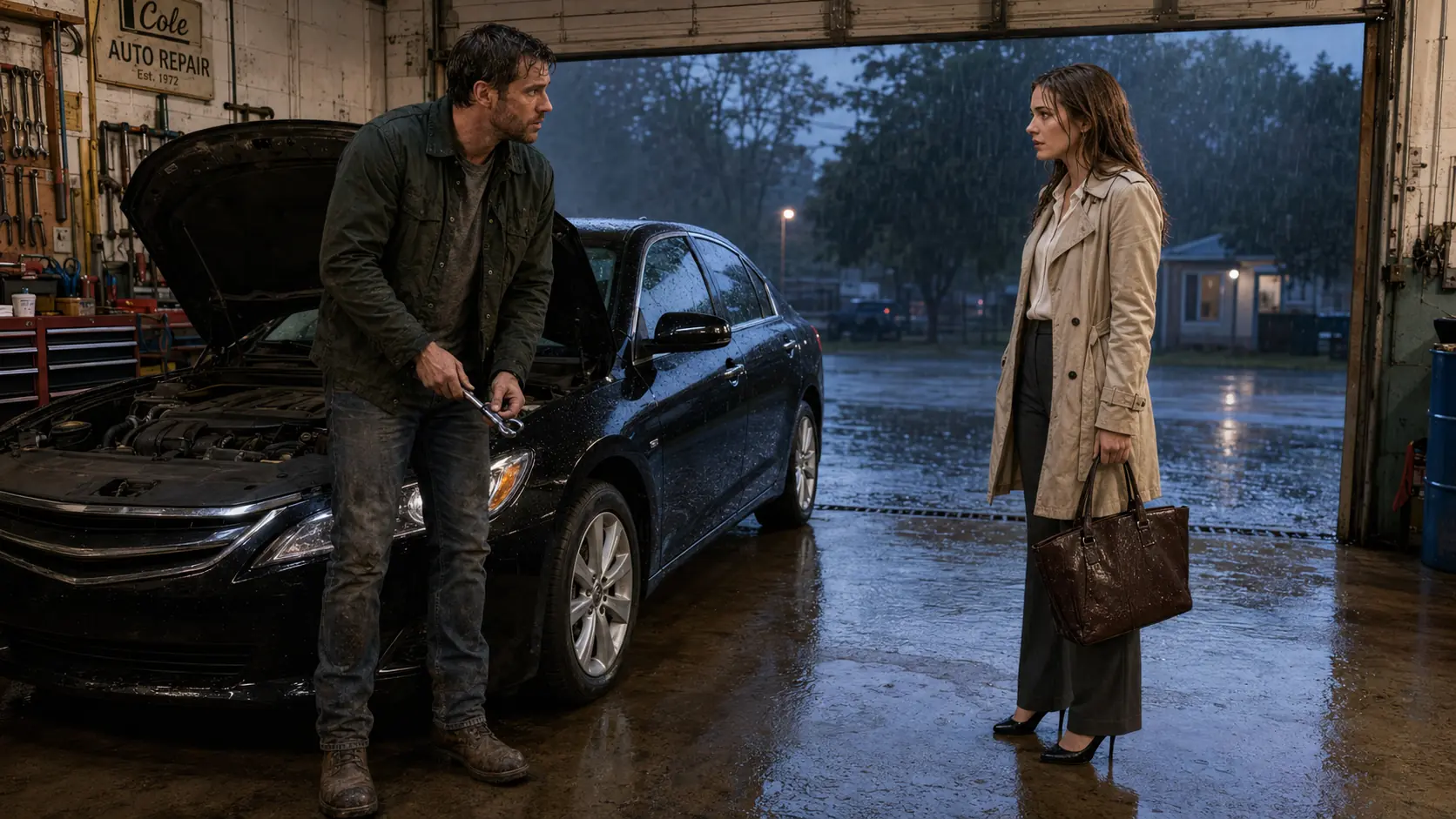
The floors creaked. The wiring was outdated. The old freight elevator groaned like an animal waking from hibernation. Dust coated the shelves where sacks of grain had once been stacked, and sunlight fell through high windows in pale squares.
Claire arrived each morning with coffee, notebooks, and a determination that impressed Nathan more than he wanted to admit.
She listened.
That surprised him most.
People with money often hired working people and then explained their own jobs to them. Claire didn’t. She asked questions, wrote down answers, and remembered details.
When Nathan said the rear delivery bay could be converted into a service entrance, she sketched it.
When he pointed out water damage near the south wall, she called a structural inspector the same day.
When he explained that the old boiler system was beyond saving, she didn’t argue just because replacement would cost more.
“You trust people who know what they’re talking about,” Nathan said one afternoon.
Claire looked up from her notes. “Isn’t that the point of hiring them?”
“You’d be surprised.”
“I’m surprised by people every day. Usually not in a good way.”
There was no bitterness in her voice.
Only experience.
Over time, Nathan learned pieces of her life.
Her father, William Whitmore, had built the company from nothing, then died suddenly from a heart attack eighteen months ago. Claire had inherited both his shares and his enemies. Investors who had smiled at her father now treated her like a temporary obstacle. Board members called her “bright” when they meant young, “passionate” when they meant emotional, and “ambitious” when they meant inconvenient.
She had been engaged once, briefly, to a man named Preston Vale, whose family had money in half the developments along the coast. The engagement ended when Claire realized Preston loved the idea of merging companies more than marrying her.
Nathan did not like Preston, though he had never met him.
Claire learned pieces of Nathan too.
That Hannah had died when Lily was four.
That Nathan had bought Miller’s Auto from his former boss using a loan, savings, and what he called “blind optimism.”
That he cooked pancakes every Saturday because Lily believed pancakes were a form of emotional medicine.
That he had not been on a date in three years, though Claire only learned this when Lily announced it during a building walkthrough.
“My dad doesn’t date,” Lily said cheerfully, stepping over a coil of extension cord.
Nathan froze.
Claire looked at him with raised eyebrows.
“Lily.”
“What? You don’t.”
“That’s not building-related.”
“It’s true-related.”
Claire pressed her lips together.
Nathan could see laughter in her eyes.
Lily continued, “Mrs. Alvarez says he should because he looks sad when he folds towels.”
Nathan closed his eyes. “Please stop helping.”
Claire finally laughed.
It was not the polite laugh from the roadside.
It was open, bright, and unguarded.
Nathan realized he wanted to hear it again.
That realization scared him.
So he became careful.
He kept conversations focused on work. He avoided looking too long when Claire tucked hair behind her ear. He ignored the way his chest tightened whenever she praised Lily’s drawings or remembered Nathan liked his coffee black with one sugar.
But love, or the beginning of it, rarely asks permission.
It arrived slowly.
In ordinary moments.
Claire sitting on the floor beside Lily, helping her glue fabric swatches into a tiny model room for the future lodge.
Nathan bringing Claire a sandwich when she forgot lunch for the third time that week.
Claire standing quietly beside him at the town council meeting while three local business owners accused her of trying to “turn Cedar Falls into a playground for rich tourists.”
Nathan speaking up, not loudly, but firmly.
“She’s hiring local,” he told the room. “She’s restoring a building nobody touched for eight years. She’s listening more than most people who’ve lived here their whole lives. Maybe give her a chance before you hang her for having a nicer coat.”
The room went quiet.
Claire stared at him afterward in the parking lot.
“You didn’t have to do that,” she said.
“I know.”
“They’ll gossip.”
“They already do.”
“About us?”
Nathan looked at her.
The air between them changed.
“Probably,” he said.
Claire’s eyes held his.
For one dangerous second, he thought she might say something that would change everything.
Instead, she looked away.
“I don’t want to make your life harder.”
“You’re not.”
“Nathan.”
He heard the warning in her voice.
Not because she didn’t feel something.
Because she did.
And she was afraid of it too.
He nodded once. “I should get Lily home.”
Claire swallowed, then nodded. “Of course.”
That night, Nathan stood in the kitchen washing dishes while Lily colored at the table.
“Dad,” she said.
“Yeah?”
“Do you like Miss Claire?”
Nathan nearly dropped a plate.
“She’s a client.”
“That’s not what I asked.”
He turned off the faucet.
Lily looked at him with Hannah’s serious eyes.
Nathan dried his hands slowly. “I think she’s a good person.”
“That means yes but scared.”
He stared at his daughter.
“Who taught you that?”
“Mrs. Alvarez watches romance movies loud.”
Nathan laughed despite himself.
Lily put down her crayon. “Mom would want you to smile more.”
The laughter left him gently.
He walked to the table and sat across from her.
“I smile.”
“Not the big one.”
Nathan looked at his daughter, at the missing tooth, the messy ponytail, the purple marker on her fingers.
He reached across and took her small hand.
“I loved your mom very much.”
“I know.”
“I still do.”
“I know that too.”
“And liking someone else doesn’t make that disappear.”
Lily nodded with the solemn wisdom only children seemed to carry. “Hearts can have more rooms.”
Nathan closed his eyes for a moment.
Then he smiled.
The big one.
The project almost died in April.
Claire’s board called an emergency meeting in Portland after Preston Vale made a formal offer to buy the Cedar Falls property and three other small-town holdings. The offer was high enough to tempt every impatient investor. If accepted, the feed store would be demolished and replaced by luxury storage units.
Claire drove to Portland that morning in a black company SUV, leaving Nathan with a folder of inspection notes and a bad feeling.
By noon, rumors had spread through town.
By two, the hardware store owner said the deal was already done.
By four, Nathan received a text from Claire.
They voted to sell.
He stared at the message in the shop until the words blurred.
Then another message came.
I’m sorry.
Nathan did not know whether she was apologizing for the building, the work, the hope, or whatever had been growing quietly between them.
Maybe all of it.
He called her.
She didn’t answer.
That evening, he drove past the feed store on his way home. The windows reflected the sunset. For the first time in weeks, the building looked abandoned again.
Lily was quiet at dinner.
“She didn’t win?” she asked.
“No.”
“Can grown-ups vote wrong?”
“All the time.”
“Can they fix it?”
Nathan thought of Claire, alone in some Portland boardroom, fighting people who had already decided she was too young to lead what her father built.
“Sometimes,” he said.
After Lily went to bed, Nathan sat at the kitchen table and opened the folder of inspection notes.
He had spent weeks inside that building. He knew every weakness, every repair, every possibility.
He also knew something Claire’s board didn’t.
The old feed store wasn’t just a property.
It was a story.
And stories could move people money couldn’t.
By midnight, Nathan had written a letter.
Not a polished proposal. Not a business document.
Just the truth.
He wrote about the building, about Cedar Falls, about the jobs the project could create, about the families who might gather in a restored hall instead of driving an hour to the nearest event space.
He wrote about William Whitmore, based on the stories Claire had shared, and how men who built things from nothing usually understood the value of places others overlooked.
Then he wrote about Claire.
He did not write that he was falling in love with her.
But it was there anyway.
In every line about her patience, her integrity, her refusal to treat people like numbers on a spreadsheet.
The next morning, he sent it to every local business owner he knew.
By afternoon, twenty-three people had signed it.
By evening, seventy-eight.
By the next day, the town council requested a public hearing before any demolition permits could be approved.
Someone posted the letter online.
Then a regional newspaper picked it up.
Then a business columnist wrote an article titled:
The CEO Fighting To Save Small Town Hospitality From Her Own Board.
Claire called Nathan at 9:17 that night.
He answered on the second ring.
For a moment, neither of them spoke.
Then Claire said, “You wrote that letter.”
Nathan leaned against the kitchen counter. “I did.”
“You had no right to make me sound that noble.”
“You had every right to be described accurately.”
Her breath shook through the phone.
“I was ready to quit,” she whispered.
Nathan’s chest tightened.
“Don’t.”
“I’m so tired.”
“I know.”
“They keep telling me I’m too emotional to run the company.”
“You’re not too emotional. You just still care what happens after the money clears.”
Silence.
Then Claire said, “Why did you do it?”
Nathan looked toward the hallway where Lily’s night-light glowed softly.
“Because someone once told me she needed people around her who still see people.”
Claire was quiet for a long time.
When she spoke again, her voice was different.
Gentler.
“Nathan, I don’t know what this is between us.”
His hand tightened around the phone.
“Neither do I.”
“I’m afraid of needing someone.”
“I’m afraid of letting someone in.”
“That sounds complicated.”
“It is.”
A soft laugh moved through the line, almost a sob.
“Maybe we don’t have to rush it,” Claire said.
Nathan closed his eyes.
“No,” he said. “We don’t.”
The public pressure worked.
Not immediately.
Nothing real ever moved that cleanly.
But investors began asking different questions. The board delayed the sale. Claire presented a revised plan with local support, lower renovation costs, and a phased opening strategy Nathan helped build from the practical side.
Three weeks later, the board voted again.
This time, Claire won by one vote.
The Dawson Feed Store would become The Whitmore House at Cedar Falls.
The town celebrated as if they had personally defeated an empire.
Nathan pretended not to notice when Claire cried quietly behind the building after the announcement.
He found her standing near the old loading dock, one hand pressed to her mouth, shoulders trembling.
He stopped a few feet away.
“You okay?”
She laughed through tears. “I won.”
“Looks like it.”
“I thought it would feel bigger.”
“It will tomorrow.”
She wiped her face quickly. “I hate crying at work.”
“You’re behind a feed store. Doesn’t count.”
She looked at him.
Then she stepped forward and hugged him.
Nathan froze for half a second.
Then his arms came around her.
She fit against him like something he had been missing without having words for it.
But he did not kiss her.
Not then.
Because she was emotional, and he respected her too much to turn gratitude into something else.
Claire seemed to understand.
When she pulled back, her eyes searched his face.
“Thank you,” she whispered.
Nathan smiled softly. “You already said that.”
“I’ll probably say it again.”
The renovation took seven months.
During that time, Nathan’s life changed in ways both visible and quiet.
His shop got busier after the newspaper article mentioned him. People came from two towns over, saying they wanted the mechanic who had helped save the old feed store.
Claire hired him officially as a local operations consultant for the building’s mechanical restoration, which sounded ridiculous enough that Lily made him a paper badge reading IMPORTANT BUILDING GUY.
He framed it in the shop office.
Claire became part of their routine slowly.
She came for Saturday pancakes once, then again, then often enough that Lily set out three plates without asking.
She and Nathan took walks after work, sometimes with Lily skipping ahead, sometimes alone when Mrs. Alvarez insisted she needed “grandmother practice” and took Lily for the evening.
They talked about Hannah.
Not all at once.
Nathan told Claire about the woman he had married at twenty-four, the nurse who sang off-key while cooking, the mother who cried the first time Lily laughed.
Claire listened without jealousy.
That mattered.
One evening, sitting on a bench outside the half-renovated building, Claire said, “I don’t want to replace her.”
Nathan looked at her. “You couldn’t.”
“I know.”
He turned toward her.
“But you don’t make me feel like I’m losing her by being happy.”
Claire’s eyes filled, but she smiled.
“That might be the most beautiful thing anyone has ever said to me.”
He looked down, embarrassed. “I’m better with engines.”
“No,” she said. “You’re better with hearts than you think.”
Still, they moved slowly.
No dramatic confession.
No sudden promise.
Just hands brushing.
Then holding.
A kiss on Claire’s cheek after a long day.
Then, one cool September evening, their first real kiss beneath the restored sign of The Whitmore House, with the windows glowing behind them and the smell of fresh paint in the air.
It was quiet.
Tender.
A beginning, not an ending.
Lily found out the next morning because Nathan burned the pancakes.
“You kissed her,” she said immediately.
Nathan turned from the smoking pan. “How do you know that?”
“You’re smiling weird.”
Claire, sitting at the kitchen table, covered her face with both hands.
Lily grinned. “Finally.”
The grand opening of The Whitmore House at Cedar Falls happened in November.
The old feed store had become something almost magical, though Nathan would never use that word out loud.
The downstairs café had long wooden tables made by a local carpenter, shelves filled with pottery from a woman outside town, and a counter that served apple cake from the diner’s original recipe.
Upstairs, six guest rooms held iron beds, handmade quilts, and windows overlooking Main Street.
The event hall in the back had polished floors and soft white walls covered with old photographs of Cedar Falls.
Above the front desk hung a framed black-and-white picture of William Whitmore standing in front of his first inn, smiling beside a sign he had painted himself.
Claire stood near the entrance greeting guests, elegant in a forest-green dress, her brown hair swept back, her smile calm but emotional.
Nathan watched from across the room with Lily beside him.
“She looks like a queen,” Lily whispered.
“She does.”
“Are you going to marry her?”
Nathan choked on his coffee.
“Lily.”
“What? Too soon?”
“Yes.”
“How soon is not too soon?”
“Go eat cake.”
Lily shrugged and ran off.
Claire crossed the room toward him, her eyes bright.
“What did she ask?”
“Nothing dangerous.”
“So marriage.”
Nathan stared at her.
Claire laughed. “She asked me last week.”
“Of course she did.”
The laughter between them was easy now.
But then Claire took his hand.
“I need to show you something.”
She led him upstairs to the second floor, down a hallway still quiet before guests were allowed up. At the end was a door Nathan had assumed led to storage.
Claire unlocked it.
Inside was a small office overlooking Main Street.
There was a desk, two chairs, built-in shelves, and a brass plaque mounted on the wall.
Nathan stepped closer.
The plaque read:
Nathan Cole Community Workshop
For The Man Who Helped Build More Than He Repaired
He stared at it.
Claire stood beside him, nervous for the first time that day.
“This space is for you,” she said. “Not to leave your shop. I know how much that means to you. But for weekend classes, youth repair programs, apprenticeship meetings. You told me once you wished kids had more places to learn practical skills before life got expensive. So now they do.”
Nathan couldn’t speak.
Claire continued quickly, “The company will fund the first three years. Tools, materials, insurance. You can run it however you want. And if you hate it, we can change—”
He turned and pulled her into his arms.
She stopped talking.
For a long moment, he just held her.
He thought about the night on Route 16, the broken umbrella, the rain, the choice he almost didn’t make because he was tired and late and already carrying too much.
He had thought he was helping a stranded woman.
He had not known he was opening a door.
Not just for Claire.
For himself.
For Lily.
For a future he had been too afraid to imagine.
Claire leaned back enough to look at him.
“Is it too much?”
Nathan shook his head.
“It’s the first thing in a long time that feels like more.”
Her eyes softened.
“I love you,” she said.
The words were quiet.
Not rushed.
Not desperate.
They had taken months to arrive, and because of that, they felt steady.
Nathan touched her face gently.
“I love you too.”
Claire smiled through tears.
Downstairs, the crowd applauded as the mayor began his speech, unaware that something more important had just happened above them.
Nathan kissed Claire softly.
When they returned downstairs, Lily looked at their faces and immediately shouted, “I knew it!”
Half the room turned.
Claire laughed.
Nathan covered his eyes.
And for the first time in years, he did not feel embarrassed by happiness.
One year later, The Whitmore House had become the heart of Cedar Falls.
Travelers came for the restored rooms and stayed for the town. Local teenagers filled Nathan’s weekend workshops, learning to change oil, repair old bicycles, fix small engines, and believe their hands could build futures.
Claire’s company changed too.
After the success of Cedar Falls, she shifted Whitmore Hospitality back toward her father’s original vision: smaller properties, real communities, slower growth, stronger roots.
Some board members resigned.
Claire did not miss them.
On a bright spring afternoon, Nathan stood outside the workshop helping a fourteen-year-old boy rebuild a carburetor while Lily sat nearby doing homework at a picnic table.
Claire arrived carrying lemonade and wearing a pale blue dress under a cream cardigan, her hair loose in the breeze.
She paused in the doorway, watching them.
Nathan looked up and smiled.
The big one.
The one Lily had once said he had lost.
Later, after the students left, Claire sat beside him on the steps of The Whitmore House.
Lily was inside helping the café owner arrange muffins, which mostly meant eating the broken ones.
Claire rested her head against Nathan’s shoulder.
“Do you ever think about that night?” she asked.
“The rain?”
“Mhm.”
Nathan looked toward Main Street, where the restored sign swung gently in the wind.
“All the time.”
“You could have gone home.”
“I almost did.”
“I’m glad you didn’t.”
He took her hand.
“So am I.”
Claire smiled. “You fixed my car.”
Nathan looked at the building, the workshop, his daughter laughing inside, the woman beside him.
“No,” he said softly. “I think you fixed something too.”
Claire looked up at him.
He kissed her forehead.
And the life Nathan Cole thought had ended in grief opened wider than he ever expected.
Not all at once.
Not like lightning.
But slowly.
Like morning finding its way through rain clouds.
Like an old building becoming beautiful again.
Like two careful hearts learning that love did not have to erase the past to make room for tomorrow.