The woman’s car sat steaming on the shoulder like a wounded animal, its hood raised in surrender to the July heat.
I pulled my rust-eaten pickup behind her car, easing onto the gravel with a sound that made the old frame groan beneath me. 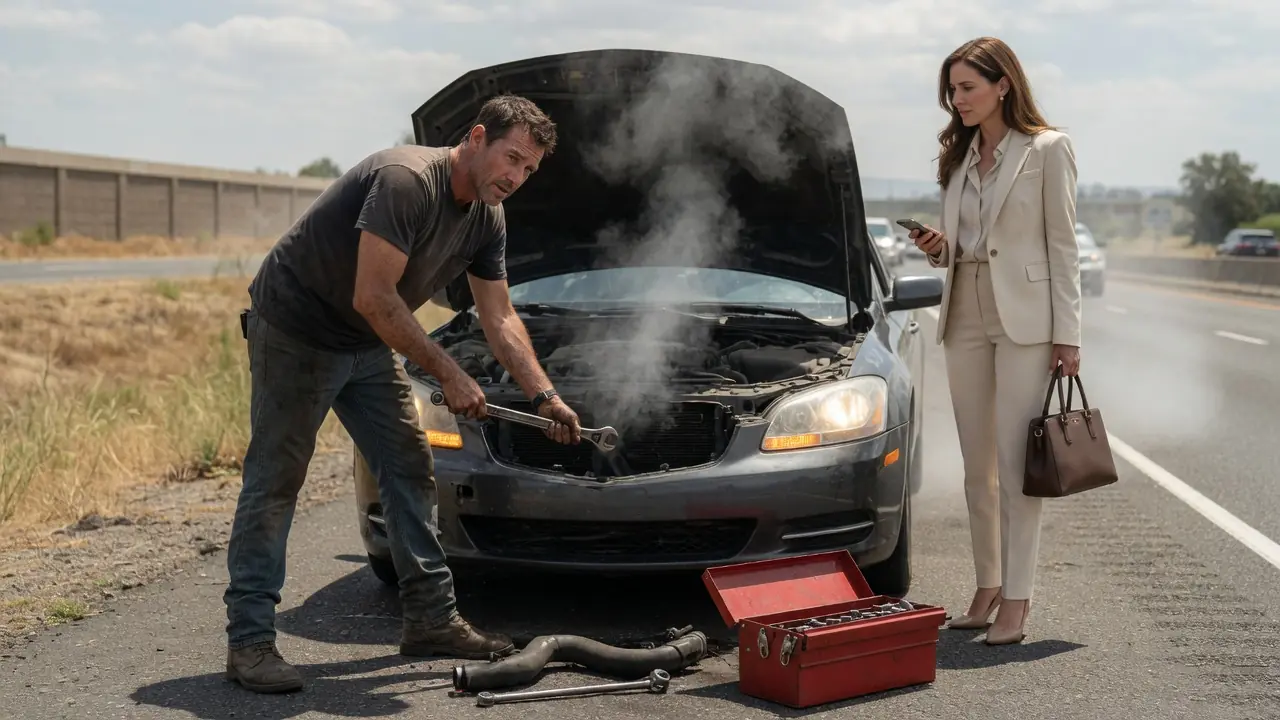
The hazard lights blinked their quiet warning to the world, orange flashes pulsing against the shimmer rising off the asphalt.
It was the kind of afternoon that made the whole highway look half melted.
Heat rolled off the road in waves. Cicadas screamed from the trees beyond the guardrail. Somewhere far ahead, eighteen-wheelers roared toward Nashville, their tires humming over the pavement like distant thunder.
Through my windshield, I watched the woman pace beside the BMW.
She wore designer heels that had no business on cracked asphalt. Her cream-colored suit looked sharp enough to belong in a boardroom, not on the side of a two-lane highway outside town. Her phone was pressed to her ear with the desperate grip of someone whose perfect world had tilted sideways and refused to tilt back.
Even from twenty yards away, I could tell she was not used to being helpless.
Some people panic loudly.
She panicked with control.
Her posture stayed straight. Her voice remained tight and polished. But her free hand kept opening and closing at her side, and every few seconds, she glanced at the engine as if sheer disappointment might shame it into working again.
The BMW gave another hiss of steam.
I recognized that sound.
A cooling system giving up.
A car saying enough.
“Stay in the truck, buddy,” I told my seven-year-old son, Marcus Jr., who was already unbuckling his seat belt with the eager curiosity that made him equal parts blessing and heart attack waiting to happen. “Daddy’s just going to help this lady real quick. Then we’ll get those groceries home before the ice cream turns into soup.”
Marcus pressed his nose against the passenger window, fogging the glass with his breath.
“Her car’s sick, isn’t it, Dad?”
“Looks that way.”
“Can you fix it?”
“I can try.”
“You can fix anything.”
I smiled before I opened the door.
That kind of faith should have made me feel powerful. Most days, it scared me.
To my son, I was the man who fixed broken lamps, leaking faucets, stalled engines, loose cabinet doors, and the old washing machine that banged around during the spin cycle like it was trying to escape the house.
To the mortgage company, I was account number 4178-22B, three months delinquent.
To the utility company, I was final notice.
To the clients who still called when they needed cheap electrical work, I was reliable, if available, assuming no one underbid me.
To myself, on the mornings when I looked in the mirror before sunrise, I was a tired forty-year-old widower trying to keep one little boy’s world from collapsing.
I stepped down from the truck and grabbed my toolbox from the bed.
The metal handle was hot from the sun. My palm knew its weight better than it knew rest.
Twenty-three years of fixing things had taught me that broken usually meant fixable, if you were patient enough to understand why something had stopped working in the first place.
Cars.
Washing machines.
Leaky pipes.
Faulty outlets.
Engines that overheated.
Switches that sparked.
They all had reasons.
People were harder.
People did not always show you where the crack was.
The woman ended her phone call with a sharp jab of her finger just as I approached. Up close, I could see more than the suit and heels. Fine lines around her eyes. A small tremor at the edge of her mouth. Makeup applied with precision over exhaustion it could not fully hide.
Expensive china with hairline cracks.
“I’m sorry,” she said quickly, before I could speak. Her voice was crisp, trained, the kind of voice that probably made conference rooms go quiet. “I don’t need assistance. I’ve already called for roadside service.”
I nodded toward the steaming engine.
“Ma’am, with respect, you’re going to be waiting a while out here. Sunday afternoon, July heat, half the county overheating on the highway. AAA’s going to be backed up.”
Her eyes flicked over me.
My grease-stained T-shirt advertised an auto shop that had closed two years ago. My jeans had dark marks at the knees. My boots were scuffed, and my pickup behind me had rust along both wheel wells. In the passenger seat, Marcus waved enthusiastically through the glass.
I watched her calculate.
People did that when they first met me.
Not always unkindly.
Just quickly.
Truck.
Clothes.
Hands.
Kid.
Stranger.
Risk.
“I don’t want to trouble you,” she said.
“You’re already in trouble. I’m just offering to make it smaller.” I set my toolbox down. “Mind if I take a look? Won’t cost you anything.”
The BMW hissed again, like it was arguing on my behalf.
She looked at the engine.
Then at the empty stretch of highway.
Then at me.
“I suppose,” she said finally. “If you think you can help.”
“I’ll tell you what I can tell.”
She stepped back, heels clicking against the asphalt.
“I’m Catherine Westbrook.”
The name tugged at something in the back of my mind.
Not recognition exactly.
More like a headline I had passed over in a newspaper. A name from a business article. A sign on a building downtown.
I nodded.
“Marcus Thompson.”
Then I pointed back at the truck.
“That’s Marcus Jr. He’s the one with the opinions.”
Catherine glanced at my son, who was now making both hands wave as if guiding a plane onto a runway.
For the first time, the hard edge of her expression softened.
“He seems very interested.”
“He thinks every breakdown is a medical emergency.”
“Well,” she said, looking at the steam, “he may not be wrong.”
I leaned under the hood.
The familiar smell hit me first.
Hot metal.
Antifreeze.
Burned coolant.
A stressed engine sitting under an unforgiving sun.
I traced the source quickly. The radiator hose had split near the clamp, a clean tear that had opened under pressure. Green coolant pooled beneath the car like strange blood.
“When’s the last time you had this serviced?” I asked.
Catherine shifted her weight.
“I honestly don’t know.”
There was embarrassment in her voice.
“My assistant handles things like that. I drive it. Someone else maintains it. That’s how it’s always been.”
I nodded.
Not judgment.
Just information.
“Good news is, it’s fixable. Bad news is, you’re not driving anywhere with that hose split. Even if I patched it, you’d overheat again in five minutes.”
Her phone buzzed.
She looked at the screen and closed her eyes for half a second before answering.
“James, I know. I understand the implications. I’m literally stranded on the side of the highway.”
She listened.
Her jaw tightened.
“Yes, I’m aware of the Morrison account. Yes, I’m aware of the deadline. I said I’ll be there somehow.”
She hung up.
The executive mask cracked just enough for me to see the person underneath.
“This day is becoming impossible,” she said quietly.
“Where do you need to be?”
“The Grand View Hotel downtown.”
I glanced at the sun, then at the road.
“I can give you a ride.”
She stared at me.
“You would do that?”
“You’re stuck.”
“I’m a complete stranger.”
“My dad always said you help people when they’re stuck. Doesn’t matter if you know them. Stuck is stuck.”
Catherine looked at me for a long moment.
That sentence did something to her. I saw it in her face. Like a key turning in a lock she had forgotten was there.
“My suitcase is in the back seat,” she said.
“I’ll get it.”
She hesitated.
“I can pay you.”
“No, ma’am.”
“Please don’t do that.”
“Do what?”
“Help me and then make me feel ridiculous for wanting to repay you.”
That surprised me.
She said it without arrogance. More like honesty from someone who had spent too long in a world where every favor came with a receipt.
“I’m not trying to make you feel ridiculous,” I said. “I just don’t want money for helping somebody off the side of the road.”
“I’m not used to that.”
“I can tell.”
For a second, she almost smiled.
I loaded her suitcase into the bed of my truck, then helped her lock the BMW. The car looked strange there on the shoulder, sleek and expensive and temporarily useless.
The highway did not care what something cost once it broke.
Inside my pickup, Marcus sat up straighter as Catherine climbed into the passenger seat. He had moved his booster seat to the back earlier that summer, and he now considered himself mature enough to welcome guests like a host.
“Hi,” he said. “I’m Marcus, but Dad says you can call me MJ if you want. Only Grandma calls me Marcus Jr. when I’m in trouble.”
Catherine buckled her seat belt carefully.
“Nice to meet you, MJ. I’m Catherine.”
“Is your car going to die?”
“Marcus,” I said.
“What? I’m asking because I care.”
Catherine laughed.
Not a polite laugh.
A real one, sudden and startled.
“No,” she said. “Your father thinks it can be saved.”
“He can save anything.”
I pulled onto the road.
“Buddy, don’t oversell me.”
“I’m not. You fixed Mrs. Patterson’s porch light. And the washing machine. And the sink. And my space shuttle control panel.”
Catherine turned slightly.
“Space shuttle control panel?”
“I’m building a rocket ship out of cardboard boxes,” Marcus explained. “It’s going to have real lights and switches because Dad has electrical stuff.”
“Sounds advanced.”
“It is. It’s going to the moon first. Then Mars. Then maybe a planet where people can go if they need a new home.”
Catherine’s face changed at that.
Not much.
But enough that I noticed.
“A new home,” she repeated.
“Yeah,” Marcus said. “Like if their old home gets broken.”
The truck cab went quiet for a moment.
I looked at Catherine in the rearview mirror. She was watching my son with an expression I could not name.
Tenderness.
Regret.
Maybe both.
The drive downtown took forty minutes.
Marcus filled most of it with commentary. He pointed out the park where we fed ducks on Saturdays, the library where story time happened, the pizza place that gave free breadsticks for good report cards, the gas station where the clerk let him choose a lollipop when I bought coffee after church.
Catherine listened like every detail mattered.
Not the fake listening adults sometimes give children, all nods and empty smiles. She asked questions. She remembered answers. When Marcus explained that the rocket ship needed three emergency buttons because “space is dangerous,” she asked what each button did.
He lit up like a Christmas tree.
People underestimated how little it took to make a child feel important.
When we reached the Grand View Hotel, my pickup looked painfully out of place.
The hotel rose from the downtown skyline like a monument to money. Marble columns. Glass doors. Doormen in dark uniforms. Valet parking. Planters full of flowers that probably had a maintenance budget larger than my grocery bill.
I pulled up to the curb and put on the hazards.
Marcus pressed his face to the window.
“Do you live here?”
Catherine smiled.
“No. I’m just staying here for business.”
“It looks like a castle.”
“Sometimes castles are less fun than they look.”
I got out and lifted her suitcase from the truck bed. The doorman looked at my pickup, then at me, then at Catherine, and quickly adjusted his face into professionalism.
Catherine reached for her purse.
“Marcus, please. Let me at least pay for gas.”
“No, ma’am.”
“You really are stubborn.”
“My wife used to say the same thing.”
The words came out before I could stop them.
Catherine’s face softened.
“Your wife?”
“Lisa. She passed two years ago.”
“I’m sorry.”
“Me too.”
Marcus leaned out the back window.
“My mom was the best at pancakes,” he said.
My throat tightened.
Catherine bent slightly toward him.
“I bet she was.”
“She put cinnamon in them, but Dad always forgets.”
“I do not always forget.”
Marcus gave Catherine a look that clearly said he always forgets.
She smiled.
That smile was different from the boardroom smile I had seen on her face when we first met. This one reached her eyes.
“MJ,” she said, “thank you for sharing your dad with me today.”
“You can come see my rocket ship when it’s done.”
“I’d like that very much.”
She turned back to me.
“Marcus Senior, I can’t thank you enough.”
“It was nothing.”
“No,” she said softly. “That’s exactly the kind of thing people say when it was something.”
I did not know how to answer.
She studied me one last time, as if memorizing details.
Then she walked through the hotel doors and disappeared into light, marble, and polished glass.
On the drive home, Marcus was unusually quiet.
That never lasted long.
“Dad?”
“Yeah, buddy?”
“Why did she look sad?”
I kept my eyes on the road.
“Sometimes grown-ups carry heavy things.”
“Like boxes?”
“Not boxes.”
“Like when you miss Mom but try not to cry because you think I’ll get scared?”
There were days when fatherhood felt like being seen too clearly by someone too small to carry what they saw.
“Something like that,” I said.
“Do you think we helped her?”
I thought about Catherine laughing in my truck. About the way she had repeated Marcus’s words. A new home. About how she had stood at the hotel entrance looking less certain than she had on the highway.
“Maybe a little.”
Marcus nodded.
“Good. Mom said helping counts even if it’s little.”
I gripped the steering wheel.
“She was right.”
That night, after Marcus was asleep with his rocket ship drawings spread across his pillow, I sat alone at the kitchen table.
The grocery bags had been put away. The ice cream survived, barely. The house was quiet except for the hum of the refrigerator and the occasional creak of old wood settling in the heat.
A stack of bills sat in front of me.
Mortgage notice on top.
Final notice.
Thirty days to bring the account current or foreclosure proceedings could begin.
The red letters looked louder than words should be allowed to look.
I had been dancing around disaster for months.
Juggling payments. Fixing one leak while three more opened. Taking small electrical jobs from anyone who would call. Charging less than I should because big contractors underbid me on anything large enough to matter.
Before Lisa got sick, Thompson Electrical had been solid.
Not huge.
But solid.
Three employees. Builder contracts. Residential jobs. Service calls. A reputation for fair pricing and clean work.
Then cancer walked into our house and ate the calendar first.
Appointments.
Treatments.
Lab work.
Hospital stays.
Calls from doctors.
Calls from insurance.
Calls from billing departments that used soft voices while delivering hard numbers.
I started missing jobs. Turning down contracts. Losing workers. Losing clients. Losing sleep.
Lisa fought for three years.
Medical bills fought harder.
By the time she was gone, our savings were gone too. The life insurance barely covered the funeral. I kept the house because I could not bear the thought of taking from Marcus the last physical place where his mother had lived.
Every room held her.
The kitchen where she taught me her grandmother’s pancake recipe.
The living room where we danced badly to old jazz records.
The hallway where Marcus took his first steps.
The porch where Lisa and I used to sit after putting him to bed, talking about vacations we never took and retirement we were too young to understand.
Sentiment does not lower a mortgage payment.
I tapped numbers into the calculator.
Same result.
Still short.
Always short.
My phone rang at 9:15.
Unknown number.
I almost ignored it.
Unknown numbers were usually collectors or companies pretending to offer help while circling like buzzards.
But I answered.
“Hello?”
“Mr. Thompson?”
Catherine’s voice.
I sat straighter.
“This is Catherine Westbrook. I hope I’m not calling too late.”
“No, ma’am. Is everything all right? Your car?”
“The car will be fine. This is not about the car.”
Something in her voice made me still.
Softer.
Less polished.
“I’ve been thinking about what happened today,” she continued. “About what you did.”
“It wasn’t much.”
“Please don’t say that.”
I looked at the mortgage notice.
“Sorry.”
“I spent the evening in meetings with people who wanted things from me. Access. Approval. Advantage. They smiled because it benefited them. They offered help because help was leverage.”
She paused.
“What you did today was different. You had nothing to gain.”
“I had my son watching.”
“That matters?”
“It matters more than anything.”
Catherine was quiet.
Then she said, “I did some research after we parted ways.”
My stomach tightened.
“What kind of research?”
“Thompson Electrical. Your business. Your wife’s illness. Your mortgage.”
The chair under me seemed to shift.
“Ms. Westbrook—”
“Catherine.”
“How did you know about my mortgage?”
“I know because Westbrook Financial holds it.”
The words hit like a blow.
For a moment, I could not breathe.
Westbrook Financial.
The name from the letters.
The name printed at the top of the final notice in front of me.
My hand tightened around the phone.
“You’re the company foreclosing on my house.”
“No,” she said quickly. “Not yet. But yes, your mortgage is in our portfolio. We purchased a group of residential loans from Hometown Bank six months ago. Yours was among them.”
I pushed back from the table.
The room suddenly felt too small.
“So today was a setup?”
“No.”
“Your car breaks down beside the road, I stop, and now you just happen to know everything about my life?”
“Marcus, the breakdown was real. I had no idea who you were when you stopped. I didn’t connect your name to the file until tonight.”
I did not speak.
She continued, carefully.
“I was reviewing distressed accounts before my meeting tomorrow. Your file was already on my list.”
The red letters on the notice seemed to burn.
“What list?”
“Foreclosure review.”
A cold feeling moved through my body.
Marcus was asleep down the hall.
His rocket ship drawing on his pillow.
His mother’s photo on his nightstand.
The house around me full of memories that a company could turn into paperwork by morning.
Catherine’s voice lowered.
“I was going to authorize the foreclosure process tomorrow.”
I closed my eyes.
There it was.
The thing I had feared for months, spoken calmly by the woman whose car I had fixed because my father raised me to stop for strangers.
“Why are you telling me this?”
“Because after today, I couldn’t sign it.”
Silence filled the kitchen.
Outside, a dog barked somewhere down the street.
The refrigerator hummed.
Catherine said, “Tell me about your business.”
“What?”
“Not the file. I’ve read the file. Tell me what you do.”
“I fix things.”
“I know that part.”
“No, you know the numbers. That’s not the same thing.”
I looked at my hands.
Grease in the cracks.
Small cuts along the knuckles.
A burn scar near my thumb from a panel that should have been shut off and wasn’t.
“I started helping my dad when I was twelve. Wiring houses. Crawling through attics. Learning which old homes lied about their age by the smell of the insulation.”
A small laugh escaped her.
I kept going.
“Went to trade school. Worked for contractors. Got licensed. Started Thompson Electrical because I got tired of watching people get overcharged for simple fixes. Built it slowly. Did good work. Had three guys working with me before Lisa got sick.”
“What changed?”
“Everything.”
The word came out flat.
“Cancer doesn’t ask if you have jobs scheduled. It doesn’t care about invoices or payroll. Some weeks I spent more time in hospital waiting rooms than on job sites. My guys needed steady pay, and I couldn’t blame them for leaving. Builders moved on. Clients found someone else.”
“And after she passed?”
“After she passed, I was a widower with debt, no savings, half a business, and a seven-year-old who still asked when Mom was coming home.”
Catherine said nothing.
“I could have declared bankruptcy,” I said. “People told me to. Walk away from the debt. Sell the house. Start somewhere smaller. Cleaner. Cheaper.”
“Why didn’t you?”
I looked around the kitchen.
Lisa’s blue coffee mug still in the dish rack because I had never found the strength to put it away. Marcus’s school pictures on the fridge. The little pencil mark on the doorway showing how tall he was the summer before she died.
“This is our home,” I said. “It’s where his mother lived. Where he learned to walk. Where every memory of her still has a place to sit. He already lost her. I couldn’t take this from him too.”
When Catherine spoke again, her voice had changed.
“Do you know what I was doing when my car broke down today?”
“You said a site visit.”
“Yes. A housing development called Birch Hollow. Forty-three homes. Forty-three families. The builder collapsed under lawsuits after cutting corners. Foundations cracked. Drainage failed. The mortgages were bundled and sold. Westbrook Financial bought the portfolio at a discount.”
I listened.
“I toured the properties this morning,” she said. “I saw children’s bicycles in driveways. A veteran sitting on his porch with a cane. A woman carrying groceries from an old minivan with two toddlers behind her. I saw all of that and still drove away planning to finalize foreclosure because the numbers made sense.”
Her breath caught slightly.
“The numbers made sense.”
I knew that tone.
A person hearing herself too clearly.
“I was supposed to meet with lawyers tonight to authorize the process,” she continued. “Westbrook would recoup most of the investment by selling the land to a commercial developer. Clean. Profitable. Legal.”
“Supposed to?”
“I cancelled the meeting.”
I sat back.
“Because of a radiator hose?”
“Because of your son.”
My throat tightened.
“Marcus?”
“He sat in your truck and told me his father could fix anything. He told me you helped Mrs. Patterson even though she couldn’t pay you. He told me when somebody needs help, you help if you can, even if they can’t help you back.”
She paused.
“Then he told me his rocket ship was going to find new planets for people who needed a new home because their old one got broken.”
I looked down at the mortgage notice.
“I had forty-three broken homes in a folder,” Catherine said quietly. “And I was about to break them further.”
Neither of us spoke for a long moment.
“What happens to my house?” I asked.
“Nothing,” she said.
I closed my eyes.
“Nothing?”
“Your mortgage is being restructured. Late fees forgiven. Penalties removed. Payment reduced. Term extended. No foreclosure.”
My hand shook around the phone.
“I can’t accept charity.”
“It is not charity.”
“It sounds like charity.”
“It is correction.”
That word stopped me.
“Correction?”
“Yes,” she said. “Of a system that looked at your file and saw delinquency instead of context. A widower instead of a risk category. A father instead of an account.”
I swallowed hard.
“I don’t know what to say.”
“You don’t have to say anything tonight.”
“But why me?”
“Because you stopped.”
Her answer came immediately.
“Because when I was stranded, you did not ask whether helping me was profitable. You did not ask whether I deserved it. You did not ask whether my inconvenience was my fault. You helped because I was stuck.”
The tears came before I was ready.
Silent.
Hot.
Humiliating.
I pressed the heel of my hand against my eyes.
Catherine kept talking, softer now.
“And Birch Hollow will not be foreclosed either. We’re restructuring those loans and partnering with a nonprofit to repair the worst foundation and drainage problems. It will cost us money short-term.”
She paused.
“But I think I may have been measuring loss wrong.”
I could not speak.
Catherine did not rush me.
When I finally found words, they were broken.
“My son gets to stay in his mother’s house?”
“Yes.”
“Thank you.”
“No,” she said. “Thank you.”
Two days later, I was under the hood of Catherine’s BMW in my driveway, installing the new radiator hose while Marcus sat on the tailgate holding a flashlight he absolutely did not need to hold in broad daylight.
“Dad says every repair needs a supervisor,” he told Catherine.
Catherine wore jeans and a simple blue sweater instead of a cream suit. Without the corporate armor, she looked younger and more tired, but also more human.
“I see,” she said seriously. “And you are the supervisor?”
“I’m the assistant supervisor.”
“Who’s the main supervisor?”
“Dad. But I’m almost ready for promotion.”
I tightened the clamp and shook my head.
“Promotion pending behavior review.”
Marcus gasped.
“Rude.”
Catherine laughed.
The BMW repair took thirty minutes. A simple hose, fresh coolant, a pressure check. Nothing dramatic.
I closed the hood.
“She’s good.”
Catherine started the engine, listened, then shut it off.
“How much?”
I named my regular hourly rate and the cost of the part.
She handed me a check.
I looked at it.
“This is too much.”
“It includes the roadside diagnosis, towing coordination you refused to charge for, and inconvenience.”
“I didn’t tow anything.”
“You coordinated emotionally.”
I looked at her.
She smiled.
“Just take the check, Marcus.”
I took it because I was learning, slowly, that refusing every good thing was not dignity. Sometimes it was fear wearing work boots.
Marcus ran inside to get his rocket ship drawings.
He returned with a stack of cardboard plans, crayon diagrams, and one folded piece of poster board labeled MISSION HOMEFINDER in large uneven letters.
Catherine sat in the grass while he explained everything.
The rocket had five buttons.
Red for emergency launch.
Blue for snacks.
Green for landing.
Yellow for “finding planets where people are nice.”
Purple for calling Dad.
Catherine studied the drawings with the seriousness of an engineer reviewing launch systems.
“This mission matters,” she said.
Marcus nodded.
“It’s for people who need somewhere safe.”
She looked at me over his head.
The understanding between us was quiet.
That evening, for the first time in months, I sat at the kitchen table without a stack of bills in front of me.
The mortgage notice was gone.
In its place sat the new agreement, numbers I could actually meet, a payment schedule that did not feel like a threat.
But more than that, there were three business cards Catherine had left.
One belonged to a contractor who managed renovation work for Westbrook properties.
One belonged to a nonprofit director coordinating repairs at Birch Hollow.
One belonged to Catherine’s assistant, with a note written on the back:
For Thompson Electrical scheduling.
She had not only saved my house.
She had opened doors for my business.
The first call came the following week.
A repair contract at Birch Hollow.
Then another.
Then a small renovation job.
Then electrical inspections for homes that needed safe wiring before families could refinance.
I hired my old employee Ray back part-time.
Then full-time.
Then another man named Curtis who needed work after his roofing job disappeared.
Six months later, Thompson Electrical had three trucks again.
Not fancy.
Not new.
But running.
Marcus drew our new logo.
It was terrible.
I used it anyway on the office wall.
Catherine stayed in our lives, though not in the way people might imagine.
This was not some fairy tale where the rich woman fell instantly in love with the poor widower because he fixed a hose. Life is more complicated than that.
But she came by sometimes.
For coffee on the porch.
For updates on Birch Hollow.
For rocket ship inspections.
The first time she joined us for Saturday pancakes, Marcus stood on a chair and announced that Dad forgets the cinnamon, but today he will not because we have a guest.
Lisa would have laughed until she cried.
I put cinnamon in the batter.
Catherine took one bite and closed her eyes.
“These are wonderful.”
“Mom’s recipe,” Marcus said.
Then, softer, “Dad makes them now.”
Catherine looked at me.
I looked away first.
Some grief is private even when shared.
Birch Hollow changed slowly.
Not all at once.
Foundations were repaired. Drainage systems fixed. Loan terms rewritten. Families stayed. Kids kept their schools. A veteran named Mr. Alvarez kept his porch. A single mother named Tessa kept the bedroom her twins had painted yellow.
Westbrook Financial took a financial loss that quarter.
The shareholders grumbled.
The board pushed back.
Catherine stood in front of them with charts, files, and a calm expression that hid steel.
She showed them long-term return projections.
Community stabilization data.
Reputation value.
Default reduction after structural repairs.
But later, she told me the real reason.
“I was tired of defending profitable cruelty with clean language.”
I thought about that for a long time.
A year after the roadside breakdown, Catherine invited Marcus and me to Birch Hollow for a community cookout.
I almost did not go.
I did not like crowds where people might call me a hero for doing paid electrical work on houses that should have been safe from the beginning.
But Marcus wanted to bring the rocket ship.
So we went.
He had upgraded it by then. The cardboard was reinforced with duct tape and painted silver. The lights actually worked. The buttons were labeled in his careful handwriting.
Kids from Birch Hollow gathered around it immediately.
Marcus became mission commander.
Catherine stood beside me near the picnic tables, watching him explain the snack button to two younger children.
“He gave me that idea,” she said.
“Who?”
“Your son.”
I looked at her.
“New homes. Safe places. A mission.”
She nodded toward the neighborhood.
“That was his language before it became mine.”
I watched Marcus laugh as one of the little girls pressed the blue snack button and demanded cookies.
“He misses his mother,” I said quietly. “But sometimes I think he carries her forward better than I do.”
“How?”
“Lisa believed kindness was practical. Not soft. Practical. Like food. Like electricity. Like a ride when someone is stranded.”
Catherine smiled faintly.
“She sounds remarkable.”
“She was.”
We stood there for a while, listening to the sounds of children, neighbors, music from a portable speaker, and someone arguing over whether burgers needed more salt.
A woman approached with two plates of food.
Tessa, the single mother with twins.
She handed one to me.
“Mr. Thompson, you fixed the wiring in my kitchen.”
“Yes, ma’am.”
“My kids can sleep without that burning smell in the walls now.”
I nodded.
“I’m glad.”
She looked at Catherine.
“And I don’t know all the business reasons you decided what you decided. But my boys still have their room.”
Catherine accepted that like it weighed more than any award.
“I’m glad,” she said.
Tessa looked between us.
“Sometimes people don’t know what saving a house saves.”
Then she walked away.
Catherine did not speak for a long time.
When she did, her voice was quiet.
“I almost signed them away.”
“But you didn’t.”
“Because your car was behind mine.”
“Because your hose split.”
“Because you stopped.”
“Because my son talked too much.”
She laughed.
That laugh, by then, had become familiar.
The good kind.
The kind that did not sound surprised to exist.
Years passed, as they do when life stops collapsing long enough for you to notice seasons again.
Marcus grew taller.
The rocket ship eventually retired to a corner of the garage, dusty but honored. He got interested in robotics, then astronomy, then electrical circuits because apparently living with me had done damage.
Thompson Electrical became stable.
Not rich.
Stable.
The first year I paid every bill on time, I kept waiting for something bad to happen as punishment for breathing too easily.
Nothing did.
That was hard to trust.
Catherine changed too.
Westbrook Financial launched a division focused on hardship restructuring, community reinvestment, and homeowner retention. Plenty of people called it smart branding. Some called it moral theater. A few called it bad business.
Catherine called it remembering.
The Birch Hollow model spread to other distressed portfolios. Not every family stayed. Not every house could be saved. But more families had options than before.
Sometimes saving people looks like victory.
Sometimes it looks like paperwork written differently.
One October evening, Catherine came by the house carrying a framed photograph.
It showed my old pickup parked behind her BMW on the highway shoulder, captured from a traffic camera she had somehow requested legally.
Two vehicles.
One broken down.
One rusted but running.
Hazard lights blinking.
Underneath, a small engraved plate read:
Stuck is stuck.
I stared at it.
“You framed a traffic camera photo?”
“I did.”
“That’s weird.”
“It’s meaningful.”
“It’s still weird.”
Marcus, now ten, walked in and immediately loved it.
“That’s the day Dad saved your car.”
Catherine looked at him.
“Yes.”
“And you saved our house.”
She looked at me.
“I helped correct a mistake.”
Marcus frowned.
“Adults make everything sound boring.”
I laughed.
He was not wrong.
We hung the photo in the office of Thompson Electrical.
Customers asked about it sometimes.
I told the short version.
A woman got stuck.
I stopped.
Things changed.
The longer version was harder to tell.
How do you explain that kindness is not a transaction, but sometimes it returns anyway?
How do you explain that a split radiator hose can interrupt a foreclosure?
That a child’s rocket ship can save forty-three families?
That a woman trained to read spreadsheets can learn, in one hot afternoon, to read people again?
That a widower can keep a house because he stopped on the shoulder of a road?
Years later, Marcus asked me about that day while we worked in the garage.
He was twelve, old enough to handle tools responsibly, young enough to still leave them in the wrong places. We were replacing a light fixture for a neighbor who insisted she would pay me in lemon bars.
“Dad,” he said, tightening a screw carefully, “what if we hadn’t stopped?”
I looked up.
“What do you mean?”
“For Catherine. What if we drove past?”
I thought about it.
Her BMW steaming under the July sun.
My mortgage file on her desk.
Birch Hollow waiting in folders.
Our house sitting unknowingly at the edge of foreclosure.
“I don’t know,” I said honestly.
“Would we have lost the house?”
“Maybe.”
“Would those other families?”
“Maybe.”
He frowned at the fixture.
“So one choice changed all that?”
“One small choice.”
“That’s scary.”
“Yes.”
“And cool.”
“That too.”
He handed me the screwdriver.
“Mom would’ve stopped.”
I swallowed.
“Yes, she would have.”
“Then we did the right thing.”
“We did.”
He nodded, satisfied.
Kids do that sometimes. They simplify what adults complicate because they see the center of things faster.
We did the right thing.
That was all.
On the fifth anniversary of the highway breakdown, Catherine invited us to the dedication of a new community repair center at Birch Hollow.
It was housed in a renovated garage near the entrance of the development. Westbrook funded it. Thompson Electrical wired it. Local contractors volunteered time. The center offered basic home repair workshops, emergency maintenance help, and financial counseling for families before problems became disasters.
Above the entrance, a sign read:
The Lisa Thompson Community Repair Center
I stood in front of it and could not move.
Catherine stood beside me.
“I should have asked first,” she said.
I shook my head.
“You knew I would say no.”
“Yes.”
“Then why?”
“Because your wife’s idea of kindness built more of this than any board decision I made.”
Marcus looked up at the sign.
His eyes were wet.
“She would have liked it.”
I put an arm around his shoulders.
“She would have loved it.”
At the dedication, Catherine spoke first.
Not with the old corporate crispness.
With something warmer.
“Years ago,” she said, “I saw homes only as assets. Numbers. Risk. Recovery value. Then my car broke down on the highway, and a man stopped to help me with no expectation of reward. His son told me people needed safe places when their old homes got broken.”
She looked at Marcus, who immediately tried to hide behind me.
“That sentence changed my life.”
A ripple of laughter moved through the crowd.
Catherine continued.
“Today, this center opens with a simple belief: homes are not just property. They are memory, stability, safety, and dignity. When something breaks, we should ask whether it can be repaired before we decide it should be taken away.”
People clapped.
I did not.
I was busy trying not to cry in front of half the neighborhood.
Then Marcus spoke.
He had insisted he would not, right up until he decided he would.
He stepped onto the small platform with a folded piece of paper.
“My mom used to say helping counts even if it’s little,” he read. “My dad says stuck is stuck. Catherine says numbers don’t tell the whole story. I think they are all saying the same thing.”
He looked out at the crowd.
“If somebody is stuck and you can help, help.”
That was the whole speech.
It received the loudest applause.
Catherine leaned toward me.
“He’s better at this than we are.”
“Yes,” I said. “By a lot.”
That night, after the dedication, after the food and music and handshakes, after Marcus fell asleep in the truck on the drive home, I pulled into our driveway and turned off the engine.
The house waited in the dark.
Our house.
Still ours.
The porch light glowed warm over the front steps. Lisa’s rosebush, the one I had nearly killed twice, had somehow survived another summer. The kitchen window showed the faint light over the sink.
I sat there for a moment before waking Marcus.
Five years earlier, I had sat at that kitchen table beneath the weight of numbers that did not care about grief.
Now the house held new memories.
Pancakes with cinnamon.
Rocket ship blueprints.
Catherine drinking coffee on the porch.
Marcus growing taller against the doorway marks.
Bills paid on time.
Work boots by the back door.
A life repaired, not replaced.
Marcus stirred in the passenger seat.
“We home?”
I smiled.
“Yeah, buddy. We’re home.”
Sometimes people ask me why I stopped that day.
They expect some grand answer.
A lesson from grief.
A speech about responsibility.
A moral principle polished enough to put on a plaque.
The truth is simpler.
I saw someone stuck.
I had tools.
So I stopped.
I did not know she was Catherine Westbrook.
I did not know her company held my mortgage.
I did not know she was returning from a site visit that could have ended with forty-three families losing their homes.
I did not know my son’s chatter about rocket ships and safe planets would plant a seed in a woman who had forgotten to read stories behind numbers.
I only knew that a BMW was steaming on the shoulder and a woman in a cream suit looked defeated under the July sun.
I only knew my father’s voice.
You help folks when they’re stuck.
Stuck is stuck.
That was enough.
The world likes to tell us kindness is small.
A ride.
A repair.
A sandwich.
A few dollars.
A porch light fixed for a neighbor who cannot pay.
But small kindness is often the hinge on which entire futures turn.
A radiator hose splits.
A stranger stops.
A child speaks.
A woman listens.
A file does not get signed.
A house remains a home.
Years later, when I look at the framed traffic-camera photo in my office, I do not see a BMW or a rusted pickup.
I see the moment before everything changed.
Two vehicles on the shoulder.
One broken.
One barely holding together.
Both carrying people who needed help in ways neither understood yet.
I see a man trying to teach his son what kind of person to become.
I see a woman one decision away from forgetting her own humanity.
I see heat rising from cracked asphalt.
Hazard lights blinking.
And the strange, stubborn grace that moves through ordinary people when they decide not to keep driving.
Catherine still says I saved her that day.
I tell her she saved us.
Marcus says we are both wrong.
According to him, the BMW saved everybody by breaking down at exactly the right time.
He may have a point.
Machines have reasons for giving up.
People do too.
But sometimes, with patience, tools, and a little kindness, broken things can be fixed.
Sometimes a hose can be replaced.
A mortgage can be rewritten.
A business can be rebuilt.
A neighborhood can be repaired.
A boy can keep his mother’s house.
And a woman who once measured lives in numbers can remember that the most important things are the ones no spreadsheet knows how to count.