On a freezing Thursday evening, Ethan Carter, an exhausted single dad mechanic, fixed a stranger's broken car for free, not knowing she would change his life forever. She didn't leave her name, just a quiet thank you, and eyes that lingered longer than expected.
Hours later, the entire auto shop froze in silence. A black luxury car pulled in. Security stepped out first, then her, the same woman, but now everyone was calling her Ms. Harper, the new CEO, and the owner of everything Ethan thought he understood about his life.
The thermometer outside Carver & Sons Auto Repair read 23°, but Ethan Carter had long stopped noticing the cold. He noticed other things, the way the fluorescent tube above Bay 3 flickered every 11 seconds, he’d counted. The faint smell of burnt rubber that never quite left the concrete floor, no matter how many times he scrubbed it.
The particular quiet that settled over the shop around 5:30 on a Thursday, when the last customer had gone and the day's invoices sat tallied on the pegboard by the door, never quite adding up to what they should.
The sound of the heating unit cycling on, which meant the temperature outside had dropped another few degrees. The quality of his own tiredness, not the bad kind, not the defeated kind, but the good, honest weight of a day that had been used correctly.
He noticed Lily. She was 6 years old and sitting cross-legged on the old army cot he’d wedged between the parts shelves and the back wall, the spot he called her office, which she accepted with tremendous seriousness. She had a worksheet spread across her knees, a pencil gripped in her small fist, and her tongue pressed between her teeth the way it always was when she was doing math. She was wearing his old Red Sox cap, brim turned sideways. It swallowed her head.
"Dad," she said, without looking up, "how many is 7 + 8?"
"15."
"Are you sure?"
"Pretty sure."
She wrote it down, nodded, and moved on with the gravity of someone filing a legal document. Ethan watched her for a second too long, the way he always did, like if he looked away, she might disappear, or grow up, or both.
He was 38 years old. He had grease under his fingernails that never fully washed out. A bad shoulder from a compression fitting that had slipped two winters ago, and a mortgage on the small house four blocks east that had seemed manageable until it hadn't.
He'd been working at Carver & Sons for 11 years, longer than most of the other guys. Long enough that when old Ray Carver had his stroke last spring and the family decided to sell, Ethan had been the one everyone looked to. Not because he was the senior tech, Marcus had 3 years on him, but because Ethan was the one who stayed late without being asked, who kept the inventory honest, who remembered which regular customers had bad knees and needed the car pulled to the curb for them. He stayed because of Lily, and he stayed despite her, too. It was easier, some days, to think about engines. Engines made sense. Engines followed rules.
He was torquing a wheel bearing on a '17 Chevy Silverado when headlights swept across the bay doors. Not unusual, people pulled in after hours sometimes, saw the light still on, tried their luck. He heard the car before he saw it. Not the engine, the engine had stopped. What he heard was the soft, expensive clunk of a door that costs more than his truck. And then the sound of heels on the frozen asphalt, too hurried to be casual, too measured to be panicked.
He slid out from under the Silverado and stood up. She was standing just inside the bay door, one hand still holding her phone, dressed in a charcoal wool coat that was too thin for this weather. Late 30s, he guessed. Dark hair pulled back simply. She wasn't wearing anything that announced itself, no conspicuous jewelry, no logo he recognized, but there was something in the way she stood that he couldn't quite name, like she was used to walking into rooms and having them adjust to her, but was presently trying not to be.
"I'm sorry," she said. "I saw the light. My car just died about half a block up. I pushed it in."
She paused. "I mean, I tried to push it in. A man walking his dog actually helped me steer."
Ethan looked past her. A dark blue sedan sat at a slight angle just outside the door, a Mercedes E-Class, maybe 3 years old. Even in the dim light, he could see it was well maintained, not a neglect issue.
"What did it do?" he asked.
"It just stopped. I was at the light on Beaumont, and it made a sound like a cough, and then nothing."
"Battery light come on before that?"
She thought. "Yes, a few days ago."
Ethan pulled on his jacket and walked out to the car. He popped the hood with the release inside, grabbed his flashlight, and leaned in. The alternator belt had snapped, clean break, probably been fraying for a week or more. The battery had been running on its reserve until it hadn't.
He went back in.
"Alternator belt. I've got the part in stock, it's a common size. 45 minutes, maybe less."
She looked at him steadily.
"How much?"
"Parts are $11. Labor?" He paused. He looked at her face, which was controlled but tired in a way that had nothing to do with the cold.
"Don't worry about the labor tonight."
She blinked. "I'm sorry."
"It's late. The part's practically free, and the job straightforward. I'll write it up as a favor."
There was a silence. She seemed to be processing this as if he'd said something in a language she'd once studied but hadn't spoken in years.
"I can pay you," she said.
"I'm not. I don't need charity."
"I know," Ethan said. "Neither do I. I'm just saying, sometimes people need a hand more than they need a transaction." He shrugged. "Drive safe on the way home. It's getting colder."
He turned and walked back to the parts shelves.
She didn't say anything for a moment. Then, "Okay."
Her name, he would not know for some time, was Olivia Harper. She had spent the last 14 years turning failing things into successful ones. She had restructured a logistics company in her late 20s that everyone told her was too far gone. She had taken a regional manufacturing firm from negative EBITDA to acquisition ready in 4 years. She was, depending on who you asked, visionary, ruthless, precise, or all three.
She had been on the covers of two business publications, appeared on three panels, declined six speaking invitations this calendar year alone, because she found panels exhausting and the Q&As performative. She employed 340 people across two countries. She had a standing 7:00 a.m. call on Mondays that she never canceled, and a personal rule against checking email after 9:00 p.m. that she broke approximately four nights out of seven. She had not, in recent memory, been treated like just a person.
She stood inside Bay 1 of Carver & Sons Auto Repair and watched Ethan Carter work, and found that she could not think of a single reason to leave. She told herself she was waiting for the car. She sat on a metal stool he'd wordlessly dragged over and set her phone face down on her knee, which she never did; she was always fielding something, and she watched him work.
He moved efficiently, no wasted gestures. He talked to himself faintly, not in a strange way, more like narrating a sequence. The shop smelled of oil and cold metal and, faintly, something sweet she couldn't place.
Then, she heard a small voice.
"Are you a princess?"
She turned. There was a little girl standing about 6 feet away, wearing a comically oversized baseball cap and holding a worksheet. She was regarding Olivia with the frank, assessing stare that only young children and very confident adults ever master.
"I'm not," Olivia said.
The girl considered this. "You look like one. Your coat is fancy."
"It's just a coat."
"Mine has a dog on it." The girl gestured to indicate a jacket hanging on a hook behind her. It did, in fact, have a dog on it—a golden retriever, embroidered.
"Dad picked it. He's good at presents."
Olivia looked at the back of the man under the hood.
"Is he?"
"He got me the pencil case with the zipper that works. Other ones don't work." The girl said this with the authority of someone who had done extensive product testing.
"I'm Lily."
"Olivia."
Lily came two steps closer and lowered her voice.
"Are you in trouble? People who come after dark are usually in trouble."
"My car broke down."
"Dad fixes that."
Lily nodded with complete confidence.
"He fixes everything."
Olivia looked at the girl for a moment.
"He fixes everything," she said with the simple, absolute faith of someone for whom this was not aspiration, but fact. She had not felt that kind of certainty, not about anyone, in a very long time.
Twenty minutes later, the car was done. Ethan lowered the hood, wiped his hands, and came to stand a few feet from her. Not close. Respectful distance.
"Should be good. I'd recommend getting the whole belt system checked within the next month. The tensioner's showing some wear. Anywhere will do it. Doesn't have to be here."
"You're recommending I go to a competitor?"
"I'm recommending you stay safe."
She looked at him. He had dark eyes, steady and unremarkable seeming until you caught them in the light, and then something in them was more complicated than his overall quietness suggested.
"Why would you do all this?" she said. The labor, the recommendation, all of it.
He thought about it for a second, like he was deciding whether to give the short answer or the longer one.
"Because someone might need help more than they need money. And because he glanced at Lily, who was back on her cot, worksheet resumed."
Because she's watching. Olivia followed his gaze to the little girl. She looked back at him.
"Thank you," she said. And she meant it the way she almost never meant things anymore without calculation, without follow-through planned.
He nodded once. He didn't say you're welcome, which somehow felt more genuine than if he had.
She drove away at 6:43 in the evening. She did not give him her name. She drove for four blocks before she pulled over and sat in the dark for 2 minutes with her hands in her lap. Then she drove home.
Friday morning arrived the way most mornings did. Too early, too cold, and with Lily's shoe missing. Ethan found it behind the dryer. How it got there was genuinely beyond him, and they made it out the door with 4 minutes to spare before the school bus. He stood on the front porch and watched the bus pull away. Lily's face appearing briefly in the window, her palm flat against the glass. Which was their thing. Their signal. Their small ceremony of departure.
Then he drove to work. The drive took 11 minutes. He knew every traffic light and which ones you could catch on green if you timed the turn off Beaumont correctly. He knew the bakery on the corner that put out yesterday's bread on the sidewalk rack at 7:15 half price. Still good, and he had on enough mornings stopped for the sourdough that Lily would eat half of before school, and he would finish cold at his desk by noon. He knew this route, this city, these particular streets. The way you only know things you have moved through a thousand times without thinking about them.
He thought about the woman in the charcoal coat. He thought about her for approximately 30 seconds. Then a light turned red, and he made himself stop.
Marcus was already there when he arrived, standing by the coffee machine with the expression he wore when something was wrong that he hadn't figured out how to say yet.
"You see the notice?" Marcus said.
Ethan poured his coffee. "What notice?"
"Email from corporate. They sent it at 7:00 this morning."
Marcus handed him his phone. Ethan read it. Carver and Sons Auto Repair, along with 14 other service centers acquired by the Carver family's holding company, had been sold. The buyer was a Boston-based private equity firm. A new executive would be installed to oversee the company group within the week. All employees were requested to continue normal operations. Continue normal operations. As if there were another option.
"You know anything about the buyer?" Ethan said.
"Nothing. Firm's called Harper Meridian Group."
Marcus took his phone back. "I Googled them. Big. Like really big. They do turnarounds by struggling chains, restructure, sell again in 5 years. So we're a turnaround. We've been a turnaround since Ray had his stroke."
Ethan drank his coffee and looked around the shop. Bay doors open despite the cold because the ventilation was lousy. Three bays operational. The fourth had a hydraulic lift that had been tagged out for 2 months because the part was on back order, or had been until someone forgot to reorder it.
The scheduling system was a clipboard on the wall and a spreadsheet that Marcus's cousin had set up in 2019, and nobody had really updated it since. They were not, by any serious measure, a well-run operation. Ethan was not worried, exactly. He had always been harder to frighten than his situation probably warranted. He paid his bills. He did good work. He went home to Lily. If the new owner wanted him gone, they'd find a reason, and he'd find something else. He was not precious about it. He put his mug down and went to open bay one.
The day's first car was already waiting. She arrived at 8:17 on a Tuesday morning. No one was expecting it, not then, not like that. The notice had said within the week, but it was only day four, and no one really believes those things happen on schedule.
Ethan heard it before he saw it. The sound of cars, plural, pulling into the lot. He looked up from the brake rotor he was measuring. Outside, a black Escalade had parked alongside a second vehicle, a dark sedan, driver still in it.
Two men in dark coats were stepping out of the Escalade. Not mechanics. The way they moved said security. Then the back door of the sedan opened. She stepped out. The charcoal coat was gone. Today she wore a structured navy jacket, shoulders squared, collar precise. Her hair was up. She carried nothing. Someone else would carry things for Olivia Harper when she arrived at a place she now owned.
Ethan felt the brake rotor slip in his hand. He caught it. Set it down carefully. Marcus appeared at his shoulder.
"That's her," Marcus said very quietly. "That's the CEO."
Ms. Harper. Ethan said nothing. She was walking toward the shop entrance now, and her eyes were moving across the space the way eyes do when they are not admiring, but assessing, taking inventory, calculating. She looked at the tagged-out lift in bay four. She looked at the clipboard on the wall.
She looked at the scheduling spreadsheet someone had printed and pinned next to the fire extinguisher. Then her eyes found him. For half a second, half a second, no more, something moved across her face. Not surprise. She'd known he was here. Something more complicated than surprise. It was gone before anyone else could have seen it.
"Good morning," she said, addressing the room. Her voice was calm and completely level. Nothing in it said they had met.
"I'm Olivia Harper. I'll be conducting a full operational review this week. I'd like to start with whoever handles scheduling and inventory."
Marcus stepped forward. "That's me, mostly. Marcus Webb, senior technician."
She looked at him with the focused courtesy of someone who was listening, but also already thinking three things ahead.
"Thank you, Mr. Webb. We'll start in 20 minutes."
She turned to the man at her shoulder, compact, 50s, sharp suit, and said something Ethan couldn't hear. She did not look at Ethan again. He went back to the brake rotor. Her name in the building changed things, the way a new barometric pressure changes weather before any cloud appears.
Derek Pullman, the shop's general manager, a man Ethan had never fully trusted because Derek had a salesman's instinct for telling people what they wanted to hear, and a particular talent for making himself look busier than he was, began working very hard at being visible. He showed up early.
He wore his better shirt. He walked Ms. Harper through the service center with the enthusiasm of a man who has convinced himself he’s built it himself. He had not built anything. He had been there 2 years and had spent most of them finding ways to attribute his own errors to other people and bill customers for labor that, upon honest reflection, had not been fully completed. Ethan knew this. He had known it for 18 months.
He had said something to Ray Carver's son once and been told, politely but clearly, that Derek was family adjacent and to leave it alone. He left it alone. He was not, temperamentally, a crusader. He fixed what was broken in front of him and tried not to manufacture problems where none existed yet.
But the review changed things. On Wednesday, Olivia's team, two analysts with laptops, speaking in the low, deliberate tones of people who are trained not to react, began going through the financial records. On Thursday morning, someone discovered a discrepancy in the parts billing. Three months of invoices where the parts cost recorded internally didn't match the parts cost billed to customers.
The difference, across 14 invoices, was not enormous, about $4,000, but it was consistent. And consistent is a word that turns auditors' eyes cold. Derek moved fast. By Thursday afternoon, there was a document. Ethan wasn't sure how it was produced so quickly, but it had his name on it. His name on the invoice system, his login, his authorization codes. Derek had, apparently, at some point had access to Ethan's credentials, whether borrowed, observed, or obtained through the same quiet scheming that ran beneath everything Derek did, Ethan didn't know.
What he knew was that on Thursday at 4:15, he was asked to come to the conference room. Olivia was there. Derek was there. The two analysts were there. A woman Ethan hadn't seen before, legal counsel, he guessed, from the way she had a notepad but wasn't taking notes, just watching, sat in the corner. Derek presented the documents with the sorrowful gravity of a man who takes no pleasure in difficult truths.
He laid them out carefully. He spoke about trust and about the responsibility they all had to the company's transition period and about how these discrepancies could not simply be overlooked. Ethan sat and listened. When Derek finished, Olivia said,
"Mr. Carter, would you like to respond?"
He looked at her directly. She looked back at him with a face that was utterly composed and behind the composure, he could not read one single thing.
"Those aren't my authorizations," he said. "I mean, they're my login, but I didn't enter those invoices. Can you prove that?"
Derek said, with the tone of a man who already knows the answer. Ethan thought about it. He thought about timestamps. He thought about the two invoices from a Thursday in September when he'd been at Lily's school for parent-teacher conferences from 2:00 in the afternoon until 6:00.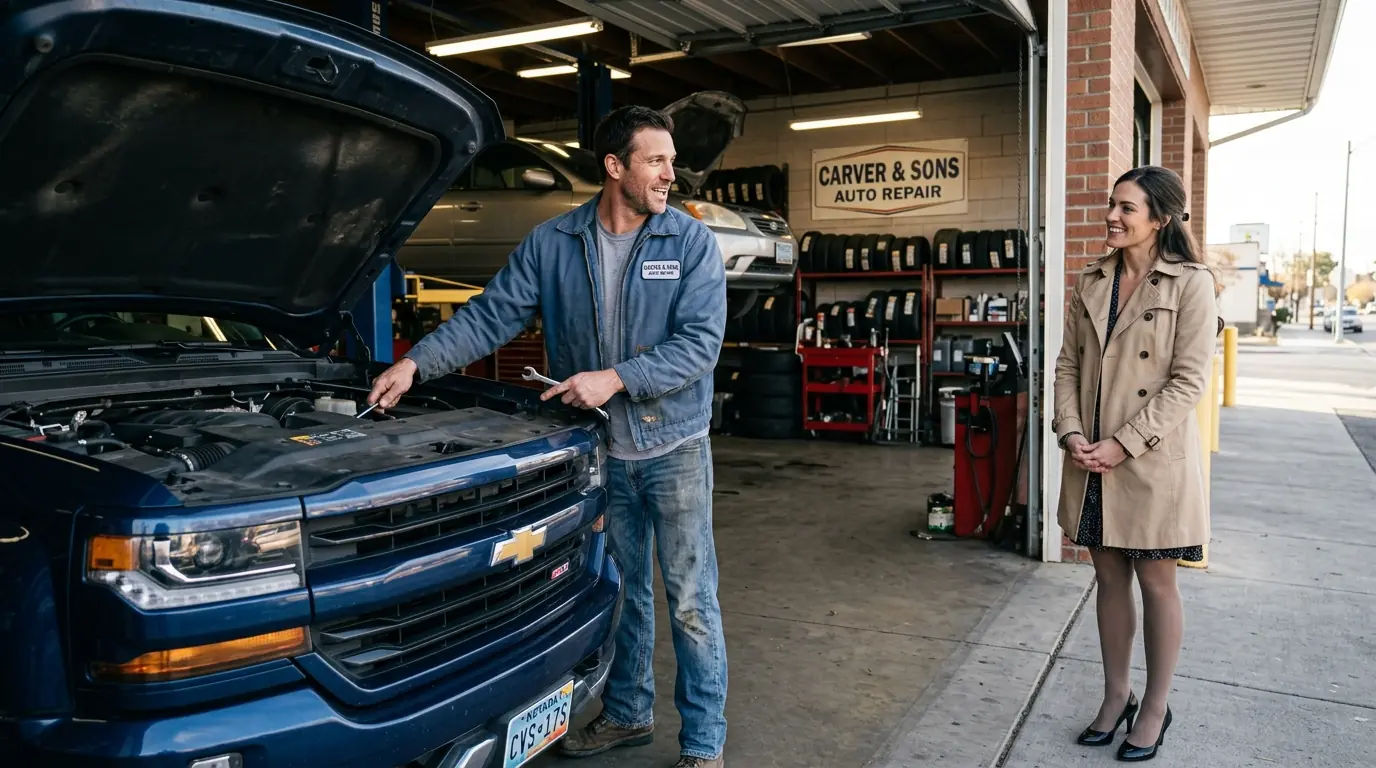
He was not in the building. He had signed out. There was a form. There was a teacher who remembered him because he'd asked three specific questions about Lily's reading level that the teacher later said were the most engaged parental questions she'd had all week.
"Yes," Ethan said. "I can."
Derek's expression didn't change.
But something behind his eyes recalibrated. Olivia said,
"We'll recess until tomorrow morning."
Friday morning, 8:00. The full staff had been asked to be present, unusual, and everyone knew it. The bays sat idle. Eleven people stood or sat in the waiting area that had been expanded with folding chairs. The air smelled like burnt coffee and something that might have been anxiety. Ethan had spent Thursday night at the kitchen table after Lily was asleep pulling together what he could, a text to Lily's teacher who replied within minutes.
"Of course, I remember you asked about her phonemic awareness. You were there until well after 5:00." Time-stamped receipts from the school parking garage. His own phone's GPS history, which his carrier stored for 30 days. He'd put it all in a folder. Not because he thought it would necessarily matter, but because it was true and the truth deserved a folder.
He arrived at 8:00 sharp and found Olivia already there, standing by the window with a coffee, looking at nothing in particular. She didn't acknowledge him. Derek arrived at 8:02 wearing a fresh shirt, bringing the particular energy of a man who has convinced himself he's already won.
The meeting began. Derek reprised his presentation. He was thorough. He used words like systemic and pattern of conduct with the confidence of someone who'd practiced them. Olivia listened. She did not look at Derek while he spoke. She looked at the table. When he finished, she said,
"Thank you, Mr. Pullman." She reached forward and opened the laptop in front of her. "My team completed a full audit of the system logs last night," she said. "Not the invoice records, the access logs. Every login, every timestamp, every workstation ID."
She looked up. "Mr. Pullman, can you explain why your employee badge was used to access the parts inventory terminal in bay two on September the 14th at 3:17 in the afternoon?"
The room was very quiet.
"My badge has been… I've had issues with the reader."
"Your badge," she said, "was swiped at the terminal. The terminal then logged 17 minutes of invoice activity. During those 17 minutes, Mr. Carter's credentials were used to enter and authorize 12 of the 13 billing discrepancies we identified."
She paused. "The 13th was entered while Mr. Carter was documented as off-site at his daughter's school, which his phone's location data confirms." She closed the laptop.
"Additionally," she said, "three of the overcharged customers are still in the system with valid email addresses. Two of them, when contacted by my team last evening, confirmed they were told in writing by email from this shop's management account that they had been charged the correct amount. That email account is registered to your workstation, Mr. Pullman."
Derek had gone the color of old concrete.
"This was not a billing discrepancy," Olivia said. Her voice had not risen. It had, if anything, become quieter, the quietness of something very controlled.
"This was a deliberate, sustained effort to steal from customers and attribute the record to another employee." She looked at him for a moment. "I don't reward dishonesty and I don't allow it to stand." She nodded to the woman in the corner, legal counsel. "Mr. Pullman, you're terminated, effective now. There will be a formal review for potential criminal referral. Please surrender your badge to Mr. Webb on your way out."
Derek stood. His chair scraped. He looked once at Ethan, a look with no clean emotion in it, just the raw exposure of a man whose scheme has been dismantled in front of witnesses. He left. The room remained very quiet for a moment.
Then Olivia turned to the rest of the staff and said, in a tone that was still composed but had shifted by some few degrees toward human,
"I want to be clear that this review is about accountability, not anxiety. The rest of you are not under suspicion of anything. I'll be holding individual meetings this afternoon to talk about the shop's direction going forward. That's all for now."
People began to move, the slow, cautious movement of those who have just watched a significant thing happen and haven't yet processed it. Ethan stood. Olivia, without looking at him, said,
"Mr. Carter, a moment, if you don't mind."
Everyone else filtered out. The room became what it is after a crowd leaves, somehow more itself, more honest about its dimensions. The folding chairs. The old whiteboard with marker ghosts of previous meetings still faintly visible. The window that looked out on the parking lot where a cold November sky sat heavy and gray over the asphalt. She was still standing by the window when he stopped a few feet away. He waited.
"I owe you an apology," she said. Not a preamble, just the statement, delivered cleanly.
"For what?" he said.
"I knew about Pullman before yesterday." She turned to face him. Up close, without the careful distance she'd maintained all week, she looked like herself, not the CEO, just her. "I had the access logs from day two. I needed to see whether he would escalate the accusation against you when the pressure increased, whether he would commit to it."
She paused. "He did."
Ethan thought about Thursday night at the kitchen table. The folder. Lily asleep down the hall.
"You could have told me," he said. "That would have been better."
"Yes," she said again. "It would have. I'm sorry."
He looked at her for a moment. There was something almost unfamiliar about a person who apologized without qualifying it. No but, no however, no given the circumstances, just the acknowledgement.
"Why did you come back?" he said.
"Here."
"This shop specifically." She looked at him steadily. "The portfolio includes 15 service centers. This was one of 14 I needed to review." She paused. "But yes, I came to this one first."
The implication settled between them quietly. "No one has ever," she started, stopped. The controlled expression had opened somewhere and whatever was underneath was more complicated and more human than the version she'd been presenting all week.
"In my world, people do things because of what I represent, resources, connections, decisions. Nobody fixes my car for free and then recommends I go to a competitor."
"It wasn't complicated," he said.
"I know," she said. "That's what made it complicated."
He almost smiled. "I was angry," he said, "when I realized you'd let me sit in that room with Pullman's evidence on the table and didn't say anything. I know, I'm still a little angry."
"That's fair." He looked at her. She looked back. Outside, the gray sky had started to release the first sparse flakes of early season snow, tentative, like they weren't sure they were committed yet.
"Lily would want to know you're not in trouble," he said.
Something moved through Olivia Harper's face, not a smile exactly, but a loosening, like something had been held tightly for a long time and had just slightly been set down.
"How is she?" Olivia said.
"Currently convinced that the number eight is personally against her."
"Math homework, eight is genuinely tricky." Olivia said. "It took me until third grade. Don't tell her that. She'll use it as an excuse."
There it was, the smile. Small, real, not performed.
"I'd like to talk to you about the shop," she said, returning to practicality but not fully, the smile hadn't entirely left. "About its future."
"And about what role you might want to play in that."
"I'm a mechanic," he said. "You're the only person in this building who's been here longer than three years and still cares about what happens to it."
"That's not nothing."
She paused. "I'm not offering charity. I'm making a business decision. Give me a few days."
He said. "Of course." He nodded. He moved toward the door.
"Ethan," she said. He stopped.
"Thank you," she said. "For the car."
"And for being the kind of person you are."
He stood there for a moment. "Thank you," he said, "for actually investigating before you decided."
He left.
December arrived gradually and then all at once, the way Boston winters do. The shop changed. The tagged-out lift in bay four was operational by the second week of December. Olivia had approved the part order on day one of her review without fanfare as though it were simply an obvious thing that should have happened already.
Lead technical supervisor, which in practice meant he was doing what he'd already been doing but with the title to match and the authority to make decisions he'd previously had to route through people like Derek Pullman. The salary increase was meaningful but not extravagant, which he trusted more than extravagance.
He didn't see Olivia for nearly two weeks after the meeting. She was, he knew vaguely, everywhere and nowhere. The portfolio was large. She had other sites to review, other fires that were her professional obligation. She operated at a scale and velocity that his daily life simply didn't approximate.
He told himself this was fine. He told himself this on a Wednesday evening while making pasta with Lily, who was at the counter asking increasingly specific questions about whether dinosaurs had liked pasta and whether if a dinosaur had tasted pasta, they would have liked the kind with the ridges better than the smooth kind.
"The ridges hold the sauce," Ethan said. "So, dinosaurs would have liked the ridges one."
Lily concluded. "Probably."
His phone buzzed. An unknown number, which he almost didn't answer. He answered. "It's Olivia."
He turned toward the stove. "Hi." He said. "I'm sorry to call."
She stopped. Started differently. "I have an embarrassingly basic question about my car."
"There's a noise. I wanted to ask someone I trust."
"What kind of noise?"
"A clicking."
"When I turn left."
"Constant clicking or just at certain speeds?"
"Certain speeds, mostly slow."
"CV joint," he said. "Probably the outer one on the passenger side. It's not urgent but you shouldn't leave it more than a few weeks."
A pause. "You knew that immediately," she said. "That's the job."
Another pause, longer. "Are you free Saturday?" she said. "I mean not for the car."
"I can bring it to the shop."
"I meant…" a pause where she seemed to be recalibrating something. "I meant for dinner, you and Lily, if she'd like to come. There's a place in the South End that makes the gnocchi by hand and I have a reservation I’m not going to use otherwise."
He looked at Lily, who was at this moment using a fork to demonstrate to an imaginary dinosaur how the ridge pasta worked.
"Saturday," he said. "Yeah."
"We can do Saturday."
Saturday was good. The restaurant was warm and low-lit. The gnocchi was what she'd promised and Lily spent the first 20 minutes asking the waiter detailed questions about where the pasta came from, which the waiter, a patient man named Jerome who had clearly been well-trained, answered without condescension, including a small detour into the history of potato gnocchi in northern Italy that Lily received with solemn appreciation.
Olivia watched this interaction with the expression of someone observing a foreign country's customs and finding them unexpectedly charming.
"She talks to everyone like they're worth talking to," Olivia said quietly to Ethan. "She gets that from her grandmother."
He said. "My mother could get a life history out of anyone in six minutes flat. It's a gift."
"It's occasionally very slow at the grocery store," he said. "But yes."
She laughed, actually laughed, not the polished, appropriate laugh that people deploy in professional settings, but the real kind, slightly surprised, slightly helpless. He decided he liked it. They stayed two hours longer than he'd planned.
Lily fell asleep on the car ride home, her head against the window, the restaurant's little complimentary mint still in her closed fist. Olivia was in the passenger seat, he'd insisted on driving. She'd let him after approximately four seconds of token resistance and the city moved past the windows in streaks of orange light.
"She's extraordinary," Olivia said quietly, meaning Lily, not looking at him.
"I know," he said. "You should be proud."
"Every day," he said and meant it the way he meant very few things, completely, without reservation.
She looked out the window for a moment. "I'm not good at this," she said.
He didn't ask what this was. He had a sense.
"You're better than you think," he said.
"That's something people say."
"Sometimes people say things because they're true." She turned her head and looked at him sidelong. The orange light caught her face at an angle that made her look, just for a moment, less like someone who ran companies and more like someone sitting in a car at night looking for something she wasn't sure how to name.
"I don't know how to do things slowly," she said.
"Sure you do," he said.
"You had the access logs on day two."
"You waited five days."
She was quiet for a moment. "That's different."
"Is it?" Another quiet. "No."
She said. "I suppose it isn't."
He pulled up in front of her building, a modern glass tower in Back Bay that said everything about the life she'd built and nothing about whether that life had felt like enough, and she gathered herself to get out.
"Ethan," she said.
"Yeah."
"Lily called me the pasta lady on the way out."
"I heard her."
"I know. I'm sorry."
"Don't be." She said. "I haven't had a nickname in a long time." She got out.
He drove home with the city quiet around him and something warm in his chest that he hadn't identified yet but wasn't in any hurry to name.
The months between that December and the following October were not a straight line. Nothing real is a straight line. There were weeks where Olivia was traveling and their contact was sporadic, a text here, a brief call, the particular discipline of people who have learned not to ask too much of things that are still forming.
There was a Sunday in February when Lily had a fever of 102 and Ethan called Olivia, not because he was panicking but because Lily had asked for the pasta lady and he had not known what to say to that and Olivia had driven over at 9:00 in the evening with a children's audiobook on her phone and had sat in the hallway outside Lily's room for two hours reading the chapters aloud through the half-open door until the sound of even breathing said Lily was asleep.
There was a night in April when Ethan told her about Lily's mother, not telling, just the plain version. She had left when Lily was two. She was living in Arizona now. She sent birthday cards. It was what it was and Olivia had listened without interrupting and without saying anything afterward that was smaller than the thing she'd just heard.
There was a fight in June, a real one, about whether Ethan was being used as a project. His words, said more sharply than he meant because he was tired and had been thinking it for three weeks without saying it. She had not denied it but she had also not accepted it and the argument that followed had the quality of two people who are telling the truth to each other for the first time rather than being careful, which was uncomfortable and necessary and ultimately, three hours later, had left them somewhere clearer.
"I don't know how to need people without it feeling like a weakness," she said.
"I know," he said.
"I don't know how to trust things without waiting for them to fall apart."
They sat with that for a while.
"Okay." She said eventually.
"Okay." He said.
It was not a resolution so much as an agreement to keep going. They kept going.
The shop, over the following months, became something it hadn't been before, a place that ran well and knew why it ran well. Ethan had brought Marcus in to help redesign the workflow for bay assignments, had overhauled the customer follow-up system, had caught two additional instances of billing irregularities left over from the Pullman era, and flagged them both. Olivia's analyst team had called him directly twice to ask his read on operational questions at two of the other service centers, which she had not arranged, and which he had not mentioned to her until she brought it up herself.
"You're helping rebuild a portfolio," she said.
"I'm answering questions about car maintenance," he said.
"You’re doing both," she said.
"You're allowed to take credit for both."
In late September, Lily asked, with the directness that was her primary mode of interaction with the world,
"Is Olivia going to live with us?"
Ethan was making eggs. He kept making eggs. "Why do you ask?"
"Because she's here a lot," Lily said, "and she knows where the good mugs are now."
"That's how you can tell." He was quiet for a moment. "Do you want her to?" he said.
Lily thought about this with the seriousness she applied to all important decisions. "Yes," she said. "But she has to like the pasta with ridges."
She does, he said.
"Good," said Lily, and went back to her cereal.
October the 22nd was a Saturday. The sky had done the thing it sometimes does in New England in mid-autumn. Pulled itself together after a week of cold and gray into something clear and gold, as if the season had decided to make one final luminous argument for itself before winter.
The venue was small, a converted carriage house in the western suburbs with exposed beams and candles in mason jars, and approximately 40 people who had actually mattered to both of them, which was fewer than most people think they need until they're sitting in the room and finding that 40 is exactly right. Marcus was there with his wife.
Lily's teacher was there. She'd been invited after the parent-teacher conference story had come out at dinner one evening, and Olivia had said, with complete sincerity, "That woman saved your job. She deserves a wedding invitation." Olivia's assistant, Patricia, was there, and her CFO, and two women who had been her closest friends since business school, and who had, upon meeting Ethan, asked him a series of rapid and slightly terrifying questions about his intentions that he'd found he did not mind at all.
Lily walked the aisle first. She was wearing a dress the color of warm cream, and she was carrying a small basket of late-season marigolds, and she was treating the entire endeavor with the focused, ceremonial gravity of someone who understood that this was important, and also, possibly, that she was the most important person in the room at this moment.
She made eye contact with each guest individually as she passed them, which was not traditional flower girl behavior, but was absolutely Lily. She reached the front and took her place next to Ethan and looked up at him and said, in a loud whisper that the first three rows definitely heard,
"The dress is itchy, but it's okay."
"You're perfect," he said.
"I know," she said.
Then, Olivia appeared at the back of the room. She had told the stylist she wanted to look like herself, which had taken two appointments to properly define, but had eventually arrived at something that was exactly right.
A simple ivory dress with clean lines, her hair down in a way she rarely wore it, no statement jewelry, just two small diamond earrings that had belonged to her grandmother. She walked without accompaniment. She had thought about this, had considered who might walk with her, and had decided that she had spent enough of her life walking toward things alone that this walk should feel like a choice and not an absence. It did.
When she reached him, he looked at her the way he sometimes looked at Lily, like if he looked away, something irreplaceable might change. The vows were not long. He had written his himself, the way he did most things, simply, without performance, saying what was true.
"I fixed your car," he said.
Which is not the grand gesture you probably expected from a love story, but you showed up in a doorway on a cold evening, and you didn't try to impress me, and you let Lily ask you if you were a princess, and you said thank you like you meant it. He paused. "I've spent a long time thinking that what I had was enough, and it was. It was full and good and real. And then you showed me what full can mean when there's someone else in it. You fixed something in me I didn't know needed fixing, so I think that makes us even."
She had promised herself she would not cry before she started speaking. She was already crying when she started speaking.
"I'm not historically good at slow things," she said. "At trust, at letting something be uncertain long enough to become real." She looked at him. "You were patient with me, not in the soft, indulgent way, in the harder way. The way where you tell the truth even when it's uncomfortable, and you show up even when it's inconvenient, and you don't let me get away with the parts of myself that are armor rather than actually me." She paused.
"I spent a lot of years building things, companies, structures, systems. I was good at it, and I was proud of it, and I was also, I think, a little bit lonely in it." She looked at Lily, who was watching with huge eyes, and then back at him.
"I didn't know how much I needed one until I had one." The ring went on. Lily, who had been excellent throughout, released a small sound of satisfaction, as if confirming to herself that the proceedings had been conducted correctly.
Outside, afterward, the light had gone gold and long in the way of late afternoon October, slanting through the old carriage house windows and making everything inside it amber warm. Someone had put a record on something unhurried and true, and there was wine and the kind of laughter that happens when people are genuinely glad to be in the same room.
Lily was on Olivia's hip, which she'd been putting up with since approximately 3 minutes after the ceremony, which everyone agreed was a rapid escalation of physical affection from a 6-year-old. Olivia had accepted this transition with the composure of someone who, over 10 months, had learned that resistance to Lily's conversational gravity was neither possible nor desirable.
Lily was explaining something, probably dinosaurs, probably pasta, possibly the deeply held conviction she had developed last month that October was the best month because it contained both Halloween and the correct kind of weather. With the detail and commitment she always brought to important topics, Ethan stood a few feet away and watched the two of them. Marcus appeared at his shoulder with two glasses and handed him one.
"You good?" Marcus said.
"Yeah," Ethan said.
"She's good," Marcus said, meaning Olivia, meaning the assessment he'd been running for months and had just delivered his final score.
"Yeah," Ethan said again.
Across the room, Olivia looked up from Lily's explanation and found him. The look lasted only a second, just long enough to be a complete conversation in itself, the kind that takes years to learn how to have. He raised his glass slightly. She raised hers.
Lily, noticing she'd lost her audience, said, "Are you listening to me?"
"Always," Olivia said, looking back down at her.
Later, after the guests had thinned and the candles had burned to comfortable nubs. Lily had been carried asleep to the quiet room at the back, where someone had laid a blanket in anticipation, because 40 people who love a little girl think of things like that. Ethan and Olivia stood outside on the stone step where the carriage house met the dark garden.
The air was cold. The sky was the particular deep blue of October night, clear and fathomless. Stars making their case across the full span of it. She leaned back against him, and he put his arms around her from behind, and they stood there in the dark and the cold and didn't say anything for a long while.
He thought about the evening he'd first seen her, the headlights crossing the bay door, the charcoal coat too thin for the weather, the way she'd said thank you like it was a word she'd been saving for the right moment. He thought about Lily asleep in the back room with the wedding flowers still half clutched in her small hand because someone had given her a fresh one to hold during the reception, and she had taken it as a solemn responsibility.
He thought about the 11 months between that cold Thursday and this cold October, the slow and uneven and genuine work of it, the way two people who have learned to distrust easy things learn, eventually, to trust a hard one.
"Thank you," she said eventually.
"For what?"
"The alternator belt," she said, very seriously.
He laughed, actually laughed, the kind that moves through your whole chest. "Anytime," he said.
She turned her head so the back of it rested against his shoulder. They looked up at the October sky together, all of it, the cold and the gold and the stars and the quiet house behind them with the sleeping child inside. It was, without qualification, without the asterisk that life usually attaches to good things, enough. It was more than enough. It was full. It was, in the exact way that matters and that no planning can manufacture, the place they had each been moving toward without knowing there was a destination at all.
From one small act of kindness, a broken car, a cold evening, a man who helped because someone might need it more than he needed anything in return. Something was built that neither of them had known how to plan for. Something that required no grand gesture, no perfect moment, no clarity of intention at the start. Only the willingness from both of them to keep going. That is usually how the best things happen.