Inside the open garage of a quiet suburban home in Oak Haven, Washington, Daniel Carter stood frozen beside the raised hood of a silver sedan. An oil-stained wrench hung loosely from his trembling hand, while warm afternoon sunlight illuminated the grease across his forearms and the shock spreading over his weathered face. Directly opposite him stood an extraordinarily beautiful woman in a short navy-blue dress, nude heels, and understated gold earrings, her tear-filled hazel eyes fixed on the man she had once promised never to leave. Near the workbench, ten-year-old Emily sat silently on a wooden stool, slowly realizing that the elegant stranger beside the broken car was the mother she barely remembered.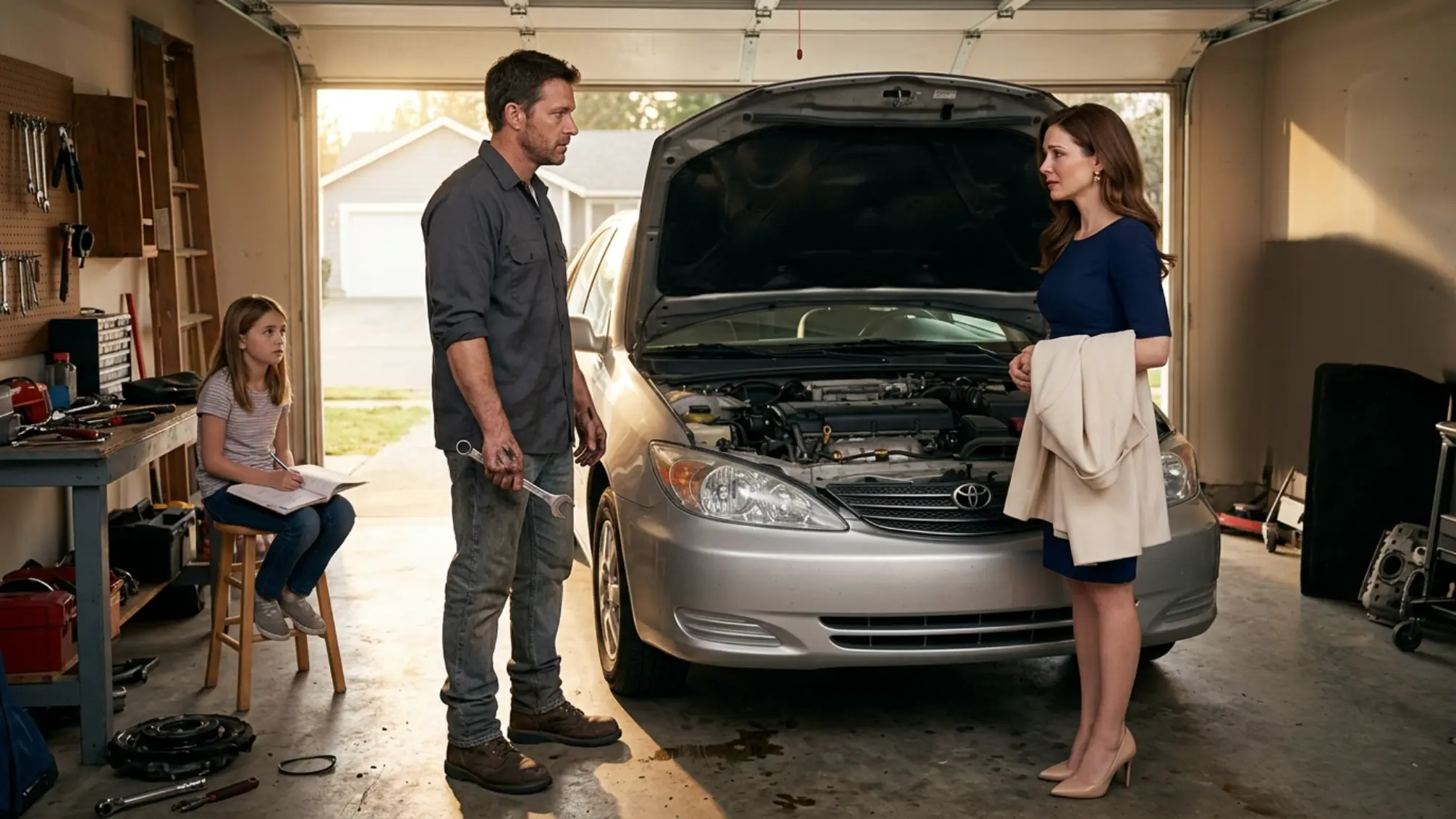
The words settled beneath the garage roof like dust after something had collapsed. Daniel stared at Laura Bennett, searching her beautiful face for the younger woman he remembered from Seattle—the ambitious wife who once laughed barefoot in their apartment kitchen, who drew impossible dreams on restaurant napkins, and who disappeared when those dreams became debts. Time had softened the sharpness around her eyes, but it had not changed the small scar near her left eyebrow or the way she pressed her lips together whenever she was afraid of crying.
Emily looked from Laura to Daniel. Her unfinished math worksheet rested forgotten in her lap, and the pencil she had been holding slipped quietly onto the concrete floor. She had seen photographs of her mother as a young woman, though Daniel kept only two hidden in a box inside his bedroom closet. Until that afternoon, those pictures had never felt connected to someone real.
“You’re Laura,” Emily said.
Laura flinched at the use of her first name, but she nodded. “Yes.”
Daniel moved immediately between them—not aggressively, but protectively. The instinct had been built through seven years of raising Emily alone, seven years of fevers, school concerts, scraped knees, nightmares, and birthday mornings when the child stared at the empty chair across the table but refused to ask why no one sat there.
“She doesn’t owe you a conversation,” he said.
“I know.”
“She doesn’t owe you forgiveness.”
“I know that too.”
Daniel’s jaw tightened. “Then what exactly do you expect?”
Laura glanced toward the silver sedan. “I expected a mechanic. I didn’t know this was your house.”
The car had rolled into his driveway twenty minutes earlier with a loose exhaust bracket producing a metallic clicking noise. Laura had introduced herself as the new neighbor living in the blue house at the end of the block. Daniel had barely looked at her while checking the engine because he had trained himself to focus on machines rather than people.
Then she mentioned Seattle.
He finally raised his eyes, and seven years disappeared in a single breath.
Daniel lowered the sedan’s hood with a heavy metallic thud. “The bracket is secure. The car is safe to drive.”
“How much do I owe you?”
“Nothing.”
“Daniel—”
“Welcome to the neighborhood.”
He turned toward his workbench, hoping the movement would end the conversation. Laura remained beside the car, her cream coat folded across one arm while the navy dress made her appear more suited to an evening restaurant than an oil-stained garage. She had once loved expensive clothes because they made her feel as though she had escaped the uncertainty of her childhood. Now the elegance looked like armor that no longer protected her.
Emily climbed down from the stool.
“Did you know it was me?” she asked.
Laura’s composure cracked. “No, sweetheart.”
Daniel’s head snapped toward her. “Don’t call her that.”
Laura lowered her eyes. “I’m sorry.”
Emily did not retreat. “Would you have come if you knew?”
Laura looked at the girl she had last seen at three years old. Emily’s dark-brown hair came from Daniel, but the hazel eyes belonged unmistakably to her. So did the slight tilt of her head when she wanted an honest answer and suspected the adults around her were hiding one.
“I don’t know,” Laura admitted.
Daniel let out a cold breath. “At least that answer is honest.”
“I was afraid you would tell me to leave.”
“I am telling you now.”
Laura closed her eyes for a second. “Then I’ll leave.”
She opened the driver’s door but paused before entering. Her hand rested on the roof while her shoulders trembled beneath the afternoon sun.
“I know saying I’m sorry cannot repair what I did,” she said without looking back. “I only need you both to know that leaving never became easier. I simply became better at pretending it had.”
Daniel said nothing.
Laura entered the sedan and drove away, the repaired engine running smoothly as she disappeared down the tree-lined street.
Emily stood beside her father until the sound faded.
“Was that really my mom?”
Daniel placed the wrench on the workbench. “Yes.”
“Why did you tell me she had to work far away?”
He had expected that question someday. In every version he imagined, Emily was older, and he had time to prepare words that would protect her without becoming another lie. Instead, the truth arrived in a navy dress on an ordinary Tuesday afternoon.
“Because you were little,” Daniel said. “And I didn’t want you believing she left because of you.”
“Did she?”
“No.” His answer came instantly. “Never because of you.”
“Then why?”
Daniel pulled a wooden chair closer and sat across from his daughter. “Your mother and I were going through a difficult time. We had no money. My business had failed, and I was angry at myself. She was scared, and instead of facing it with us, she ran.”
Emily studied the driveway where the sedan had been. “Do you hate her?”
“I did for a long time.”
“What about now?”
Daniel looked at the oil embedded beneath his fingernails. He had built an entire identity around Laura’s absence: dependable father, abandoned husband, man who stayed when someone else fled. Seeing her again forced him to confront the possibility that anger had become another habit he no longer knew how to release.
“I don’t know,” he said.
That evening, Daniel activated what Emily called the pancake protocol. Whenever life became too heavy for a normal dinner, they made breakfast food at night. Pancakes did not solve grief, but the familiar rhythm of mixing batter, warming syrup, and arguing about chocolate chips made difficult conversations feel less frightening.
Emily sat at the kitchen table while Daniel poured batter onto the griddle.
“Does she live here now?”
“At the end of the block.”
“So we’ll see her.”
“Probably.”
“Will she come back?”
Daniel flipped a pancake harder than necessary. “Not unless we invite her.”
Emily traced a circle through a drop of syrup. “Do you want to?”
“No.”
The answer was too fast.
She looked up. “You always tell me not to make decisions while I’m angry.”
“This is different.”
“Because you’re the adult?”
“Because I know what happened.”
“I don’t.”
Daniel turned off the burner. His daughter’s calmness disarmed him more effectively than anger would have.
“What do you want to know?”
Emily asked about Seattle. Daniel told her about the apartment overlooking a rainy street, the failed technology company that consumed their savings, and the bills he hid because he felt ashamed. He admitted that he became distant, worked constantly, and stopped speaking to Laura except when another problem required attention.
None of it excused her departure.
But the truth was not as clean as the story Daniel had repeated in his mind.
Laura had not left a perfect marriage. She had abandoned a broken one rather than helping rebuild it.
“Did she say goodbye to me?” Emily asked.
Daniel hesitated. “She kissed you while you were sleeping.”
“How do you know?”
“I saw her from the hallway.”
“You let her go?”
The question struck a place he had avoided for seven years.
“I thought she needed one night away,” he said. “I didn’t know her suitcase was in the car.”
Across the neighborhood, Laura sat alone on the living room floor of the blue house. Moving boxes surrounded her, but she had opened only one. Inside were documents, old books, and a photograph of Daniel holding newborn Emily in a Seattle hospital room.
Laura lifted the frame.
She had carried it through every apartment, promotion, and executive office she occupied. It stood inside drawers rather than on desks because explaining it required admitting what success had cost her. Whenever someone asked whether she had children, Laura said the situation was complicated.
There was nothing complicated about it.
She had a daughter.
She had abandoned her.
Laura had spent seven years becoming everything she believed would prove leaving had been necessary. She rose from junior marketing manager to regional director, then chief strategy officer of a technology company. She earned enough to purchase expensive clothes, travel internationally, and live above a city skyline.
Yet no promotion stopped her from waking on Emily’s birthday with a pain beneath her ribs.
She drafted hundreds of messages to Daniel and sent none. At first, pride stopped her. Later, shame did. Each passing year made contact more difficult because every apology would have to explain why it arrived so late.
Moving to Oak Haven had not been part of a plan to find them. Laura’s company approved remote work, and she chose the suburb because its quiet streets reminded her of a life she had once dismissed as small. The house at the end of the block became available through a relocation agency.
Fate had placed her three hundred yards from the family she lost.
The next morning, Daniel walked Emily toward the school bus stop. Laura stood in her front yard struggling with a heavy box of books. She wore jeans and a simple cream sweater instead of the navy dress, and her hair was tied loosely at the back of her neck.
She noticed them but did not call out.
Daniel continued walking.
Then he saw the bottom of the box beginning to tear.
“Wait by the mailbox,” he told Emily.
He approached Laura and caught the box before it opened.
“You’re lifting with your back,” he said. “Use your legs.”
Laura stared at him. “You don’t have to help.”
“I’m protecting the books.”
A faint smile touched her mouth, then vanished. Together, they carried the box to the porch.
“Thank you,” she said.
Daniel nodded and turned away.
“Daniel.”
He stopped.
“I won’t approach Emily again unless she asks me to.”
“That’s not entirely your decision.”
“No. It’s yours and hers.” Laura swallowed. “I only wanted you to know I understand.”
Daniel walked back toward his daughter without answering. The gesture was not forgiveness. It was simply the first moment in seven years when he saw Laura acknowledge that her wishes were no longer central.
Emily watched him rejoin her.
“You helped her.”
“The box was breaking.”
“You could have let it.”
“That would have ruined the books.”
She smiled knowingly. “Sure, Dad.”
For the next two weeks, Laura remained visible but distant. She worked from home, planted lavender beside her porch, and visited the local library every Thursday. Daniel occasionally saw her through the garage door while she walked past, but she never entered the driveway.
Emily noticed everything.
One afternoon, she returned from school holding a flyer for the library’s youth art workshop. Laura Bennett was listed as the volunteer instructor.
“She knows how to draw,” Emily said.
“She always did.”
“Can I go?”
Daniel examined the flyer. “Do you want to attend because of the art or because she’ll be there?”
“Both.”
He wanted to refuse. Every protective instinct warned him that Laura could disappear again, leaving Emily with a wound deeper than the one created when she was too young to remember. But refusing would also teach his daughter that fear should make decisions for them.
“You may go once,” he said. “I’ll stay nearby.”
The library workshop occupied a bright room overlooking a small garden. Daniel sat outside the glass wall pretending to read while Emily joined six children around a table covered with colored pencils and paper.
Laura’s hands shook when she saw her.
She did not embrace Emily or draw attention to their connection. She introduced the assignment—designing a house that represented safety—and treated every child with equal care.
Emily drew a large garage.
Inside it stood two figures beside a car. A smaller figure sat on a stool between them.
Laura paused when she saw it.
“Tell me about your picture,” she said softly.
“The garage is where Dad and I do homework and fix things.”
“And the woman?”
Emily kept coloring. “She doesn’t know whether she belongs there yet.”
Laura’s eyes filled, but she did not cry.
“What would help her belong?”
Emily looked up. “Staying.”
After the workshop, Daniel waited beside the entrance. Emily ran toward him carrying the drawing. Laura followed at a respectful distance.
“She’s very talented,” Laura said.
“She gets that from you,” Daniel replied before he could stop himself.
The compliment surprised both of them.
Emily held out the picture. “Can Laura come to dinner?”
Daniel stared at his daughter.
“Not tonight,” Laura said quickly. “Your father and I need time.”
Emily crossed her arms. “Adults always say they need time when they mean they’re scared.”
Daniel almost laughed despite himself.
Laura looked toward him. “She gets that from you.”
The first dinner occurred two weeks later.
Daniel prepared spaghetti because it was impossible to interpret romantically. Laura arrived carrying bread from a local bakery and a small potted rosemary plant rather than flowers. She wore a modest navy sweater dress that reached her knees, and the sight of the color brought Daniel back to the afternoon in the garage.
The meal began awkwardly.
Emily carried most of the conversation, describing school, violin lessons, and the science fair. Laura listened as though every ordinary detail was precious. When Emily mentioned learning to change a tire, Laura smiled through tears.
“Your father always believed everyone should know basic repairs.”
“He says helplessness is expensive.”
“That sounds exactly like him.”
After dinner, Emily brought out her violin. She played a short piece with several imperfect notes while Daniel watched from the kitchen doorway. Laura pressed one hand against her mouth.
When the final note faded, she stood and applauded.
“You were wonderful.”
“I missed one part.”
“So did every musician who ever learned anything.”
Daniel remembered Laura saying those exact words to him after a disastrous presentation early in their marriage. The familiarity hurt, but it also reminded him that before fear and resentment consumed them, they had once been gentle with each other.
Later, Emily went upstairs.
Laura remained beside the kitchen table.
“She is extraordinary,” she said.
“She worked hard to become that.”
“I know you did too.”
Daniel folded his arms. “Do you?”
Laura accepted the anger without retreating. “No. I don’t know what every day cost you. I wasn’t there.”
“You could have been.”
“Yes.”
“You left a note.”
“I know.”
“Three sentences after six years together.”
“I know.”
Daniel’s voice rose. “Stop saying you know as if understanding now gives me back the nights she cried for you.”
Laura’s face crumpled. “It doesn’t.”
He turned away, gripping the counter.
“I was drowning, Laura. My company failed. My father died. I felt useless, and the person who promised to stand beside me decided I was too broken to love.”
“I did love you.”
“You left.”
“I was terrified that your failure would become my entire life.” Tears slid down her cheeks. “I thought success could protect me from becoming my mother—dependent, frightened, and trapped. I told myself I was escaping before we destroyed each other.”
“And Emily?”
Laura pressed both hands against her heart. “There is no explanation that makes leaving her less monstrous.”
The rawness of the answer silenced him.
“I have spent seven years wishing I could return to that night,” she continued. “Not because I expect the same life back. I only wish I had been brave enough to stay through the worst part of it.”
Daniel looked at her.
“Why didn’t you call?”
“At first, pride. Then shame. Every birthday I missed made me less deserving of the next one.”
“You’re right.”
Laura nodded as if accepting a sentence. “I know.”
Daniel closed his eyes. Anger still lived inside him, but it no longer stood alone. Beneath it was grief, and beneath grief remained a tenderness he had tried to bury.
“I cannot promise you another chance,” he said.
“I’m not asking for one.”
“What are you asking for?”
“A chance to earn trust without demanding a reward.”
Over the following months, Laura did exactly that.
She attended Emily’s violin recital but sat in the back. She helped with art projects without calling herself a mother. When Daniel needed to work late on a customer’s transmission, Laura brought dinner to the garage and left after Emily finished eating.
She never criticized Daniel’s parenting or attempted to purchase affection. Her expensive gifts remained inside stores. Instead, she gave time—the one thing she had withheld for seven years.
Emily began visiting the blue house for supervised afternoons. Laura taught her watercolor techniques, and Emily taught Laura how to identify engine parts from diagrams. Their connection developed cautiously, filled with questions no child should have needed to ask.
“Will you move again?” Emily asked one afternoon.
“No.”
“What if your job changes?”
“I’ll change jobs.”
“What if staying gets hard?”
Laura placed down her pencil. “Then I’ll tell you I’m scared. I won’t disappear.”
Emily studied her face. “Promise?”
“I already broke one promise to you. So I won’t ask you to believe another until my actions prove it.”
Daniel heard about the conversation later.
It was the first moment he allowed himself to imagine that Laura had truly changed.
Spring arrived in Oak Haven. Daniel’s garage became busier, and Laura began helping local businesses with marketing during evenings. She volunteered at the library and stopped wearing corporate clothes except for video meetings.
Their relationship did not return through one dramatic declaration. It rebuilt through coffee left on a workbench, shared school pickups, and quiet conversations after Emily went to bed.
One Saturday, Laura’s sedan rolled into the driveway again.
Daniel looked beneath the hood and found nothing wrong.
“You invented an engine problem,” he said.
Laura leaned against the fender wearing a short navy dress beneath a light cardigan. “There is a clicking sound.”
“Where?”
“Somewhere near the driver.”
Daniel stared at her, then laughed—the first unguarded laugh she had heard from him since Seattle.
“You’re terrible at this.”
“I had to get you into the garage.”
“You live down the street. You could knock.”
“That seemed less dramatic.”
The smile between them faded into something tender.
Laura looked toward the stool where Emily usually studied. “Do you ever think there could be something between us again?”
Daniel wiped his hands slowly. “Every day.”
Hope flickered across her face.
“So does fear,” he added.
“I understand.”
“I cannot survive you leaving twice.”
Laura stepped closer but did not touch him. “Then don’t trust the woman who left. Watch the woman who stays.”
Daniel studied her hazel eyes.
Seven years earlier, he would have tried to repair their marriage in one desperate night. The man he had become understood that some things required patience, replacement parts, and repeated testing under pressure.
He extended his hand.
Laura looked at it before placing hers inside.
“This is not forgiveness for everything,” he said.
“I know.”
“It is not a promise.”
“I know.”
“It is a walk around the block.”
Her fingers tightened around his. “That is more than I deserve.”
Daniel shook his head. “Stop deciding what you deserve. Just decide what you’ll do with what you’re given.”
They left the garage together.
Emily watched from the kitchen window, smiling as their shadows stretched along the pavement. They did not walk like lovers reunited by fate. They walked like two people approaching a bridge they had once burned, uncertain whether the repaired boards would hold.
Six months later, Laura still lived in the blue house.
She attended Emily’s birthday, sat beside Daniel during the school concert, and joined the pancake protocol whenever life became difficult. Emily sometimes called her Laura and sometimes Mom. No one corrected her either way.
One evening, Daniel finished closing the garage and found Laura waiting beneath the porch light in the navy dress she had worn the day they met again.
“Special occasion?” he asked.
“I wanted to remember where we started over.”
Daniel looked around the garage—the repaired cars, neatly arranged tools, Emily’s stool, and the concrete floor where the past had arrived without warning.
“We didn’t start over that day.”
“No?”
“We stopped running.”
Laura’s eyes filled.
Daniel stepped closer and touched her cheek. “Starting over came later.”
He kissed her gently.
It was not the kiss of two young people promising they would never fail. It belonged to adults who already had failed, hurt each other, and learned that love meant more than emotion during easy years.
From the doorway, Emily cleared her throat.
“Are we having pancakes or not?”
Daniel pulled away, laughing.
Laura wiped her eyes. “Pancakes sound perfect.”
They entered the house together, leaving the garage light glowing behind them.
Daniel had spent years believing his story was about the woman who abandoned him. Eventually, he understood it was about the father who stayed, the daughter who refused to let fear silence her questions, and the woman who returned without demanding that regret erase consequence.
Laura had once left because she believed broken lives were beyond repair.
Daniel taught her otherwise.
Not by fixing her car, forgiving her instantly, or pretending seven lost years did not matter—but by allowing her to stand inside the life he had rebuilt and prove, one ordinary day after another, that this time she intended to stay.