Garrett Wade Morrison stood in the fluorescent wash of his garage, right hand hovering over the master switch that would kill the lights and end another year.
December 31st, 8:15 p.m. Snow fell outside in thick curtains, muffling Pinewood Ridge under white silence. The kind of quiet that made a man think too much about the past seven years, about the choices that had brought him from MIT to this two-bay garage in a Vermont town where everyone knew his daughter’s name, but nobody asked about the engineering degree gathering dust in his desk drawer.
The phone erupted. Not his cell, that ancient thing barely held a charge anymore, but the landline mounted to the wall beside his pegboard of perfectly organized wrenches. Garrett frowned at the unfamiliar Boston area code glowing on the caller ID. Seven years since anyone from that world had reached out. Seven years since the lawyers from Stellar Automotive had threatened to bury him in litigation for daring to suggest that profit shouldn’t outweigh human lives.
His hand moved toward the receiver, then stopped.
The garage door stood half open behind him, and through it he could see his daughter, Maeve, sitting in the passenger seat of his F-250, backpack clutched to her chest, waiting with the patient trust of an eight-year-old who believed her father would always come home.
He almost let it ring. He should have let it ring. But Grace’s voice whispered from memory, from all those nights she’d stayed up late reviewing case files while he coded in the next room.
“Always answer, Garrett. You never know who needs help.”
So he picked up.
The woman on the other end spoke with the clipped precision of someone billing by the quarter hour. Rebecca Khalil, she introduced herself, attorney at Henderson and Associates, representing a class of plaintiffs in an action against Stellar Automotive.
During discovery, they had uncovered something: patent filings, licensing agreements, a technology called SafeDrive AI, originally credited to one Garrett Wade Morrison, MIT graduate, former senior engineer who had supposedly abandoned all claims when he left the company in 2018.
Except Stellar hadn’t shelved the technology like they’d told him. They’d licensed it. General Motors, Ford, Toyota, all three had implemented variations of his algorithm in their newest models. The system that detected driver fatigue through micro-expressions and biometric patterns, the one that could have saved Grace from the drowsy trucker who’d crossed the median on I-94, had been generating revenue for nearly six years.
Khalil’s preliminary calculations suggested he was owed approximately $3.7 million in unpaid royalties.
Garrett’s knees went soft. The wrench he’d been holding clattered to the concrete floor. The sound was impossibly loud in the empty garage.
His vision tunneled.
$3.7 million. Enough to fund Maeve’s entire education, from elementary through doctorate. Enough to actually finish the microgrid prototype he worked on in stolen hours after she went to sleep. Enough to stop giving discounts to every widow and veteran who limped into his shop with vehicles they couldn’t afford to repair properly. Enough to finally prove that Grace’s death had meant something, that the technology born from his grief could actually save the lives it was designed to protect.
His voice came out raw.
“Stellar told me the project wasn’t commercially viable. They said the cost-benefit analysis didn’t support implementation.”
A pause on the line, heavy with the weight of what they both knew.
“They lied, Mr. Morrison. We have documentation showing they knew the system worked. They simply made more money licensing it quietly than they would have paying you what they owed.”
Garrett hung up without another word.
His reflection stared back from the darkened window of the bay door. Thirty-eight years old. Stubble that had gone gray at the temples. Hands scarred from seven years of working on engines instead of algorithms.
Behind him, Maeve’s small shape shifted in the truck. He turned away before she could see his face. Before she could ask why Daddy was crying on New Year’s Eve when he’d promised this year would be better than the last.
The phone rang again ten minutes later, just as he finished locking up. Different caller this time. Different desperation.
A woman’s voice, educated accent, trying hard to mask rising panic. Her car had died on Route 7, she explained, maybe seven miles north of Pinewood Ridge. She’d found his number online. She needed help.
Garrett checked his watch. 9:05 p.m.
Maeve had already been at the garage since 3:30, doing homework at the desk he’d set up in the corner of his office, drawing pictures for customers while he diagnosed transmissions and replaced brake pads. She deserved to be home, deserved hot chocolate and the New Year’s countdown special on TV, deserved a father who kept predictable hours and didn’t drag her out into blizzard warnings because some stranger needed roadside assistance.
He almost said no. The refusal formed on his tongue, professional and apologetic.
But something in the woman’s voice caught him. Not entitlement. Not the demanding tone of wealth expecting service. Fear. Real, undisguised fear that she was trying very hard to control.
He recognized it because he’d lived it. Had felt it rising in his throat the night he’d called 911 from the hospital parking lot while nurses worked on Grace’s broken body in a trauma bay he wasn’t allowed to enter.
Maeve appeared in the doorway of the office, already wearing her puffy purple coat, the one with the constellation pattern that glowed in the dark. Her brown hair escaped from beneath a knit cap Grace had made three winters before she died, back when the future had seemed like something you could plan for instead of something that happened to you while you were busy making other arrangements.
“Daddy, is that someone who needs help?”
Garrett looked down at his daughter, at the way she clutched her copy of A Wrinkle in Time under one arm, ready for another adventure. Grace had always said Maeve understood things beyond her years, had been forced to understand them because grief doesn’t wait until you’re old enough to process it properly. The girl knew what it meant to need help, to be stranded, to pray that someone would answer when you called into the darkness.
“Yeah, baby. Their car broke down in the snow.”
“Then we should help them, right? That’s what Mommy always said. We help people even when it’s hard. Especially when it’s hard.”
Grace’s philosophy, delivered through their daughter’s voice, hit him exactly where he was most vulnerable.
Garrett closed his eyes, saw again the itemized bill from Grace’s funeral, the one he’d paid in installments over eighteen months, because MIT degrees and Detroit engineering salaries don’t prepare you for sudden widowhood at thirty-one. The cemetery plot overlooking the ridge where he took Maeve every Sunday to leave flowers and tell Mommy about school and friends and all the small victories of growing up without her.
He made the call back, told the stranded woman he’d be there in twenty minutes, and tried not to calculate how many emergency calls he’d answered in seven years that had cut into family time, into the finite reservoir of moments he’d have with Maeve before she grew up, left for college, and built a life that didn’t revolve around her father’s small-town garage.
The F-250 rumbled through Pinewood Ridge’s empty streets, past Betty’s Diner, where the regulars gathered for their nightly poker game, past the VFW hall strung with lights that spelled out “Happy New Year” in bulbs, half of which had burned out in October.
Maeve sat beside him, reading by flashlight, lips moving silently over words like tesseract and dimension. Garrett felt the familiar ache of knowing she was too smart for this town, too brilliant to spend her childhood in a place where the library had three thousand books and ambition meant managing the hardware store instead of working there.
The radio crackled with weather warnings.
Blizzard conditions expected from 10:00 p.m. through January 3rd. Eighteen to twenty-four inches of accumulation. Winds gusting to forty miles per hour. Travel not recommended.
Interstate 89 would close by midnight. Route 7 shortly after. Anyone caught out in this would be stuck for days, maybe longer, if the town lost power like it did every major storm.
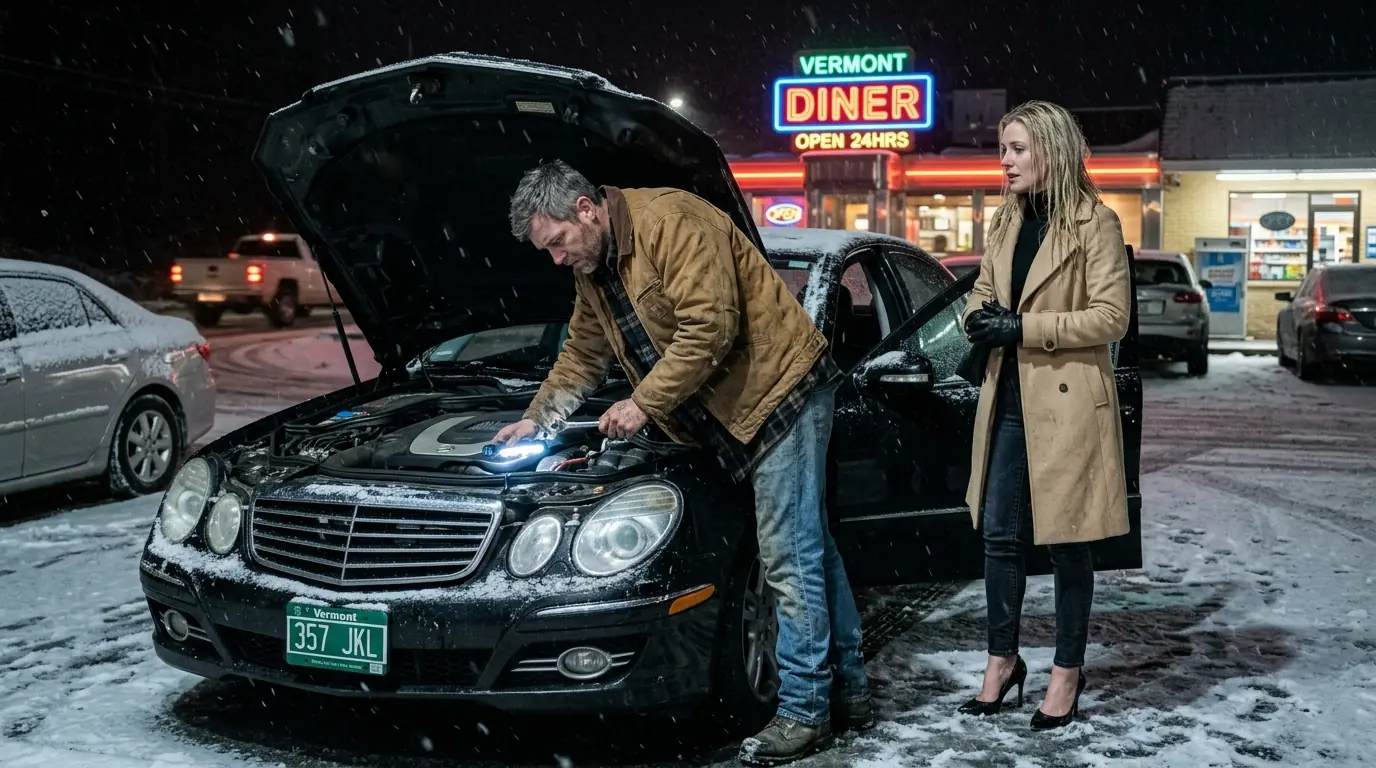
Route 7 stretched dark and empty ahead, snow already building in drifts across the asphalt. Garrett’s headlights caught the Mercedes first, a sleek black shape hunched on the shoulder like an injured animal, hazard lights blinking weakly through the white curtain.
$160,000 of German engineering rendered useless by Vermont weather and the fundamental laws of thermodynamics.
He pulled the truck alongside and told Maeve to stay put with the heater running.
The woman standing beside the Mercedes looked like she’d stepped out of a magazine spread about successful people who had their lives together. Burberry coat that probably cost more than his truck. Designer jeans. Heels that had no business on a country road in a snowstorm. Blonde hair pulled back in a style that was coming undone in the wind. Makeup smudged around eyes that tracked his approach with the wary assessment of someone used to evaluating threats.
Early forties, Garrett guessed, with the kind of beauty that came from expensive maintenance and genetic luck, currently undermined by obvious exhaustion and poorly concealed panic. Her phone was out, held up like a talisman against the darkness, searching for signal that didn’t exist this far from town.
She turned as he approached, and Garrett saw the exact moment she clocked him. Work boots, Carhartt jacket worn thin at the elbows, grease under his fingernails that never quite washed clean no matter how hard he scrubbed.
He watched her face calculate. Could she trust this stranger? Did she have any choice?
“Need a hand, ma’am?”
The obvious question, delivered in his Maine accent that seven years in Vermont hadn’t softened.
Her shoulders dropped a fraction of an inch, tension releasing just enough to let words through.
“My car died completely. I was driving back to Boston from Burlington and it just stopped.”
Garrett moved past her to the Mercedes, popped the hood with the confidence of someone who’d diagnosed a thousand failing engines. Snow had already accumulated on the intake manifold. Ice forming in places that should never see moisture.
He touched components with practiced efficiency. Alternator frozen solid. Fuel lines probably crystallized. The ECM housing was cold enough to tell him that particular computer had given up trying to keep this machine alive in conditions it was never designed to handle.
Luxury vehicles and New England winters made poor companions. Built beautiful cars, but they built them for autobahns and temperate climates, not for rural America where salt ate metal and cold murdered electronics.
He straightened and met her eyes over the open hood.
“Alternator’s frozen. Your ECM, engine control module, basically the brain, is fried, and your fuel injection system has ice in the lines.”
She waited, arms wrapped around herself, shivering.
“Can you fix it?”
“Eventually. Need parts from the Mercedes dealership in Burlington, which won’t open until after New Year’s. Installation takes six to eight hours once I have everything.” He gestured at the falling snow. “And there’s a blizzard coming. Roads will be closed by morning. Nothing’s getting through for at least three days.”
Her face went through several expressions in quick succession: disbelief, anger, resignation. Then a flash of something that looked like barely controlled desperation. Her hand moved to her wrist, touching an expensive watch with the automatic gesture of someone seeking comfort from a familiar object.
“I have a meeting on January 3rd in Boston. I have to be there.”
Garrett heard the emphasis, the weight she put on “have to,” and recognized the tone of someone whose entire identity was wrapped up in being needed, in being essential, in never missing a commitment. He’d known people like that in Detroit, had been one of them before Grace’s death taught him that the world kept turning even when you stopped showing up.
“Can’t control the weather, ma’am. Even if I fix your car tonight, you’re not driving in this. Interstate’s closing. You’d be lucky to make it ten miles before sliding into a ditch.”
Movement from his truck caught his eye. Maeve’s face pressed against the passenger window, breath fogging the glass. She waved at him with the mittens Grace had knit, the mismatched ones with the star pattern that his daughter refused to replace, despite outgrowing them two years ago.
He waved back, saw her smile, and felt the familiar guilt of a father who couldn’t give his child anything close to a normal childhood.
The woman noticed.
The question carried judgment, just the faintest edge of it, and Garrett felt his jaw tighten. Seven years of single parenthood had given him a thick skin about parenting criticism, but it still stung coming from strangers who’d never had to choose between leaving a child home alone and disappointing a customer.
“I’m a single parent. Can’t leave her by herself. Babysitters don’t work New Year’s Eve.”
Something shifted in her expression. Surprise bleeding into what might have been understanding, or perhaps just recognition of a difficult reality she’d never had to face.
“I see. That must be challenging.”
Challenging. The word people used when they meant impossible, but didn’t want to sound cruel.
Garrett turned back to the Mercedes and began the process of hooking up his tow chains with the automatic efficiency of someone who’d done this hundreds of times. The metal was cold enough to burn through his work gloves.
“I’ll tow you into town, into my garage. You can make calls from there, figure out your next move, but you’re not getting to Boston tonight.”
“Where’s the nearest hotel?”
“Pinewood Inn. Probably fully booked. New Year’s tourists who got trapped by the storm warnings.”
He secured the last chain, gave it a testing pull.
“But you can try.”
She pulled out her phone again, stared at the no-service icon, and Garrett watched her face cycle through frustration before landing on a kind of exhausted acceptance.
He dug his own phone from his pocket, an iPhone 7 with a cracked screen that Maeve had decorated with star stickers, and handed it over. He watched her perfectly manicured nails navigate the obsolete interface, wondering what kind of emergency could make a woman drive through Vermont in a snowstorm on New Year’s Eve alone, without anyone to call for help besides a tow truck listed on Google.
The conversation with the inn was brief. He didn’t need to hear both sides to know the answer from the way her shoulders slumped.
“They’re full.”
Garrett made a decision he suspected he’d regret by morning.
“I have a small apartment above my garage. It’s not fancy. Used to be my workshop, but it’s warm and clean. You can stay there tonight. Sort things out tomorrow.”
She stared at him like he’d suggested something inappropriate.
“Why would you help me? You don’t know me.”
Fair question. Garrett didn’t have a good answer except the truth, which was that Grace had raised him to believe in helping people even when it was inconvenient. And Maeve was watching from the truck, learning by example what kind of man her father chose to be.
Maeve’s voice carried through the cracked window, high and clear in the winter silence.
“Because it’s New Year’s Eve. Fresh starts. And you need help.”
The woman’s expression softened, just fractionally, looking at the small bundled shape in the truck. Garrett saw her reassess the situation. Father and daughter, emergency call on New Year’s Eve, offering shelter to a stranded stranger. Not a threat, just people trying to do the right thing in a world that didn’t always make it easy.
“I’m Victoria,” she said, offering her hand, formal even standing in four inches of snow on a dark highway. “Victoria Hayes.”
“Garrett Morrison. And that’s Maeve.”
Her handshake was firm, businesslike, the grip of someone used to boardrooms and negotiations. Garrett’s hand swallowed hers, calloused palm against smooth skin, and he felt the contrast between their worlds in that brief contact. She let go quickly, stepped back, wrapped her arms around herself again against the cold.
The drive back to Pinewood Ridge took twenty minutes through deteriorating conditions. Victoria sat in the middle of the bench seat because Maeve refused to give up her window position, and Garrett was acutely aware of her presence in his peripheral vision. The way she tensed every time the truck slid slightly on black ice. The way her hand kept moving to check her dead phone. The scent of her perfume cutting through the truck’s usual smell of coffee and dog.
They didn’t have a dog, but the previous owner had, and some ghosts never left.
Maeve talked. His daughter had inherited Grace’s gift for conversation, the lawyer’s ability to ask questions that got to the heart of things without seeming invasive.
“What’s your name? Victoria? That’s pretty, like a queen. What do you do?”
“I run a medical technology company. We make computers that help doctors diagnose diseases earlier.”
“That’s so cool. Daddy makes computers, too. Well, he used to. Now he fixes cars, but he’s really, really smart. He went to MIT.”
“Maeve.”
Garrett kept his eyes on the road, voice carrying gentle warning.
“Don’t bother Ms. Hayes.”
“She’s not bothering me.” Victoria’s voice held surprise, as if she’d forgotten that conversations could happen without agenda. “It’s refreshing. Honesty.”
Through the rearview mirror, Garrett studied her face in profile. Exhaustion carved lines around her eyes that makeup couldn’t quite hide, and there was something in the set of her mouth: determination fighting a losing battle with despair. He recognized it from his own reflection during those first months after Grace died.
Victoria Hayes was holding on by fingernails, and whatever waited for her in Boston on January 3rd had the power to break her grip entirely.
Pinewood Ridge materialized through the snow like a vision from a Christmas card someone had left out too long. Main Street string lights swayed in the wind, half the bulbs dark, spelling out “Happy New Year” in flickering promise. Betty’s Diner glowed warm, the old-timers visible through the window, hunched over their eternal poker game. The VFW hall, the library, the hardware store, all closed for the holiday. Dark windows reflecting back the truck’s headlights.
“Welcome to Pinewood Ridge,” Garrett said. “Population 2,100, where everybody knows your business before you do.”
Victoria looked out at the small town with an expression he couldn’t quite read.
“It’s quaint.”
Maeve bounced in her seat.
“It’s the best place in the world. Mrs. Betty makes apple pie every Thursday, and Mr. Kowalski teaches me about constellations, and Miss Eleanor lets me shelf books at the library, even though I’m too young officially, but she says I’m responsible enough.”
“And breathe, Maeve.”
Garrett smiled despite the exhaustion creeping into his bones.
“Ms. Hayes doesn’t need your whole tour guide speech.”
But Victoria was looking at Maeve with something that might have been wistfulness.
“It sounds wonderful, having a community like that.”
The words carried weight, the kind that comes from absence.
Garrett filed that observation away with the others. No wedding ring, no emergency contacts in her phone worth calling. Driving alone on New Year’s Eve. The desperate need to get to a meeting that couldn’t be rescheduled. Victoria Hayes had success written all over her, had money and power, and probably a corner office with a view that cost more per month than his entire mortgage. But she didn’t have community, didn’t have the kind of safety net that caught people when they fell.
Morrison’s Auto Repair sat at the eastern edge of Main Street, a two-story building Garrett had bought for $48,000 and spent six months renovating with his own hands. The ground floor held three service bays, tool chests organized with the precision that drove his employees crazy but made Garrett’s engineer brain happy, and a small office with a desk built from reclaimed barnwood. The second-floor apartment was accessed by external stairs he’d rebuilt twice because Vermont winters were hell on pressure-treated lumber.
He backed Victoria’s Mercedes into bay two, killed the truck’s engine, and sat for a moment in the sudden silence.
Through the garage window, he could see his toolboard, every wrench and socket in its designated place. The shadow board he’d marked out with Grace’s help during their first month in Pinewood Ridge. She’d thought it was excessive, had teased him about his need for order, but she’d helped him trace every outline anyway, because that was Grace, supporting his quirks even when she didn’t share them.
“You can use the office phone to call whoever you need,” Garrett said as he climbed out, helped Maeve down, then gestured Victoria toward the small office. “Reception’s better inside town limits.”
She nodded, already moving with the purposeful stride of someone about to handle a crisis, and disappeared into the office.
Through the window, Garrett watched her pick up the phone, dial with angry precision, then pace the small space while she talked. Even from outside, he could read the tension in her shoulders, the way her free hand cut through the air, emphasizing points the person on the other end couldn’t see.
Maeve tugged his sleeve.
“Is Ms. Hayes in trouble, Daddy?”
“I think so, baby.”
“Are we going to help her?”
Garrett looked down at his daughter, at the earnest concern in eyes that matched his own, and felt the familiar ache of loving someone so much it physically hurt.
“We’re already helping her. Gave her shelter. Fixing her car. That’s all we can do.”
“Mommy would say that’s never all we can do.” Maeve’s voice carried absolute certainty. “She’d say we keep helping until the help works.”
Out of the mouths of children came truths that adults spent lifetimes avoiding.
Grace had believed in radical kindness, in showing up for people even when it was inconvenient, in treating strangers like future friends who just didn’t know it yet. That philosophy had gotten her killed. Wrong place, wrong time, wrong trucker who hadn’t slept in eighteen hours and thought he could push through to make his delivery deadline.
But Garrett couldn’t bring himself to teach their daughter cynicism. Couldn’t poison Grace’s legacy by raising Maeve to believe the world was every man for himself.
The office door opened. Victoria emerged looking worse than when she’d gone in. Makeup completely gone now, eyes rimmed red. She walked like someone trying to hold pieces of herself together through sheer force of will. Garrett recognized that particular brand of barely controlled panic because he’d worn it himself for the first year after Grace’s funeral.
“Bad news?”
“My CFO is sabotaging a major investment deal. Or possibly incompetent. Either way, my company’s about to lose $180 million in funding, and I’m stuck in Vermont with no way to get back in time to fix it.”
The words came out flat, emotionless, the kind of tone people used when the alternative was screaming.
Garrett had heard it from his own mouth the day he’d cleaned out his Detroit office, boxing up seven years of work while Harold Brecken watched from the doorway and reminded him that the non-compete clause meant he couldn’t work in automotive for eighteen months.
“Come on.”
He picked up his toolbox and headed for the exterior stairs.
“Let’s get you settled upstairs. Tomorrow’s soon enough to figure out next steps.”
The apartment smelled like sawdust and machine oil, with underneath notes of the lavender spray Garrett used because Maeve insisted spaces should smell nice. Six hundred square feet of organized chaos. Kitchenette with hot plate and mini fridge. Living area with a sagging couch he’d rescued from someone’s curb. Coffee table he’d built from pallets. Bedroom visible through an open door, containing nothing but a bed and a dresser.
New Year decorations covered every surface. Maeve’s handiwork transformed the utilitarian space into something almost cheerful. Paper chain countdown in bright construction paper. Snowflakes cut from printer paper and hung with fishing line. Drawings of fireworks taped to walls.
Victoria stood in the doorway, taking it all in. Garrett braced for judgment that would confirm everything he already knew. That he’d fallen far. That MIT engineers weren’t supposed to end up in six-hundred-square-foot apartments above garages in towns nobody had heard of. That Grace would be disappointed in how small he’d let their lives become.
“It’s cozy,” Victoria said, her voice holding something that sounded like sincerity. “Thank you for this.”
Before Garrett could respond, the lights died. All of them simultaneously, plunging the apartment into absolute darkness broken only by the dim glow of snow through the windows.
Maeve squeaked, startled, but not scared. She’d lived through enough power outages to know the routine.
“Stay put,” Garrett said, his voice calm through the darkness, muscle memory taking over. “Maeve, candles are in the kitchen drawer. Victoria, don’t move. I’ll get a lantern.”
He navigated by feel and memory, found the drawer, and pulled out the Coleman lantern he kept charged for exactly this scenario. Light bloomed warm and yellow, pushing back the darkness, revealing his daughter already pulling candles from their designated spot and Victoria frozen in place, looking lost in a way that had nothing to do with literal darkness and everything to do with being out of her element.
Five minutes later, the apartment glowed with six candles strategically placed and the lantern on the coffee table. Maeve bounced with excitement. Power outages were adventures when you were eight and didn’t have to worry about frozen pipes or spoiled food or how long the generator would last.
The battery radio crackled with confirmation that the storm had taken down power across three counties. Restoration times unknown. Travel now officially impossible on all major routes.
Victoria tried. Her phone got one wavering bar of service, and she immediately called someone.
“Janet, I need you to listen carefully. The power’s out. I have minimal signal, but I need you to do something for Aura.”
Garrett moved to the kitchen, giving her privacy while starting water for tea on the camping stove he kept for emergencies. Through the kitchen pass-through, he could hear fragments of her conversation. Words like projections and board meeting and Carter, delivered with increasing urgency. He watched her pace the small space like a caged animal. Watched her composure crack a little more with each sentence.
When she hung up, her hands were shaking.
She sat heavily on the couch, head in her palms, and Garrett recognized the posture of someone who’d just run out of options.
He brought her tea, Earl Grey because it was all he had, in a chipped mug with a faded MIT logo that Maeve had found at a yard sale and insisted on buying because, “Daddy, you went there.”
Steam rose between them, and Victoria wrapped her hands around the warmth like it could anchor her to something solid.
“Thank you,” she said, barely a whisper.
“Rough day.”
She laughed, sharp and bitter.
“Rough year. Rough decade. I built my company from nothing. Poured everything into it. And now my CFO is either incompetent or actively trying to destroy what I’ve created. And I can’t even get back to defend it.”
Garrett sat in the chair across from her and let silence stretch. Grace had taught him the value of listening, of giving people space to fall apart without rushing to fix them. Sometimes the kindest thing you could do was witness someone’s pain without trying to minimize it.
“Corporate politics?” he finally asked.
“Worse. Betrayal.”
Victoria looked up, and in the candlelight, her face seemed younger, more vulnerable.
“My CFO submitted financial projections to our biggest potential investor with numbers that don’t match anything I approved. Either he’s trying to tank the deal or he’s lost his mind. Either way, the board is panicking, the investor is reconsidering, and I’m stuck here while everything I’ve worked for collapses.”
The story had a familiar shape. Garrett had lived his own version in Detroit, had watched people he trusted use his work for ends he’d never approved, had felt the helpless rage of being sidelined from decisions that should have been his to make.
“I know something about having work stolen.”
The words came out before he could stop them.
“My last company took a safety system I designed, patented it under corporate ownership, then shelved it because implementation was too expensive. Then my wife died in exactly the kind of accident that system was designed to prevent.”
Victoria’s eyes widened.
“That’s horrific.”
“That’s business. At least according to the lawyers who explained why I didn’t have a case.”
Garrett stood and moved to the window, where snow was already drifting against the glass.
“Sometimes the people we trust to do the right thing choose profit instead, and we’re left picking up pieces.”
“Is that why you left? Came here?”
“I left because my daughter needed a parent who was present, not constantly traveling or working late or stressed about the next deadline. I left because Detroit was full of ghosts, and Pinewood Ridge was where Grace grew up, where she wanted to retire.”
He turned back to face Victoria.
“I left because I was tired of building things that made other people rich while the problems I actually cared about solving got ignored.”
Maeve appeared from the bedroom wearing her glow-in-the-dark pajamas, carrying her stuffed rabbit that had been Grace’s when she was small.
“Daddy, is Ms. Hayes staying for midnight wishes?”
“I don’t want to intrude on your traditions,” Victoria started to stand, but Maeve was already beside her, small hand on her arm.
“You have to. Everyone needs New Year wishes, especially people who are sad. And you look really sad.”
The naked honesty of children, delivered without malice or agenda.
Victoria’s eyes went bright with unshed tears, and she nodded. Because what else could you do when an eight-year-old called you sad and offered wishes as medicine?
“Our tradition,” Garrett explained, “is we each write a wish on paper and put it in this bowl.”
He retrieved a metal mixing bowl from the kitchen.
“At midnight, we burn them. Symbolic fresh start.”
“Burning wishes seems counterintuitive.”
“The universe can’t grant wishes it can’t see,” Maeve said, her logic unassailable in her own mind. “We send them up in smoke so they get delivered.”
Victoria accepted paper and pen from Maeve’s outstretched hands. Garrett watched her stare at the blank page, watched indecision play across her features. When had she last made a wish? When had she last allowed herself to want something that couldn’t be achieved through strategy and execution?
He wrote his own wish with the ease of seven years’ practice. Same wish he made every year.
Finish the grid. For Grace. For the others.
He folded it before Victoria could see and dropped it in the bowl. Maeve added hers with ceremony. Then both of them waited while Victoria’s pen hovered, trembled, finally moved across paper. She folded it quickly, protective, and added it to the bowl without meeting their eyes.
The clock on the wall read 11:47. Thirteen minutes until a new year began, whether they were ready or not.
Garrett lit the wishes, watched paper curl and blacken, smoke rising toward the ceiling in thin gray ribbons. Maeve pressed against his side, warm and solid and alive. Everything that mattered in his world condensed into seventy-two pounds of fierce love and innocent hope.
Somewhere in the distance, fireworks began. The volunteer fire department’s annual display, muffled by snow but still visible as flashes of color through the window.
Maeve counted down the final seconds with the enthusiasm of someone who believed midnight held magic. And when she reached zero, she threw her arms around both adults, simultaneously pulling them into an impromptu hug that Victoria accepted with obvious discomfort, which gradually softened into something like gratitude.
After Maeve went to bed, Garrett found Victoria standing by the workshop corner, looking at the tarp-covered table he used for his real work, the work that mattered. She’d pulled back a corner, revealing blueprints and schematics that clearly didn’t belong in a small-town mechanic’s garage.
“What is this?”
Garrett considered lying. Considered pulling the tarp back and changing the subject. But something in Victoria’s face, genuine curiosity mixing with the kind of hunger that came from recognizing your own obsessions in someone else, made him honest.
“Distributed power system for rural hospitals. Combination of solar, wind, and battery storage with an intelligent grid management AI. Could keep a small hospital running for seventy-two hours without external power at about one-tenth the cost of traditional generators.”
She moved closer, fingers tracing the technical drawings with the confidence of someone who could read schematics.
“This is sophisticated. Why are you building it in a garage?”
“Because no hospital system will invest in technology from a mechanic without credentials they respect. Because I don’t have funding for prototypes or regulatory testing. Because I work on it at night after Maeve goes to sleep, and it’s been six years, and I’m maybe halfway to something I could actually demonstrate.”
He heard the bitterness in his own voice and tried to soften it.
“After Grace died in a hospital that lost power during a thunderstorm, after their generator failed and her monitoring equipment went dark for the three minutes it took to die, I decided to build something that would make sure it never happened to anyone else.”
Victoria’s hand stilled on the blueprints. When she looked up, her eyes held the sheen of tears.
“My father died of pancreatic cancer, misdiagnosed for six months because the rural hospital he went to didn’t have proper diagnostic equipment, didn’t have access to the kind of AI screening that could have caught it early. That’s why I built Hayes Biotech, to make sure advanced diagnostics weren’t just for wealthy people in major cities.”
In the candlelight, in the small apartment above his garage, while snow buried Pinewood Ridge under two feet of silence, Garrett Wade Morrison looked at Victoria Louise Hayes and saw something he hadn’t expected to find in a stranded stranger. Recognition. Kinship. The particular brand of grief that came from losing people to systems that prioritized profit over prevention, to bureaucracies that let convenience override compassion.
“We’re both building monuments to dead people we loved.”
The observation hurt to speak aloud.
“Or we’re trying to make their deaths mean something,” Victoria said. Her voice was steady now, grounded in purpose. “Which is more than most people manage.”
She told him about her company then. About AI diagnostic systems that could identify cancers six months earlier than human radiologists. About clinical trials showing forty percent improvement in early detection rates. About the $180 million investment that would let them scale to rural hospitals across the country. About David Carter, her CFO, who had somehow submitted projections to James Wright that were forty percent inflated, numbers that would collapse under scrutiny and tank the entire deal. About the board meeting scheduled for January 3rd that she couldn’t attend because Vermont weather and German engineering had conspired to keep her here.
Garrett listened and calculated, his engineer’s mind automatically analyzing the problem from angles she couldn’t see because she was too close to it.
When she finished, when her voice finally ran down into exhausted silence, he asked the question that mattered.
“Do you think Carter made a mistake, or is this deliberate?”
Victoria’s jaw tightened.
“I don’t know, but I’m going to find out.”
Her phone buzzed, a message arriving through the uncertain signal. She read it, face going pale in the candlelight, and Garrett knew before she spoke that the bad news had found new depths.
“Carter’s calling an emergency board meeting. January 3rd, 1:00 p.m. He’s moving to have me removed as CEO, claiming the projection discrepancies show I’m not fit to lead.”
Her laugh was hollow.
“He’s orchestrating a coup while I’m stuck here, and there’s nothing I can do to stop it.”
The wind howled outside, rattling windows, confirming what they both knew. She wasn’t going anywhere for at least forty-eight hours, maybe longer if the storm did what the forecasters predicted. Victoria Hayes would miss her own trial, would lose the company she’d built, would watch from two hundred miles away while David Carter dismantled everything she’d created.
Unless someone helped her fight from here.
Garrett pulled out his laptop, the good one he kept for his grid work, not the ancient desktop he used for garage billing.
“I used to do forensic analysis at Stellar. When employees tried to steal IP, I was the one who tracked digital fingerprints and proved malfeasance.”
He met her eyes across the coffee table.
“If Carter altered those projections, there will be evidence in the metadata, timestamps, revision histories, access logs. Let me look.”
Victoria stared at him like he’d offered something impossible.
“Why would you help me? You barely know me.”
Garrett thought about that phone call from Rebecca Khalil, about $3.7 million in stolen royalties. About seven years of watching companies prioritize quarterly earnings over human costs. Thought about Grace in her hospital bed, making him promise to teach Maeve that helping people mattered more than helping yourself.
“Because I know what it’s like to be betrayed by someone you trusted. And because my daughter’s watching, learning what kind of man her father chooses to be when someone needs help.”
He opened the laptop, gestured for her to sit beside him.
“Now give me your login credentials, and let’s find out what David Carter’s been doing when you weren’t looking.”
They worked through the night while Maeve slept, and snow buried Pinewood Ridge, and the new year arrived with all its uncertain promises. They worked until Victoria’s head drooped against his shoulder, and Garrett realized that somewhere in the small hours, the stranger he’d rescued had become someone worth saving.
Morning broke over Pinewood Ridge with the pale light of January 1st, filtering through clouds that promised more snow. Garrett woke on the couch with a crick in his neck and Victoria’s laptop still balanced on his knees, screen dark now, battery drained sometime in the small hours after they had finally found what they were looking for.
The apartment was silent except for Maeve’s soft breathing from the bedroom and the wind still rattling the windows with determined fury.
Victoria sat at the kitchenette table, already awake, staring at her phone like she could will it to show something other than the single bar of signal that flickered in and out of existence. She’d changed into the spare clothes he’d offered, one of Grace’s old MIT sweatshirts and jeans that were slightly too long. Without makeup, hair loose around her shoulders, she looked younger and more vulnerable, less like the CEO who commanded boardrooms, and more like someone who’d spent the night discovering that the people you trusted most were often the ones who stabbed deepest.
Garrett stood, joints protesting. Thirty-eight felt a lot older than it should when you had been hunched over a laptop until 4:00 a.m.
“Coffee?”
“God, yes.”
He moved through the morning routine on autopilot. Fill the kettle from the bottled water. Set it on the camping stove. Measure grounds into the French press Grace had insisted on buying because she said life was too short for bad coffee. The familiar actions grounded him while his mind chewed on what they’d uncovered in the digital debris of Victoria’s company files.
David Carter had been busy.
The financial projections he’d sent to James Wright had been altered on December 28th, three full days after Victoria’s final approval. Timestamp metadata showed the changes made at 11:47 p.m., accessing the files through a backdoor administrator account that Carter had installed six months prior.
The modifications were subtle. Growth rates increased by thirty-eight percent. Implementation timelines accelerated by four months. ROI calculations massaged until they painted a picture of returns that no realistic business model could sustain. Numbers designed to look impressive in a pitch deck and disastrous under scrutiny.
But that was just the surface.
Digging deeper through access logs and email archives that Victoria’s credentials unlocked, Garrett had found a pattern. Carter had been meeting with executives from MedTech Solutions, Hayes Biotech’s primary competitor, since August. Dinners in Boston. Golf outings in the Berkshires. A weekend in Martha’s Vineyard. All carefully kept off official calendars, paid for through a consulting LLC that Carter had incorporated in Delaware three months before the first meeting.
“He’s setting up a soft landing.”
Victoria’s voice cut through the silence, and Garrett turned to find her standing in the kitchen doorway.
“If the Wright deal collapses, Hayes Biotech’s valuation crashes. MedTech can acquire us cheap. Carter negotiates his own package as part of the deal. Probably C-suite position, stock options, golden parachute. Classic corporate raid.”
Garrett poured coffee, handed her a mug.
“Can you prove it to the board with what we found last night?”
“Maybe, if I can get back to Boston in time to present it.”
She wrapped both hands around the ceramic warmth and stared into the black liquid like it held answers.
“But Carter’s already poisoned the well. He’s been calling board members individually, spinning this narrative that I’m reckless, that my judgment is compromised, that he’s the responsible adult trying to save the company from my ambition.”
“How many votes does he have?”
“At least three solid. Robert Richardson, board chairman. Old money. Never liked that a woman in her thirties built something he couldn’t buy his way into. Margaret Westfield from Pharma, conservative as they come, thinks I move too fast. Dennis Pack, venture capital guy who probably has his own deal with MedTech.”
She set down the mug and pressed her palms against her eyes.
“I need five votes to survive. Wright’s vote is swing, and right now he thinks I’m either incompetent or complicit in fraud.”
Outside, a snowplow rumbled past, the scrape of its blade against asphalt harsh and metallic. Garrett moved to the window, watched it clear Main Street in slow passes. Emergency vehicles only, the radio had said. Everything else stayed buried until the storm passed completely.
“What time is the meeting?”
“1:00 p.m. January 3rd.”
“Forty-nine hours from now.”
Garrett did the math. Even if he could get her car fixed, unlikely without parts from Burlington, even if the roads cleared, the interstate wouldn’t open until late on the second at earliest. She’d have maybe six hours to drive two hundred miles, prepare her defense, and face a board that Carter had spent days preparing to vote against her.
“You need a better strategy than showing up breathless with evidence they’ll say you fabricated in desperation.”
Victoria’s laugh was bitter.
“I need a miracle.”
“Those are in short supply.”
Maeve emerged from the bedroom, rumpled and confused by finding two adults already awake.
“Is it morning? Did Santa come? Oh, wait. That was yesterday.”
She blinked at Victoria.
“You’re still here? Does that mean you’re staying for New Year’s Day breakfast? Daddy makes the best pancakes.”
The shift in Victoria’s expression was subtle, but Garrett caught it. The corporate mask slipping for a moment to reveal something softer underneath.
“I’d love pancakes.”
They ate in the pale morning light. Maeve chattered about her resolutions. Learn cursive. Read all of Narnia. Build a better volcano for science fair. Victoria picked at her food with the distraction of someone whose mind was two hundred miles away, fighting battles she couldn’t reach.
Garrett watched her drift and recognized the particular hell of helplessness, of knowing exactly what needed to be done but being unable to do it.
After breakfast, while Maeve disappeared into her room to draw, Victoria made calls on Garrett’s landline. He gave her privacy and went downstairs to check the Mercedes, but he could hear fragments through the floor. Her assistant Janet first, getting updates that made Victoria’s voice sharper with each exchange. Then someone named Elena Rodriguez, apparently the chief medical officer, one of the board members Victoria counted as an ally. That conversation lasted thirty minutes and involved a lot of technical discussion about clinical trial data and FDA approval timelines that went over Garrett’s head.
When Victoria came down to the garage an hour later, she looked like she’d aged a year in sixty minutes.
“Elena will support me, but she says Richardson’s been working the neutral members hard. Claims he has some kind of character evidence that I’m not fit to lead. Won’t say what it is, just hints darkly about judgment and priorities.”
She leaned against the Mercedes, arms crossed.
“And Wright won’t return my calls. His assistant says he’s considering his options.”
Garrett straightened from where he’d been examining the fuel system.
“You need to flip Wright before the meeting. He’s the fulcrum. Get him on your side, and the neutral members follow.”
“And how do I do that from here?”
“You make him come to you.”
Victoria’s eyebrow arched.
“The man’s about to invest $180 million based on information he now thinks is fraudulent. Why would he drive to Vermont in a blizzard to talk to the CEO he’s losing faith in?”
“Because you’re going to offer him something Carter can’t. Not just a business deal, but a vision that makes him want to be part of something bigger than returns on investment.”
Garrett grabbed a shop rag and wiped grease from his hands.
“You said your father died because a rural hospital didn’t have proper diagnostic equipment. You built your company to fix that. But that’s not what you’ve been selling to Wright, is it?”
Victoria’s silence was answer enough.
Garrett pressed on, momentum building as the shape of the strategy clarified in his mind.
“You’ve been selling him on market penetration and scalability and revenue projections. Business talk. Numbers that someone like Carter can manipulate because numbers are just numbers. They don’t mean anything beyond themselves.”
He gestured at the workshop corner upstairs, at the microgrid blueprints Victoria had examined last night.
“But purpose, mission, technology that saves lives because saving lives matters more than quarterly earnings. That’s harder to fake. That’s the kind of investment that makes a man’s legacy, not just his portfolio.”
“You want me to pivot an entire $180 million pitch to mission-driven development in...” She checked her watch. “Less than forty-eight hours with no access to my team or my data or my...”
“You want to save your company or not?”
The bluntness landed hard. Victoria flinched, then straightened, and Garrett saw the steel reassert itself in her spine. This was the woman who’d built a biotech company from nothing, who’d gone head-to-head with venture capitalists and pharmaceutical giants and carved out space in an industry that didn’t make room for outsiders easily.
She just needed to remember that strength.
“Tell me what you’re thinking.”
They went back upstairs, where Garrett’s laptop waited, battery recharged, and he pulled up the files he’d been examining before dawn while Victoria dozed against his shoulder.
MedTech Solutions public filings. Press releases. Partnership announcements. A company built on acquisition and consolidation, on buying innovation rather than creating it, on squeezing margins and cutting costs until what remained was profitable but soulless.
“Wright spent thirty years in venture capital. He’s made billions backing the right companies at the right time. But look at his recent investments. All safe plays, established markets, incremental improvements to existing technologies.”
Garrett pulled up Wright’s portfolio.
“He’s getting older, thinking about legacy. What does he want to be remembered for, making rich people richer or fundamentally changing how healthcare works for the people who need it most?”
Victoria leaned over his shoulder, studying the screen. She smelled like his shampoo and Grace’s clothes and determination.
“So I appeal to his ego. Make him see that backing Hayes Biotech isn’t just business. It’s history.”
“More than that. You show him a roadmap for how medical technology can actually serve rural America, not just coastal cities. You make him understand that Carter’s pushing a MedTech acquisition because MedTech only cares about markets with density and purchasing power. They’ll gut your rural programs the moment the ink dries.”
“And you know this how?”
Garrett pulled up another file, this one from his own research into hospital technology procurement.
“Because I’ve been studying rural healthcare infrastructure for six years. Because every company that claims to care about underserved populations abandons them the moment the profit margins don’t justify the effort. Because Grace died in a hospital that lost power, and I’ve made it my business to understand why places like that never get the investment they need.”
Something shifted in Victoria’s face, calculation mixing with growing excitement. She pulled out her phone, signal holding steady for the moment, and started typing notes rapid fire.
“If I can get Wright to see Hayes Biotech as the vehicle for actually solving rural healthcare access. If I can show him that Carter’s projections were designed to make us look like a traditional acquisition target, when what we really are is a platform for systematic change.”
“Then you’re not just defending yourself against Carter’s coup. You’re offering Wright something he can’t get from MedTech or any other established player. You’re offering him purpose.”
“I need to call him now.”
Victoria was already dialing, pacing the small apartment with the restless energy of someone who’d found solid ground after hours of drowning.
“James, it’s Victoria Hayes. I know you’ve been avoiding my calls, and I understand why, but I need one hour of your time before the board meeting, in person. No, not Boston. Vermont. Pinewood Ridge. I’ll explain everything when you get here, but if you’re serious about transforming healthcare rather than just investing in it, you need to hear what I have to say. Tomorrow, January 2nd, anytime when the interstate reopens. Yes, I’m serious. Two hundred miles in winter. If you’re not willing to drive that far to hear the truth, then maybe you’re not the kind of investor Hayes Biotech needs anyway.”
She ended the call and turned to Garrett with something like triumph lighting her features.
“He’s coming. 2:00 p.m. tomorrow. He said I have one hour to convince him not to pull out entirely.”
“Then we better make sure you’re ready.”
They worked through the day while snow continued falling, and Maeve built elaborate structures with blocks in the corner, and the radio updated them on road conditions that remained impassable.
Victoria outlined her pitch while Garrett poked holes in it, challenged assumptions, forced her to defend claims with evidence rather than corporate speak. He pushed her harder than necessary, maybe, but he’d sat through enough Stellar presentations to know that passion without precision just sounded desperate.
“You keep saying equitable access like it’s a magic phrase. What does that actually mean in practice?”
Victoria’s jaw tightened with frustration.
“It means rural hospitals get the same diagnostic tools as Mass General.”
“How? Those hospitals have ten-person IT departments and budgets measured in thousands, not millions. Your AI requires cloud infrastructure, regular updates, integration with existing systems. Who pays for that ongoing cost? How do you make it sustainable without external subsidies?”
“We build in tiered pricing. Subsidize rural implementations with revenue from urban centers.”
“Which means urban hospitals pay more to support rural ones. How do you sell that to urban hospital administrators who only care about their own bottom line?”
Victoria’s hands clenched into fists. She was three seconds from telling him to back off when understanding flickered across her face.
“You’re doing this on purpose. Playing devil’s advocate.”
“Wright will ask these questions. Carter will have primed him to ask them. You need answers that are more than idealistic wishful thinking.”
Garrett softened his tone slightly.
“I believe in what you’re trying to do, but belief doesn’t survive contact with skeptical investors unless it’s armored with practical implementation.”
They kept going. Hours blurred together. Coffee turned cold in mugs. Maeve ate lunch, entertained herself, and eventually curled up on the couch for a nap while two adults hammered out the shape of an argument that might save a company or might just be elaborate fantasy.
Somewhere around 3:00 p.m., Victoria’s phone rang with a call from Elena Rodriguez.
“Victoria, we have a problem. Carter just sent another email to the board. He’s claiming you’ve been unreachable for forty-eight hours, that you’re hiding from accountability, that your absence proves you’re not capable of crisis leadership.” Elena’s voice carried through the speaker, sharp with concern. “Richardson’s using it as ammunition. Says a real CEO would have found a way to be present regardless of circumstances.”
“I’m stranded in a blizzard.”
“He doesn’t care. He’s saying you should have anticipated the storm, left earlier, arranged backup plans. He’s painting you as reckless and unprepared.”
Victoria’s face went pale.
Garrett watched her composure crack, watched the doubt seep in through fissures that Carter’s calculated attacks had created. This was how they broke you, not with dramatic confrontations, but with steady erosion of confidence, with reframing every circumstance as evidence of your inadequacy.
“Elena, tell Richardson that I’ll be at the board meeting. Tell him I’ll have answers for every question, evidence for every claim. And when this is over, David Carter will be looking for a lawyer instead of a C-suite position.”
She hung up without waiting for a response. Then she turned to Garrett with eyes that were bright and hard and barely holding back tears.
“I can’t do this. I can’t salvage a company from two hundred miles away while my CFO systematically destroys my reputation with an audience I can’t reach.”
Maeve stirred on the couch, disturbed by raised voices.
Garrett moved to Victoria, put a hand on her shoulder, and felt the tension vibrating through her like current through wire.
“Yes, you can. Because you’ve spent the last six hours building an argument that doesn’t just defend you. It redefines the entire conversation. Carter wants to make this about competence and projections. You’re going to make it about vision and values. And when Wright hears what you have to say tomorrow, when he understands that you’re offering him a chance to be part of something that actually matters, Carter’s coup stops being viable.”
“And if Wright doesn’t buy it? If he’s already decided MedTech is the safer bet?”
Garrett had no answer for that except the truth.
“Then you lose. But you lose fighting for something worth fighting for, which is more than most people manage.”
The words hung in the cold apartment air, and Victoria searched his face like she was trying to determine if he actually believed what he was saying or just telling her what she needed to hear.
Whatever she found there must have been enough, because she nodded slowly, straightened her shoulders, and went back to the laptop to refine the presentation that might save her life’s work.
Evening came early, with winter sun setting behind clouds at 4:30. Power returned in fits and starts, lights flickering on briefly before dying again, but by 6:00 p.m., the grid stabilized, and suddenly they had heat and internet and the illusion of normal infrastructure.
Garrett made dinner from canned soup and bread he’d bought before the storm. Nothing fancy, but hot and filling. Maeve talked about school starting back up in a week, about the book report she had to do, about whether Ms. Victoria would still be here tomorrow or if she’d disappear like most adults who passed through their lives.
“I’ll be here tomorrow,” Victoria said gently. “I have an important meeting at 2:00 p.m. that your dad’s helping me prepare for, but after that, I’ll probably need to go back to Boston.”
Maeve’s face fell.
“Oh. Okay. That makes sense. Important people have important places to be.”
“Hey.”
Victoria reached across the table and touched Maeve’s hand.
“Sometimes important means being present for people who matter. And you matter. You and your dad both. You’ve helped me remember that.”
It was the most personal thing Victoria had said since arriving, the first crack in her professional armor that revealed something human underneath. Maeve beamed, and Garrett felt something shift in his chest, some ice he’d been carrying since Grace died warming just slightly in the presence of someone who saw them as people rather than obligations.
After dinner, Maeve insisted on teaching Victoria how to play the card game she’d invented, rules that made no sense and changed every round, but somehow remained internally consistent in an eight-year-old’s logic. They played until bedtime, and when Garrett tucked his daughter in, she whispered a question against his shoulder.
“Do you like Ms. Victoria, Daddy?”
Loaded question. Dangerous question.
“She’s a nice person who needed help.”
“That’s not what I asked.”
Maeve’s eyes were Grace’s eyes, seeing through his evasions to the truth he wasn’t ready to examine.
“I think she’s lonely, like you’re lonely. I think maybe you could be lonely together, and then neither of you would be lonely anymore.”
Out of the mouths of children came observations that adults spent therapy sessions avoiding.
Garrett kissed her forehead, told her to sleep well, and retreated before she could ask follow-up questions he definitely couldn’t answer.
Victoria had commandeered the couch, laptop open, working through slide decks that she’d built from templates and passion and desperation. Garrett brought her tea and sat in the chair he’d occupied the night before, watching her work with the focused intensity of someone who knew this was her last chance to get it right.
“Can I ask you something?” Her voice came without looking up from the screen.
“Sure.”
“Why are you helping me? Really? We’re strangers. You have your own life, your daughter, this business. You don’t owe me anything, but you’ve spent two days basically putting your life on hold to fix my problems. Why?”
Garrett considered deflecting, offering easy answers about basic human decency and helping people in need. But Victoria had been honest about her fear and vulnerability, had let him see past the CEO mask to the person underneath. She deserved honesty in return.
“Because watching you fight reminds me that I gave up too easily. I walked away from Detroit, from engineering, from trying to change systems that I thought were too big to fight. Built myself this small, safe life where the problems are tractable and the stakes are manageable. But you’re still fighting, still trying to build something that matters, even when people you trust sabotage you. That takes courage. I’m not sure I have anymore.”
Victoria looked up from the laptop, and in the warm light of the apartment, her eyes held something that might have been recognition or might have been something more complicated.
“You didn’t give up. You’re building a microgrid system that could revolutionize rural healthcare infrastructure. That’s not giving up.”
“I’m tinkering in a garage. You’re actually doing it, actually changing lives. There’s a difference.”
“Only because I have resources and connections you don’t.”
She closed the laptop and gave him her full attention.
“But if you had those things, if someone believed in your work enough to fund it properly, to help you navigate regulatory approval and manufacturing and distribution, would you be tinkering then, or would you be changing the world?”
The question landed like a challenge.
Garrett had spent six years telling himself that his small-scale work was enough, that he was making a difference in his own way, that he’d made peace with reduced ambitions. But Victoria was holding up a mirror that showed him what he had actually done. Retreated. Hidden. Chosen safety over significance because taking another swing at changing things meant risking another failure, another betrayal, another loss that might break him beyond repair.
“I don’t know.” The admission cost him. “Maybe I’m scared to try again.”
“Fear is rational. People who hurt you once usually hurt you twice.” Victoria’s voice carried the weight of experience. “But fear isn’t a strategy. It’s just a reason to stay still while the world moves around you.”
She stood and crossed to the window where snow had finally stopped falling. The night sky was clearing, stars emerging between racing clouds, and Pinewood Ridge glittered below with the lights of people who’d weathered the storm and come through intact.
“I lost my father when I was twenty-six. Built Hayes Biotech because I couldn’t save him, but maybe I could save someone else’s father. Poured everything into it. Relationships, health, any semblance of normal life. Told myself the sacrifice was worth it because the work mattered.”
She pressed a hand against the cold glass.
“But Carter’s trying to take it from me, and I realize that all those sacrifices won’t mean anything if the company becomes just another corporate asset optimized for shareholder value. The mission dies even if the business survives.”
“So don’t let him take it. That’s what tomorrow’s about.”
She turned back to face him.
“But after, even if I win, even if Wright backs me and the board votes to keep me, I’ll still be running a company where my own CFO tried to destroy me, where I can’t trust the people I work with, where every decision is scrutinized for signs that maybe Richardson was right, maybe I’m not fit to lead.”
Garrett heard what she wasn’t saying. That victory might just mean different forms of losing. That winning the battle could leave her too wounded to enjoy the war. He’d lived that himself, had survived Grace’s death, only to discover that survival looked a lot like slow death when you faced it alone.
“You don’t have to do it alone,” the words emerged before he’d fully thought them through. “If you need people you can trust, people who understand that profit isn’t the only metric that matters, maybe it’s time to bring in partners who actually share your values.”
Victoria’s expression shifted, became calculating in a way that suggested she was seeing possibilities she hadn’t considered before.
“Partners like you.”
“I’m a mechanic with a half-built prototype and a garage full of debt.”
“You’re an MIT engineer who can do forensic analysis on corporate malfeasance and who has designed a power system that could save thousands of lives.”
She moved closer, and Garrett was suddenly aware of how small the apartment was, how little distance separated them.
“If I survive tomorrow, if Wright backs me and I keep my company, I’m going to need someone I can trust to build the infrastructure that makes rural healthcare access actually possible. Someone who cares more about impact than promotion.”
“You’re offering me a job.”
“I’m offering you a partnership. You bring the microgrid system and your expertise. Hayes Biotech provides funding, regulatory support, manufacturing connections, everything you need to actually deploy this technology. We do it as equals, with contracts that protect your IP and your vision. No corporate ownership, no stolen patents, no Stellar Automotive nonsense.”
Garrett’s pulse kicked up. This was the offer he’d fantasized about during long nights working alone in his garage. The fairytale ending where someone with resources believed in his work enough to make it real.
But fairytales came with catches, with hidden costs, with ways to fail that you couldn’t see until you were already falling.
“Why would you trust me? We’ve known each other thirty-six hours.”
“Because you helped me when you had no reason to except that it was the right thing to do. Because your daughter is watching, and you’re the kind of father who leads by example. Because I read people for a living, and everything about you says you’re genuine.”
She held out her hand.
“I can’t promise it’ll be easy or that we won’t hit obstacles, but I can promise you’ll never wonder if you gave up too soon.”
Garrett looked at her outstretched hand, at the opportunity being offered in a stranger’s apartment during a blizzard that had forced their paths to cross. Thought about Maeve’s words. Maybe you could be lonely together, and neither of you would be lonely anymore. Thought about Grace’s voice from memory, always pushing him to take risks in service of things that mattered.
He shook Victoria’s hand. Her grip was firm, businesslike, but her eyes held something warmer than business.
“If we’re doing this, we do it right. Full partnership agreement in writing, reviewed by lawyers who aren’t on your payroll. And I reserve the right to walk if the mission gets compromised.”
“Deal. Now help me finalize this presentation, because if I don’t nail it tomorrow, none of this matters anyway.”
They worked until 2:00 a.m., Victoria building slides while Garrett challenged every claim, suggested refinements, and occasionally got up to check that Maeve was still sleeping peacefully in the next room.
The presentation that emerged wasn’t just a defense against Carter’s sabotage. It was a manifesto for how medical technology could serve communities that traditional healthcare consistently abandoned. Victoria wove Garrett’s microgrid in as proof of concept, as evidence that Hayes Biotech wasn’t just talking about rural access, but actively building the infrastructure to make it possible.
When they finally stopped, exhausted and wired on caffeine, Victoria turned to Garrett with an expression he couldn’t quite read.
“Thank you for all of this. I came here as a stranded stranger, and you’ve given me back something I’d lost.”
“What’s that?”
“Hope that there are still people who help because helping matters, not because of what they can extract in return.”
Garrett thought about Rebecca Khalil’s phone call, about $3.7 million in stolen royalties waiting to be claimed, about all the ways that money could change his life and Maeve’s future. Thought about how he’d almost let it ring, almost let Victoria freeze on that dark highway because answering meant inconvenience.
“Grace used to say that helping people is never the wrong choice, even when it’s the hard choice. I’m just trying to live up to her standards.”
“She must have been extraordinary.”
“She was. Still is, in the ways that matter. She lives in Maeve, in the values we’re trying to teach her, in moments like this where I hear her voice telling me to do the hard thing because it’s right.”
He gestured at the laptop with its finished presentation.
“Tomorrow, you’re going to walk into that meeting and remind everyone why they invested in you in the first place. And if they’re too shortsighted to see it, then they deserve to lose the company to Carter and watch him run it into mediocrity.”
Victoria smiled, tired but genuine.
“You’re good at pep talks.”
“I’m good at recognizing when people are worth fighting for. Go get some sleep. Tomorrow is going to be a long day.”
She nodded but didn’t move. She stood there in the middle of the apartment like she had something else to say but couldn’t find the words.
Finally, she said, “Garrett, whatever happens tomorrow, I meant what I said about the partnership. If you want it, it’s yours. No strings, no games, just two people trying to build something that matters.”
“I want it.” The truth felt solid in his mouth. “I’ve wanted it since Grace died. Wanted to turn her death into something that saves others. Just been too scared to try again. But yeah, if you’re offering, I’m in.”
They stood there for a long moment. Two people who’d been strangers thirty-six hours ago, now bound by shared purpose and tentative trust, and the understanding that sometimes the universe throws you exactly what you need when you’ve stopped looking for it.
Then Victoria headed for the bedroom, and Garrett settled on the couch. Somewhere in the darkness before dawn, the storm finally broke, and stars emerged cold and clear over Vermont.
January 2nd arrived with crystalline clarity, the kind of morning where every branch wore its coat of ice like jewelry, and the sun reflected off snow hard enough to blind.
Garrett woke early from habit, found Victoria already at the kitchen table with coffee and her phone pressed to her ear, speaking rapid-fire to someone about board procedures and voting protocols and the exact legal requirements for emergency CEO removal. She’d showered somehow. He heard the water running earlier while he was still half asleep. She was dressed in the closest approximation to professional she could manage with borrowed clothes and limited options. Grace’s blazer over her own blouse. Jeans instead of the suit pants buried under snow in her Mercedes. Hair pulled back severe and controlled, war paint for a different kind of battlefield.
Garrett made breakfast without interrupting her call. Scrambled eggs and toast for Maeve, who appeared yawning and immediately wanted to know if Ms. Victoria was leaving today. The question carried weight that an eight-year-old didn’t fully understand but felt instinctively. The sense that people who entered their lives during storms usually left when weather cleared. That connection was temporary and goodbyes were inevitable.
“Not until after her meeting,” Garrett said, setting a plate in front of his daughter. “Mr. Wright is driving up from Boston this afternoon to talk with her.”
“That’s far. He must really want to talk.”
Maeve attacked her eggs with the focus of someone fueling up for adventure.
“Can I come to the meeting? I promise to be quiet.”
“It’s a grown-up business meeting, baby. Boring stuff about money and companies.”
“Daddy, I know what companies are. Ms. Victoria is trying to save hers from the bad man who wants to take it. That’s not boring. That’s like a quest. Quests are interesting.”
Victoria ended her call and turned to them with something like amusement breaking through her tension.
“She’s not wrong. It is like a quest, dragon slaying included.”
“Can I help?” Maeve’s eyes went wide with hope. “I’m good at helping.”
“You’ve already helped more than you know.” Victoria’s voice softened in a way Garrett hadn’t heard before. Unguarded and genuine. “You reminded me what matters beyond balance sheets. That’s worth more than most consulting fees.”
Maeve glowed under the praise, and Garrett felt the familiar ache of watching his daughter connect with adults who wouldn’t stay, who’d return to their real lives and leave Maeve to understand once again that people passed through but rarely remained.
He’d been careful about that since Grace died, about not letting Maeve get attached to temporary presences, about maintaining boundaries that protected her from accumulating losses. But Victoria had slipped past those defenses somehow, had become real to his daughter in forty-eight hours, and the goodbye that loomed later today would hurt more than it should.
The landline rang. Garrett answered to find Pete Kowalski’s gravelly voice on the other end.
“Garrett, you still got that stranded woman’s Mercedes in your bay? Black AMG?”
“Yeah. Why?”
“Because there’s a state police cruiser parked on Main asking Betty about who owns it. Ran the plates. Apparently, they’re heading your way.”
Garrett’s stomach dropped. He looked at Victoria, who had gone very still, listening to his half of the conversation.
“Thanks for the heads-up, Pete.”
Two minutes later, a knock came at the exterior door, firm and official. The kind that meant authority and questions and complications they didn’t need.
Garrett opened it to find Trooper Sarah Mitchell, someone he knew vaguely from the VFW hall where she sometimes showed up for community events. Mid-thirties, professional, with the expression of someone executing duty without particular enthusiasm.
“Morning, Garrett. Sorry to bother you. We got a call from Boston PD doing a welfare check. Someone reported a Victoria Hayes missing, last known location somewhere on Route 7 near here. Black Mercedes registered to her company. That vehicle downstairs?”
Victoria appeared behind Garrett, and he felt her tension like a physical presence.
“I’m Victoria Hayes. I’m not missing, just stranded by the storm. Who called it in?”
Mitchell consulted her notepad.
“Didn’t get the caller’s name. Came through official channels. You want to confirm you’re safe and here voluntarily?”
“Completely voluntarily. Mr. Morrison’s been helping me with my vehicle and providing shelter during the blizzard.” Victoria’s CEO voice emerged, calm and authoritative. “I appreciate the welfare check, but I’m fine.”
“Mind if I see some ID, just for the report?”
Victoria produced her license. Mitchell wrote down details, asked a few more questions that were clearly protocol rather than suspicion. But Garrett watched the trooper’s eyes track between them, between Victoria’s borrowed clothes and the domestic scene visible through the open door. Breakfast dishes. Maeve waving from the table. The intimacy of shared space, drawing conclusions that weren’t accurate but looked plausible from outside.
“You folks have a good day. Roads are clearing. The interstate should open by noon if you need to head back to Boston.”
Mitchell tipped her hat and retreated down the stairs, boots crunching on ice.
Garrett closed the door and turned to find Victoria pale, hands clenched.
“That was Carter. Had to be. He called in a welfare check to create a paper trail showing I’m unreachable, unstable, possibly in some kind of compromised situation.”
“He’s documenting your absence to use against you at the meeting.”
“More than that, he’s planting seeds for a narrative. Successful CEO has breakdown during crisis, disappears to small town, found staying with a mechanic while her company collapses. It plays into every sexist stereotype about women being too emotional for leadership, too easily distracted by personal relationships, too...”
She stopped, visibly fighting for control.
“He’s building a case that removes me without needing to prove the financial fraud. Just shows I’m unfit.”
Garrett felt anger rise hot in his chest. He’d watched this playbook at Stellar, had seen talented people destroyed not through direct confrontation, but through careful erosion of credibility, through innuendo and implication, and the weaponization of circumstances against character. Carter was good at it. Clearly had practice.
“Then we make sure Wright sees through it. Make sure he understands that you’re not hiding. You’re preparing. That you’ve been working nonstop to untangle Carter’s deception while Carter’s been working nonstop to bury you under convenient lies.”
Victoria pulled out her phone, started typing furiously.
“I need to get ahead of this. Call Elena. Call the board members who might still listen. Establish the truth before Carter spins the welfare check into evidence of instability.”
She spent the next two hours on calls, on emails, building her defense against attacks she couldn’t see but could predict with the grim accuracy of someone who’d navigated corporate warfare before.
Garrett listened to fragments while he worked on clearing the Mercedes from his bay. The vehicle needed to go, even if it wasn’t fixed. It needed to not be occupying his workspace when normal business resumed tomorrow. He activated the hydraulic lift, raised the car, stood beneath it, and studied frozen components with the detached focus of someone using physical work to avoid thinking about how invested he had become in a stranger’s fight.
Maeve appeared at his elbow.
“Daddy, is Ms. Victoria going to lose her company?”
“I don’t know, baby.”
“That would be sad. She worked really hard to build it. It’s not fair if the bad man takes it just because he lies better than she tells truth.”
Eight years old and already understanding that fairness was aspiration rather than guarantee, that the world didn’t automatically reward good intentions or punish bad actors.
Garrett set down his wrench and knelt to Maeve’s eye level.
“Sometimes people who do wrong things win anyway, and sometimes people who do everything right still lose. But that doesn’t mean you stop trying to do right. Doesn’t mean you give up fighting just because the fight’s hard.”
“Is that what you did when your old company was mean to you? You kept fighting?”
The question pierced him.
Garrett heard his own voice explaining to Victoria why he’d walked away from Detroit, why he’d chosen a small, safe life over continued engagement with systems he believed were corrupt. He heard the truth. His daughter was forcing him to confront that he’d stopped fighting, had chosen retreat over resistance, had let Stellar win by default when he couldn’t imagine a path to victory that didn’t destroy him in the process.
“No, Maeve. I gave up. I walked away and told myself it was about protecting you, about choosing family over career. But really, I was scared. Scared of losing again. Scared of being hurt again. Scared that if I kept trying, I’d just prove that I wasn’t strong enough to win.”
Maeve wrapped her arms around his neck, fierce and sudden.
“But you’re helping Ms. Victoria fight. So maybe you didn’t give up all the way. Maybe you were just waiting for the right fight.”
Wisdom from children always landed differently, unfiltered by adult cynicism, striking straight at truths you’d been avoiding.
Garrett held his daughter and felt something shift in his chest, some calcification around old wounds cracking just slightly to let air through. Maybe helping Victoria wasn’t just about her. Maybe it was about proving to himself that he could still engage, could still take risks in service of purpose, could still believe that fighting mattered even when winning wasn’t guaranteed.
At noon, the radio confirmed that Interstate 89 had reopened. Traffic moving slowly, but moving. Wright would be able to make the drive from Boston, would arrive around 2:00 p.m. as scheduled.
Victoria disappeared into the apartment to finalize her presentation, to rehearse arguments and anticipate objections, to prepare for the conversation that would determine whether she kept her life’s work or watched it get dismantled by someone who valued acquisition over mission.
Garrett made lunch, sandwiches, nothing fancy, and brought a plate up to where Victoria sat, surrounded by case papers, laptop, and phone, looking like someone who’d been at war for days without sleep.
She barely acknowledged the food, just nodded, “Thanks,” and kept working. He recognized the obsessive focus of someone who believed that if they just worked hard enough, prepared thoroughly enough, they could control outcomes through sheer force of will.
“You need to eat. Running on adrenaline only works until you crash.”
“I’ll eat after Wright leaves.” Her fingers flew across the keyboard, adjusting slides. “I need to nail this. Can’t afford to be anything less than perfect.”
“Perfect is a trap. Makes you rigid when you need to be responsive.”
Garrett sat across from her and pushed the sandwich closer.
“Wright’s going to ask questions you didn’t anticipate. If you’re so locked into your perfect pitch that you can’t adapt, you’ll lose him in the first ten minutes.”
Victoria’s hands stilled. She looked up with eyes that were bloodshot and desperate.
“I don’t know how to do this any other way. I built Hayes Biotech through preparation and execution and never letting people see weakness. If I show up anything less than completely in control, Richardson will use it as ammunition.”
“Richardson’s not your audience today. Wright is. And Wright doesn’t need to see control. He needs to see conviction. Needs to believe that you care about this mission more than you care about winning a political fight.”
Garrett gestured at her laptop.
“That presentation you’ve built, it’s good. Really good. But it’s all head, no heart. You’re selling him on strategy when what he needs to buy is purpose.”
“I told you about my father yesterday. About building this company to save people like him.”
“That’s in the presentation as a data point, a motivation stated in past tense. But what about now? Right now, sitting here, what keeps you going? Because I watch you work, and it’s not just about winning. There’s something deeper driving you, something Carter and Richardson can’t touch because they don’t understand it.”
Victoria set down her laptop. Her hands were shaking slightly. Exhaustion or emotion or both.
When she spoke, her voice was quiet, stripped of its usual authority.
“I’m terrified that if I lose this company, my father’s death will have been for nothing. That I’ll have spent sixteen years sacrificing relationships and health and any semblance of normal life, and at the end, all I’ll have is proof that I wasn’t good enough to protect what I built. That everything I gave up was wasted on a failure I couldn’t prevent.”
There it was, the truth beneath the corporate warrior exterior, the fear that powered her relentless drive. Garrett had felt the same thing after Grace died. The terror that her death was just random tragedy without meaning, that his work to honor her memory might ultimately prove futile. He understood the need to make loss count for something, to transform grief into purpose, because the alternative was drowning in the senselessness of it all.
“Your father’s death wasn’t for nothing. It taught you what matters. And if you lose Hayes Biotech but keep fighting for rural healthcare access, keep building solutions that save people who get forgotten by the system, then you still win the only fight that actually counts. The company’s just a vehicle. The mission’s what matters.”
“Easy to say when it’s not your company being stolen.”
“You’re right. It’s easier. But it’s still true.”
Garrett leaned forward, held her gaze.
“When you talk to Wright, don’t defend Hayes Biotech like it’s a possession you’re trying to keep. Defend it like it’s a tool you need to continue work that’s bigger than ownership. Make him understand that Carter stealing your company isn’t about you losing power. It’s about rural hospitals losing the one technology company that actually gives a damn about serving them.”
Victoria absorbed that, seemed to test the frame against her internal metrics, then finally nodded.
“You’re saying make it about them, not me.”
“I’m saying make it about everyone who needs what you’re building but won’t get it if MedTech takes over. Make Wright understand that this isn’t a binary choice between two investment opportunities. It’s a choice about what kind of healthcare system America builds for the next generation.”
Something shifted in Victoria’s posture. Tension released slightly as the reframe took hold. She picked up the sandwich, took a bite, and chewed mechanically.
“You should have been a consultant. You’re better at this than most of the strategists I pay six figures annually.”
“I’m just a mechanic who reads people and remembers that business is ultimately about humans making decisions based on values. Most consultants forget that part.”
At 1:45 p.m., a silver Lexus pulled into the lot, parking beside the garage entrance. James Wright emerged, late sixties, silver hair, suit that probably cost more than Garrett’s truck, moving with the careful precision of someone whose body was betraying him to age but whose mind remained sharp as ever.
He looked up at the apartment windows where Victoria had positioned herself to watch. Even from this distance, Garrett could see him assessing, calculating, forming opinions based on optics.
Victoria descended the external stairs in borrowed professional clothes and whatever dignity she could assemble from forty-eight hours of crisis management. Garrett watched through the garage window as she greeted Wright, as they exchanged handshakes, weather pleasantries, and the small talk that preceded serious negotiations.
Then Victoria gestured toward the garage office, and Wright followed. Garrett gave them privacy by retreating upstairs, where Maeve was doing a puzzle and trying not to look curious about the important visitor.
The meeting lasted ninety minutes.
Garrett occupied himself with busy work. Checking inventory. Organizing tools that were already organized. Anything to avoid thinking about how much rode on the conversation happening one floor below. Maeve sensed his tension and stayed quiet, unusual for her, occasionally shooting him concerned glances that reminded him painfully of Grace watching him spiral during the Stellar lawsuit.
When Victoria and Wright finally emerged from the office, Garrett positioned himself where he could observe without being obvious. Wright’s expression was unreadable, professional mask firmly in place. Victoria looked drained but alert, the kind of tired that came from performing at peak intensity for extended periods.
They shook hands again. Wright said something that made Victoria’s shoulders relax fractionally. Then he headed for his Lexus while Victoria climbed the stairs with the heavy tread of someone who had just survived an ordeal.
She closed the apartment door behind her and leaned against it, eyes closed.
Garrett waited. Let her take whatever time she needed to transition from battlefield to sanctuary.
When she finally opened her eyes, they were bright with something that might have been tears or might have been fierce satisfaction.
“He’s backing me. Full investment increased to $250 million. But there are conditions.”
Relief and caution warred in Garrett’s chest.
“What conditions?”
“He wants the partnership model we discussed implemented immediately. Wants to see proof that Hayes Biotech is committed to rural access as primary mission, not just marketing strategy. Which means he wants your microgrid project fully funded and integrated into our product development within six months.”
“That’s fast.”
“That’s Wright’s terms. He said...” She paused, seeming to gather herself. “He said you convinced him more in our ten-minute conversation about your prototype than I did in ninety minutes of presentation. That watching an MIT engineer choose to work in a small-town garage because he cared more about impact than prestige told him everything he needed to know about whether Hayes Biotech’s mission was genuine.”
Garrett processed that.
Wright had taken ten minutes to grill him about the microgrid, asking technical questions that proved the man had done his homework, that he understood power systems and rural infrastructure better than most venture capitalists would bother to learn. Garrett had answered honestly, without corporate polish, explaining exactly why distributed power mattered for rural healthcare and what barriers existed to implementation and why most companies ignored the problem because the economics didn’t justify the effort.
“So Wright’s bet isn’t on your company. It’s on whether we can actually deliver something that changes rural healthcare infrastructure.”
“His bet is on both. He believes I can run the business, but only if I’m surrounded by people who share the mission instead of just collecting paychecks.”
Victoria moved to the couch and sat heavily.
“He also told me something about Carter. Wright’s team did their own investigation after he received the suspicious projections. Found evidence of Carter’s offshore accounts, his meetings with MedTech. Wright’s been feeding me information this whole time, watching to see if I’d figure it out or if I’d just accept the sabotage as personal failure.”
“He tested you for three days?”
“While I panicked and felt like everything was collapsing, Wright was running an experiment to see how I’d respond to crisis. Whether I’d blame others or take responsibility. Whether I’d fight or surrender. Whether I’d prioritize the company or the mission.”
She laughed, sharp and bitter.
“I passed, apparently, but it was close. If you hadn’t helped me see that this wasn’t about defending my position but about protecting the mission, I’d have shown up defensive and self-focused. Would have failed Wright’s test without knowing I was being evaluated.”
Garrett sat beside her, careful to maintain distance that was becoming harder to justify as connection deepened.
“What happens at the board meeting tomorrow?”
“Wright will be there. He’s informed Richardson that he’s voting to keep me as CEO and that any board member who votes otherwise will be voting against his $250 million investment. That changes the calculus. Richardson can’t override Wright without losing the funding that keeps Hayes Biotech viable.”
She rubbed her eyes, exhaustion finally catching up.
“Carter will be removed. Wright made that condition non-negotiable. Full investigation into the financial manipulation. Criminal referral, if the evidence supports it. The board members who supported Carter’s coup will have to explain their judgment to an investor who now controls enough equity to demand accountability.”
“So you won.”
“I survived. Winning comes later when we actually deliver on the promises I made to Wright, when your microgrid is installed in fifty rural hospitals and we can prove that mission-driven technology development actually works at scale.”
She turned to face him.
“Which means I need you to say yes officially to the partnership, to relocating your prototype work to a real facility with real funding, to being part of something bigger than what either of us can build alone.”
The offer sat between them, massive and terrifying and exactly what Garrett had wanted since Grace died.
Except wanting something in abstract was different from accepting it in concrete reality, from choosing to step back into the world that had chewed him up and spit him out broken. His hands tightened on his knees. Old fears rising.
“I have Maeve. I can’t just uproot her life, move to Boston, drag her away from the only home she’s known.”
“You don’t have to move. We set up a development facility here in Pinewood Ridge. Bring jobs to this town. Train locals on advanced manufacturing. Make this the center of rural healthcare innovation instead of expecting you to abandon your community.”
Victoria’s voice carried conviction.
“Wright loved that angle. Said it proved we’re serious about walking the talk, about building infrastructure in the places that need it most rather than concentrating everything in coastal cities.”
“And if it fails? If we can’t deliver what you’ve promised? I’ll have let down Maeve, let down this town, proved that I was right to give up seven years ago.”
“Then we fail together, and we learn, and we try again. That’s how innovation works. You take risks. Some don’t pan out. You adapt and keep pushing.”
Victoria reached out, hesitated, then put her hand on his arm.
“But staying safe, staying small, protecting yourself from potential failure, that’s not noble sacrifice for your daughter’s sake. That’s fear dressed up as responsibility, and you’re better than that.”
The words hit hard because they were true.
Garrett had been hiding behind Maeve, using her need for stability as an excuse to avoid risking himself again. But kids didn’t need fathers who played it safe. They needed fathers who showed them how to engage with the world despite uncertainty. How to fight for things that mattered despite the possibility of losing.
Grace would have called him on this deflection immediately, would have pushed him to acknowledge that he was choosing comfort over growth and calling it parenting.
“I need to think about it.”
The hedge came automatically, defensive.
“You have until tomorrow. Board meeting’s at 1:00 p.m. I need to be there in person. If you’re coming with me as official partner, we announce it then. If not...” She shrugged. “Then I find someone else, and you stay here working on your prototype alone.”
Victoria stood, moved toward the bedroom to gather her things.
The meeting was ending. The forty-eight-hour interlude closing. Soon, she’d drive back to Boston, and life would return to its normal rhythms. Garrett would go back to fixing cars and taking Maeve to school and working on his microgrid in stolen hours and telling himself it was enough. Would watch opportunity walk out the door because accepting it meant risking the pain that came from letting people close enough to hurt you.
Maeve appeared from her room and seemed to read the energy immediately.
“Ms. Victoria is leaving soon.”
“Yes. I need to be in Boston tomorrow for an important meeting.”
“Did your meeting with the investor man go good? Is he going to help save your company?”
“He is. Thanks in large part to your dad.”
Victoria knelt to Maeve’s level.
“You were right about him being really smart. He helped me understand things I’d forgotten were important.”
“Are you taking him with you to Boston? Because he could help more if he’s there.”
Out of the mouths of children came observations that cut through adult complications to simple truths.
Victoria glanced at Garrett, then back to Maeve.
“I’d like him to come. I’d like both of you to be part of what I’m building if your dad’s willing to take that risk. But it’s his choice to make.”
“Daddy.”
Maeve turned to him with eyes that held more understanding than eight years should allow.
“Are you going to help Ms. Victoria, or are you going to be scared?”
The question stripped away every justification and excuse, reduced his decision to its essential binary. Help or hide. Risk or retreat. Engage with the messy, uncertain world where people betrayed you and systems disappointed you and trying didn’t guarantee success. Or stay safe in the small life he’d carved out where the problems were manageable and the stakes were contained.
He looked at his daughter, at this fierce, brave girl who’d lost her mother but hadn’t let loss make her timid. Looked at Victoria, who’d spent three days fighting for something she believed in despite having every reason to surrender. Looked at the apartment around him, at the life he’d built from grief and fear and the desperate need to protect what remained after tragedy took everything else.
Grace’s voice in memory, from their last real conversation before the accident.
“Promise me you won’t let fear win, Garrett. Promise you’ll keep building things that matter. Keep believing that trying is better than hiding. Promise me you’ll show Maeve what it looks like to be brave.”
He’d made that promise and then broken it. Had let fear dictate his choices for seven years while telling himself he was being responsible. But bravery wasn’t about the absence of fear. It was about choosing action despite fear, about deciding that purpose mattered more than safety.
“I’ll come to Boston, meet the board, see the operation, understand what I’m actually signing up for before I commit,” Garrett said, his voice coming steadier than he felt. “But I’m not promising anything beyond that. I reserve the right to walk if this turns into another Stellar situation where mission gets sacrificed to profit.”
Victoria’s face broke into the first genuine smile he’d seen from her, unguarded and brilliant.
“That’s all I’m asking. A chance to show you that not every company operates like Stellar. That some of us actually mean what we say about values.”
“When do we leave?”
“6:00 a.m. tomorrow. That gives me time to brief you on the drive, prep you for board questions, make sure you understand the political dynamics before we walk into that meeting.”
She glanced at Maeve.
“Is that going to work? Can you arrange coverage for her?”
“Betty’s Diner. Betty watches Maeve when I have emergencies. She’ll take her for the day.”
Garrett looked at his daughter.
“That okay with you, Maeve? Spending tomorrow with Miss Betty while Daddy and Ms. Victoria go to an important meeting?”
“Can I stay overnight? Betty said I could have a sleepover anytime. She has a dog and makes hot chocolate with real cocoa.”
Maeve bounced with the prospect of adventure.
“I’ll call her.”
The rest of the day moved with strange momentum, the sense that decisions made couldn’t be unmade and paths chosen would lead places he couldn’t predict. Victoria worked on briefing documents while Garrett arranged Maeve’s sleepover, packed an overnight bag, and tried not to think about all the ways this could go wrong.
Dinner was quiet. Everyone lost in their own thoughts, the weight of tomorrow pressing down until even Maeve’s usual chatter subdued.
At bedtime, Maeve hugged him extra tight.
“Daddy, are you nervous about tomorrow?”
“Yeah, baby. Pretty nervous.”
“It’s okay to be nervous. Ms. Eleanor at the library says brave people are nervous all the time. They just do the brave thing anyway.”
She pulled back to look at him.
“Seriously. I think you’re very brave, and Mommy would think so, too.”
Garrett’s throat tightened.
“How do you know what Mommy would think?”
“Because I remember some things. And in my memories, she’s always telling you to try hard things. So that’s what she’d say now. Try the hard thing because it matters.”
He held his daughter, this miracle of Grace’s continuing influence, and felt something settle in his chest. The fear didn’t disappear. It never would entirely. But it stopped being the only thing that mattered. Purpose could coexist with fear, could even use it as fuel for careful planning and thorough execution.
After Maeve slept, Garrett found Victoria on the couch, staring at her laptop but not really seeing it. She looked up when he entered, and in the warm lamp light, she seemed younger, less the corporate CEO and more just a person trying to navigate impossible circumstances with insufficient resources.
“Thank you,” she said softly. “For helping me. For taking this risk. For reminding me why I started this company in the first place.”
“You’d have figured it out without me.”
“Maybe. Or maybe I’d have gone into that board meeting defensive and defeated. Would have validated every doubt Richardson planted. Would have lost everything because I forgot that the mission matters more than my ego.”
She closed the laptop.
“These past three days, being forced to slow down, to actually think about what I’m fighting for, that’s not something that would have happened in Boston. I’d have just powered through on adrenaline and stubbornness and probably made it worse.”
Garrett sat in the chair opposite her, maintaining the careful distance they’d both preserved even as connection deepened.
“What happens after tomorrow? Assuming the board votes to keep you. Assuming Carter gets removed and Wright’s investment goes through. Do we just go back to our separate lives and coordinate through email?”
“I don’t know.”
Honesty threaded through her voice.
“I’m not good at personal relationships. Spent sixteen years prioritizing work over everything else, telling myself that sacrifices were necessary for success. Ended up successful and alone, which is exactly what I deserve.”
“Nobody deserves loneliness.”
“Some of us earn it through choices we make. Through deciding that other people are secondary to ambition. That connection takes time better spent on strategy. That caring too much makes you vulnerable in ways that can be weaponized.”
She met his eyes.
“But then my car broke down, and a stranger helped me anyway. And his daughter reminded me that people are actually the only thing that matters. And now I don’t know how to reconcile the person I’ve been with the person I want to become.”
The vulnerability in her admission matched his own uncertainty, created symmetry between their parallel struggles with letting go of self-protective isolation. Garrett had spent seven years choosing safety. Victoria had spent sixteen choosing success. They had both arrived at the same destination: functional lives that lacked the connection that made living meaningful.
“Maybe we figure it out together. Take it slow. See what develops. Don’t force anything, but don’t run from it either.”
He surprised himself with the suggestion, with the willingness to imagine possibility.
“The partnership is professional, but that doesn’t mean we can’t also build something personal if it feels right.”
“Are you saying you’d be interested in...” She hesitated over the word. “Dating a small-town mechanic and a Boston CEO? Because the logistics alone are complicated before we even get to personality differences and lifestyle incompatibilities.”
“I’m saying I like you, respect you, feel more alive around you than I have in seven years. And yeah, logistics are messy, and we’d have to figure out a lot. But Grace taught me that you don’t let practical obstacles prevent you from choosing people who matter. You just do the work to make it function.”
Victoria’s expression cycled through several emotions. Surprise. Weariness. Cautious hope. When she spoke, her voice was barely above a whisper.
“I like you, too. Didn’t expect to. Didn’t plan for it. But somewhere between car breakdowns and corporate espionage and your daughter’s radical honesty, I started caring about what happens to you, to both of you. And that terrifies me because caring means risk, and risk means potential loss.”
“Everything worth having comes with risk of losing it. That’s how you know it matters.”
They sat in loaded silence, the space between them charged with unspoken possibility and mutual recognition of complicated timing. Tomorrow would bring board meetings and professional decisions that would shape their working relationship. But underneath that loomed personal questions that couldn’t be answered in conference rooms, that would require vulnerability and patience and willingness to build something without blueprints or guaranteed outcomes.
Finally, Victoria stood.
“I should sleep. Tomorrow’s going to be intense.”
“Victoria.”
Garrett caught her attention before she reached the bedroom.
“Whatever happens with the board, whatever we decide about the partnership or anything else, I’m glad your car broke down on Route 7. Glad you called Morrison’s Auto. Glad that sometimes the universe forces paths to cross when they need to.”
She smiled, genuine and unguarded.
“Me, too. Good night, Garrett.”
“Good night.”
He lay awake on the couch long after her breathing evened into sleep, staring at the ceiling and thinking about crossroads and choices and the strange alchemy that could transform strangers into something more significant in the span of three winter days.
He thought about Grace’s belief in helping people. About Maeve’s insistence that being brave mattered. About seven years of hiding from engagement finally ending because a desperate woman needed a tow truck and a mechanic remembered that trying mattered more than safety.
Tomorrow would bring confrontation and resolution, would force decisions that had been seven years deferred. But tonight, Garrett let himself feel something he’d thought had died with Grace. Hope that connection was possible. That opening yourself to another person didn’t guarantee destruction. That maybe choosing to risk was the only way to actually live instead of just survive.
The stars wheeled overhead outside windows still rimmed with ice, and somewhere in the Vermont darkness, morning approached with all its uncertain promises.
Garrett closed his eyes and let exhaustion finally claim him, knowing that whatever tomorrow brought, he’d chosen to face it standing instead of hiding.
And that alone felt like victory worth celebrating.