Clare Donovan had turned the key in the ignition more times than she could count.
Each attempt produced the same sharp click, followed by silence.
The SUV sat stubbornly in the parking lot of a small grocery store outside Westfield, Ohio, refusing to start as rain slid down the windshield in thin silver lines. 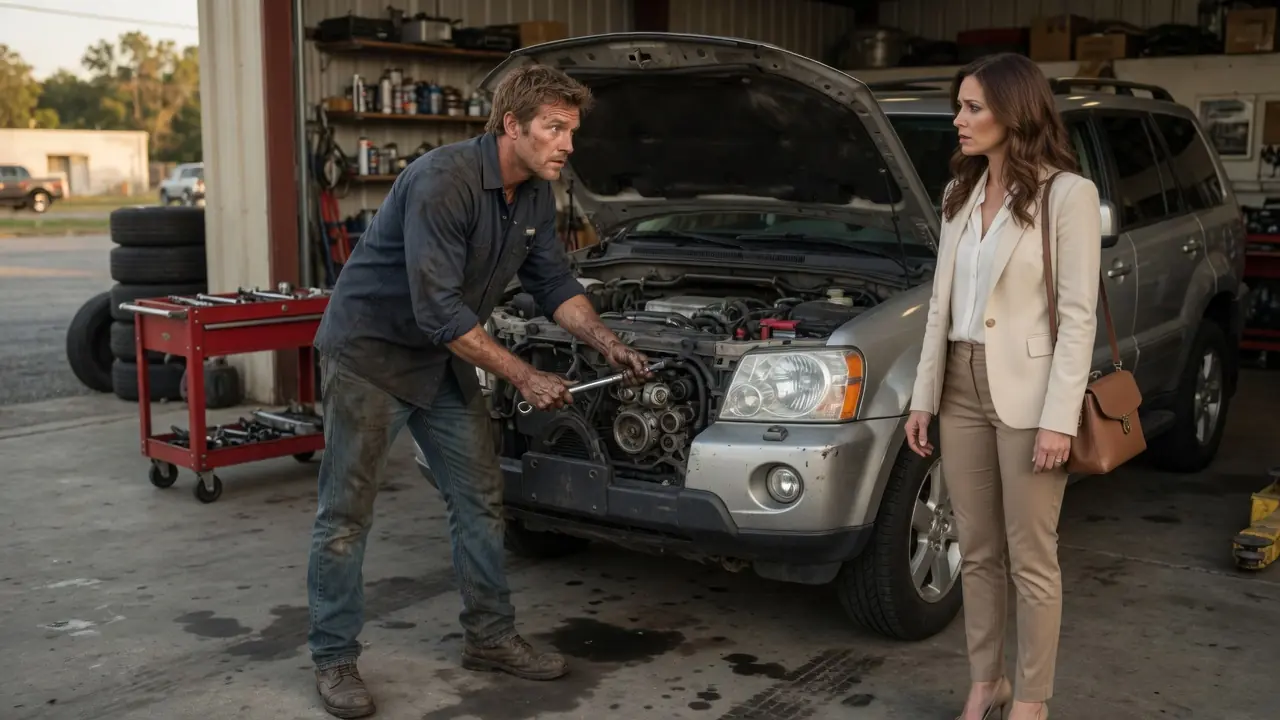
Clare sat behind the wheel in a cream blazer, pencil skirt, and heels that had been chosen for a boardroom, not a roadside emergency. Her phone showed one bar of signal, flickering in and out as if it too had decided this was not the day to be useful.
“Come on,” she whispered, gripping the steering wheel. “Not today.”
She tried again.
Click.
Nothing.
A long breath left her chest.
That morning, Clare had led a boardroom meeting in downtown Columbus, negotiating a multimillion-dollar contract with a calm voice, perfect posture, and the kind of controlled authority that made people twice her age sit straighter. She had walked through market projections, cost analyses, employee retention plans, and investor concerns without letting anyone see how tired she was.
Now, three hours later, she was stranded outside a grocery store with a dead SUV, a dying phone, and a son who needed to be picked up from robotics club by five.
The irony would have been funny if she had not been so close to crying.
Clare Donovan was thirty-six years old, founder and CEO of Donovan Design Group, a company that had grown from a small interior consulting firm into a regional design and commercial renovation business. She built office spaces, boutique hotels, restaurants, and luxury residential projects. She understood contracts, budgets, supplier delays, and the delicate art of keeping wealthy clients happy without letting them bully her team.
She did not understand engines.
Engines belonged to another world.
A world of belts, bolts, wires, oil, and men who could hear trouble before they saw it.
Clare turned the key once more.
This time, the SUV coughed.
Then sputtered.
Then, with a rough, reluctant sound, the engine came to life.
Clare froze.
For one second, relief flooded her so strongly she almost laughed.
Then the engine shook unevenly, and her relief thinned into suspicion.
“No,” she muttered. “I don’t trust you.”
The SUV had been acting strangely all week. Slow starts. Flickering dashboard lights. That clicking sound she had pretended not to hear because she was too busy, too tired, too buried under deadlines to add one more problem to the list.
But now, with the engine running unevenly and the rain turning heavier, she knew she needed help before the vehicle stranded her somewhere worse.
She searched for the nearest repair shop.
The first result made her pause.
Harris Auto Repair — 1.7 miles away.
The name tugged faintly at a memory she could not place.
She guided the SUV carefully through the wet streets, avoiding sudden stops, whispering encouragement to a machine that seemed personally offended by being asked to function. The garage sat near the edge of town, beside an old brick hardware store and across from a diner with fogged windows. The sign above the garage door was faded but clean.
Harris Auto Repair. Honest Work. Fair Prices.
Clare pulled into the lot just as the engine gave another rough shudder.
“Perfect timing,” she murmured.
Inside, fluorescent lights flickered overhead, casting long shadows across walls lined with tools, spare tires, oil cans, and a dusty pegboard where wrenches hung in careful order. The air smelled of motor oil, rubber, warm metal, and coffee that had probably been sitting too long in a pot somewhere. It was the opposite of Clare’s world of glass conference rooms, polished floors, and expensive lighting.
Yet something about it felt steady.
Grounded.
Real.
Her heels clicked against the concrete floor as she stepped out of the SUV.
A man looked up from under the hood of a silver sedan.
He was in his mid-thirties, tall, with broad shoulders and a strong frame shaped by work rather than gyms. His fair skin carried a faint tan from hours spent outside, and sandy brown hair stuck up in places as if he had run his hand through it too many times. A subtle scar marked the skin near his left eyebrow. His blue work shirt was streaked with oil, his jeans worn at the knees, and his hands were rough, capable, and grease-darkened.
He wiped them on a rag and looked at her vehicle.
“Starter trouble?” he asked.
His voice was calm.
A little familiar.
Clare frowned slightly.
“It won’t start properly,” she said. “Or it starts only after making me question all my life choices.”
One corner of his mouth lifted.
“That serious, huh?”
“It clicked about eight times, then decided to cooperate just long enough to scare me.”
He nodded, already walking toward the SUV.
“Mind if I take a look?”
She hesitated for only a second.
“Please.”
He moved with the quiet confidence of someone who had spent a lifetime under hoods and around engines. He popped the hood, leaned in, and began inspecting the starter motor, battery connections, and wiring. Clare watched the deliberate way his hands moved, the practiced rhythm of someone who understood machines not as mysteries but as conversations.
“When was the last time you had the starter checked?” he asked without looking up.
“I’m not sure. I bought the SUV six months ago.”
“Used?”
“Yes.”
“Dealership tell you everything was perfect?”
Clare gave a dry laugh.
“Of course.”
“That means they washed it.”
Despite herself, she smiled.
He reached deeper into the engine compartment.
“Loose terminal inside the starter connection,” he said after a minute. “Not fully gone, but it’s been getting worse. That’s why it starts sometimes and clicks other times.”
“You can tell that already?”
“I listen for a living.”
Clare leaned against the front fender, suddenly aware of how out of place she looked in her blazer and heels.
“I’m Clare, by the way.”
The mechanic looked up.
For the first time, their eyes met fully.
And something inside her memory stirred.
“Jason,” he said.
Jason.
The name landed softly but strangely in her chest.
She looked at him more closely. The blue eyes. The scar near his left eyebrow. The gentle grin. The way he tilted his head slightly before speaking, as if weighing the kindest version of what he wanted to say.
No.
It could not be.
“Jason Harris?” she asked slowly.
He paused with the socket wrench in his hand.
His brow furrowed.
Then recognition sparked across his face.
“Clare?”
Her breath caught.
“From Westfield High?”
He blinked, then smiled in disbelief.
“Clare Donovan.”
She laughed once, almost embarrassed by the sudden rush of memory.
“Oh my God. I can’t believe it.”
Jason straightened and wiped his hand again before offering it to her.
She took it.
His grip was warm, strong, and familiar in a way that made no sense after fifteen years.
“I never forgot you,” he said. “You were the only person in physics class who actually read the instructions before touching the wires.”
Clare laughed.
“And you were the only reason I passed that class.”
“That is absolutely not true.”
“It is extremely true.”
He shook his head, but he was smiling.
Just like that, the garage seemed to dissolve around her for a moment, replaced by a high school science lab with long black tables, buzzing fluorescent lights, and two teenagers bent over a circuit board. Clare remembered Jason at seventeen, quiet and patient, explaining voltage without making her feel stupid. She remembered the way he used to lend her pencils because she always lost hers. She remembered the tiny scar near his eyebrow from when he bumped into a locker during sophomore year and pretended it did not hurt.
Most of all, she remembered having a crush on him so quiet and careful that she never told anyone.
Not even herself, really.
Life had moved on.
College.
Marriage.
A son.
Divorce.
A company.
Deadlines.
Responsibilities.
And somewhere in all that living, Jason Harris had become a name folded away in an old memory.
Until her car refused to start.
Jason tightened the loose connection with steady hands.
“All right,” he said. “Try it now.”
Clare slid back into the driver’s seat and turned the key.
The engine roared to life smoothly.
No click.
No sputter.
No hesitation.
Relief rushed through her.
“Oh my God. Thank you.”
“Just a starter connection,” Jason said. “You’ll still need a proper replacement soon, but this should keep you from getting stranded today.”
She reached for her purse.
“How much do I owe you?”
He waved it off.
“It took a few minutes.”
“Jason.”
“I’m not taking your money for tightening a bolt.”
“I run a company. I understand labor value.”
“And I run this shop. I understand when something doesn’t need an invoice.”
Clare stared at him.
There was no arguing with that tone.
She pulled a business card from her purse and handed it to him.
“Then take this. If you ever need anything, call me.”
Jason looked down at the card.
Clare Donovan, CEO. Donovan Design Group.
His eyebrows rose slightly.
“Well,” he said, “I guess physics worked out for one of us.”
She smiled.
“You own the shop.”
“Technically, the bank and I are in a committed relationship.”
“Still. It’s yours.”
His expression softened.
“Yeah. It’s mine.”
A small voice came from the office doorway.
“Daddy, is the fancy lady’s car fixed?”
Clare turned.
A little girl stood there holding a juice box and a small stuffed fox. She was about six, with sandy brown curls, blue eyes like Jason’s, and a suspicious expression that made her look much older than she was. She wore a purple sweatshirt with silver stars and pink rain boots.
Jason’s face changed instantly.
The mechanic became a father.
“Emma,” he said gently, “we don’t call people fancy ladies.”
The girl considered this.
“She has shiny shoes.”
Clare looked down at her heels and laughed.
“That’s fair. They are very shiny.”
Jason sighed.
“Clare, this is my daughter, Emma. Emma, this is Ms. Donovan.”
Emma walked closer, inspecting Clare.
“Are you Daddy’s friend?”
Jason rubbed the back of his neck.
“We knew each other in high school.”
Emma looked unimpressed.
“That was a long time ago.”
“Thanks,” Jason said.
Clare crouched slightly to Emma’s level.
“It was. Your dad helped me pass physics.”
Emma brightened.
“Daddy helps everyone fix stuff.”
Clare glanced at Jason.
“I’m starting to see that.”
A buzzing from Clare’s phone broke the moment.
Owen’s school.
Her stomach tightened.
She answered quickly.
“Mrs. Donovan? This is Miss Tate from robotics club. Owen is fine, but pickup is at five. Just checking because he said you might be delayed.”
Clare checked her watch.
4:42.
Panic flickered.
“I’m on my way.”
Jason was already closing the hood.
“You’re good to go. Drive straight there. No extra stops.”
“Thank you. Really.”
He gave her a small nod.
“Good to see you, Clare.”
“You too, Jason.”
She got into the SUV, but before pulling away, she looked back through the rain-speckled windshield.
Jason stood near the garage bay with Emma beside him, her small hand tucked into his oil-stained one.
For reasons Clare could not explain, the sight stayed with her long after she drove away.
That evening, after picking up Owen, making pasta, answering six emails, reviewing a contract amendment, and pretending she was not thinking about Jason Harris, Clare found her son sitting cross-legged on the kitchen floor with a broken remote-control car in pieces around him.
Owen was eight years old, with dark hair, serious brown eyes, and an intense curiosity that made him ask questions even when everyone else had run out of patience. He had inherited Clare’s focus and his father’s quietness, though his father had not remained in their lives long enough for Owen to inherit much else.
“What happened to the car?” Clare asked.
“I’m improving it.”
“It looks deceased.”
“It’s not deceased. It’s in development.”
Clare smiled and sat beside him.
“Need help?”
Owen looked at her.
“Do you know how motors work?”
She hesitated.
“I know how to hire people who know how motors work.”
He sighed with the disappointment of a tiny engineer.
“I wish I knew someone who fixed things.”
Clare thought of Jason.
His steady hands.
His patient voice.
His daughter asking if the fancy lady’s car was fixed.
An idea took root before she could talk herself out of it.
“Actually,” she said, “I might know someone.”
The next afternoon, Clare returned to Harris Auto Repair with Owen in the passenger seat and the broken remote-control car in a shoebox.
Owen had asked seventeen questions on the drive.
“Is he a real mechanic?”
“Yes.”
“Does he fix race cars?”
“I don’t know.”
“Does he know about electric motors?”
“Probably.”
“Can I ask him?”
“Yes.”
“Can I ask many questions?”
Clare smiled.
“Try not to ask all of them in the first minute.”
When they arrived, Jason was rolling a toolbox across the garage floor. He looked up and seemed genuinely surprised to see her.
“Starter acting up again?”
“No,” Clare said. “Different emergency.”
Owen stepped forward, holding the shoebox like a sacred offering.
“My car is in development.”
Jason looked at the box, then at Clare.
“In development?”
“That’s what he calls it,” Clare said.
Owen opened the box.
“I took it apart because it was too slow, but now I can’t get the motor to connect again.”
Jason crouched beside him.
Not with fake adult patience.
With real interest.
“Well,” he said, “let’s see what we’ve got.”
Emma appeared from the office almost immediately.
“Is that a car?”
Owen looked at her.
“Remote-control car.”
“Does it go fast?”
“It used to.”
“Did you break it?”
“I upgraded it incorrectly.”
Emma nodded as if this made perfect sense.
“My dollhouse elevator is also upgraded incorrectly.”
Jason laughed.
“I told you, elevators made of string and tape require maintenance.”
Within minutes, the two children were sitting on the cleanest section of the workbench while Jason showed Owen how the motor connected to the battery pack. Emma leaned close, offering commentary that was only sometimes helpful.
Clare watched from a folding chair nearby.
At first, she checked emails.
Then she stopped pretending.
Jason was patient in a way that undid her.
He did not rush Owen. He did not take over. He explained wires, current, small contacts, and why forcing a part usually meant breaking something smaller. When Owen made a mistake, Jason simply said, “Good. Now you know one way it doesn’t work.”
Owen absorbed every word.
Emma handed tools with great seriousness, though she kept calling the screwdriver “the twisty stick.”
Clare sat there in her blazer and slacks, coffee cooling in her hand, and felt something inside her loosen.
This was not efficient.
It was not billable.
It did not scale.
It had no strategic value.
And it felt more meaningful than anything she had done all week.
After nearly an hour, Owen’s car came back to life.
It shot forward across the garage floor, swerved left, bumped into a tire, and flipped onto its side.
Owen cheered as if it had won a championship.
Emma clapped.
Jason grinned.
“Not bad for a first rebuild.”
Owen looked up at him with shining eyes.
“Can I come back?”
Clare opened her mouth to say they could not impose, but Jason answered first.
“Sure. If your mom says it’s okay.”
Both children looked at Clare.
She felt trapped by hope.
“We’ll see,” she said.
Owen groaned.
Emma whispered, “That usually means yes but later.”
Clare laughed.
Jason looked at her, and for a moment, the room grew quieter.
Not silent.
Just focused.
As if something between them had taken a small step closer.
Over the following weeks, Harris Auto Repair became part of Clare’s life in a way she had not planned.
It began with practical reasons.
The SUV needed a new starter.
Then Owen wanted to show Jason a sketch of a better remote-control car body.
Then Emma invited Owen to see the dollhouse elevator, which had become a pulley system, which then became a lesson in basic mechanics.
Then Jason texted Clare a photo of Owen and Emma wearing safety goggles, both looking absurdly proud beside a tiny battery-powered fan they had built from spare parts.
Clare showed the photo to her assistant, Marissa, who said, “You’re smiling.”
“I smile.”
“You smile professionally. That is different.”
Clare put the phone face down.
“I’m allowed to have friends.”
“Was I asking?”
“Yes, with your face.”
Marissa wisely left the office.
Week by week, Clare and Jason found excuses to see each other.
Lunches shared in the garage office.
Coffee in paper cups beside the workbench.
Conversations while Owen and Emma sorted bolts by size.
Quiet evenings when Clare arrived after work, still wearing heels, and Jason handed her an old shop hoodie because the garage was cold.
“You’ll ruin your blazer,” he said once.
“It’s already seen worse things than engine oil.”
“Like what?”
“Board meetings.”
Jason laughed.
The sound stayed with her.
Clare learned that Jason had been married.
His wife, Hannah, had died three years earlier after a sudden illness that changed everything quickly. Emma had been only three. Jason spoke of Hannah carefully, not because he wanted to hide her, but because the memories were still fragile in certain places.
“She loved this garage,” he told Clare one evening while Owen and Emma built ramps out of scrap wood. “She said it was loud, dirty, and honest.”
“That sounds like praise.”
“It was, from her.”
“She helped you run it?”
“She did the books. Talked customers down when they were mad. Made this place feel less like a shop and more like a family business.”
Clare looked toward the small office, where a framed photo sat on the shelf. A smiling woman with dark hair held a toddler Emma on her hip, both of them standing in front of the garage sign.
“She was beautiful,” Clare said.
Jason nodded.
“She was.”
“I’m sorry.”
“Me too.”
There was no awkwardness in the silence that followed.
Clare understood grief in a different way.
Her marriage had not ended in death, but in absence. Owen’s father, Richard, had left when Owen was five, not dramatically, not with some explosive betrayal, but through a slow withdrawal that had hurt in its own quiet way. Business trips became longer. Calls became shorter. Promises became vague. Eventually, he admitted he did not want the life they had built.
He sent money.
He missed birthdays.
Owen stopped asking when he would visit.
Some losses came with sympathy cards.
Others came with legal documents and a child learning not to hope too loudly.
Jason listened when Clare told him that.
He did not say Richard was a fool, though his face suggested he thought it.
Instead, he said, “Owen watches you like you hung the moon.”
Clare looked away.
“I’m not sure that’s healthy.”
“It means he trusts you.”
“It means he depends on me too much.”
Jason leaned against the workbench.
“Kids depend on the people who stay. That’s not a failure.”
Clare swallowed.
She had not realized how badly she needed someone to say that.
The garage became a haven.
For Owen, it was a world of wonder. He learned how to check tire pressure, how batteries worked, why engines needed oil, how a loose connection could stop a whole system, and why safety goggles were not optional even if they made Emma look “like a bug scientist.”
For Emma, it was a place where her father smiled more.
For Clare, it became a place where she could breathe.
Her corporate world was not evil. She loved her company. She loved design, problem-solving, and building spaces that worked. But somewhere along the way, she had begun to measure her worth only by performance. Revenue. Growth. Deadlines. Employee count. Client approval. Investor confidence.
At Harris Auto Repair, nobody cared about her quarterly targets.
Jason cared whether she had eaten.
Owen cared whether they could build a better ramp.
Emma cared whether Clare knew how to braid hair, because Jason was “medium okay but not advanced.”
One Friday evening, rain fell hard outside, drumming on the garage roof. Clare sat on a stool near the workbench while Jason cleaned tools. Owen and Emma were in the office eating grilled cheese sandwiches and watching a movie on an old tablet.
“You know,” Clare said softly, “I’ve spent so many years chasing deadlines, contracts, and boardroom victories. I thought that meant I was building a life.”
Jason looked up.
“And now?”
“Now I feel more alive sitting in this garage watching two kids argue over a screwdriver.”
He smiled.
“To be fair, the screwdriver argument had emotional depth.”
“Emma called it the twisty stick again.”
“She is committed to her terminology.”
Clare laughed, then grew quiet.
“I didn’t realize how lonely success could feel.”
Jason set down the rag.
“People don’t talk about that part much.”
“No. They talk about the view from the office, not how quiet it is when you go home.”
Jason leaned against the bench across from her.
“Sometimes the best work isn’t the work people applaud. Sometimes it’s these little moments. Watching someone learn. Fixing something that mattered to them. Being needed in a way that has nothing to do with your title.”
Clare felt a lump rise in her throat.
“I never realized how much I missed that.”
Jason’s eyes met hers.
“Maybe some things were meant to wait.”
“For what?”
“For the right time,” he said. “The right people. The right broken starter.”
Her heart did something foolish.
Something young.
Something that remembered physics class and borrowed pencils.
Before she could answer, Emma called from the office.
“Daddy, Owen says spaceships need wheels, and I say they don’t because space has no roads.”
Jason closed his eyes.
Clare smiled.
“Duty calls.”
He pointed at her.
“This debate may decide the future of engineering.”
The easy rhythm might have continued that way, slowly and safely, if life had not decided to test it.
In early February, Clare received an email from her largest investor.
The subject line was short.
Expansion Opportunity — Westfield Corridor
She opened it between meetings and felt her stomach tighten.
Her investors wanted Donovan Design Group to acquire and redevelop a property cluster near Westfield’s old commercial district. The project would include boutique retail, coworking space, luxury apartments, and a flagship design showroom. The numbers were strong. The location was ideal. The timeline was aggressive.
The property map attached to the proposal included Harris Auto Repair.
Clare stared at the screen.
For a moment, she could not move.
The garage was marked in blue, labeled as “parcel suitable for demolition or adaptive redevelopment.”
Demolition.
The word felt obscene.
She clicked through the documents quickly, her pulse rising.
The investment group had already begun conversations with several property owners nearby. Jason’s lot was listed as “critical frontage.” Without it, the project lost visibility and parking access. With it, the proposal became financially powerful enough to secure a major funding round.
Her assistant knocked once and entered.
“Clare? Your eleven o’clock is here.”
Clare closed the laptop.
“Give me five minutes.”
Marissa studied her face.
“Are you okay?”
“Yes.”
It was a lie.
A familiar one.
That evening, she did not go to the garage.
Jason texted at seven.
Owen forgot his sketchbook here. Want me to drop it off?
Clare stared at the message for a long time.
Then replied:
Long day. We’ll pick it up tomorrow. Thank you.
He answered:
Everything okay?
She typed three different responses and deleted all of them.
Finally, she wrote:
Just work.
Jason did not push.
That somehow made it worse.
For three days, Clare avoided the garage.
She told Owen she was busy.
She told herself she needed time to think.
She told Marissa to reschedule anything involving the Westfield proposal until she could review the numbers more thoroughly.
But Marcus Vale, her lead investor, was not a man who appreciated hesitation.
He called her Thursday afternoon.
“Clare, this corridor project is exactly what we’ve been waiting for. High visibility, strong margins, mixed-use potential. Why are you dragging your feet?”
“I’m not dragging my feet. I’m reviewing community impact.”
Marcus laughed lightly.
“Community impact?”
“Yes.”
“Clare, it’s an aging strip with a few underperforming businesses. We can offer buyouts, relocation assistance, whatever makes the press release sound generous.”
Her hand tightened around the phone.
“One of those businesses is not underperforming. It’s a family-owned garage.”
“Sentimental?”
“Human.”
“Same thing in real estate, unfortunately.”
She closed her eyes.
“Marcus.”
“Look, I respect your compassion. It’s part of your brand. But don’t confuse kindness with strategy. This deal could secure your next five years. You have employees depending on your ability to make hard choices.”
There it was.
The pressure point.
Employees.
Payroll.
Growth.
Responsibility.
He was not wrong.
That was what made it difficult.
After the call, Clare sat alone in her office, looking out at the city. For years, she had believed good leadership meant carrying impossible choices without flinching. Now she wondered how many times she had called something difficult when it was simply wrong.
That evening, Owen stood in the kitchen holding his backpack.
“Are we ever going back to Jason’s?”
Clare looked up from the sink.
“What?”
“You keep saying tomorrow.”
Her chest ached.
“I know.”
“Did he do something wrong?”
“No.”
“Did Emma?”
“No, sweetheart.”
“Then why don’t we go anymore?”
Clare dried her hands slowly.
Because my company wants to tear down the place where you learned engines have patience.
Because I’m afraid I’ll choose wrong.
Because I don’t know how to protect everyone.
Instead, she said, “I’ve been dealing with something complicated.”
Owen’s face grew serious.
“Can Jason fix it?”
Clare almost laughed.
Then almost cried.
“I don’t know.”
On Saturday morning, Clare drove to the garage.
Owen sat beside her, unusually quiet.
When they arrived, Emma ran out first.
“Owen! You missed pulley testing.”
Owen jumped out, immediately drawn into her excitement.
Jason emerged from the garage a moment later.
He looked tired.
Not angry.
Just careful.
“Hey,” he said.
“Hi,” Clare replied.
The distance between them felt awful.
Jason wiped his hands on a rag.
“You okay?”
“No.”
His expression changed.
“Come inside.”
They sat in the small office while Owen and Emma worked nearby under strict instructions not to touch anything with wires.
Clare placed the printed development proposal on Jason’s desk.
He looked at it.
Then at her.
“What is this?”
“My company is being pushed to lead a redevelopment project on the Westfield corridor.”
He opened the folder.
She watched him find the map.
Watched him see his garage marked in blue.
Watched his face close slowly.
“Oh.”
“Jason—”
“They want the shop.”
“Yes.”
“And you knew.”
“For three days.”
He leaned back, jaw tight.
“That’s why you disappeared.”
“Yes.”
The truth sat between them, sharp and ugly.
Jason looked through the pages quietly. Clare hated that he did not yell. Yelling would have been easier. Instead, he read the numbers, the property description, the investor notes, the phrase adaptive redevelopment that somehow made erasing a family business sound tasteful.
“My dad built this place,” Jason said finally.
“I know.”
“No, Clare. You know it as a fact. I mean he built it. With his hands. After my grandfather died, he kept it alive. After Hannah died, this place kept me alive.”
Clare’s eyes burned.
“I know it matters.”
“Do you?”
“Yes.”
He looked at her then.
“Are you going to do it?”
She did not answer fast enough.
Pain moved across his face.
“I see.”
“No,” she said quickly. “You don’t.”
“I think I do.”
“I’m trying to find another way.”
“Is there one?”
“I don’t know yet.”
Jason looked down at the proposal.
“I’ve had offers before. Developers come in with nice words and numbers that look big until you realize they’re pricing your history like scrap metal.”
“I don’t want that.”
“But you might still sign it.”
Clare’s throat tightened.
“I have two hundred employees. If I walk away from every profitable deal because it hurts someone, I may not have a company left.”
Jason nodded slowly.
“That’s fair.”
His calm hurt more than anger.
“But I have one daughter,” he continued. “One promise to Hannah. One place where Emma still feels her mother. I can’t treat that as negotiable just because someone else’s spreadsheet needs more parking.”
Clare closed her eyes.
“I’m sorry.”
“Me too.”
Owen appeared in the office doorway, sensing something wrong.
“Mom?”
Clare stood quickly.
“We should go.”
Emma looked from Jason to Clare.
“Did the grown-ups break something?”
Nobody answered.
That night, Clare could not sleep.
She sat at her dining table surrounded by maps, zoning documents, site plans, financial models, and photographs of Harris Auto Repair. She looked at every possible angle. Every parking layout. Every frontage requirement. Every investor demand.
At two in the morning, she stopped looking at the garage as an obstacle.
She looked at it as an anchor.
A design idea began to form.
Not demolition.
Integration.
Preservation.
Adaptive use, but honest this time.
By sunrise, she had filled an entire notebook.
By noon, she had called Marissa, her architect, her legal team, and one very annoyed Marcus Vale.
“What if we build around it?” she said during the emergency video call.
Marcus stared at her.
“What?”
“The garage stays. Harris Auto Repair becomes the anchor tenant. We redesign the corridor around existing local businesses instead of erasing them.”
“That reduces rentable square footage.”
“It increases story value, community buy-in, and long-term stability.”
“Story value does not pay debt service.”
“It does when customers care where they spend money.”
Her architect leaned forward.
“Actually, if we preserve the garage frontage and build the design showroom above the rear parcel, we could create a shared maker courtyard. Auto repair, furniture restoration, design studio, small retail. Craft and repair as the theme.”
Marissa smiled slowly.
“That’s good.”
Marcus looked unconvinced.
“It’s messy.”
“So is every real place people love,” Clare said.
He narrowed his eyes.
“You’re emotionally involved.”
“Yes.”
That silenced the room.
Clare continued.
“And being emotionally involved has made me see what the original proposal missed. We were about to destroy the one thing that made the corridor worth saving. People don’t want another sterile luxury block. They want places with roots.”
Marcus said nothing.
Clare leaned closer to the screen.
“You wanted a flagship. This is it. A design district built around repair, craft, sustainability, and local history. Donovan Design Group doesn’t bulldoze meaning. We build with it.”
The room went quiet.
Then her architect said, “I can work with that.”
Marissa said, “Marketing can absolutely work with that.”
Marcus sighed.
“I hate that this might be brilliant.”
Clare smiled for the first time in days.
“Good. Then let’s make it impossible to reject.”
Two days later, Clare returned to Harris Auto Repair.
This time, she came alone.
Jason was under the hood of a truck. He looked up when she entered, and the guarded expression on his face nearly broke her.
“I have something to show you,” she said.
He wiped his hands.
“Clare—”
“Please.”
She set a new folder on the workbench.
Not the old proposal.
A new one.
Jason opened it cautiously.
The first page was a rendering.
Harris Auto Repair remained exactly where it stood, the original sign restored, the brick cleaned, the garage bays upgraded but preserved. Behind and beside it rose a low, beautiful mixed-use building with warm wood, steel, glass, and a central courtyard. The courtyard connected the garage to a design showroom, small workshops, a café, and a community learning space.
At the center of the rendering was a sign.
Harris Repair & Design District.
Jason stared at it.
Clare held her breath.
“The garage stays,” she said. “You stay. Full ownership protection. Long-term operating agreement. Renovation funded through the development budget, but no loss of control. We build around the shop, not over it.”
Jason did not speak.
She rushed on.
“Owen and Emma inspired part of it. A youth workshop program. Mechanical basics, design basics, practical skills. We can partner with the school district. Your shop becomes the heart of the project.”
His jaw worked.
“You did this?”
“Yes.”
“For me?”
Clare shook her head.
“For all of us. For you, for Emma, for Owen, for my employees, for the town. For the version of my company I can still be proud to lead.”
Jason looked at the rendering again.
“Hannah always wanted a community workshop,” he said quietly. “She said kids needed places to learn with their hands.”
Clare’s eyes filled.
“Then let’s build that too.”
He closed the folder slowly.
“I’m still hurt.”
“I know.”
“You should have told me sooner.”
“I know.”
“You scared me.”
“I scared myself.”
He looked at her then.
No polished boardroom language could help her now.
Only truth.
“I thought success meant never letting personal feelings interfere with hard decisions,” Clare said. “But I think I got that wrong. Feelings are information too. They tell us what we’re about to lose.”
Jason’s face softened slightly.
“And what were you about to lose?”
She swallowed.
“You.”
The word hung between them.
Quiet.
Honest.
Terrifying.
Jason stepped closer.
“I’m not a project, Clare.”
“I know.”
“And I don’t need saving.”
“I know that too.”
“What do you need?”
She looked at him.
“A chance to do this right.”
He was silent for a long moment.
Then he reached for her hand.
His fingers were warm, rough, familiar.
“One chance,” he said.
Clare let out a breath she had been holding for days.
“One chance,” she promised.
The months that followed were not easy.
Nothing real ever was.
There were zoning meetings, investor reviews, budget revisions, community hearings, architectural surveys, and tense conversations with people who preferred clean demolition to complicated preservation. Marcus Vale questioned costs weekly. Jason questioned legal language twice as often. Clare’s team worked late nights. The town argued. Reporters called the project ambitious, risky, charming, impractical, visionary, and sentimental depending on the day.
Through it all, the garage stayed open.
Owen and Emma became unofficial mascots of the project. They wore tiny hard hats during site visits and argued over whether the youth workshop should include robotics, engines, furniture repair, or all of the above. Emma insisted the workshop needed a snack shelf. Owen insisted it needed a circuit station. Jason said both were possible if they cleaned up after themselves.
Clare and Jason rebuilt trust the slow way.
Not with grand apologies.
With consistency.
She told him difficult things sooner.
He told her when he felt overwhelmed instead of pretending he was fine.
They learned each other in ordinary ways.
Clare learned Jason drank coffee too late and then complained he could not sleep. Jason learned Clare forgot lunch when stressed and kept protein bars in her desk that tasted like cardboard. Clare learned Emma liked her hair braided in two uneven braids because “perfect is boring.” Jason learned Owen became quiet when he worried adults were angry, and that the best way to reach him was to ask for help with a practical task.
The children found family faster than the adults did.
One evening in late spring, Owen and Emma sat side by side on the garage floor, building a small wooden car with battery-powered lights. Clare and Jason stood nearby, watching.
Emma leaned toward Owen.
“If our parents get married, you can be my brother.”
Owen looked at her.
“Do we get to vote?”
“I already voted yes.”
“That’s not how voting works.”
“It is if I win.”
Jason coughed to hide a laugh.
Clare covered her mouth.
Owen looked up.
“Are you two getting married?”
Clare nearly dropped her coffee.
Jason turned red.
“That is not currently on the workbench,” he said.
Emma frowned.
“Can we put it there?”
“Finish the car,” Jason said.
The kids groaned.
But after they returned to their project, Jason looked at Clare.
“Not currently on the workbench,” she repeated.
He smiled.
“Seemed safer than answering.”
She laughed.
For the first time, the idea did not scare her.
A year after Clare’s SUV refused to start, the Harris Repair & Design District opened.
The ribbon-cutting took place on a bright Saturday morning in early summer. The old garage sign had been restored and rehung, its letters repainted but not replaced. The repair bays gleamed with updated equipment. The courtyard was filled with planters, benches, and long tables for community workshops. Donovan Design Group’s showroom occupied the upper level, overlooking the garage through tall windows.
The first youth workshop was fully booked.
Owen demonstrated a simple motor circuit.
Emma explained pulley systems, still calling screwdrivers twisty sticks despite everyone’s objections.
Jason gave a short speech and nearly cried when he mentioned Hannah.
Clare stood beside him and did cry when he thanked her for seeing the garage not as an obstacle but as a heartbeat.
Marcus Vale attended in a linen suit, looking slightly uncomfortable among real people and power tools.
“I’ll admit it,” he told Clare quietly. “You were right.”
She smiled.
“I’m sorry, could you repeat that while I record?”
“Absolutely not.”
The project became more successful than anyone expected.
Customers came for the design showroom and stayed for the garage café. Local families signed up for workshops. Donovan Design Group gained national attention for human-centered redevelopment. Investors loved the numbers once the numbers loved them back. Jason’s shop grew without losing itself. Two local businesses that had been near closing found new customers because the district brought foot traffic without erasing them.
But the best moments were smaller.
Owen learning to solder safely.
Emma teaching a younger child how to use a hand drill under supervision.
Clare eating lunch at the garage counter instead of at her desk.
Jason walking into her office with oil on his sleeve and flowers in his hand, looking completely out of place and completely right.
One evening after closing, Clare found Jason in the courtyard.
The summer air was warm. String lights glowed overhead. The garage doors were closed, the showroom lights dimmed, and the children were upstairs in the workshop loft playing a board game under Marissa’s supervision.
Jason stood beside the restored Harris Auto Repair sign, looking at it quietly.
Clare walked up beside him.
“What are you thinking?”
He took a deep breath.
“My dad would’ve liked this.”
“And Hannah?”
“She would’ve said I took too long to paint the office.”
Clare smiled.
“She sounds wise.”
“She was.”
He turned to her.
“I used to think keeping the garage exactly the same was the only way to honor them. But this…” He looked around the courtyard. “This feels like it’s still ours. Just bigger.”
Clare nodded.
“I used to think building meant replacing what came before. Now I think the best building listens first.”
Jason reached for her hand.
“You changed my life, Clare.”
She shook her head.
“My car broke down.”
He laughed softly.
“Best mechanical failure I ever saw.”
She leaned into him.
“Don’t say that around my SUV. It will get ideas.”
He grew quiet then.
“I love you.”
Clare closed her eyes.
The words were not dramatic.
Not shouted in the rain.
Not delivered in some perfect romantic setting.
They were spoken beside a garage sign, under string lights, with the faint smell of oil and summer flowers in the air.
Somehow, that made them perfect.
“I love you too,” she whispered.
Six months later, Jason proposed in the youth workshop.
Not because it was elegant.
Because, as Emma explained loudly, “This is where everything got fixed.”
Owen had helped build a small wooden box with a hidden compartment. Emma had decorated it with gears, flowers, and one crooked heart. Jason handed it to Clare during a family workshop night, his hands shaking slightly despite having rebuilt engines without fear.
Clare opened the box.
Inside was a ring.
Simple.
Beautiful.
Entirely unexpected, even though everyone else in the room seemed to know.
Jason knelt on one knee.
“Clare Donovan,” he said, voice thick, “you came into my garage because your car wouldn’t start. Then somehow you helped my life start again. You loved my daughter, trusted my work, challenged me, scared me half to death, and stayed long enough to rebuild what almost broke.”
Emma whispered, “Good speech, Daddy.”
Jason smiled through emotion.
“Owen, Emma, and I already voted.”
Owen raised a hand.
“It was unanimous.”
Emma added, “I voted twice.”
Jason looked up at Clare.
“Will you marry me?”
Clare was crying too hard to answer at first.
Then she nodded.
“Yes. Absolutely yes.”
The children erupted.
Emma hugged her waist.
Owen hugged Jason.
Marissa took photos.
Marcus Vale, who had somehow been invited, stood in the back pretending he had something in his eye.
The wedding took place the following autumn in the courtyard between Harris Auto Repair and Donovan Design Group.
There were flowers along the benches, string lights overhead, and toolboxes hidden badly behind white fabric because Emma insisted “the garage should dress up too.” Clare wore a simple ivory dress. Jason wore a navy suit and polished boots. Owen carried the rings in the wooden box he had built. Emma scattered flower petals with the focus of someone performing critical engineering work.
Clare walked down the courtyard path not toward a perfect life, but toward a real one.
A life with oil stains, school pickups, board meetings, homework, grief, laughter, broken appliances, repaired engines, and two children who had already decided they were siblings before paperwork caught up.
When she reached Jason, he took her hand.
“You okay?” he whispered.
She smiled.
“Engine’s running.”
He laughed softly.
During the vows, Jason promised to be steady when life clicked and stalled. Clare promised to listen before building, to protect what mattered, and to never again confuse progress with erasing history. Emma whispered to Owen that grown-ups used too many words, and Owen whispered back that this was probably legally required.
After the ceremony, they danced in the courtyard while music played from a speaker Owen had repaired with Jason’s help. Customers, employees, neighbors, investors, mechanics, designers, teachers, and children filled the space. It was not the kind of room Clare once imagined for herself.
It was better.
Late that night, after the guests left and the children fell asleep on a pile of blankets in the workshop loft, Clare and Jason stood alone in the garage.
The lights were low.
The tools hung neatly on the wall.
The air still carried the familiar scent of motor oil and warm metal.
Clare looked at the spot where her SUV had first sat with its stubborn starter and dying battery connection.
“I was so annoyed that day,” she said.
Jason smiled.
“I remember.”
“I thought it was the worst possible timing.”
“It was.”
She looked at him.
“Was it?”
He took her hand.
“No,” he said. “It was exactly on time.”
Clare leaned against him, listening to the quiet hum of the building around them.
Her company had grown, but more importantly, it had changed. Owen had confidence she had never seen before. Emma had laughter in places grief had once quieted. Jason had kept his promise to Hannah by letting the garage become more than a memorial. And Clare had found something she had not known she was missing.
Not just love.
Not just family.
A life that felt built instead of performed.
Sometimes, a breakdown is not the end of the road.
Sometimes, it is the only reason you stop long enough to see what you have been driving past.
Clare had arrived at Harris Auto Repair frustrated, stranded, and certain she did not have time for one more problem.
She left with a repaired starter, an old friend rediscovered, and the first hint of a future she never could have designed alone.
And years later, whenever anyone asked how she and Jason found each other again, Clare always smiled and said the same thing.
“My car knew before I did.”
Jason would laugh, shake his head, and correct her.
“It was a loose starter connection.”
But Clare knew better.
Some connections only look loose.
Some have been waiting years to be tightened again.