Three weeks after that night, a lawyer would knock on Daniel Holbrook’s diner door and remind him of that couch.
But tonight, Daniel didn’t know.
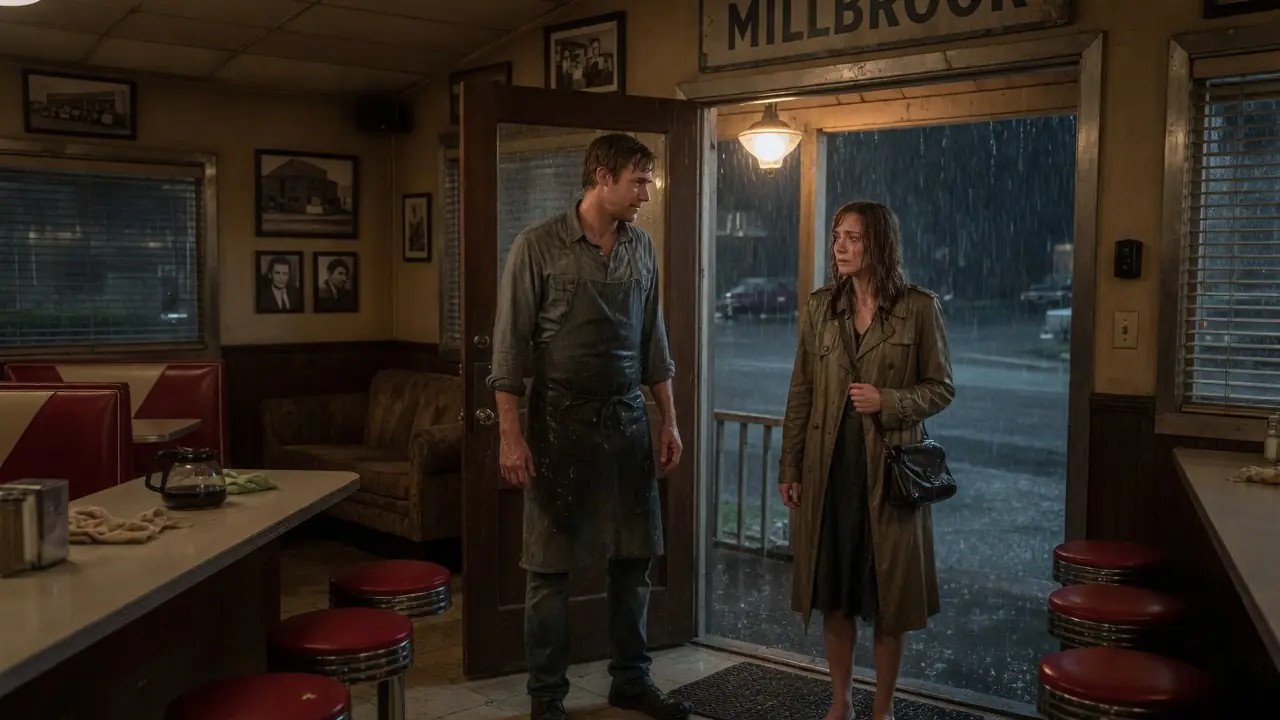
Tonight, he only saw a woman soaked through, standing on the porch of his diner at 11:40 in the evening, shaking, her eyes red from the wind.
“I don’t have a place to sleep. My car died. I’m sorry.”
Daniel should have asked who she was.
He didn’t.
He opened the door wider and nodded toward the old couch in the corner of the diner.
“Come in. We’ll figure it out in the morning.”
The diner smelled like burnt coffee and rain. Daniel locked the front door behind her, turned the deadbolt out of habit, then turned it back. He pulled a clean towel from behind the counter and set it on the cushion next to her.
“There’s a fresh pot on. You take it black?”
“Yes.”
She wrapped the towel around her shoulders. She did not take off her coat. Her hands were trembling, but it was not from fear. It was the kind of trembling that comes from being cold for a long time and only noticing once the cold stops.
Daniel poured two cups. He set one in front of her on the small side table by the couch. He took his own to the counter and stood behind it because that was the only place in the building where he knew how to stand.
He did not ask her name.
He did not ask where she had been driving from.
He did not ask why a woman who could afford a car worth more than his diner had ended up at his door without a phone.
She drank the coffee slowly. Her eyes moved around the room.
The diner was small, twelve seats, a counter with seven stools, a wall of black-and-white photographs of Millbrook High School football teams going back to 1968, a bookshelf next to the entrance that held paperbacks customers had left behind, a jar of pens, and one framed photograph.
The photograph was of a woman holding a newborn baby. The woman was laughing. The baby’s eyes were closed.
Eleanor’s coffee cup stopped halfway to her mouth. She held it there for one second longer than she should have. Then she set it down on the table and looked at the photograph for another moment before turning her face toward the window.
Daniel was washing a plate at the sink. He did not see.
She slept on the couch with one hand resting on the wallet beside her hip.
Inside the wallet, behind her driver’s license, folded into a square so small it had become almost a token, was a letter. She had carried it for twelve years.
She did not sleep deeply.
She did not need to.
She had come for one night.
At 5:47 in the morning, she was already awake. The coffee maker was on. Daniel was in the kitchen with his back to her, slicing bread. He had not asked her if she wanted breakfast. There was a plate on the counter anyway.
She left forty dollars on the kitchen table.
When she reached for the door, he was already there, holding it open. He took the bills from the table and put them back into the pocket of her coat before she could stop him.
“You don’t owe me anything.”
He paused on the threshold.
“You didn’t ask my name.”
“You didn’t need to say. If you wanted to, you would have.”
She nodded.
She walked down the porch steps the way a person walks who has just been given something they did not know how to ask for.
Halfway down the sidewalk, she stopped. She turned back and looked at the diner once more, the way a person looks at a place they intend to remember.
Then she was gone.
Three weeks passed.
Daniel had tried, in the first few days, to find her. He called the towing service that worked the back roads out of Millbrook. The dispatcher told him a luxury SUV had been recovered from Route 19 the morning after the storm. The bill had been paid by a limited liability company registered in Delaware. There was no name attached.
Daniel had thanked him and stopped asking.
He had stopped thinking about her by the end of the second week.
Mostly.
It was 11:00 on a Thursday night when the knock came.
Daniel was wiping down the counter. The diner had been closed for an hour.
The knock was three beats, evenly spaced.
A man in a dark suit stood on the porch with a leather briefcase and an umbrella he had not opened.
The pause was small but deliberate.
“She asked me to come and tell you who she is, and to tell you about your wife.”
Daniel did not move from the doorway. The cold from outside pressed in around the man on the porch.
“You can come in.”
Whitlock stepped inside. He looked around the diner the way a man with three lawyers in his firm looks at a place with twelve seats and a bookshelf. Not with contempt, with something closer to caution.
He sat at the counter without being asked. He set the briefcase flat on the surface and clicked the latches.
“Mrs. Vance asked me to begin with the document.”
He laid a folder between them. It was thicker than Daniel expected, forty pages, possibly fifty. The cover sheet bore a single line of text in serif font.
The Margaret Holbrook Community Preservation Trust.
Daniel did not touch it.
He looked at the title. He looked at Whitlock.
“Why is my wife’s name on that?”
“Mrs. Vance wishes to explain that herself. She is waiting outside. She will not come in unless you allow it.”
Daniel did not answer. He pulled the folder toward him and opened it.
The first page was a summary.
Four million dollars.
Ten-year disbursement schedule.
Beneficiaries: small businesses in the borough of Millbrook, Pennsylvania, with priority given to family-owned operations of twenty years or more on the public commercial registry.
The trust was designed to indemnify those businesses against eminent domain proceedings and predatory acquisition offers, specifically including offers from Vance Industries or its subsidiaries.
Daniel read it twice.
He turned to the operative clauses.
He stopped at section 3.7. He read it twice. He went to section 12.2. He read that one three times.
He closed the folder.
There was a small sound at the corner of his mouth that was not quite a laugh.
Whitlock watched him.
“Mr. Holbrook, this trust is structured under the Tier Three Pennsylvania Community Preservation Framework.”
“That is correct.”
“Do you know who wrote the original template?”
“I do not.”
Daniel looked at him.
“I did. In 2016, at Caldwell and Marsh. I was a partner there for eight years before my wife got sick. The clause at 3.7 was mine. So was the indemnity language at 12.2. The whole framework was written in my office on the thirty-second floor of the One Oxford Centre building in Pittsburgh. I left the firm in 2019.”
Whitlock’s face did not change, but the color went out of it.
He looked at the folder. He looked at Daniel.
“No one in our firm was aware.”
“Of course you weren’t.”
Daniel stood up. He walked around the counter, past Whitlock, to the front door. He opened it and looked across the street.
She was standing under the streetlamp by her car. No coat against the cold this time. A simple jacket. No driver. No security. Alone. The way she had been on the porch three weeks ago when she had told him her car had died and he had let her in without asking the questions a reasonable man should have asked.
“Come in, Ellie.”
She crossed the street slowly. Her hands were in her jacket pockets. She climbed the porch steps and stopped on the threshold.
“You knew.”
“I knew the moment you walked in last night. Twenty minutes after I saw your face on the local news two weeks ago. I knew when you didn’t tell me your name. I knew when you looked at the photograph on the bookshelf and held your coffee the wrong way for one second too long. I knew. I let you stay anyway.”
She did not respond.
She stepped inside. She walked past Daniel, past Whitlock, past the counter. She stopped at the bookshelf. She looked at the photograph of Margaret holding Lily, the one she had looked at three weeks ago when the rain was still in her hair.
She did not turn around when she spoke.
“Your wife saved my life twelve years ago. I don’t know where to begin.”
Daniel sat down in the booth nearest the window.
He did not say anything.
He had run out of things to say at that exact moment.
Whitlock excused himself. He took his briefcase and stepped onto the porch and pulled the door shut behind him without making a sound.
The lock had been broken since November. Daniel had not bothered to fix it.
Eleanor turned away from the bookshelf.
“I need Edith Marlowe to be in the room when I tell you everything. She has the rest of it. I have only one piece.”
“Edith Marlowe lives three blocks from here.”
“Tomorrow, ten in the morning, at her house. She is expecting us.”
Daniel did not ask how Eleanor knew where Edith lived. He did not ask why Edith would be expecting them.
He understood that the questions he could ask now were small ones, and the answers he wanted were not the kind he could get tonight.
He asked one anyway.
“Why the storm?”
Eleanor sat down on the stool across from him. She did not soften.
“I drove past your diner six times in six months. I never stopped. I parked at the gas station on Route 19 and watched the front window for an hour on a Tuesday in September. I left without ever opening the door of my car. The night of the storm, I came back. My car died on Mill Pond Road. That part was real. I did not call a tow. I left the car where it was, and I walked here in the rain because I needed to know if you were the man Margaret thought you were. I did not have the right to ask you that question, but I asked it. I’m sorry.”
Daniel was quiet for a long time.
“You don’t have to apologize for kindness.”
“I have to apologize for treating yours like a test.”
Footsteps sounded on the stairs, soft ones.
Lily came down in her astronomy pajamas, the ones with the constellations printed across the chest, holding a book she had been reading by flashlight in her bed.
She stopped on the bottom step when she saw Eleanor.
“You’re the lady from the couch.”
“Yes.”
Lily came the rest of the way down. She did not look at Daniel. She walked to the couch and sat on it the way a child sits on a thing she has decided belongs to her.
“Do you know this one?”
She turned the book so Eleanor could see the cover.
Cassiopeia.
The W of bright stars rising over a black field.
“Cassiopeia,” Eleanor said. “The W.”
“Your mother used to tell you about her when you were younger than you are now.”
Daniel was standing by the door.
He heard the sentence. He did not turn his head, but his eyes changed.
Margaret had told Cassiopeia to Eleanor.
Margaret had told the same story to a stranger in a courtroom in 2014, who had then carried it for twelve years like a child carries a stone in her pocket.
He had not known.
Margaret had never told him about a young woman in a courtroom.
Lily sat next to Eleanor on the couch where Eleanor had slept three weeks before.
They talked about stars for ten minutes.
Daniel watched. He did not move from the doorway.
When Lily went back up the stairs, Eleanor stood.
“Tomorrow, ten in the morning. I’ll be there.”
She walked to the counter. She placed something on it, a piece of paper folded into quarters. The creases were soft and dark with the work of many hands and many years.
She did not say what it was.
She left.
Daniel waited until the sound of her car had faded down Main Street.
Then he picked up the paper.
It was Margaret’s handwriting.
You don’t owe me anything. But if you ever need to pay it back, find someone else who’s where you were. That’s how this works.
MH, April 22nd, 2014.
Daniel sat down in the booth where he had been sitting an hour ago. He held the letter in both hands.
He did not cry.
He sat.
Eleanor drove the sixty miles back to Pittsburgh that night and was in her office on the forty-seventh floor of the Vance Industries Tower by 6:00 in the morning.
She had not slept.
She did not need to.
Marcus Aldridge came in at 7:30. He was carrying a coffee from the lobby vendor and the morning Wall Street Journal. He set both on her desk before he saw her face.
“Eleanor, you’re in early.”
“Tell me about the Millbrook acquisition list.”
Marcus did not blink. Twenty-five years of corporate operations had taught him not to.
“Routine portfolio. We have title and zoning on fourteen Main Street properties. The borough has been receptive.”
“Pull Holbrook’s Diner, Eleanor. Pull it today and bring me the original underwriting on the entire list before lunch.”
He nodded. He left.
He did not ask why a property worth less than half a million dollars on a portfolio carrying four hundred twenty million in projected return mattered enough to interrupt her morning.
He did not ask, but he wondered.
By noon, he had a private investigator under contract in Millbrook.
Daniel drove to the sheriff’s substation on Route 22 before the diner opened.
Sam Reeves was at his desk eating a breakfast sandwich. Daniel set the letter from the previous night on the desk between them.
Sam read it.
He set the sandwich down.
“Margaret did pro bono work in Pittsburgh before you two married.”
“I knew that.”
“I never knew what cases.”
“I didn’t either.”
Sam looked at him.
“Go talk to Edith Marlowe.”
“What does Edith have to do with this?”
“Edith moved to Millbrook in 2017. Six months after Margaret died. She bought a house on Hawthorne Street with cash. She has never said why. I figured she had family in the area.”
“She doesn’t.”
“I checked once, a long time ago. Because that’s what I do when something doesn’t sit right. I never said anything to you because there was never a reason. There is now.”
Daniel sat with that.
He had seen Edith every Saturday at the farmer’s market for five years. He had bought her tomatoes. He had carried her groceries to her car twice. She had never mentioned Margaret. He had never thought to ask why she would.
She had been watching him and Lily for five years in silence.
He called Eleanor at her office that afternoon. Her assistant put him through immediately.
They spoke for fifty minutes.
She told him about the pretrial hearing in April of 2014, the one where the Vance family lawyer had come into the conference room with an envelope, and Margaret had stood up and told him, in a voice quieter than the air conditioning, to sit down and put the envelope back in his briefcase, or she would call the district attorney from the room.
She told him about the morning of the verdict.
The jury had been out for six hours. When the foreman read the word acquitted, Eleanor had sat down on the courtroom bench and put her face in her hands.
Margaret had not celebrated.
Margaret had taken her hand briefly across the defense table and said the sentence she would carry for the rest of her life.
Daniel listened.
When she finished, he was sitting on the kitchen floor of the apartment above the diner. The lights were off. Lily was asleep down the hall.
“She never told me about you.”
“She never told anyone. I think she thought telling would make the thing she did smaller.”
He did not speak for a long time.
“Tomorrow morning, I’ll pick you up at the Pittsburgh station at 9:30.”
“All right.”
The train from Pittsburgh arrived at the small Millbrook station at 9:26.
Eleanor stepped off carrying a leather bag. No makeup. A coat she had owned for years.
Daniel was waiting at the curb in his pickup.
He did not get out.
She climbed in.
He did not ask how the train ride had been. She did not ask whether he had slept.
The drive to Hawthorne Street took six minutes.
Neither of them spoke.
Edith Marlowe opened the door before they reached the top step.
She was seventy-one years old, white-haired, narrow-shouldered, and her face when she saw them held no surprise at all. It held the expression of a woman who had been waiting twelve years and had used the time to make herself ready.
“Come in. The tea is hot.”
The living room was small and full of books. Two walls of law texts, one wall of black-and-white photographs from a Pittsburgh that no longer existed.
On the coffee table, set in the center as if it had been placed there hours ago and not moved, was a wooden box.
Edith poured tea. She sat in the chair facing the couch. Eleanor and Daniel sat on the couch but not close.
“I have kept this since 2014. Margaret asked me to keep it and never send it back. She told me that someday a person would come looking. She did not say who.”
Edith looked at Eleanor.
“You came first. Daniel came second. You both came.”
She opened the box.
Inside, neatly arranged, were a brown leather notebook, four manila case folders bound with rubber bands, and a single photograph in a paper sleeve.
Edith took out the notebook and handed it to Daniel.
“Page forty-seven.”
Daniel opened it. He found the page. He read the entry once. He read it again.
April 22nd, 2014.
Eleanor Vance, age twenty-five. Vehicular manslaughter. Acquitted. Drove herself to court the first day. Refused her family’s money. Wouldn’t look at the prosecution table. Cried in the jury room hallway when the verdict came back. Has the eyes of someone trying to buy back her own life. Told her to live one that was worth saving. I hope she does.
MH.
Below it, in different ink, written six months later:
December 14th, 2014.
Saw EV at the courthouse from across the lobby. She is running a small foundation now. Anonymous donations to public defender’s offices. She is living it.
MH.
Daniel handed the notebook to Eleanor without speaking.
She read the first entry. She read the second one. She set the notebook down on her lap. Her hands were not steady.
Edith took the photograph from the box and laid it on the table.
A small picture, faded at one corner.
Outside the Federal Courthouse in Pittsburgh, late afternoon light. Eleanor at twenty-five, her face wet, looking at the ground. Margaret standing one step behind her, looking not at the camera, but at Eleanor.
Eleanor did not pick the photograph up.
Edith turned to Daniel.
“There is one more thing Margaret left. She told me to give it to you only when you were ready. I think you are ready now.”
She stood. She walked into the back room.
Daniel followed.
Eleanor stayed in the living room with the notebook in her lap, the photograph on the table, and her hands not steady.
In the back room, Edith opened a small cabinet. She took out an envelope. The flap had been opened once, long ago, then resealed.
She handed it to him.
“This was written on the eleventh of March, 2017, three weeks before Margaret passed. She did not send it. She gave it to me and told me to wait.”
Daniel stood in Edith’s back bedroom. The afternoon light came through the curtain at an angle that made the room feel suspended.
He held the envelope for a long moment before he opened it.
The letter inside was two pages, written in Margaret’s small, careful handwriting, the same handwriting that had been on the note Eleanor had left on his counter the previous night, the same handwriting in the notebook in the living room.
Daniel,
If you are reading this, you have done the thing I hoped you would do.
I did not tell you many things about my legal work in Pittsburgh, not because I did not trust you, but because I did not want you to carry the weight of the people I could not save.
There were many of those.
There were also a few I could.
I want to tell you about one of them now, in case my time runs shorter than the doctors are saying.
Her name is Eleanor Vance. She was twenty-five years old when I met her. Her father had died three weeks earlier, and she had been drinking on the night of the funeral. She got in her car and drove home, and on the way home, she struck and killed a homeless man named Walter Briggs, who stepped out from between two parked cars on Liberty Avenue.
She stopped. She called 911. She stayed with him until the paramedics arrived. She did not lie. She did not run.
Her family wanted me removed from the case so they could bring in a firm that would make the trial go a particular way. She refused them. She told me she would rather lose with the truth than win with the family lawyers.
I won the case because the toxicology came back showing Mr. Briggs was three times the legal limit, and witnesses confirmed he had stepped into traffic.
The acquittal was correct.
It was also, I think, the only thing that kept her alive that year.
I told her one thing on the courthouse steps. I told her to live a life worth being saved.
I have watched her from a distance since then. She has done it. She has founded a small grant program for public defenders. She has not contacted me. I have not contacted her.
I want her to know that what she did was not a transaction. Kindness has no invoice.
You will never meet her, Daniel. That is my hope.
But if a day comes when she finds you, please know this. She is one of the reasons I practiced law. You are the other one.
I love you. I love Lily.
Tell her about the stars when she is old enough.
Margaret.
Daniel folded the letter. He set it back on the cabinet.
He did not cry.
He sat down on the edge of the bed. The bedspread was old and clean. He put his hands on his knees and looked at the floor for a long time.
Edith came in without making a sound. She did not say anything. She sat in the chair by the window.
Then she stood up and left him alone.
When he came back to the living room, Eleanor was sitting with the notebook on her lap. Her eyes were red, but she was not crying.
He sat down in the chair across from her, not on the couch beside her.
“Margaret watched you for ten years. She knew about the foundation. She knew you were living.”
Eleanor was quiet.
“She never told me because she did not want me to carry it.”
“She is gone now. I am carrying it. That is the work of being married.”
“I am not angry.”
Eleanor looked at him.
“Do you hate me for the storm?”
He thought about it for a long time.
“No. You came because you are the kind of person who cannot leave a debt alone. That is exactly the kind of person Margaret said I would like.”
Edith came in from the kitchen.
“Marcus Aldridge is asking questions in Pittsburgh. Someone called my old office this morning requesting the pro bono files from 2014. They were told no. They will find another way.”
Eleanor stood up.
“He will use Margaret to come after me. He will paint me as a CEO bought by the family of the lawyer who saved her.”
“Then we get there first.”
That evening, they drove to the cemetery on the eastern edge of Millbrook.
The road narrowed as it climbed the hill. The maples along the gravel turn were bare except for the last red leaves on the upper branches.
Daniel parked beside the chapel. Eleanor followed him up the path.
The grave was on the high side of the slope, under an old maple that had been there since before the cemetery had been built around it.
The headstone was simple.
Margaret Holbrook.
Beloved wife.
Beloved mother.
1976–2018.
They stood there without speaking. The wind moved through the upper branches and brought the smell of wood smoke from a chimney down in the valley.
Eleanor reached into the inside pocket of her coat and took out a folded square of paper. The creases were soft, the corners worn through at the edges. She set it on the top of the headstone, weighted by a small flat stone from the path.
It was the letter Margaret had written to her twelve years ago, the one she had carried since.
“I memorized it years ago. I don’t need to carry it anymore.”
Daniel did not ask what was on the paper.
He thought he might know.
He looked at the headstone.
“She collected stones every place we went. There’s a box of them in the apartment above the diner. I never knew what to do with the box.”
Eleanor looked at the small stone on top of the letter.
“Don’t do anything with it. Keep it. Some things don’t need to be turned into something else.”
He nodded.
She stepped half a foot closer to him. Their shoulders did not touch, but they were close enough that he could feel the warmth of her coat.
She placed her hand flat on the side of the headstone for one second, then she drew it back.
He watched the gesture.
He did not say anything.
They drove back to the diner in the dark.
Sam Reeves was waiting at the counter when they came through the door. Lily was asleep upstairs. The lamp over the cash register was on.
“Child Protective Services called me at 4:00 this afternoon. Anonymous complaint about Lily. I traced the call. Burner phone, Pittsburgh area code. The metadata came back to a server cluster that belongs to a Vance Industries subsidiary.”
Daniel closed his hands into fists on the counter.
Eleanor was already taking out her phone.
“He’s accelerating. He’s going to use a child.”
“He’s going to lose. He’s going to lose badly. But we have forty-eight hours before he can finish building the version of this story he wants the board to hear. We get there first.”
Daniel did not argue.
He picked up his phone and called Sam back, even though Sam was sitting three feet from him.
“Take Lily tomorrow. The whole day.”
“Karen has already started the pancake batter. She figured.”
Daniel almost smiled.
It was the first time all day.
In the morning, before the train, Lily sat at the kitchen table eating pancakes with her father.
She did not know exactly what was happening. She knew her father was going somewhere in his good suit, and her father did not have a good suit unless something serious was happening.
“Are you going to help the couch lady, Dad?”
“I’m going to help a town and one more life.”
Lily did not understand the second half of the sentence. She nodded anyway.
Daniel put on the suit. It was the only one he still owned. He had last worn it eight years ago on the morning he had buried Margaret.
The jacket was tight across the shoulders now. The tie still knotted the same way.
He drove to the station.
The train to Pittsburgh was on time.
Eleanor met him in the lobby of the Vance Industries Tower at 10:00.
She looked at him for a moment before she spoke.
“You were this man once.”
“I still am. I just fell asleep.”
The boardroom was glass on three sides. Pittsburgh spread out below in late autumn gray.
Five members of the executive board sat along one side of the table. Marcus Aldridge sat at the far end with three of the company’s senior counsel and two public relations consultants whose names Daniel did not catch.
He had brought reinforcement.
He had a story prepared and the people prepared to tell it for him.
Eleanor sat down at the head of the table. Daniel sat in the empty chair to her right.
“I’d like to begin with a personal disclosure.”
Marcus shifted in his seat.
He had not expected her to start there.
She told the story.
Twelve years ago. March of 2014. Three weeks after her father’s funeral. The intersection of Liberty and 16th. A man named Walter Briggs. A criminal complaint. A court-appointed defender named Margaret Holbrook. A trial that had run four days. An acquittal supported by toxicology and three eyewitness statements. A sentence on the courthouse steps that she had carried for twelve years.
Live a life worth being saved.
She told it in six minutes.
The room did not move.
The senior counsel sitting next to Marcus had stopped taking notes.
When she finished, she pushed a folder down the length of the table.
“This contains the full case file from the Allegheny County Public Defender’s Office, released today with my consent. It also contains a notebook kept by Margaret Holbrook during her years of pro bono work, and it contains a financial flow analysis of the Millbrook portfolio compiled in the last forty-eight hours by an outside consultant.”
Marcus stood up.
“This is a moving story, Eleanor. It does not change the fact that you were using your position as chief executive officer to shield the family of a lawyer with whom you have a personal legal history. That is a textbook conflict of interest, and the board needs to consider it under section nine of the bylaws.”
Daniel stood up.
He was forty years old. He had not worn the suit in eight years. He had not stood in a room like this one since the morning he had told the firm he was leaving to take care of his wife.
None of that was relevant now.
“Daniel Holbrook. Former partner, Caldwell and Marsh, 2008 through 2019. Margaret Holbrook was my wife. I did not know about the Vance case until two days ago. My wife did not tell me because my wife did not tell anyone. That is how she did pro bono work.”
He let that sit for two seconds.
“I am not here because I need to be protected. I am here because I have spent the last thirty-six hours reading the financial filings Mr. Aldridge submitted to this board on the Millbrook project. Inside those filings, I found three layers of shell companies, a transfer of $4.7 million to a Cayman Islands account in the name of Mr. Aldridge’s wife, and a transactional pattern that I personally helped break apart in a fraud case at Caldwell and Marsh in 2014.”
Marcus’s jaw tightened.
“You did not know who I was. You assumed I ran a diner. I do run a diner. I also used to write the language you are sitting on the wrong side of right now. Both things are true.”
The board took the vote.
Four in favor of removing Mr. Aldridge.
One abstention.
Security was already at the door.
Marcus stopped at the threshold and looked back at Eleanor.
“You think this ends with me? Margaret wasn’t the only person your family owed. Ask your mother about the car. Ask her about what she did with the steering column twelve years ago.”
The door closed.
Eleanor did not move.
Daniel looked at her.
She shook her head once, very small.
Later, two weeks later, Marcus Aldridge was arrested by FBI agents in the lobby of his Sewickley home.
Embezzlement, wire fraud, securities violations across three jurisdictions.
The Millbrook revitalization project was canceled by board vote. The Margaret Holbrook Community Preservation Trust was formally activated the following Monday.
Thirteen businesses on Main Street were placed under its protection.
Holbrook’s Diner was one of them.
The first Saturday of November came in clean and cold. Yellow leaves lay on the brick of Main Street.
Eleanor drove down from Pittsburgh in the middle of the afternoon.
Daniel was on a stepladder outside the diner, repainting the letters on the front sign. The H in Holbrook’s had been fading for two years. He had been meaning to redo it.
He was redoing it now.
Lily was on the porch step in a wool sweater two sizes too big for her, reading a new astronomy book Eleanor had sent in the mail.
Eleanor came up the walkway carrying a small box wrapped in brown paper. She knelt in front of Lily.
“This is for you. Your mother had one in her apartment in Pittsburgh in 2014. I saw it on her ceiling once. I thought you might like one.”
Lily opened the box.
Inside, suspended on thin wires, was a constellation made of small brass stars.
Cassiopeia.
The W.
Glow-in-the-dark beads at the center of each star, a small hook to mount it to the ceiling.
Lily hugged the box. She climbed off the porch and ran inside, calling for her father to come and put it on her bedroom ceiling.
Daniel climbed down from the stepladder. He set the paintbrush in the can.
He and Eleanor walked.
The town park was three blocks east. The path through it was lined with sugar maples that had dropped most of their leaves.
They walked slowly.
They did not hold hands.
“I don’t know what this is going to be.”
“I don’t either.”
“I’m not asking you to.”
“You know I came because of Margaret.”
“I know. But you stayed because of yourself. That’s different.”
They sat down on a bench under one of the maples.
Lily was visible at the far end of the path, talking to a neighbor’s dog through a fence. She waved. They waved back.
An older woman walking past on the path nodded at them and smiled and kept walking.
It was the smile a stranger offers to what looks like a family.
Eleanor set her hand on the wooden slat of the bench.
Daniel’s hand was already there.
Their fingers were six inches apart, then four, then they were touching.
Neither of them said anything.
Neither of them moved.
Lily did not see.
The wind moved through the maples, and a few last yellow leaves came down. The light was the color of late afternoon in early November in southern Pennsylvania, soft and tired and gold.
After a while, Eleanor said his name once.
After a while, Daniel said hers.
Then they sat without saying anything else, and the afternoon went on around them.
Three months later, the first week of February, snow had been falling on Millbrook for two days.
The diner had never been busier.
The new brass plaque next to the door had been installed by the mayor herself at a small ceremony in December.
It read:
Founded 1962.
Protected by the Margaret Holbrook Community Preservation Trust, 2026.
Eleanor was in Millbrook three weekends out of four now. She had rented a small apartment two blocks from the diner.
In Pittsburgh, she had founded the Margaret Holbrook Legal Aid Clinic, a permanent fund attached to the Allegheny County Public Defender’s Office. Three young attorneys had been hired in the first month. None of them knew about Eleanor’s case in 2014.
That was the point.
Friday night, snow falling soft and even outside the windows, the diner had closed at 9:00.
Daniel was wiping down the grill.
Eleanor and Lily were in the apartment kitchen upstairs, standing at the stove. Lily was on a stepstool holding a wooden spoon with both hands. Eleanor was guiding her through a pot of tomato soup.
They were laughing at something neither of them could have repeated later.
Snow kept falling.
The knock came at 9:47.
Daniel went downstairs and crossed to the front door.
Through the glass, he could see a young woman on the porch. Twenty-four, maybe younger. Wet hair. No coat. Her arms wrapped around herself. She was looking at the boards of the porch and not at the door.
He opened it.
“I’m sorry. I don’t have anywhere to sleep. I don’t have anyone to call. Someone at the coffee place on the corner said I could ask here.”
Daniel stood still for one second.
He looked up the staircase toward the apartment above the diner.
Eleanor had appeared at the top, a dish towel in her hand. She did not say anything. She looked at him.
Lily’s voice came down the stairs.
“Dad, the soup is almost done. Should I get another bowl?”
Daniel turned back to the woman on the porch.
“Come in. The couch isn’t soft, but it’s dry. And dinner is almost ready.”
The young woman stepped through the door. She did not say anything. She did not know how to.
Eleanor came down the stairs. She walked to the cupboard and took out a fourth bowl. Lily came down behind her, dragged a fourth chair to the small table by the window, and set a fourth place.
The young woman stood in the middle of the room with her arms still around herself, not sure where to stand.
“Sit anywhere. We don’t have a head of the table.”
Daniel held the door open one more second before he closed it. He looked out at Main Street through the falling snow. The streetlamps were ringed with halos.
Across the street, in the upper window of the bookshop, he thought for one moment that he saw the silhouette of an older woman standing on the porch of the building opposite, looking back at him and nodding once.
He blinked.
The silhouette was gone.
There was probably no one there.
There had probably never been anyone there.
He closed the door.
Outside the diner window, the snow fell soft and steady on Main Street.
And inside, at a table set for four for the first time in eight years, a man who had once been a stranger to his own life served soup to a woman who had once been a stranger at his door, to his daughter who had been there all along, and to another stranger who had not yet been asked her name.
Because a wife he had buried long ago had once written, in a letter she never sent, that this was how it worked.
That kindness, when it found a home, did not stay there.
It moved.