The fluorescent lights of the Mobil station on Wethersfield Avenue hummed against a wet October sky. Owen Brockway stood third in line, his last twenty folded in his pocket, his termination notice still warm in the other.
At the counter, a woman tried a third card.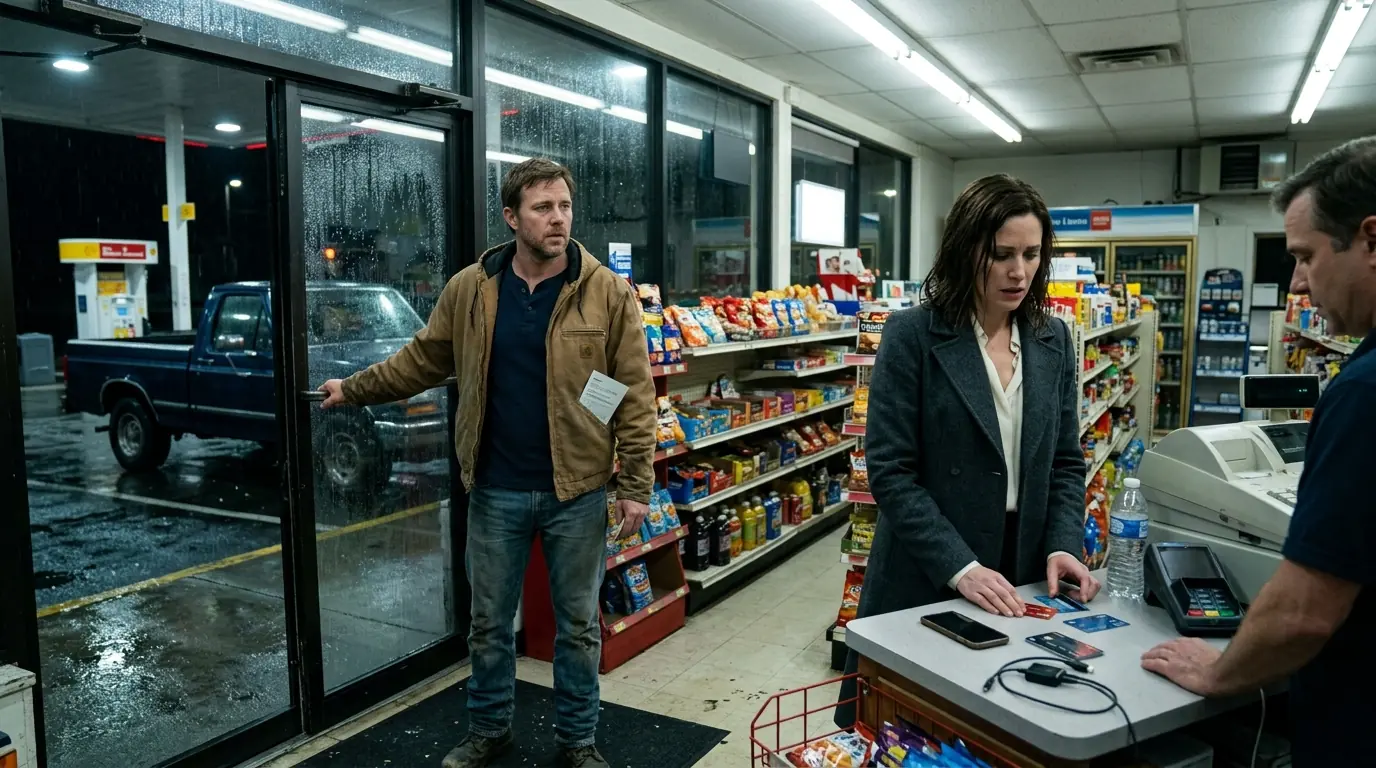
The reader beeped red.
She had a dead phone, a phone charger, a bottle of water, and a voice that was working too hard to stay steady.
“Ma’am, I’m sorry.”
Owen stepped forward and laid the twenty on the counter.
“For her things. Keep the change, please.”
He left before she could thank him.
The drive from the warehouse to East Hartford took 22 minutes. Owen Brockway made it in 20.
The Ford Ranger had 190,000 miles on it and a rattle in the front left wheel that he had been telling himself for nearly a year he would get to.
He parked behind the duplex on Forbes Street, sat with the engine off for a moment, and folded the termination letter twice along its existing creases before slipping it into the inside pocket of his jacket.
Then he walked up the stairs.
Ellis was at the kitchen table, pencil in hand, the way she always was at 4:30 on a Thursday. Eight years old, blonde like her mother, brow furrowed at a worksheet of two-digit subtraction.
“Hi, Daddy.”
“Hi, Peanut. How are the borrowings?”
“Mr. Lopez said I forgot a one.”
“You can forget a one. Ones forgive.”
She smiled without looking up.
He set his lunch box on the counter, walked past her to the bedroom, and pushed the folded envelope to the back of the bottom dresser drawer under a stack of Jennifer’s old sweaters he had never been able to throw away.
Standing there, with his hand still on the wood, the kitchen disappeared for a moment.
Jennifer laughing, August 2021, a pan of brown butter on the stove, her hair tied up with the elastic from a bunch of celery. She was telling him he was useless in a kitchen. He was telling her she was beautiful.
Then the recovery room at Hartford Hospital, ten months later. The way the monitors had sounded. The way the resident had stopped talking mid-sentence when the numbers shifted.
Then the mirror on the morning of the funeral. The promise he had made to no one but himself.
I will stay home. I will be there.
Then Ellis, five years old, hand in his, walking through the doors of Pitkin Elementary on her first day of kindergarten.
He had cried in the truck after.
She had not.
He came back to himself, closed the drawer, and went to the kitchen.
He pulled up his banking app while she finished the worksheet.
$43.18.
Rent was due in 20 days. His severance, such as it was, would clear in seven business days. The math, when he ran it without flinching, was tight, but not yet impossible.
“Daddy?”
“Yeah.”
“Can we have pancakes tomorrow?”
He opened the refrigerator.
Half a carton of eggs. A bottle of milk with two inches in the bottom. A jar of strawberry jam from her grandmother in Vermont.
“We can have pancakes tomorrow.”
She put down her pencil.
“Okay.”
They ate spaghetti for dinner from a box he had bought three weeks earlier. They watched 20 minutes of a nature show about octopuses. She brushed her teeth without being asked and let him braid her hair the wrong way before bed.
The way she always let him.
Because, she said, his way made her look brave.
After she was asleep, he turned off the kitchen light, lay down on the sofa in his clothes, and stared at the ceiling.
He kept thinking about the woman at the gas station counter.
Not what she had said.
Not what she had been buying.
The way her voice had tried not to break.
He knew that sound.
Some things you learn to recognize.
They never quite leave.
On the Monday after the gas station, Hadley Crane went back to the Mobil on Wethersfield Avenue.
She had not slept well that weekend.
She had told herself she was losing sleep over the company, the audit committee, and the seven phone calls she had not returned.
She knew, somewhere honest, that this was not the whole truth.
She asked for the security footage.
The clerk, a man named Evan who had been on shift Thursday night, recognized her from her photograph in the local business section. He pulled the tape without making a thing of it.
She watched a 47-second clip on his back office monitor.
A man in a faded canvas jacket stepped to the counter, laid down a folded bill, and walked out without looking at her.
The parking lot camera caught the back of his pickup as he pulled away.
A logo, half peeled, on the rear window.
Riverbend Logistics.
By 3:00 that afternoon, she was standing in the warehouse manager’s trailer on the east side of the river.
The manager was a big man in a Carhartt vest who answered her questions because she had walked in like a person who was used to answers.
“Brockway? Forklift. Second shift. Laid him off last Thursday. Round of cuts. Good worker. Quiet. Why?”
“He left something at a gas station I’d like to return.”
The manager looked at her.
The kind of look that decided not to be curious.
“I don’t give out home addresses. Sorry.”
She thanked him, walked back to her car, and pulled out her phone.
The gas station camera had given her a clean plate.
Her assistant, Theodora Pell, needed eleven minutes.
Forbes Street, 328, second floor.
At 6:00, the sky had gone the color of old pewter.
She knocked.
Owen opened the door and went very still.
She held out his twenty, folded the way he had folded it, and a thick white envelope.
“I wanted to bring this back and give you this.”
“It was a gift,” he said. “You don’t bring back gifts.”
“Keep it.”
“It wasn’t a gift. You didn’t have it to give.”
“I gave it. That makes it one.”
She did not put the bill away, but she did not insist again.
“And this,” she said, lifting the envelope, “that I really don’t need.”
“It isn’t charity. It’s a thank you.”
“It’s still a thank you I don’t need.”
She looked at him for a beat.
Then she set the envelope on the porch railing and turned to go.
The folded twenty was still in her hand.
She had made it down two steps when she stopped.
The front window of the duplex was lit from inside. From where she stood, she could see past Owen’s shoulder into a slice of living room. A secondhand sofa. A small jacket draped over the back of a chair. And against the far side, a small bookshelf.
Four books. Three of them with spines she recognized without needing to read the titles.
Above them, lying flat, was a back issue of the Harvard Business Review.
The cover line on the spine read, Trust-Based Defense Structures for Legacy Pension Pools.
The author’s name was in white type.
Owen Brockway.
She stood there for exactly three seconds.
She did not let her face change.
She walked back up the steps and knocked again.
He opened.
“I forgot to thank you.”
She held his eyes for a single steady moment. Something behind hers had moved and was no longer where it had been a minute earlier.
And Owen, who was not stupid, noticed.
She went down the steps a second time and got into the Range Rover.
When her taillights had reached the corner, Owen picked up the envelope.
Inside, there was no cash.
A heavy cardstock business card, embossed.
Hadley Crane.
Chief Executive Officer.
Crane and Sterling Financial.
On the back, in small careful handwriting, were three words.
When you’re ready.
He took the card inside, sat down at the kitchen table, and opened his laptop.
He typed Crane Sterling Hartford.
The first result was an obituary, six months old.
Theodore Crane, 68, sudden cardiac event.
Owen read it once.
Then he closed the laptop and sat in the dark for a long time.
She did not call him for three days.
He thought about her almost continuously and told himself he was not thinking about her.
On Thursday, his phone rang at 10:00 in the morning.
He was loading pallets at a different warehouse, a one-day temp gig his old supervisor had thrown his way out of pity.
He stepped behind the loading dock to take it.
“Story and Soil Coffee. Pratt Street. 3:00. If you don’t come, I won’t ask again.”
He came.
She was already there when he walked in, sitting at a small table by the window. Gray wool coat. No jewelry. She had taken off her watch and set it face down on the table next to her cup, which he understood without being told.
He sat across from her.
The waitress came.
He ordered black coffee. He took the cup with chapped hands.
Hadley did not waste a minute on warm-ups.
“Vail Capital Partners has been pushing my board for four months now to spin off our legacy retirement portfolio. $1.8 billion in assets under management. Approximately 11,000 Connecticut public sector retirees, most of them teachers, corrections officers, and state lab technicians. They want it broken up and sold to three different secondary buyers. Their public argument is shareholder value. Their actual argument is that the portfolio structure has a vulnerability they think they can lever open.”
“What vulnerability?”
“An audit trigger pathway. Specifically, the kind documented in a paper published in 2018. Harvard Business Review.”
She did not break eye contact when she said it.
He drank his coffee.
“I need someone who understands the defense structure to the level of detail at which it was originally designed. I have lawyers. I have my own analysts. None of them know it the way the person who wrote it does.”
“And if I’m not that person anymore?”
“Then I’m offering you three weeks of consulting. $50,000. Your name on no document, no filing, no public release. Non-disclosure on both sides. After three weeks, whether or not it works, you walk.”
He looked out the window.
A bus hissed past on Pratt Street.
“I drive a forklift, Ms. Crane. 7:00 in the morning to 3:00 in the afternoon. I’m home before my daughter gets off the bus. I do that for a reason. I’m not that person anymore. I’m not coming back.”
She did not plead.
She did not lean forward.
She slid her coffee toward the middle of the table, stood up, and pulled on her coat.
“I didn’t come to you because you’re Owen Brockway, formerly of Linder and Halloran. I came because of the man at the gas station. If those are two different people, I apologize for the confusion.”
She put a twenty on the table.
He noticed she had to dig for it.
She caught him noticing.
“Two Tuesdays ago, I lost a credit card at LaGuardia. The bank froze every personal account I have pending verification. I don’t usually carry cash. I don’t usually need to.”
She walked out.
He sat there for ten minutes.
When the waitress came back, he paid for both coffees with a five and a small handful of quarters and dimes, the way a man pays when he is counting.
He drove home and did not say a word for the rest of the afternoon.
Ellis, over a dinner of grilled cheese and tomato soup, asked him if he was sad.
He said, “No, Peanut. I’m thinking.”
She said, “Same thing sometimes.”
He looked at her for a long moment and almost said something.
Then he did not.
That night, he read Ellis the chapter where Charlotte explains, with the patience of a spider for a small pig who is afraid, that everything dies, but some things stay.
He had not realized, before he became a father, how much of the children’s literature he would end up reading aloud would be about dying.
He had not realized before Jennifer how often he would be grateful that someone else had already written the words.
Ellis fell asleep with her head against his shoulder and the book open on his lap.
He carried her to her bed, tucked her in, kissed her forehead, and went back out to the living room.
He sat at the kitchen table for a long time without doing anything.
Then he opened the laptop.
He typed Vail Capital Crane Sterling.
He spent 20 minutes reading.
The shape of the attack came up the way a face comes up in dim water. Slowly, then all at once.
Public filings designed to look like minority shareholder concerns. A coordinated push on the audit committee. Three independent letters from concerned institutional investors within a six-week window calculated to trigger a mandatory review of the portfolio’s risk classification.
Once the review was opened, the cover would be there to argue for divestiture under fiduciary stress.
It was the playbook.
His playbook.
Almost the playbook he had warned about in a paper he had written six months before Jennifer got sick.
The paper he had written because he had seen the technique used once in 2016 against a smaller pension fund in Pennsylvania.
He had written it because that fund had lost.
He had written it because 800 retired steelworkers had lost their supplemental medical coverage within a year of the divestiture.
And one of them had been his father’s old union brother, and his father had called him about it.
He sat by the window for a long time after he closed the laptop.
He did the math.
$1.8 billion in assets.
11,000 retirees.
Average age, 68.
Average annual supplemental medical draw, $4,200.
If the portfolio was split and sold under the structure Vail was proposing, the secondary buyers would not be obligated to maintain the medical rider.
Within nine months, maybe sooner, 11,000 people would learn that the coverage they had been promised was gone.
He had done a version of this math hundreds of times in his old life.
The numbers used to be abstract.
They were not abstract anymore.
He waited until 7:00 the next morning.
He called the number on the back of her card.
She picked up on the second ring.
“I’ll listen,” he said. “I’m not promising anything yet, but I’ll listen.”
There was a small breath on the other end. Not quite relief. Something steadier.
“Thank you,” she said. “Saturday morning. I’ll send you the address.”
She hung up.
He went to the bedroom, opened the top drawer of his dresser, and took out a small wooden box he had not opened in three years.
Inside was a watch.
Gold, thin, a Patek Philippe Calatrava that Jennifer had given him on the morning he made director.
He held it in his palm for two seconds.
He did not put it on.
He put it back in the box and closed the lid.
Then he made Ellis pancakes.
She asked him if he was going to work today.
He said, “A different kind of work. Just for a few weeks.”
She asked, “Is it a good kind?”
He said, “I think it might be.”
The fourth floor of the Crane and Sterling building on the corner of Asylum and Main had a small conference room with no name on the door.
There was a number on the keypad. You had to know the number, and very few people did.
On Saturday morning at 7:00, Owen walked into that room for the first time in three years and four months.
Hadley was already there.
So was an older woman in a charcoal blazer with silver hair cut short and reading glasses on a thin chain.
“Owen, this is Theodora Pell. She has been with my family for 31 years. There is nothing she does not see in this company, and there is nothing she carries that she has not earned the right to carry. She knows you are here. No one else in this building does.”
Theodora extended her hand. Her grip was light and dry.
“Mr. Brockway, a pleasure.”
Owen did not recognize her.
He was certain he had never met her.
He shook her hand and said it was a pleasure as well.
What he did not know, and what Theodora did not say, was that years ago she had been one of 19 analysts on his Hanover pension team in Midtown Manhattan, and that the man at the head of the table had barely looked at any of them because his attention had been entirely on the structure he was building.
Her hair had been brown then.
She did not expect him to remember.
She had not been hired in this company on the strength of that history.
She had been hired 26 years ago on the strength of her own.
She poured him tea and sat down at the end of the table.
Hadley pushed three black binders toward him.
“Everything we have on Vail’s filings to date. Everything we have on internal portfolio risk classifications. Everything we have on the audit committee correspondence for the last 14 months. The redactions are mine. If you tell me what you need, I can pull them.”
He read for two hours.
He read the way Theodora remembered him reading. Pen down. No notes in the margins. Pages turned at uneven intervals, and never out of order.
He stopped twice to look out the window, once to drink water.
He did not speak.
At the end of the second hour, he closed the third binder, set it back on top of the other two, and looked up.
“You have a leak.”
Hadley did not move.
“Four people,” he said, “have signed off on document approvals that show up in Vail’s filings within the next 96 hours. None of the four had a public reason to know the contents of those documents. I am not going to name them yet. I want to confirm one of them is what I think it is before I do.”
Theodora set her teacup down on the saucer.
The small porcelain clink was loud in the room.
Hadley said very quietly, “Take whatever time you need.”
He stayed for two more hours.
When he left, she did not walk him to the elevator.
That night, in the garage of the duplex on Forbes Street, Owen pulled down a cardboard box he had labeled in black marker three years earlier and had not opened since.
Inside were three things he had not been able to throw away and one thing he had forgotten he had kept.
An old Android phone, three generations behind, the battery long flat.
He plugged it in.
It came on slowly, as old phones do.
There was a single unheard voicemail.
April 14th, six months ago.
He pressed play.
A man’s voice, older, measured, almost apologetic.
“Mr. Brockway, my name is Theodore Crane. I read your 2018 paper four times. I am not asking you to come back to anything. I am asking you to call me before something happens that I cannot undo. My number is…”
Owen sat on the cold concrete floor of the garage for a long time.
Theodore Crane had died two weeks after that voicemail.
At 10:00 that night, there was a knock at the door of 328 Forbes Street.
Owen opened it.
Theodora Pell stood on the porch with an olive green file folder under one arm and an apology already in her face.
“I’m sorry to come at this hour. May I come in? I won’t keep you long.”
He let her in.
She did not sit until he sat.
She set the folder on the coffee table between them and did not open it yet.
“Mr. Brockway, I owe you an introduction I did not give you this morning. Years ago, I worked at Linder and Halloran. I was an analyst on your Hanover Pension Trust team for three months. You will not remember me. There were 19 of us. I am not telling you this for any reason except so that you know I am not asking you to take what is in this folder on faith.”
Owen looked at her.
Something settled into place that he had been unable to settle since the morning.
“I remember the case. I don’t remember faces from that year. I’m sorry.”
“You shouldn’t apologize. I’m telling you because I want you to know that what I have done, I have done from inside this work, not outside it.”
She opened the folder.
Inside was a thick stack of photocopied pages organized with the kind of small flag tabs that only people who had spent decades organizing other people’s documents knew how to place.
On the very first page, photocopied from what was clearly a leather notebook in a thin, careful older man’s handwriting, were three lines.
Find Brockway.
Pension trust angle.
Before Vail moves.
Owen’s name was circled twice.
He sat very still.
Theodora spoke quietly.
“Mr. Crane was my employer for 31 years. He was a careful man. He was a private man. He started writing those words in this notebook about four months before he died. He contacted three restructuring firms in that window. Each of the three had, somewhere in their book of business, a conflict with Vail Capital. Two of them had taken money from Vail-affiliated funds within the last five years. The third, in his judgment, was too closely held by directors who had personal relationships with Garrison Vail. He could not use any of them. Your name was the only clean name on his list.”
She looked at her hands.
“He told me, over breakfast, that he had read your paper four times. He told me he could not understand why a man who could write that paper had walked away. I told him I had worked for that man once and that I thought I knew. He asked me not to contact you. He wanted to do it himself.”
She looked back at him.
“He called you on April 14th. He died on April 28th. He did not have a heart condition. He had a clean physical with a complete cardiac panel the November before.”
She paused.
“I am not, Mr. Brockway, and I want you to hear me, I am not accusing anyone of murder. I have no evidence that would survive five minutes of cross-examination. I am telling you that I do not believe that death was natural. I am telling you that I have lived a long time in places where powerful people lose business, and a man at the top of an obstacle dies, and the family is sent flowers. I am telling you what I know, and I am telling you what I do not know, and I am leaving the difference between them where it belongs, which is in the dark.”
She closed the folder and slid it across the table to him.
“I promised him I would keep your name out of this until Miss Crane needed it. She needs it now.”
She stood.
“Good night, Mr. Brockway. Thank you for the tea I did not drink.”
She let herself out.
He sat with the folder on his lap for a long time.
At 11:31, he called Hadley.
She picked up on the first ring.
They were on the line for 34 minutes.
They spoke for less than five of them.
Most of it was the small, clean silence of two people listening to each other not speak.
She did not ask him if he was in.
He did not say.
When they hung up, both of them knew.
He came in at 6:30 every morning through the loading bay entrance off Ann Uccello Street, took the freight elevator to the fourth floor, and worked in the unmarked conference room until 3:45.
He was out by 4:00.
He was home every day before Ellis’s school bus reached the corner of Forbes and Burnside.
For seven days, he did almost nothing else.
What he built, he built carefully.
The first layer was structural.
He moved the legacy retirement portfolio out of Crane and Sterling’s direct corporate balance sheet and into an independent fiduciary trust governed by a separate three-member board chosen from the Connecticut Society of Actuaries and a retired federal magistrate.
The trust’s charter was bound, in legal language he wrote himself and ran past Hadley’s outside counsel for one round of polish, by a 15-year poison pill covenant.
Any attempt to liquidate, sell, transfer, or alter the trust’s structure within those 15 years would trigger automatic mandatory disbursement of the full asset base to the beneficiaries, 11,000 retirees, at par value.
There would be nothing left to sell.
Vail’s whole maneuver, which depended on extracting fees and second-tier buyer premiums from a broken-up portfolio, would buy them nothing but a check they did not want to write.
The second layer was procedural.
He embedded a supermajority clause requiring 80% shareholder approval for any liquidation event in the trust’s lifetime.
The Crane family, through Hadley and the various family holding instruments her grandfather had set up in 1967, controlled 46% of voting shares.
Theodore had cultivated relationships with another 19%.
They would not all vote with Hadley out of love.
They would vote with her on this question because the 80% threshold made any other outcome a personal liability.
The third layer was a tripwire.
He drafted a fiduciary breach trigger that would activate automatically if any member of the C-suite or board signed off on a document materially related to spin-off, sale, and/or restructuring of the legacy retirement portfolio without unanimous board consent.
The trigger fired a clause that personally indemnified the company against the actor’s signature, removed them for cause, and stripped them of severance and unexercised options.
He built it for Lawrence Madsen.
On the fourth day, Theodora gave him the email server logs.
Seven outbound attachments over five months from the COO’s machine to a Gmail address that two layers of LLCs obscured into a beneficial owner registered with the Delaware Division of Corporations.
The beneficial owner, when traced back through the chain, was a wholly owned subsidiary of Vail Capital Partners.
The seventh attachment was the Audit Committee’s internal risk assessment of the legacy retirement portfolio, sent six days before Vail’s most recent letter to the board, which had cited internal risk assessments by name.
Owen did not pick up the phone to anyone in law enforcement.
That was not the fight in front of him.
The fight in front of him was civil, corporate, and required a Monday morning board meeting.
On Friday night at 11:00, he went up to the 22nd floor to drop off the final draft.
Theodore Crane’s office was at the far end of the executive corridor, glass on three sides, the lights of downtown Hartford gathering in low constellations below.
Hadley was standing at the window, her back to the door.
He came in and put the draft on the desk.
She did not turn around.
For a moment, the only sound was the building’s ventilation, very faint, almost a breath.
“My father should still be here,” she said.
Owen stood one step back from her shoulder.
He did not touch her.
He said, “He tried. That’s why I’m standing here.”
She did not answer.
After a while, she said, “Go home to your daughter.”
He went home to his daughter.
Friday at midnight, his phone buzzed.
A text from Hadley.
I need your signature on three documents with a notary present. The notary works Saturdays. I can come by you.
7:30? he wrote back.
Fine.
He did not sleep well.
At 7:25 on Saturday morning, he was already in the kitchen in old jeans and a worn flannel, the griddle warming, a yellow mixing bowl beside the stove.
He had not bothered to think about whether this was, technically, his weekend with Ellis.
He had been with her every weekend for three years.
She came down at 7:28 in the bear-print pajamas she had begged for at Target two birthdays ago.
She stopped at the bottom of the stairs and looked up.
“Daddy, there’s a car outside.”
“I know, Peanut. It’s a work thing. A nice work thing.”
The doorbell rang.
Ellis got there first.
She opened the door, looked up at the woman on the porch, and tilted her head.
“You’re the lady from the gas station, right?”
Hadley, who had not been prepared for this, stood very still.
“Daddy told me,” Ellis said helpfully. “Mostly the part where you needed a phone charger.”
“That’s the right lady,” Hadley said.
“You should come in,” Ellis said. “We’re having pancakes.”
Hadley came in.
The notary, a tired-looking man with a briefcase, arrived seven minutes later, stamped three signatures, accepted a cup of coffee at the table, and left.
He had been in the apartment for nine minutes.
After he was gone, no one moved.
Owen set down a plate of pancakes in front of Ellis. He set down a plate in front of the chair across from her, which Hadley was sitting in.
He sat down with his own plate.
“Do you like syrup?” Ellis asked Hadley.
“I do.”
“On top or in a little bowl on the side?”
“On top.”
Ellis nodded gravely, like a person whose suspicions had been confirmed.
“That’s the right way.”
She told Hadley about Buttons.
Buttons was the rabbit in her classroom. Buttons had a white spot over one eye and a brown spot over the other.
Buttons did not like Liam Kerrigan because Liam Kerrigan had once tried to pick Buttons up by the ears, which everyone knew you were not allowed to do.
Hadley listened to all of it.
When Owen set down his coffee cup, he set it down half a second slower than he had set down the cup before, and Hadley, who was looking at him exactly then, saw it and did not say anything.
They ate for 40 minutes.
No one said the word Vail.
No one said the word Madsen.
No one said the word board.
Outside the kitchen window, the October sun moved over the brick wall of the building next door in the small, precise way Saturday morning sun moves when nothing is wrong.
At 9:15, Hadley said she needed to go.
Ellis walked her to the door because Ellis had decided this was the kind of guest you walked to the door.
When the Range Rover had pulled away, Ellis turned to Owen.
“Is she coming back tomorrow?”
He knelt down in front of her, so they were eye to eye.
“I don’t know, Peanut. I hope so.”
She thought about it.
“Me, too,” she said.
Then she ran upstairs to brush her teeth.
The Crane and Sterling board met on the 22nd floor at 10:00 on Monday morning in a long room with eleven chairs and a single oil portrait of Theodore Crane’s grandfather on the wall behind the head of the table.
Eleven seats.
Nine board members.
Two non-voting attendees.
Garrison Vail, in his capacity as the holder of just over 6% of Class A voting shares, and Lawrence Madsen, in his capacity as chief operating officer.
Theodora Pell stood at the back of the room with a manila folder and a face that betrayed nothing.
Hadley opened the meeting.
She did not raise her voice.
She did not stand.
She read a short prepared statement, two paragraphs, into the minutes.
The Legacy Retirement Portfolio, as of Friday at 5:36 in the evening, had been transferred in its entirety and by valid corporate action under the bylaws of Crane and Sterling Financial into an independent fiduciary trust governed by a separate three-member board.
The structure had been formally registered with the Connecticut Department of Banking at 7:06 on Monday morning.
The transfer was lawful.
It could not be reversed within 60 days, and beyond 60 days could only be reversed by an 80% supermajority of Crane and Sterling Class A shareholders.
There was a silence.
Garrison Vail stood up.
He was a tall man with an evenly tanned face, and he had been preparing, Owen would learn later, four versions of the speech he had planned to give on the topic of long-term shareholder value.
He got two words out.
“This board—”
A side door at the back of the room opened.
Owen Brockway walked in.
He was in a charcoal suit Hadley had had pressed for him without telling him, and a plain cotton shirt he had ironed himself at 6:00 that morning.
He carried a single folder.
He stopped at the corner of the table closest to the door.
Hadley did not look at him.
She said, “For the record, I would like to introduce the architect of the trust structure I just described to you, Mr. Owen Brockway, formerly director of corporate restructuring at Linder and Halloran Advisory, New York, author of the 2018 Harvard Business Review paper on trust-based defense structures for legacy pension pools.”
Vail’s face did not move.
Owen opened the folder.
He took out a printed copy of the paper.
He laid it gently on the table.
“I wrote the paper your strategy is based on, Mr. Vail. I also wrote the defense. Today is the first day I have seen both of them in the same room again.”
Vail sat down.
Hadley nodded once to Theodora.
Theodora walked the length of the room and placed her manila folder in front of Lawrence Madsen.
He opened it.
He read for nine seconds.
Hadley said, very quietly, “You have two hours to clear your office, Mr. Madsen. The disciplinary committee will reach you by the end of the week. You will sign no documents on behalf of this company before then. Security is outside.”
Madsen stood up.
He did not speak.
He left the room with his shoulders very straight and his face very white.
Vail, looking at no one, said, “I’d like to formally withdraw the offer we extended on the 11th.”
Hadley said, “The minutes will reflect that.”
The board adjourned at 10:36.
It had taken 36 minutes.
Three weeks after the gas station on Wethersfield Avenue, on a Tuesday morning in late October, Hadley Crane walked Owen Brockway down the executive corridor of the 22nd floor.
She stopped at the last door.
It was an office that had not been occupied since April 28th.
She opened the door.
She held out a small ring of keys.
“Chief Restructuring Officer. Co-Chief Executive Officer of Crane and Sterling Financial. The board approved your appointment this morning, unanimously, including the two members who, six months ago, were leaning toward Vail, and including the one who voted against my appointment last spring.”
He took the keys.
She said, “This is not for the twenty.”
He said, “I know.”
“It’s for the fact that you gave it to a stranger on a day when, mathematically, you did not have it to give.”
He went into the office.
He did not sit at the desk.
He walked the perimeter of the room first, the way a person walks a room they expect to be in for a long time.
He paused at the window.
He paused at the bookshelf, which was still Theodore’s, mostly empty of books and full of small objects that no one had had the heart to box up.
When he came back to the desk, he opened the top drawer.
It was the reflex of a man taking a seat.
Inside, neatly folded, was a single twenty-dollar bill.
Next to it was a small index card in Hadley’s handwriting.
The date.
The name of the gas station.
Nothing else.
She had never spent it.
He looked at it for the count of three.
He did not pick it up.
He closed the drawer.
He did not say anything.
She, watching him from the doorway, did not say anything either.
That afternoon, at 3:50, Ellis Brockway came through the lobby doors of the Crane and Sterling building in a red puffer coat, holding the hand of Theodora Pell, who had picked her up from Pitkin Elementary because Hadley had asked her to, and because Theodora liked walking children to the doors of important places.
Hadley was waiting in the lobby.
She knelt down so that they were eye to eye.
“Hi, Ellis.”
“Hi.”
Ellis looked at her for a long moment with the careful, frank attention that eight-year-olds reserve for guests who matter.
Then she said, “Are we doing pancakes again on Saturday?”
Hadley said, “I’d like that very much.”
“Same syrup rules?”
“Same syrup rules.”
Ellis nodded once, satisfied.
Owen stood two steps back, watching.
When Hadley straightened up, the back of her hand brushed the back of his for half a second less, and they both looked at the floor for a beat.
Neither of them said a word about it.
Then the three of them walked together toward the elevators.
He had given her his last twenty on a night he could not afford to.
She had given him a place to belong on a morning she could not have built without him.
Neither of them said the word for what it was.
They had learned, both of them, that the things that lasted were rarely the ones that needed saying.