On the morning it happened, Ethan Carter lost his job in under three minutes, and he never once raised his voice.
The woman who signed the termination was the company's brand-new chief executive, Victoria Hail, a name he had heard only twice before that day.
There was no explanation offered, no chance to defend the 15 years he had given to that building, only a folder pushed across a desk and a polite request that he clear out by noon.
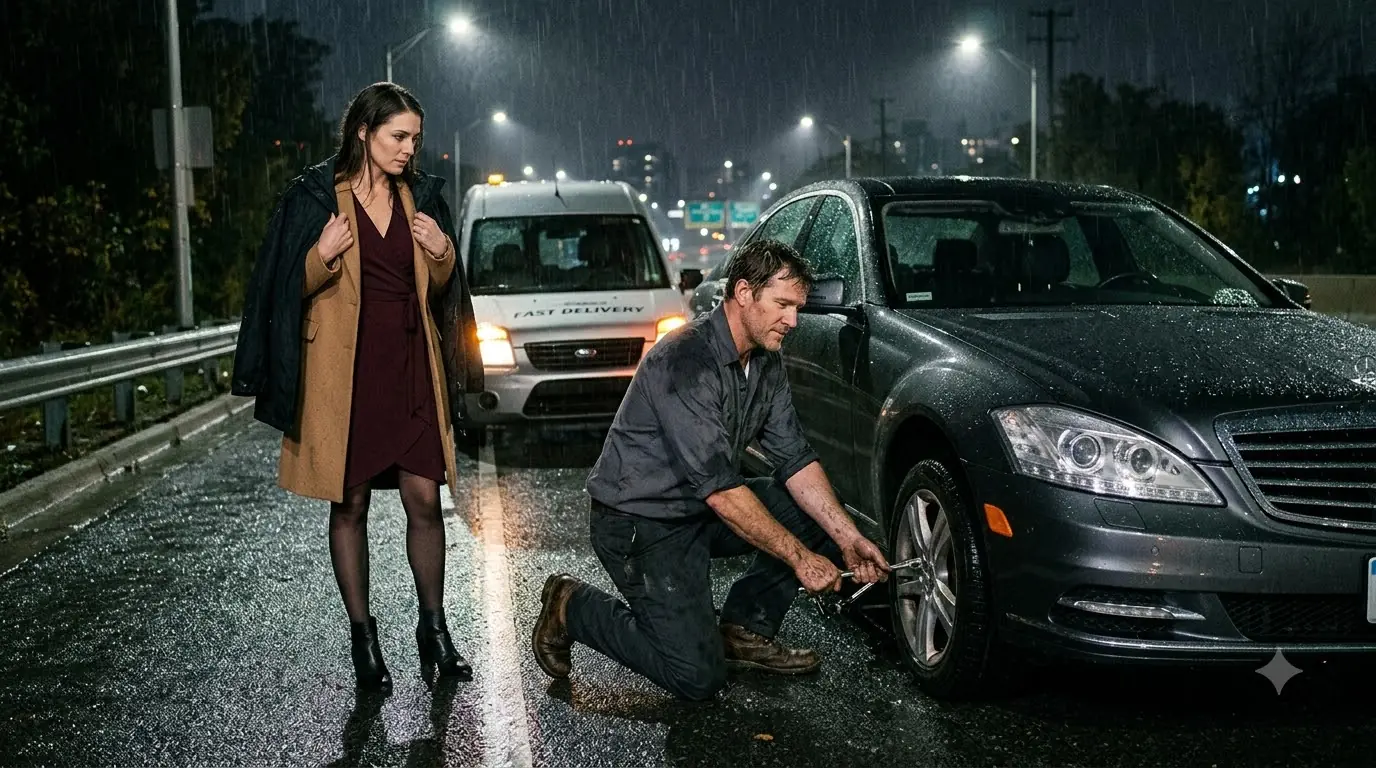
By midnight, under a cold autumn rain on an empty street, Ethan would kneel beside a stranger's broken-down car and change a flat tire for a woman he did not recognize.
The woman who signed the termination was the company's brand-new chief executive, Victoria Hail, a name he had heard only twice before that day.
There was no explanation offered, no chance to defend the 15 years he had given to that building, only a folder pushed across a desk and a polite request that he clear out by noon.
By midnight, under a cold autumn rain on an empty street, Ethan would kneel beside a stranger's broken-down car and change a flat tire for a woman he did not recognize.
He would drive her to the hospital, wrap her in his own jacket, and ask for nothing in return. Only when the emergency room lights fell across her face would he realize exactly whose signature had ended his career that morning. And only then would Victoria Hail understand who had just saved her.
The city had already begun turning gray with the season by the time Ethan walked through the glass doors of Hail Dynamics for what he believed would be an ordinary Tuesday. He had worked there for 15 years, first as a junior technician, then as a senior maintenance engineer, trusted with systems that kept an entire manufacturing floor running without incident.
Younger employees often sought him out, not because he demanded respect, but because he gave it freely, patiently explaining machinery failures at 6:00 in the morning without a hint of irritation. He was the kind of man other people quietly relied on without ever thanking him properly for it, the sort of presence a building simply assumed would always be there.
Younger employees often sought him out, not because he demanded respect, but because he gave it freely, patiently explaining machinery failures at 6:00 in the morning without a hint of irritation. He was the kind of man other people quietly relied on without ever thanking him properly for it, the sort of presence a building simply assumed would always be there.
The company, however, was in the middle of a restructuring that had swallowed entire departments in whispers and spreadsheets over the previous two months. Victoria Hail had taken over as chief executive only 11 days earlier, inheriting a boardroom already hungry for faster profits and a cleaner balance sheet, and inheriting along with it a company she barely understood beyond its numbers.
Marcus Reed, the ambitious chief operating officer, had wasted no time positioning himself as the architect of that change, and he arrived at Victoria's office with a list of names he called necessary corrections. Ethan's name sat near the top, attached to phrases that made him sound like a liability rather than a man who had once stayed 40 hours straight to prevent a factory fire.
Marcus Reed, the ambitious chief operating officer, had wasted no time positioning himself as the architect of that change, and he arrived at Victoria's office with a list of names he called necessary corrections. Ethan's name sat near the top, attached to phrases that made him sound like a liability rather than a man who had once stayed 40 hours straight to prevent a factory fire.
The document labeled him resistant to innovation, underperforming against new metrics, and misaligned with future strategy. Three phrases that erased a decade and a half of quiet competence in a single afternoon. Marcus delivered these summaries with practiced confidence, the kind that made numbers sound like moral judgments rather than simple figures pulled from a spreadsheet. Victoria, exhausted from board pressure and still learning the geography of a company she barely knew, signed dozens of these files without reading past the first paragraph.
She trusted the numbers Marcus placed in front of her because numbers, unlike people, rarely seemed to lie at first glance, and because she had not yet learned how easily numbers could be shaped by the hands presenting them.
Ethan was called into a small conference room just after 9:00 in the morning, where a human resources representative sat across from him with a folder already sealed. The words came out clean and rehearsed, the kind of sentence practiced dozens of times that day alone. "Today will be your last working day," she said.
Ethan was called into a small conference room just after 9:00 in the morning, where a human resources representative sat across from him with a folder already sealed. The words came out clean and rehearsed, the kind of sentence practiced dozens of times that day alone. "Today will be your last working day," she said.
There was nothing cruel in her tone, only distance, the particular emptiness of someone reciting policy rather than making a decision. Ethan asked no follow-up questions, offered no argument, and did not ask to see Victoria Hail, though her name had been the one attached to the decision.
He simply nodded once, the way a man nods when the weather turns against him and there is nothing left to do but accept it. Somewhere in the back of his mind, he thought of his late wife, of how she used to say that dignity was the one thing no one could ever legally take from a person, and he held on to that thought the way another man might have held on to anger.
He simply nodded once, the way a man nods when the weather turns against him and there is nothing left to do but accept it. Somewhere in the back of his mind, he thought of his late wife, of how she used to say that dignity was the one thing no one could ever legally take from a person, and he held on to that thought the way another man might have held on to anger.
He returned to his workstation and packed his belongings into a small cardboard box that had once held printer paper, filling it with a coffee mug, a photograph, and a pair of worn work gloves that had outlasted three supervisors.
Co-workers stopped by his desk in ones and twos, faces pale with disbelief, some offering quiet apologies as though they themselves were somehow responsible. Ethan thanked each of them by name and told them not to worry about him, a habit so deeply built into his character that even in that moment it came without effort.
Co-workers stopped by his desk in ones and twos, faces pale with disbelief, some offering quiet apologies as though they themselves were somehow responsible. Ethan thanked each of them by name and told them not to worry about him, a habit so deeply built into his character that even in that moment it came without effort.
One young engineer barely two years into the job admitted quietly that Ethan had taught him nearly everything he knew about the systems he now maintained and asked what he was supposed to do without him around to ask questions. Ethan simply smiled and told him he already knew more than he gave himself credit for. A small kindness offered even in the middle of his own unraveling.
He walked out through the same glass doors he had entered that morning, the rain not yet arrived but already threatening the sky above the parking structure, and no one from the executive floor came down to see him off. That evening, Ethan sat alone in his small apartment, doing the quiet arithmetic that unemployed men everywhere have done for generations, dividing what savings remained by what bills waited each month. He was not a young man anymore, though he was far from old, 38 years marked more by patience than by bitterness.
A widower who had raised his children largely alone after losing his wife years earlier, Ethan now lived by himself because his children were grown and scattered across other cities. The apartment held only him, a kettle, and the low hum of a refrigerator that badly needed replacing. He did not call a lawyer, and he did not draft an angry letter to human resources demanding an explanation he suspected he would never receive. Instead, he opened his laptop and began searching for temporary work.
Because rent, unlike sympathy, did not wait for anyone's schedule to clear, he allowed himself exactly one quiet moment of grief that night, staring at the ceiling and letting the weight of the day settle over him fully before deciding deliberately to set it down and move forward.
By the following evening, he had already signed up as a delivery driver for a courier service, delivering packages across the city in a car that groaned with every pothole it crossed. It was humbling work for a man who had once trained nearly 100 engineers. But Ethan carried it without complaint, treating each delivery with the same quiet care he had once given to complicated machinery.
By the following evening, he had already signed up as a delivery driver for a courier service, delivering packages across the city in a car that groaned with every pothole it crossed. It was humbling work for a man who had once trained nearly 100 engineers. But Ethan carried it without complaint, treating each delivery with the same quiet care he had once given to complicated machinery.
A former coworker texted him quietly that night, asking if he intended to sue the company for wrongful termination, certain that any lawyer would take one look at his record and smell an easy case. Ethan typed back only a short reply, telling his friend that carrying resentment forward would only slow him down, and that a man who spends his energy on hatred rarely has enough left over to rebuild anything. There was no self-pity in the message, only the calm resolve of someone who had faced hardship before and learned that grief, unlike anger, eventually made room for forward motion.
Word of his response spread quietly through what remained of his old department, and more than one colleague found themselves quietly ashamed of how easily the company had discarded him. Some nights, after finishing his last delivery, Ethan drove slowly past the building where he had once spent so many years, watching the lit windows of an office that no longer belonged to him in any sense. He felt no bitterness in these small detours, only a kind of curiosity about who he might become now that the identity he had worn for 15 years had been taken from him without warning.
He began waking earlier, using the extra hours before his delivery shifts to help an elderly neighbor carry groceries up three flights of stairs or to check the brakes on a young mother's car free of charge in the parking lot behind his building. It was in these small, unremarkable moments, delivering boxes in the cold with a smile intact and stopping to help strangers who could offer him nothing in return, that the character of Ethan Carter began to reveal itself fully, long before anyone with real power noticed. He never once considered that these habits, formed quietly over years and repeated without any audience, would eventually collide with the very woman who had signed away his career.
At night, when the apartment grew too quiet for comfort, Ethan sometimes took out an old photograph of his late wife, propped it against the lamp on his nightstand, and spoke to her the way he had for years whenever life pressed hard against him.
He told her about the layoff without drama, the same way he might have described a change in the weather, and admitted only once, quietly, that it had stung more than he let anyone else see. He reminded himself, as he often did, that she had built her own kind of quiet strength, raising their children through hardship long before illness ever entered their lives, and that whatever came next, he was not the first in his family to rebuild from very little.
He told her about the layoff without drama, the same way he might have described a change in the weather, and admitted only once, quietly, that it had stung more than he let anyone else see. He reminded himself, as he often did, that she had built her own kind of quiet strength, raising their children through hardship long before illness ever entered their lives, and that whatever came next, he was not the first in his family to rebuild from very little.
These private moments never made it into conversations with co-workers or neighbors, existing only for him, a small ritual of grief and resolve folded quietly into the ordinary architecture of his nights.
It was this same discipline, the ability to feel loss fully and still rise the next morning ready to work, that had carried him through every hardship of his adult life. And it was this same discipline that would soon carry him, without any fanfare, straight into the middle of a stranger's crisis on a flooded road.
It was this same discipline, the ability to feel loss fully and still rise the next morning ready to work, that had carried him through every hardship of his adult life. And it was this same discipline that would soon carry him, without any fanfare, straight into the middle of a stranger's crisis on a flooded road.
Three nights later, a storm rolled into the city with a violence that emptied the streets almost entirely, rain slamming sideways against windshields and streetlights flickering under the pressure of wind. Ethan was finishing his final delivery route near midnight when he spotted a sedan pulled halfway onto the shoulder of an otherwise abandoned road, its hazard lights blinking weakly through the downpour.
A woman stood beside the vehicle in a soaked business coat, one heel snapped clean off, her phone held uselessly in her hand because the battery had already died. Cars passed without slowing, their drivers eager to escape the weather rather than risk a stranger on a dark road, and the woman had clearly resigned herself to standing there until something worse happened.
A woman stood beside the vehicle in a soaked business coat, one heel snapped clean off, her phone held uselessly in her hand because the battery had already died. Cars passed without slowing, their drivers eager to escape the weather rather than risk a stranger on a dark road, and the woman had clearly resigned herself to standing there until something worse happened.