The rain fell hard the night Matthew walked out of Mercy General with nothing.
No loan.
No plan.
Nothing left to try.
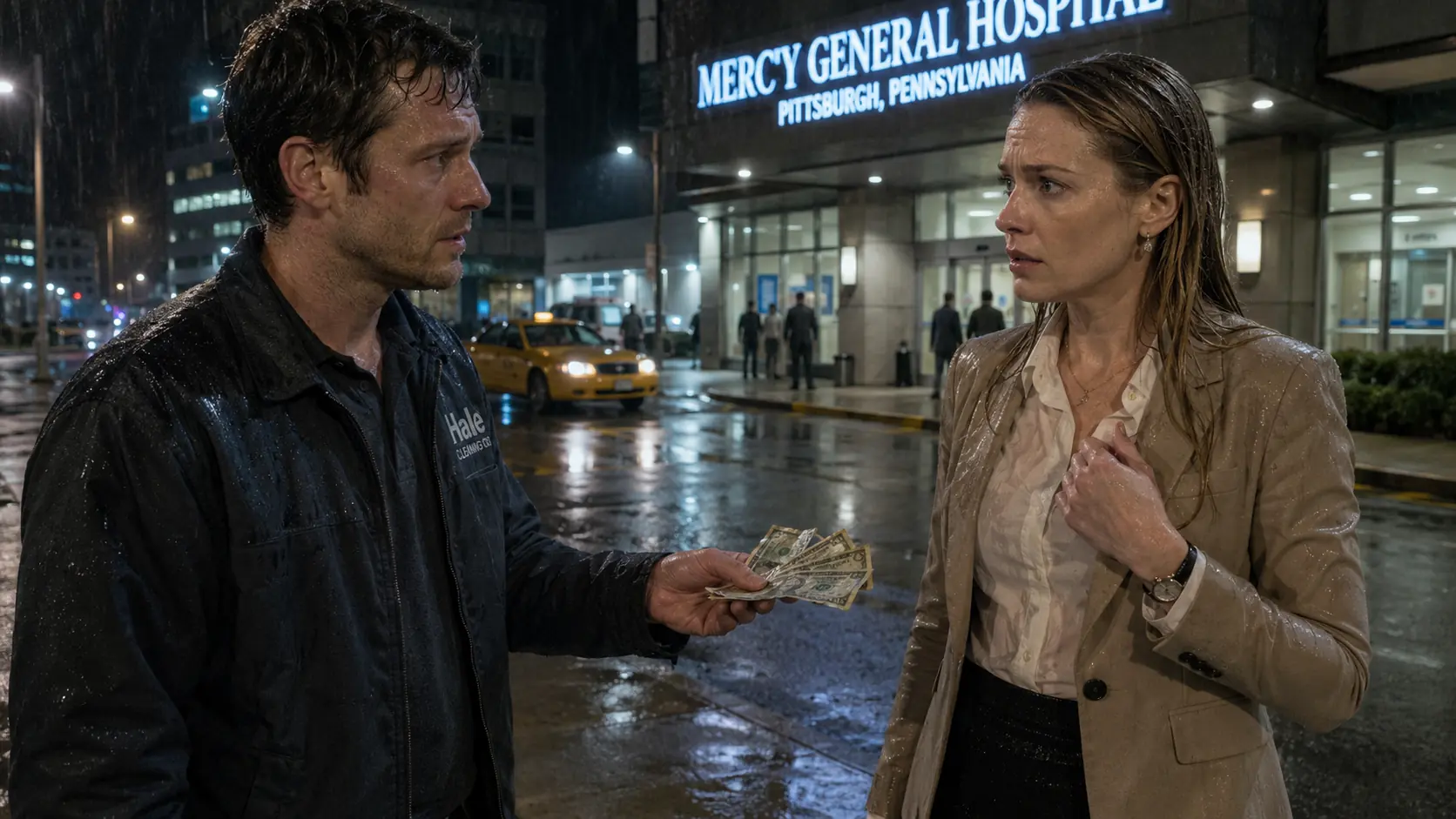
A taxi stopped at the curb ahead of him, and a woman in a soaked gray hoodie was pushed out, the door slamming shut behind her.
Driver gone.
She had no phone, no cash, no umbrella.
Matthew had $11.
He gave her seven.
He did not know she was worth 300 million.
He did not know she was the reason his world had once been taken apart.
But morning was coming, and with it, the truth.
Matthew Hale was 34 years old, though he looked older at night, the way all men who work the overnight shift eventually do.
He pushed a mop cart through the marble lobby of the Meridian Tower five nights a week, starting at 11:00 p.m. and finishing just before 6:00, when the first suits arrived with their cold brew coffees and shareholder reports.
He was invisible to them.
That was fine.
Invisibility had its advantages.
He had not always been this.
Four years ago, Matthew was a structural engineer at Centauri Systems, one of the fastest-growing tech infrastructure companies on the East Coast.
He had a desk on the 14th floor, a salary that let him think about buying a house, and a future that felt, for the first time in his adult life, like something solid.
Then the Harmon Bridge project collapsed.
Not the actual bridge, thankfully, but the internal audit following a failed load-bearing simulation.
Someone had submitted falsified stress data.
Someone had signed off on specifications that should never have been approved.
The name on those documents was Matthew Hale’s.
He had not signed them.
He had not seen them before they surfaced.
It did not matter.
He was let go in a single meeting with HR and a company lawyer.
No severance, no appeal.
His engineering license was suspended pending investigation, a process that had been ongoing for three years and showed no signs of reaching a conclusion.
His wife, already worn thin by long hours and a baby with a heart that was not quite right, left eight months later.
She did not hate him.
She just could not hold the weight of it anymore.
That left Sophie.
Sophie was six years old and small for her age.
With her mother’s dark eyes and Matthew’s stubborn habit of waking before sunrise, she had been diagnosed with a congenital heart defect at four months old, a narrowed aortic valve that the cardiologists had been monitoring with cautious optimism ever since.
That optimism ran out in September, when her last echocardiogram showed significant deterioration.
She needed surgery.
The specific procedure cost $41,000, and Matthew’s insurance, a stripped-down plan that was all he could afford on a janitor’s wages, covered less than half.
He had spent three months trying to close that gap.
He had borrowed from his brother, from an old college friend, from a credit union that had initially seemed hopeful.
He had filled out applications with the quiet persistence of a man who no longer expected good news, but felt it was his obligation to try anyway.
For Sophie.
Always for Sophie.
That evening, standing at the reception desk of Mercy General’s financial services department, he had been turned down for the final loan he had any reasonable chance of obtaining.
The woman behind the counter had been kind about it.
That made it worse.
He was walking home in the rain when the taxi stopped.
Her name, though Matthew did not learn it until much later, was Olivia Grant.
She was 32, the CEO of Centauri Systems, the same Centauri Systems that had once employed Matthew, then discarded him.
She did not know much of anything useful at that particular moment, standing shoeless on wet concrete with her hair plastered against her jaw.
She had left the office without telling her security team.
That was the first mistake.
The second was dismissing her car service.
She had wanted to walk.
Then it started raining.
Then she had grabbed a taxi without her phone, which was still in her coat in the boardroom.
The driver had been decent about it until she could not locate the credit card she thought was in the inside pocket of a jacket she did not, in fact, have on her person.
He had not been decent after that.
Matthew saw her from half a block away.
He took in the situation with the particular efficiency of a man who had learned, through hard practice, to assess what needed to be done before deciding whether he had the capacity to do it.
She was not hurt.
She was not in immediate danger.
She was just stranded, wet, rigid with the kind of embarrassment that belongs to people who are not accustomed to being helpless.
He walked over.
“Are you all right?”
She looked at him.
He was a lean man in work clothes, dark pants, and a faded jacket with a small logo on the chest.
He had the hands of someone who did physical labor and the eyes of someone who had read a great deal at some point in his life.
“I’m fine,” she said.
Her voice was steadier than he expected.
“You’re not wearing shoes.”
She looked down.
One had come off in the cab.
She had not noticed.
Matthew reached into his pocket and held out the $7, two bills and some change, slightly damp.
“For another cab. Or there’s a diner two blocks up that’s open. They won’t throw you out if you’re not ordering.”
She stared at the money.
He could see her calculating something, running some internal process that was used to operating at a much higher level than this particular transaction.
Then something shifted in her face.
“Thank you,” she said quietly.
She took it.
He nodded and started to walk away.
The rain intensified.
He made it about 20 feet before he turned around.
She was still standing there, barefoot on the wet sidewalk, holding the bills in both hands like she was not sure what they were for.
“Come on,” he said. “My place is four blocks. You can wait out the rain.”
She hesitated for exactly three seconds.
Then she followed.
The apartment was small, two bedrooms on the fourth floor of a building that smelled like cooking and old carpet.
The front room served as kitchen, living area, and the place where Sophie’s drawings were taped to every flat surface within reach.
Olivia stood in the entryway and took it in.
A folded blanket on the couch.
A plastic stethoscope toy abandoned on the floor.
A child’s drawing of a man and a small girl under a sun with six rays, labeled in careful crayon letters, “Daddy and Emmy.”
Matthew handed her a towel, put water on for tea, and did not ask her name.
That last part was the one Olivia kept returning to over the following hour.
He did not ask.
He offered her the dry clothes he kept folded in a laundry basket near the door, a flannel shirt and a pair of wool socks, and then he sat in the kitchen and read something on his phone while she changed.
And when she came back, he poured the tea and set it in front of her without ceremony, like she was a neighbor, like this was unremarkable.
Sophie appeared at 11:30, padding out of her bedroom with her hair sticking up, looking for water.
She stopped when she saw Olivia.
“Who’s that?” she whispered, not quite quietly enough.
“A friend,” Matthew said. “Go back to bed.”
Sophie considered this with the focused deliberation of a six-year-old who had opinions.
“She can have my blanket,” she announced, and disappeared back into her room.
A moment later, the pink blanket sailed through the doorway and landed on the couch.
Matthew watched it arrive, and something crossed his face.
Not quite a smile.
More like a man remembering something he had almost let himself forget.
“She does that,” he said. “She’s very free with the blanket.”
Olivia looked at the blanket.
“How old?”
“Six.”
Silence.
Then, “She looks like you.”
“She looks like her mother,” he said. “But she acts like neither of us. I don’t know where she got it.”
They talked after that in the careful way that strangers talk when neither is sure how much to say.
Matthew mentioned, without fanfare, that he had studied engineering.
He did not say where or why he had stopped.
Olivia did not mention what she did for a living.
She asked about the neighborhood, whether the diner down the street was good.
He answered honestly.
At some point, she realized she had stopped processing the conversation as a social performance.
She had stopped presenting, curating, managing.
She was just sitting at a kitchen table with a mug of tea and a man who spoke to her like she was ordinary, and she did not know whether that was terrible or the best thing that had happened to her in years.
She fell asleep on the couch around 1:00 in the morning, Sophie’s blanket pulled up to her chin.
Matthew turned off the kitchen light and went to check on his daughter.
Olivia woke at 4:17 by the microwave clock and lay still for a moment, remembering where she was.
She could hear Matthew in the kitchen, quiet movements, careful not to wake anyone.
The rain had softened to a steady drip from the gutters outside.
She sat up.
Board meeting in six hours.
A man named Dawes would already be preparing his presentation.
The internal access logs she had pulled three days ago, the ones she had not yet shared with legal because she was not certain who in legal could be trusted, were sitting encrypted on her personal device.
That device was in her coat, which was in the boardroom of a building she had left without clearance.
She pressed her palms flat on her knees and breathed slowly.
There had been three missed calls from her assistant before she lost the phone, two from a board member named Carver, and one from a number she did not recognize.
That last one was the one that had finally tipped her into walking out of the building.
The voicemail had been three seconds of breathing.
No words.
A message delivered entirely in the fact that someone had gone to the trouble of calling and saying nothing.
She was being watched.
She had known it abstractly for two weeks.
Knowing it in a concrete phone call kind of way was different.
Matthew came into the front room carrying two mugs.
He stopped when he saw she was awake.
“Couldn’t sleep,” she said.
He set one of the mugs on the coffee table and sat across from her.
He was still in the same clothes.
She wondered if he had slept at all.
“I need to call someone,” she said. “Is there any chance?”
He crossed to the kitchen counter and handed her a prepaid phone with a cracked screen.
“It’s charged,” he said.
She looked at it.
Then she looked at him.
“Do you always keep one of these?”
“For emergencies.”
“And this counts?”
“You’re awake at 4:00 in the morning looking like you’re calculating something,” he said. “That usually counts.”
She made two calls.
Short ones.
In the tone she used when she needed to be understood and not questioned.
When she set the phone down, Matthew was looking at the wall, giving her the courtesy of not watching.
“You were an engineer,” she said.
“Yes.”
“What field?”
“Structural. Infrastructure, mostly. Load tolerances, stress testing, that kind of work.”
A pause.
“A while back.”
“Why’d you stop?”
The silence that followed was not hostile.
It was the kind of silence that contains a complete answer that the speaker has decided, for the time being, not to give.
“Things change,” he said finally.
Sophie appeared in the doorway again, sleepy and unbothered.
She walked directly to Olivia, climbed up beside her on the couch, and tucked herself under her arm with the confidence of a child who had never been told no.
“She does that, too,” Matthew said.
The cars arrived at 7:12 a.m.
Matthew was at the window when it happened.
He had glanced down to check the weather, and he saw them.
Two black SUVs and a sedan, all late model, moving with the specific unhurried precision that indicated people who did not expect to be made to wait.
A woman in a dark coat got out of the lead vehicle and looked up at the building with an expression of resolute calm.
He turned around.
Olivia was standing in the middle of the kitchen in his flannel shirt and her own slacks, phone in hand, barefoot.
She had her hair pulled back now and was looking at him with something he could not quite read.
“That’s for you,” he said.
She nodded once.
“I should explain.”
“You don’t have to.”
“I think I do.”
She set the phone on the counter.
“My name is Olivia Grant. I’m the CEO of Centauri Systems. Last night was…”
She paused, seeming to test the word before she said it.
“Complicated. I wasn’t in a situation I could explain to a stranger, and I’m not sure I handled it well. But I want you to know that I understand what you did for me.”
“The money.”
She gestured at the apartment.
“The tea mugs, the folded blanket, all of it.”
Matthew stood very still.
He was not a man who showed alarm in the conventional way.
His face did not change.
His hands remained loose at his sides, but something behind his eyes went very quiet.
The way things go quiet when absorbing a shock too large to process immediately.
“Centauri Systems,” he said.
“Yes.”
He nodded slowly.
Outside, Sophie came running in from the hallway in her socks, sock-skating on the hardwood with impressive commitment.
She grabbed Olivia’s hand without preamble.
“Are you leaving?” she demanded.
Olivia looked down at her.
“I need to go soon. Yes.”
“That’s bad,” Sophie informed her.
“Sophie,” Matthew said carefully.
Olivia knelt.
She was at eye level with Sophie now, something she did not often do with anyone.
“I’ll come back,” she said.
And then, because Sophie was looking at her with absolute, unblinking honesty, she added, “I promise.”
Sophie considered this.
Then she hugged her, quickly and fiercely, and sock-skated back to her room.
Olivia stood up.
She reached into her coat pocket and produced a card.
“I’d like to help with Sophie. I know what you’re facing, medically and financially. I looked up her case last night after you mentioned—”
“No,” Matthew said.
She blinked.
“Thank you,” he said. “But no.”
She stood there holding the card.
His eyes were calm.
Not angry.
Not afraid.
Just certain.
“All right,” she said after a moment.
But as she walked out the door and down the stairs to where her team was waiting, Olivia Grant was already thinking about Matthew Hale in a way that had nothing to do with gratitude.
She ran his name through the company’s HR system at 9:17 a.m. while still in the car.
The file came up in 30 seconds.
She read it in two minutes.
She sat with what she had read for the remaining 20 minutes of the drive, and by the time she arrived at the office, she was no longer the person who had gotten in.
Matthew Hale, hired in 2018, structural engineering team, Centauri Infrastructure Division.
Performance reviews: exceptional, exceptional, commended, exceptional.
Then the Harmon Bridge project.
Then the termination memo.
Then a note, small, easily overlooked, flagging that the signed approval documents bore a timestamp inconsistent with his logged access records.
The flag had been raised by a junior compliance officer.
It had been closed three weeks later by the department head, citing insufficient basis for further review.
The department head’s name was Victor Tran.
Victor Tran was currently the company’s chief operating officer, a position he had been promoted to eight months after the Harmon investigation closed.
Olivia put the file down.
She went into the meeting with her board and her legal team and her COO, and she sat at the head of the table and did not say any of it.
Not yet.
She needed the access logs.
She needed to understand what Tran had buried and how deep it went.
And she needed to do that before she moved, because she had learned expensively, over a decade of running organizations, that you never reach for a piece until you can see the whole board.
That afternoon, she drove herself back to Matthew’s building.
She parked her own car.
He answered the door in work clothes.
He had a night shift in four hours.
He looked at her without surprise, which she found, somehow, worse than if he had.
“I know what happened to you,” she said.
He was quiet.
“I know what happened to you, and I know it was not what they documented, and I know who was responsible.”
Matthew Hale leaned against the doorframe and looked at her for a long time.
When he spoke, his voice was very level.
“How long have you known?”
“9:00 this morning.”
“Not before that.”
“Not before that.”
He absorbed this.
She watched him do it, the way he held the weight of it, redistributed it, found the balance point.
Not rage.
Not relief.
Something more complicated than either.
“The junior officer who flagged the inconsistency,” he said, “in my file. What happened to her?”
Olivia paused.
“She resigned six months later. I don’t have the details yet.”
He nodded slowly.
“Her name was Paula Reyes. She was 24 years old. She had a student loan the size of a mortgage, and she needed that job.”
He looked at the floor for a moment.
“She was the only person who told the truth.”
“I’m going to fix this,” Olivia said.
“Are you?”
“I’m going to fix it because it is wrong, and because it has been wrong for three years, and because the man who buried it has been sitting in my conference room every week drinking my company’s coffee.”
She said it flatly, without drama.
“But I came here first because you deserve to hear it from me before it became a legal process.”
Matthew looked at her.
“Why?” he said.
Not hostile.
Genuinely asking.
She did not have a rehearsed answer for that.
She looked at the sock-skate marks on his hallway floor, at the crayon sun drawing still visible through the open door, at this man who had given seven of his $11 to a stranger in the rain.
“Because you gave me your blanket,” she said. “In a manner of speaking.”
Matthew let her in.
Not because he trusted her.
Not entirely.
Not yet.
But because Sophie was watching from the hallway, and Sophie had already decided this woman was staying.
And Matthew had learned, after six years, that certain battles were not worth fighting.
They sat at the kitchen table.
The tea was made.
Some things, he supposed, had a shape they returned to.
“Tell me about Victor Tran,” he said.
She told him.
Tran had come up through the company’s finance division, moving across departments with an ease that had seemed, at the time, like versatility.
In retrospect, it was preparation.
Each lateral move had established relationships, created leverage, and positioned him at the center of information flows he could influence.
The Harmon project had been a financial shortcut.
Someone had revised the load tolerance specifications to bring the build cost down by 3%.
When the simulation failed, Tran had needed a name on the paperwork, and Matthew’s had been there.
Accessible.
Isolated.
Easy to close a case around.
“3%,” Matthew said. “3%.”
He let out a slow breath.
“Sophie’s surgery costs $41,000. I’ve been working nights for two years to save it. He did it for 3%.”
Olivia did not look away.
She had been trained over her career to manage difficult information by processing it at a distance.
It was efficient.
It was also, she had started to understand in the last 18 hours, a way of not experiencing things she should be experiencing.
She said, “You understand the number.”
He said, not angry, just precise, “That’s not the same thing.”
She thought about pushing back and decided not to.
Sophie appeared with a book and climbed into Olivia’s lap without asking.
Which meant she had been listening from the hallway and had decided the adult conversation was safe to interrupt.
She held up a worn paperback about a lighthouse keeper and a dog and looked at Olivia expectantly.
“Sophie,” Matthew said.
“It’s okay,” Olivia said softly.
She opened the book.
She read three pages while Matthew watched and said nothing.
The story was simple.
The lighthouse keeper loses the dog, searches the whole island, finds her asleep behind the woodpile.
Something about the total simplicity of it, the absolute safety of its resolution, moved through Olivia with a force she was not prepared for.
She closed the book.
Sophie had fallen asleep.
“I have to ask you something,” Olivia said.
Matthew nodded.
“The load simulations from the Harmon project, the originals, before they were altered. Did you keep them?”
He was quiet for a moment.
“On a private server. I backed everything up off-site the week before the audit because I had a feeling. I didn’t know what I had a feeling about exactly, but I backed it up.”
He looked at her.
“I’ve had those files for three years and no one to take them to who wasn’t already inside the problem.”
Olivia felt something sharpen in her.
“I can use those. With my own access logs, with the compliance flag, with what I can pull from Tran’s records, it’s enough. It’s more than enough.”
“And if he finds out before you’re ready?”
“Then we move faster than he does,” she said.
Matthew looked at her for a long time.
Then he stood up, transferred Sophie to the couch with practiced gentleness, and reached for his jacket.
“I need to show you something.”
The server was a small external unit in a lockbox inside Matthew’s closet, behind a bin of Sophie’s winter clothes.
He plugged it into his laptop with the unhurried efficiency of a man who had rehearsed this action many times in his imagination.
The files opened cleanly.
Olivia leaned over his shoulder and said nothing for three minutes while she read.
The original stress analysis was intact.
Timestamps.
Version history.
The digital signature placing its last authorized edit at 4:18 p.m. on a Thursday, three days before the falsified version had been submitted to the audit committee.
Two different documents.
One set of initials on the altered one.
Matthew’s name in a font that was, on close inspection, one-tenth of a point larger than the surrounding text.
A small thing.
The kind of thing only a person looking for it would see.
“This is enough to reopen the investigation,” she said.
“There’s more.”
He clicked deeper into the folder structure.
Cross-referenced load data.
Internal messaging archives.
A budget memo showing the cost reduction that had preceded the specification change.
“I built this case for three years,” he said. “Not because I thought I’d ever get to use it. Just because I needed to know for myself that I hadn’t imagined it.”
She understood that.
She understood it in a way she had not 12 hours ago.
They worked through the night.
She made calls she had been building toward for weeks, accelerating the timeline now that she had what she needed.
Her general counsel, a woman named Ruth, who had been with her since the company’s second year and enjoyed impossible problems the way other people enjoyed crosswords, arrived at Matthew’s apartment at 11:00 p.m. with a briefcase and focused calm.
Sophie slept through all of it, undisturbed.
By 4:00 a.m., the package was ready.
Legal exposure analysis.
Forensic documentation comparison.
Audit committee notification.
The paper trail that led from a budget memo to Victor Tran’s promotion, through the closed compliance case and the resigned junior officer and the false termination, and arrived, three years later, at a structural engineer pushing a mop cart through a marble lobby.
The emergency board session was called for the following Wednesday.
Olivia stood at the head of the conference table, the same table where she had sat three months ago, and watched Tran offer budget projections without blinking.
Then she laid it out.
No preamble.
No theater.
She put the documents on the screen and walked through them, and let the facts do what they had been waiting three years to do.
Tran understood within the first four minutes what was happening.
He tried, in the way that men with 30 years of corporate navigation behind them try, to find the angle.
The procedural question that might delay things.
The framing that might create doubt.
There was none.
The documentation was complete.
The timestamp discrepancies were irrefutable.
The budget trail was a straight line.
He was escorted from the building at 11:47 a.m.
Matthew was at work the day shift this time, a maintenance call at a different Meridian property, when Olivia called.
He listened to the summary in silence.
“And my license?” he said.
“Your engineering license is being reinstated. Legal is filing the paperwork today. The full investigation has been reopened with your original data as the evidentiary basis. The compliance officer who raised the original flag, her file is being corrected. Her resignation is being reclassified as a wrongful constructive dismissal.”
A pause.
“Her name will be cleared.”
“So will yours.”
Matthew stood in a service corridor with his phone against his ear, looking at a wall.
He did not say anything for a long time.
“Matthew.”
“Yeah,” he said. “I’m here.”
The weeks that followed moved with the particular momentum of things that have been held back too long and are now, at last, allowed to go.
The board’s audit committee issued a formal statement.
The company’s restructuring plan removed three additional positions that Tran had protected from Olivia’s earlier efficiency reviews.
Positions that, on examination, turned out to have been buffers, people whose function had been to shield Tran’s operations from scrutiny.
Two of them had known.
One had not.
Olivia made the distinction clearly in the outcome for each.
Paula Reyes, the junior compliance officer now working as a risk analyst at a firm in Charlotte, received a call from Centauri’s legal team on a Tuesday morning.
She did not pick up at first.
Her former colleague had to text her to say it was real.
That it was not a legal threat.
That the opposite thing was happening.
She called back an hour later.
Olivia took the call personally.
Matthew’s reinstatement was processed without fanfare.
Which was how he had asked for it.
His employment record was corrected.
A formal letter of apology drafted by legal, reviewed by Olivia, and signed by the full board was sent to his home address.
He read it at the kitchen table while Sophie ate cereal beside him, asking questions about each word she did not know.
The engineering license was reinstated on a Thursday afternoon.
His licensing board sent a terse, two-paragraph letter.
He folded it and placed it in the same drawer as Sophie’s medical records and his last two years of tax returns.
Olivia came to see him that Friday.
Not with a team.
Not with paperwork.
She brought coffee, two cups from the diner two blocks up, the one she had asked about the first night in the careful way people ask about things they are actually interested in.
She knocked on the door.
He let her in.
“There’s a position,” she said when they were sitting. “Lead structural analyst, infrastructure division. New role. The division is being rebuilt from scratch. The salary is significantly more than what you were earning before.”
She said the number.
“And there’s no pressure. This is not contingent on anything. The surgery is handled regardless.”
He looked at his coffee.
“Sophie’s procedure is scheduled?” she asked.
“Two weeks from Tuesday.”
His voice was even, but she had learned, over the preceding weeks, to read the things he kept even.
“Dr. Vasquez at Mercy General. He’s done 46 of this specific procedure. Sophie has already decided she likes him because he has a fish tank in his waiting room.”
Olivia smiled, and for a moment, it reached things in her face that she did not normally let move.
“The position will be there when you’re ready,” she said. “However long that takes.”
He nodded.
He said he would think about it.
She believed him.
Which was different, she realized, from believing what she usually believed when people said they would think about something.
Sophie’s surgery took four hours and 11 minutes.
Matthew sat in the waiting room with a book he did not read and a cup of coffee he did not drink.
In the plastic chair nearest the door because he needed to be able to see the hallway when the doctor came.
He had brought Sophie in before dawn, while the hospital was still quiet and the corridors smelled of floor wax and recycled air.
She had been brave in the specific way that six-year-olds are brave.
Loudly.
Performatively.
The bravery directed at her father with an intensity he understood was not about her own fear but about his.
She told him three times that she was not scared.
He told her once that he was, just a little.
She held his hand and nodded like that was the correct and expected answer.
The surgery went well.
Dr. Vasquez found him in the waiting room at 1:17 p.m. with the news, and Matthew sat very still for a moment after the doctor left and let the last three years exhale out of him.
Olivia was in a board session when the text arrived.
Two words.
No punctuation.
In the direct and unornamented style she had come to recognize as his.
She excused herself, stepped into the hallway, and stood there a moment.
She did not go back to the meeting.
She sent her deputy in her place.
The weeks after Sophie came home were quiet ones.
Matthew took a month off from the Meridian job, his last month as it turned out, though he did not formally resign until Sophie was running again, which was faster than the doctors had expected.
She had always recovered faster than expected.
He kept the service work as long as he needed it and stopped when he did not.
That was the whole of the decision.
He thought about the engineering position carefully and without rushing.
He thought about it the way he thought about most large things.
Not anxiously.
Not urgently.
But steadily, the way you assess a structure, testing where the weight was, deciding what it could hold.
One afternoon in early November, Olivia came by with no particular reason given.
Sophie answered the door and immediately presented her with a drawing she had made of a lighthouse, which Olivia accepted with the kind of seriousness the gift deserved.
Matthew made tea.
Sophie showed Olivia the fish she had been promised, now living in a small tank on the windowsill.
Three of them.
Unnamed, because she could not agree on names and had decided the problem was unsolvable.
They sat in the kitchen while the afternoon light moved across the floor, and Sophie narrated an elaborate theory about fish cognition.
Matthew watched Olivia listen.
Really listen.
Not performing it.
Not managing it.
And he felt something he had not felt in a long time.
Not happiness, exactly.
Possibility.
When Olivia left, she stopped at the door.
He stood in the frame, and they were two people in the middle of something that did not yet have a name.
The distance between them was real.
So was what sat just inside it.
Neither of them said anything.
They did not need to.
The door closed softly, and the fish tank hummed.
Sophie asked from the other room what they were having for dinner, and Matthew turned from the door and answered her.